3.6 Pentastar Engine Problems: The Definitive Reliability Guide 2026

The automotive landscape of the early 21st century was littered with the remnants of fragmented powertrain architectures. For Chrysler Group LLC, specifically during the tumultuous years preceding and following its 2009 bankruptcy and subsequent alliance with Fiat, the powertrain portfolio was a logistical nightmare.
The company relied on seven different V6 engine architectures—including the 2.7L “sludge-prone” LH, the iron-block 3.3L/3.8L minivans engines, and the 3.5L/4.0L SOHC variants—to power its fleet. This fragmentation resulted in bloated manufacturing costs, complex supply chains, and inconsistent reliability metrics across the brand’s lineup.


Enter the “Phoenix” program. Conceived as a clean-sheet design to replace this aging disparate family, the 3.6L Pentastar V6 was not merely a new engine; it was a corporate survival strategy. Introduced in the 2011 model year, this engine was tasked with powering everything from entry-level sedans like the Chrysler 200 to work-grade trucks like the Ram 1500 and off-road icons like the Jeep Wrangler.
The objective was clear: create a modular, all-aluminum, dual-overhead-cam (DOHC) engine that could deliver best-in-class horsepower, satisfy tightening CAFE (Corporate Average Fuel Economy) standards, and maintain the durability required for truck applications.
Over a decade later, the Pentastar is one of the most ubiquitous engines in North America, with over 10 million units produced. It has earned multiple placements on Ward’s 10 Best Engines list. However, ubiquity brings scrutiny. As the fleet has aged, specific, recurring, and sometimes catastrophic failure patterns have emerged. From the “ticking time bomb” of rocker arm needle bearings to the thermally compromised plastic oil filter housings, the Pentastar has developed a reputation that oscillates between “bulletproof workhorse” and “maintenance nightmare.”
This report serves as an exhaustive technical dossier for automotive professionals, fleet managers, and informed owners. It synthesizes data from technical service bulletins (TSBs), class-action litigation, metallurgical analysis, and mechanic field reports to provide the definitive guide to the 3.6L Pentastar V6 problems, diagnostics, and longevity solutions.
THE 3.6L PENTASTAR
Workhorse or Money Pit? A Data-Driven Analysis of the Most Common V6 in America.
Under the Hood of 10 Million Vehicles
Introduced in 2011, the 3.6L Pentastar V6 is the heartbeat of the Stellantis lineup. Found in everything from the rugged Jeep Wrangler to the family-hauling Chrysler Pacifica and the muscular Dodge Challenger. While generally reliable, it suffers from specific, repeatable failure points that every owner must know.
The “Big Three” Failures
Data analysis of user complaints and Technical Service Bulletins (TSBs) reveals a clear hierarchy of issues. While the engine is robust, three components account for over 80% of major repairs.
-
#1Oil Filter Housing (Cooler) The plastic housing warps/cracks, leaking oil into the engine valley (“V”). Major fire risk if ignored.
-
#2Rocker Arm / Lifters (The Tick) Needle bearings inside the rocker arm fail, eating into the camshaft. Causes the infamous “Pentastar Tick” and misfires.
-
#3Left Cylinder Head Primarily 2011-2013 models. A design flaw causes valve seats to overheat and crack. Warranty extension X56 covers some models.
Reliability by Model Year
Not all Pentastars are created equal. Early models suffered heavily from cylinder head issues. The 2016 update (“PUG” upgrade) solved many mechanical Gremlins, though the oil cooler issue persists across all years.
Engine Noise Diagnostic
The Cost of Ownership
While the Pentastar is cheaper to maintain than German luxury engines, the common repairs are not inexpensive. The Oil Cooler is the most frequent out-of-pocket expense for owners after 75,000 miles.
💡 Pro Tip
When replacing the Oil Filter Housing, do not use the OEM plastic part again. Aftermarket aluminum upgrades (like Dorman) solve the warping issue permanently.
Quick Symptom Checker
Oil Puddle Under Car
Location: Center/Rear of engine.
Ticking / Tapping
Heard best from wheel well.
Check Engine Light
Code P0302, P0304, P0306.
Engineering Architecture and Design Philosophy
To understand why the Pentastar fails, one must first understand how it was built. The engine’s architecture reflects a specific set of compromises made to balance manufacturing efficiency (cost) with performance (output).


The Block and Rotating Assembly
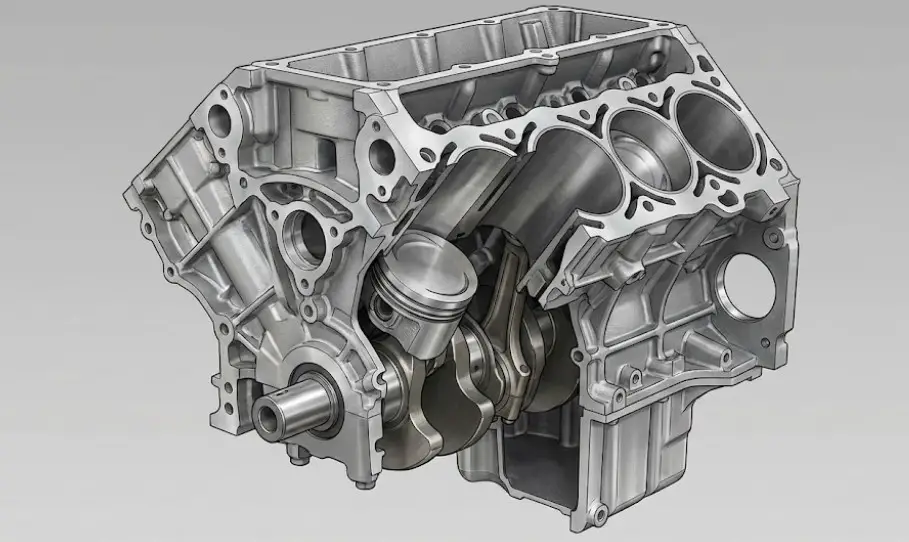
The foundation of the Pentastar is a high-pressure die-cast aluminum cylinder block. Unlike the 60-degree V6 engines of the past which often used iron blocks for durability, the Pentastar utilized a skirted aluminum block design to maximize rigidity while minimizing weight.
- Configuration: 60-degree V-angle. This is the optimal angle for a V6, balancing primary and secondary firing forces without the need for a balance shaft, which reduces parasitic loss and complexity compared to 90-degree V6s (like the GM 4.3L).
- Bore and Stroke: The engine is “oversquare,” featuring a 96 mm (3.78 in) bore and an 83 mm (3.27 in) stroke. This geometry favors high-RPM breathing and horsepower generation over low-end grunt, a characteristic that defines the engine’s rev-happy nature.
- Displacement: 3,604 cc (220 cubic inches).
- Cylinder Liners: Cast-iron liners are cast directly into the aluminum block. This ensures the piston rings have a durable surface to seal against while retaining the heat dissipation properties of the aluminum jacket.
The Cylinder Heads and Valvetrain
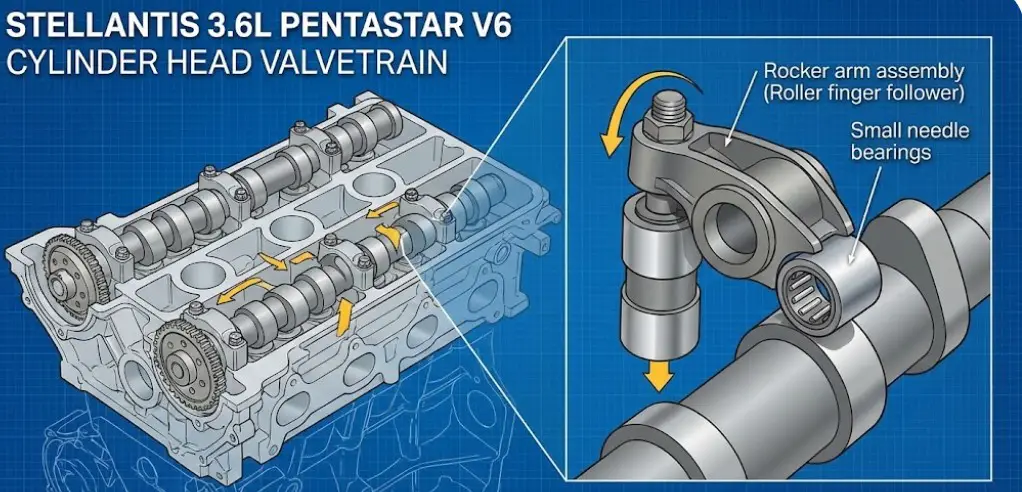
The cylinder heads are cast aluminum alloy, featuring a DOHC design with four valves per cylinder (24 valves total). This was a significant departure from the pushrod (OHV) 3.3L/3.8L engines it replaced in the minivan and Wrangler segments.
- Camshaft Drive: The engine utilizes a timing chain drive rather than a belt. This was a critical decision for perceived reliability and reduced maintenance costs. The system uses four separate chains: a primary chain from the crank to the idlers, and secondary chains driving the cam phasers.
- Variable Valve Timing (VVT): The Pentastar features dual-independent cam phasing. This allows the Engine Control Module (ECM) to advance or retard the intake and exhaust camshafts independently, optimizing the torque curve and reducing emissions.
- Roller Finger Followers: Unlike bucket-style lifters (common in Toyota 2GR engines), the Pentastar uses roller finger followers (rocker arms) pivoting on hydraulic lash adjusters (lifters). This design reduces friction but introduces the engine’s most significant weak point: the needle bearings.
The Induction Strategy: Why No Direct Injection?
At the time of its launch in 2010/2011, many competitors (Ford, GM, Hyundai) were moving aggressively toward Gasoline Direct Injection (GDI). The Pentastar engineering team deliberately chose to retain Multi-Port Fuel Injection (MPFI).
- Reasoning: Cost and carbon buildup. Early GDI engines were notorious for accumulating carbon deposits on the intake valves (since fuel no longer washed over them). By sticking with MPFI, Stellantis avoided these long-term reliability issues and the cost of high-pressure fuel pumps.
- Implication: While the Pentastar sacrifices a small percentage of fuel efficiency and compression potential compared to DI engines, it is immune to the intake valve coking issues that plague the Ford EcoBoost and early GM 3.6L engines.
Generational Evolution: The “Phoenix” vs. The “PUG”
The Pentastar is not a static platform. It underwent a massive mid-cycle refresh for the 2016 model year. Understanding which generation of engine is in a vehicle is critical for diagnostics, as the failure modes—and parts interchangeability—differ significantly.
Generation 1: The Baseline (2011–2015)
The original Pentastar, often referred to as the “Classic” or Gen 1, established the architecture.
- Applications: 2011-2015 Jeep Grand Cherokee, 2012-2017 Wrangler JK, 2011-2014 Dodge Avenger/Chrysler 200, 2011-2019 Dodge Grand Caravan.
- Compression Ratio: 10.2:1.
- EGR: None (Internal EGR achieved via cam phasing).
- Torque: Peak torque arrived relatively high in the rev range (4,400 RPM), leading to complaints of “sluggishness” in heavy vehicles like the Wrangler JK and Ram 1500 unless revved hard.
Generation 2: The Pentastar Upgrade (PUG) (2016–Present)
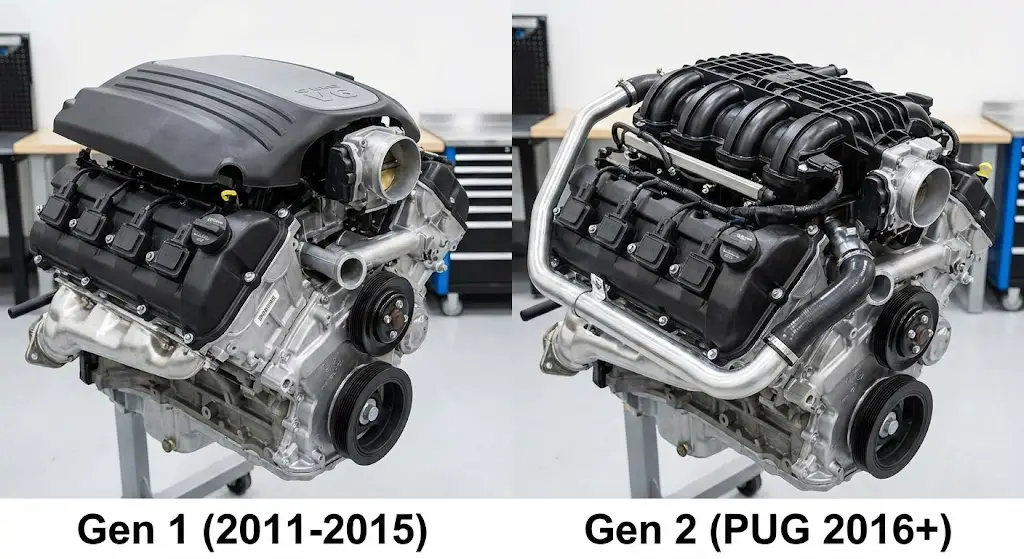
Debuting in the 2016 Jeep Grand Cherokee and later the Chrysler Pacifica and Wrangler JL, the PUG engine was an evolutionary leap designed to meet tightening emissions and fuel economy targets. This engine is mechanically distinct from Gen 1.
Key Technical Changes:
- Variable Valve Lift (VVL): This is the most significant change. The intake camshafts are equipped with a two-step lift mechanism.
- Low Lift Mode: Used during cruising and low-load operation to reduce pumping losses and improve fuel economy.
- High Lift Mode: Activated under heavy acceleration to provide maximum airflow and power.
- Mechanism: The system uses solenoid-controlled oil pressure to lock and unlock a center pin in the rocker arm assembly, switching profiles. This adds complexity and new failure points (VVL solenoids).
- Cooled EGR: To handle the increased compression ratio (now 11.3:1) without detonation (knock), engineers added an external Exhaust Gas Recirculation (EGR) system. Crucially, this is a cooled system, meaning engine coolant circulates through an EGR cooler to lower the temperature of the exhaust gas before it is reintroduced to the intake.
- Reliability Impact: The EGR cooler is a known leak point. When it fails, it can introduce coolant into the intake or exhaust, mimicking head gasket failure symptoms.
- Friction Reduction: The PUG update included low-tension piston rings and lighter valvetrain components to reduce parasitic loss. The engine weight dropped by approximately 4 lbs despite the added hardware.
- Injectors: Upgraded to 8-hole injectors (vs. 4-hole in Gen 1) for finer fuel atomization.
Identification Table:
| Feature | Gen 1 (2011–2015*) | Gen 2 / PUG (2016–Present*) |
| Intake Manifold | Smooth top, rear-mounted MAP sensor | Ribbed/Complex shape, front-mounted MAP |
| EGR System | No external valve | Prominent EGR tube on driver’s side |
| Camshaft Cover | Standard sensors | Solenoids for VVL visible |
| Compression | 10.2:1 | 11.3:1 |
| Spark Plugs | Standard Gap | Different Heat Range/Gap (Non-interchangeable) |
Critical Failure Mode I: The Left Cylinder Head (2011–2013)
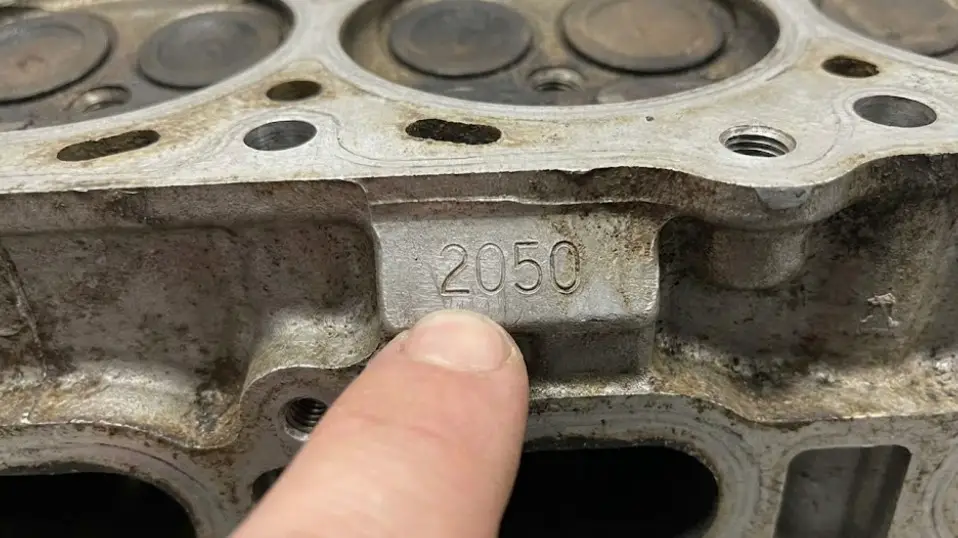
The most notorious chapter in the Pentastar’s history involves the premature failure of the left (Bank 2, driver’s side) cylinder head on early production units. This issue was so prevalent that it triggered a massive warranty extension program and defined the engine’s early reputation.
The Mechanism of Failure: Metallurgy and Design
The root cause was traced to a combination of factors in the casting and machining of the AA319 aluminum cylinder heads. Specifically, the valve seats—the hardened steel rings pressed into the aluminum head against which the valves seal—were prone to “runout” or ovalization.
In the left cylinder head (cylinders 2, 4, 6), specifically cylinder #2, the valve guide and seat alignment would degrade rapidly under thermal cycling. The heat transfer from the exhaust valve to the water jacket was insufficient in this specific casting design.
- Result: The valve seat would overheat and deform.
- Consequence: The exhaust valve would no longer seal the combustion chamber during the compression stroke. This loss of compression results in a “dead” or weak cylinder.
Symptoms and Diagnosis
The failure is insidious because it is progressive. It does not happen instantly like a snapped timing chain.
- The Ticking: Often confused with lifter tick, a leaking valve seat can produce a “chuffing” or ticking sound at idle as combustion gases leak past the valve.
- Misfire Codes: The Engine Control Module (ECM) is sensitive enough to detect the slight drop in crankshaft angular velocity caused by the weak power stroke of cylinder #2.
- P0302: Cylinder 2 Misfire Detected (The “Signature” code).
- P0300: Random/Multiple Cylinder Misfire.
- P0304/P0306: Less common, but possible.
- Power Loss: Rough idle and hesitation during acceleration.
- Leakdown Test: The definitive diagnostic is a cylinder leakdown test. A healthy engine should have <5-10% leakage. Affected Pentastars will show 25% to 80% leakage on cylinder #2, with air audible from the tailpipe (indicating leaking exhaust valves).
The “X56” Solution and Warranty Extension
FCA (Fiat Chrysler Automobiles) acknowledged the defect but stopped short of a safety recall, arguing that the vehicle remained drivable. Instead, they issued a “Warranty Extension” (Bulletin D-14-12) covering the left cylinder head for 10 years or 150,000 miles.
The Revised Part: The engineering team redesigned the cylinder head casting. The updated part (Part Number ending in AC or later, e.g., RL141353AC) features hardened valve guides and seats with improved thermal conductivity.
Identifying a “Safe” Engine:


For used vehicle buyers, determining if a 2011-2013 engine has the “bad” head is critical. The cylinder heads are stamped with a Julian Date code.
- Julian Date 2062 (206th day of 2012) or Higher: These heads were manufactured after the engineering fix was implemented on the assembly line. They are generally safe.
- Julian Date < 2062: These are the susceptible castings. If the service history does not show a replacement, the risk of failure is high.
Critical Failure Mode II: Rocker Arm Needle Bearing Collapse (“The Tick”)
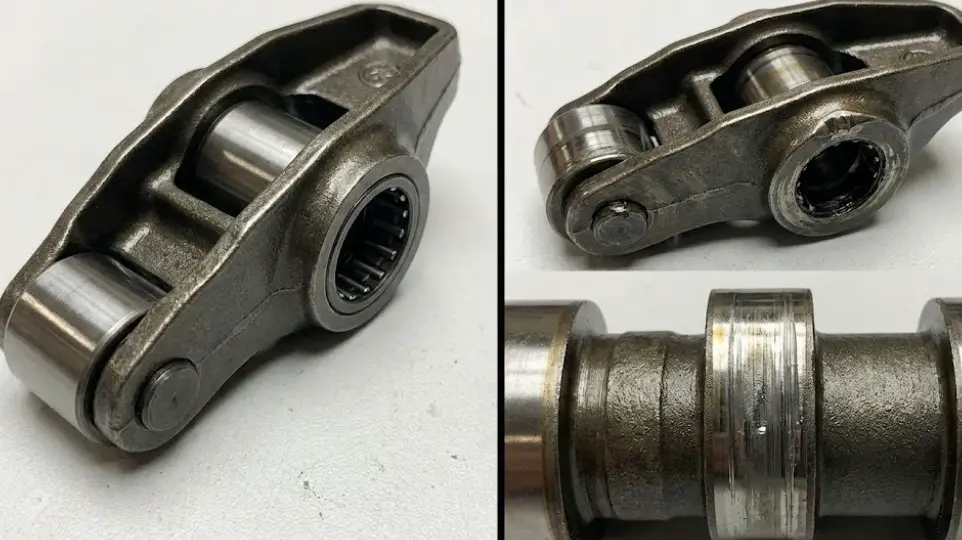
While the cylinder head issue was largely confined to early production years, the rocker arm failure is a persistent plague that affects all model years of the Pentastar, from 2011 through 2024. It is the single most common mechanical failure on the platform and the subject of the Maugain et al. v. FCA US LLC class-action lawsuit.
The Tribology of Failure
The Pentastar uses a low-friction roller rocker arm. The center of the arm contains a steel roller that rides on the camshaft lobe. Inside this roller is a set of tiny needle bearings, held in place by a cage and an axle pin.
The Failure Chain:
- Lubrication Breakdown: The needle bearings rely on “splash” lubrication from the oil squirters and general cylinder head mist. Under certain conditions—such as extended idling, low oil levels, or oil degraded by heat—the oil film breaks down.
- Bearing Seizure: The friction causes the needle bearings to overheat. They flat-spot or disintegrate.
- Roller Collapse: Without the bearings, the roller becomes loose on its axle. It creates “slop” or play in the valvetrain.
- The “Tick”: The loose rocker arm slaps against the camshaft lobe and the valve stem, creating the audible ticking noise.
- Camshaft Destruction: This is the catastrophic phase. Once the roller seizes (stops rolling), it effectively becomes a hardened steel slider dragging across the camshaft lobe. It gouges a deep groove into the camshaft lobe. This is “galling.”
- Misfire: As the cam lobe wears down, the lift of the valve decreases. Eventually, the valve doesn’t open enough to let air in/out, triggering a misfire code (P030X).
Diagnostic Acoustics: Identifying the Tick
Distinguishing the “Pentastar Tick” from normal engine noises is a primary skill for owners.
- Normal Sounds: The Pentastar has loud fuel injectors. They make a rapid, light, rhythmic “click-click-click” that sounds like a sewing machine. This is normal.
- The Killer Tick: The rocker failure sound is distinct.
- Tone: Metallic, hollow, and louder. Often described as a “clack” or “tap.”
- Frequency: It occurs at half-engine speed (camshaft speed).
- Location: Using a mechanic’s stethoscope on the valve cover will pinpoint the noise to a specific cylinder bank. It is often loudest on the passenger side (Bank 1) near the firewall, simply due to acoustics, but can happen on any cylinder.
The Class Action Litigation
Filed in the District of Delaware, Maugain et al. v. FCA US LLC alleges that FCA knowingly produced these defective rocker arms for over a decade. The plaintiffs argue that the needle bearings are undersized and made of inferior metallurgy for the load they carry. The lawsuit claims that FCA’s “fix” is simply to replace the defective part with another identical, defect-prone part, trapping owners in a cycle of repairs.
- Status (2025): The case survived a motion to dismiss in early 2023 and is proceeding. However, no massive recall has been issued. Repairs are typically out-of-pocket once the powertrain warranty expires.
Repair Strategy and Costs
The repair depends entirely on how quickly the issue is caught.
- Stage 1 (Tick only): If caught immediately, only the rocker arms and lifters need replacement.
- Stage 2 (Misfire/Cam Damage): If the cam lobe is scored, the camshaft must be replaced. Putting a new rocker on a damaged cam will destroy the new rocker in minutes.
Best Practice: Automotive experts strongly recommend replacing all 12 rocker arms and lifters on the affected bank, regardless of how many have failed. The labor to remove the intake plenum (upper and lower) and valve covers is the majority of the cost. The parts themselves are relatively cheap (approx. $10-$15 per rocker). Doing “piecemeal” replacement is false economy.
| Repair Scenario | DIY Cost (Parts) | Shop Cost (Est.) | Complexity |
| Rockers Only (One Bank) | $150 – $250 | $800 – $1,200 | High (Timing risk) |
| Rockers + Camshaft | $350 – $500 | $1,500 – $2,200 | Very High |
| Full Engine (Both Banks) | $500 – $800 | $2,500 – $3,500 | Expert Level |
The Oil Filter Housing & Cooler
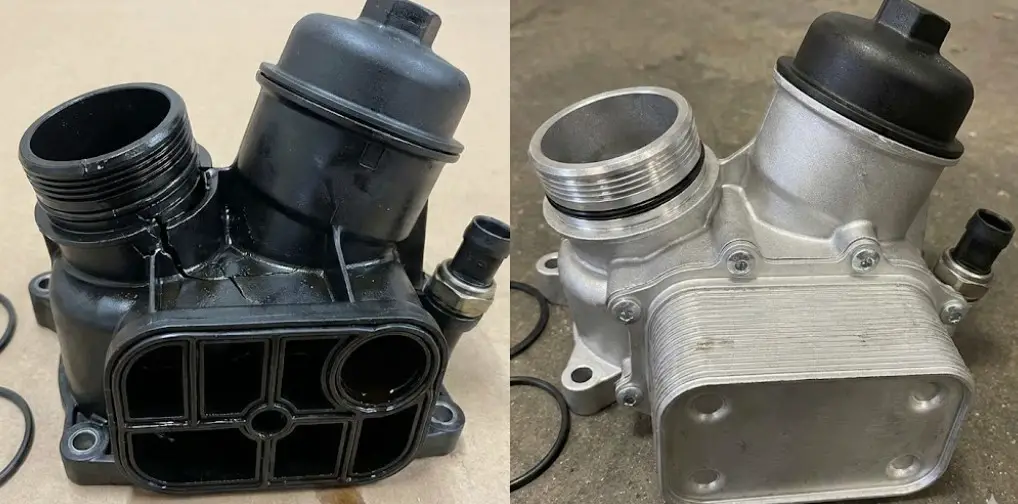
If the rocker arm is the most common mechanical failure, the oil filter housing is the most common leak. This component represents a significant engineering compromise that has cost owners millions in repairs.
Design Flaw: Glass-Filled Nylon vs. Thermodynamics
The 3.6L Pentastar uses a cartridge-style oil filter system integrated into a housing that sits deep in the “V” of the engine block (the valley). This housing also mounts the oil-to-coolant heat exchanger (oil cooler).
- Material: The factory housing is injection-molded from glass-filled polyamide (nylon) plastic.
- The Environment: The housing is bolted directly to the aluminum engine block and sits between the two cylinder heads. It is subjected to extreme thermal cycling—heating up to 210°F+ during operation and cooling to ambient temperatures daily.
- The Failure: Plastic and aluminum expand and contract at different rates. Over time (typically 50,000–80,000 miles), the plastic becomes brittle.
- Cracking: The housing cracks at the base or the neck.
- Warping: The mounting flange warps, causing the O-ring seals to lose contact with the block.
- Overtorquing: The oil filter cap requires a specific torque (25 Nm). Quick-lube technicians often overtighten it, splitting the brittle plastic neck of the housing.
The “Valley of Death” Symptoms
Diagnosing this leak can be tricky because the oil does not drip directly onto the ground initially.
- Valley Pooling: Leaking oil (and coolant) fills the valley of the engine block. It can hold a significant amount of fluid (nearly a quart) before overflowing.
- The Rear Runoff: Once the valley fills, the fluid runs out the back of the engine and down the transmission bell housing.
- The Misdiagnosis: Because the oil drips from the rear of the engine/transmission mating surface, unsuspecting mechanics often diagnose this as a Rear Main Seal leak. Replacing a rear main seal costs $1,000+ and requires dropping the transmission. This does not fix the problem.
- Fluid Mixing: In severe cases, the internal barrier between the oil and coolant passages in the cooler can fail, leading to oil in the coolant reservoir (sludge) or coolant in the oil pan (milky oil), which can destroy bearings.
The Aftermarket Solution: Aluminum
For years, the only fix was to install another plastic OEM housing, which would inevitably fail again. Recently, the aftermarket (companies like Dorman, Mishimoto, and Baxter Performance) released cast aluminum replacement housings.
- Dorman 926-876 / 926-959: This is widely considered the permanent fix. It replaces the plastic body with a one-piece aluminum casting. It uses the same filter and cooler brick but eliminates the warping/cracking risk of the plastic body.
- Recommendation: If your housing fails, do not install another plastic OEM unit. Upgrade to the aluminum version. The cost difference is negligible compared to the labor.
Systemic Issues: Electrical, Cooling, and Lubrication
Beyond the “Big Three” failures, the Pentastar has a suite of secondary issues that owners must monitor.
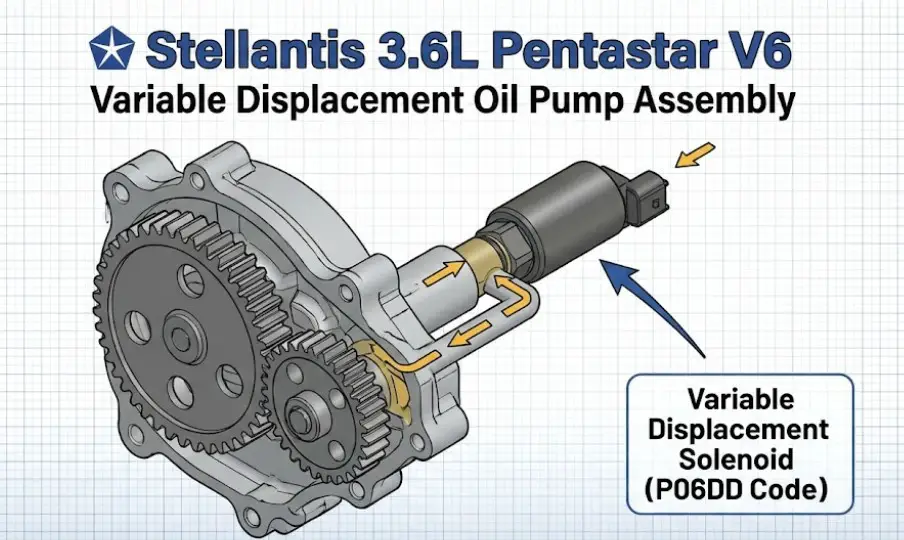
P06DD: The Variable Displacement Oil Pump
The Pentastar uses a sophisticated dual-stage oil pump to improve fuel economy.


- Operation: A solenoid on the pump controls a sliding element that changes the pump’s displacement.
- Low Pressure Mode: Below ~3,500 RPM, the pump maintains ~30 PSI to reduce parasitic drag on the engine.
- High Pressure Mode: Above ~3,500 RPM or under heavy load, the solenoid disengages, allowing the pump to deliver full pressure (65+ PSI) for bearing protection.
- The Failure: Code P06DD (“Engine Oil Pressure Control Circuit Stuck Off”) means the pump is stuck in low-pressure mode.
- Causes:
- Stuck Solenoid: The solenoid fails mechanically.
- Sludge: Dirty oil clogs the screen.
- Wrong Oil Filter: Using a cheap aftermarket filter that collapses or lacks the internal cage can restrict flow, triggering the code.
- Risk: Driving aggressively with P06DD is dangerous. If the engine stays in low-pressure mode at high RPM, the bearings can be starved of oil, leading to rod knock.
Cooling System Vulnerabilities
- Thermostat (P0128): The thermostat housing is plastic and often cracks or the thermostat jams open, preventing the engine from reaching operating temperature. This prevents the vehicle from passing emissions and disables the cabin heater.
- Water Pump: The external water pump is a common wear item, often leaking from the weep hole around 80,000–100,000 miles. Fortunately, unlike the Ford 3.5L Duratec (which has an internal water pump driven by the timing chain), the Pentastar’s pump is external and easy to replace.
- Sand Casting Sludge: On very early models (2011-2012), there were reports of residual casting sand from the manufacturing process remaining in the block. This sand would migrate to the heater core and radiator, clogging them and turning the coolant into a brown sludge. This issue has largely been flushed out of the fleet by now.
TIPM (Totally Integrated Power Module)
While not an engine part, the TIPM (fuse box/computer) in many Pentastar-era vehicles (especially Grand Cherokees and Wranglers) is notorious for failure. A failing TIPM can cut power to the fuel pump relay, causing the engine to crank but not start, or stall while driving. This is often misdiagnosed as a bad fuel pump or engine sensor.
Maintenance Protocols for Longevity
Can the Pentastar be reliable? Absolutely. There are documented cases of these engines reaching 400,000 to 600,000 miles in courier vans. The difference is maintenance discipline.
The Oil Viscosity Debate
- Spec: Most Pentastars call for 5W-20 oil to meet CAFE fuel economy standards.
- Expert Consensus: Many mechanics and engine builders recommend switching to 5W-30 synthetic oil, especially in hotter climates or for vehicles that tow. The slightly thicker oil provides better film strength for the rocker arm bearings and cam lobes without negatively affecting the VVT system.
- Intervals: The dashboard “Oil Life Monitor” may allow intervals up to 10,000 miles. Ignore this. To prevent rocker arm failure and timing chain wear, oil should be changed every 5,000 miles (8,000 km) maximum. The needle bearings are intolerant of particulate matter.
Coolant Chemistry
The Pentastar uses OAT (Organic Acid Technology) coolant (Purple/Orange). It is not compatible with the older HOAT (Hybrid Organic Acid Technology) used in previous Chrysler engines, nor generic green coolant. Mixing these creates a gel that clogs the heater core and oil cooler. Owners must ensure they use MS-12106 compliant coolant.
“Bulletproofing” Guide
For a new owner of a used Pentastar, the following preventative steps are recommended:
- Replace the Oil Cooler: If the housing is plastic and the car has >80k miles, replace it with an aluminum aftermarket unit proactively.
- Listen: Periodically roll down the window alongside a wall to reflect sound. Listen for the tick. Early detection saves the camshaft.
- Filter Quality: Use only OEM Mopar or high-quality (Wix/NAPA Gold) oil filters. Avoid cheap “lube shop” bulk filters which can collapse and trigger P06DD.
Competitive Analysis: Pentastar vs. The World
How does the 3.6L Pentastar stack up against its primary rivals in the V6 segment?
Pentastar 3.6L vs. Ford 3.5L Cyclone (Duratec/EcoBoost)
- Architecture: Both are aluminum DOHC V6s.
- Ford Weakness: The Ford 3.5L naturally aspirated engine (in Explorers/Edges) uses an internal water pump driven by the timing chain. When this pump fails, it dumps coolant directly into the oil pan, instantly destroying the main bearings. This is a catastrophic design flaw requiring a $2,000+ repair just to change a water pump.
- Pentastar Advantage: The Pentastar’s water pump is external and driven by the accessory belt. A leak is an annoyance, not a death sentence.
- Performance: The Ford 3.5L EcoBoost (Twin Turbo) destroys the Pentastar in torque and towing capacity but adds significant complexity (turbos, intercoolers, DI pumps) and repair liability. The Pentastar is simpler and cheaper to maintain.
Pentastar 3.6L vs. Toyota 3.5L (2GR-FE/FKS)
- Reliability: The Toyota 2GR V6 is widely considered the gold standard for reliability. It uses bucket lifters rather than roller rockers, making it immune to the “needle bearing” failure. It typically outlasts the Pentastar in pure longevity metrics.
- Driveability: The Toyota V6 (especially in the Tacoma) is often criticized for lacking low-end torque, requiring the transmission to hunt for gears to maintain speed. The Pentastar, especially the PUG version with VVL, offers a broader, more usable torque curve for daily driving.
- Maintenance: Both engines suffer from oil leaks (Toyota timing covers vs. Pentastar oil coolers).
Pentastar 3.6L vs. GM 3.6L (High Feature LFX/LGX)
- GM Weakness: The GM 3.6L is notorious for timing chain stretch. The chains often wear out prematurely, throwing cam correlation codes and requiring an engine-out procedure to fix (on many models).
- Pentastar Advantage: While the Pentastar has rocker issues, its timing chains are generally robust and rarely stretch if oil is changed regularly.
Repair Cost Analysis & Data Tables
For fleet managers and owners, understanding the financial exposure is key. The following tables break down the costs associated with the common Pentastar failures.
Table 10.1: Common Repair Costs (Estimates)
| Component Failure | Part Cost (OEM/Quality Aftermarket) | Labor Hours (Est.) | Total Shop Cost (Est.) | DIY Difficulty (1-10) |
| Oil Filter Housing (Plastic) | $150 – $200 | 2.5 – 4.0 | $500 – $800 | 5 (Intermediate) |
| Oil Filter Housing (Aluminum) | $200 – $300 | 2.5 – 4.0 | $600 – $900 | 5 (Intermediate) |
| Rocker Arms (One Bank) | $150 – $250 | 4.0 – 6.0 | $800 – $1,200 | 8 (Advanced) |
| Rocker Arms + Camshaft | $400 – $600 | 5.0 – 7.0 | $1,500 – $2,200 | 8 (Advanced) |
| Left Cylinder Head (New) | $600 – $900 | 8.0 – 12.0 | $2,500 – $4,000 | 9 (Expert) |
| Water Pump | $80 – $150 | 1.5 – 2.5 | $350 – $550 | 3 (Novice) |
| Spark Plugs (All 6) | $60 – $90 | 2.0 – 3.0 | $350 – $500 | 4 (Intermediate*) |
Table 10.2: Trouble Code (DTC) Decoder
| DTC | Description | Most Likely Cause in Pentastar |
| P0300 | Random Misfire | Vacuum leak, bad fuel, or multiple rocker failures. |
| P0302 | Cylinder 2 Misfire | Left Cylinder Head Failure (2011-2013) or Rocker Arm Failure. |
| P030X | Single Cyl Misfire | Rocker Arm Failure (if ticking). Coil pack (if no tick). |
| P06DD | Oil Pressure Stuck Off | Oil Pump Solenoid, Sludge, or Collapsed aftermarket oil filter. |
| P0520 | Oil Pressure Sensor Circuit | Failed Oil Pressure Sensor (located on oil cooler housing). |
| P0128 | Coolant Temp Below Thermostat | Stuck open thermostat or cracked housing. |
| P000A/B | Camshaft Position Slow Response | VVT Phaser failure or Oil Control Valve (OCV) sludge. |
Conclusion
The Stellantis 3.6L Pentastar V6 is a study in automotive dichotomy. Mechanically, the core engine—the block, crankshaft, and pistons—is a triumph of modern engineering, capable of immense durability and surprising efficiency. It rescued Chrysler from powertrain obsolescence and remains a competitive offering in a market increasingly dominated by turbocharged downsized engines.
However, the engine’s legacy is tarnished by “peripheral” quality control failures. The decision to use glass-filled nylon for the oil cooler housing in a high-thermal-stress zone was an engineering misstep that has inconvenienced millions of owners. The persistent failure of the rocker arm needle bearings—a problem that has spanned over a decade and two generations of the engine—points to a deeper supply chain or metallurgical oversight that Stellantis has struggled to definitively rectify.
For the used truck or SUV buyer, the Pentastar is not a bad choice—it is simply a choice that requires “eyes wide open.” A 2014+ Pentastar (post-cylinder head issues) with a replaced aluminum oil cooler and a history of 5,000-mile synthetic oil changes represents one of the best values on the market. It lacks the catastrophic internal water pump issues of the Ford 3.5L and the timing chain stretch of the GM 3.6L. It is an engine that can be “bulletproofed” with aftermarket parts and discipline, transforming it from a liability into a 300,000-mile asset.
![Dodge Dtc P0128: Diagnosis & Repair [2026]](https://truckguider.com/wp-content/uploads/2026/03/featured-324bfd94-768x768.webp)