
5.7 Hemi Serpentine Belt Diagram: Routing, Replacement & Torque Specs (Ram/Jeep/Dodge)

The internal combustion engine is a symphony of synchronized components, but the Front End Accessory Drive (FEAD) system acts as the conductor for the engine’s peripheral life-support systems. In the context of the Chrysler 5.7L Hemi V8—an engine that has powered millions of vehicles from the Ram 1500 to the Jeep Grand Cherokee since its reintroduction in 2003—the serpentine belt system is a single point of failure that governs charging, cooling, air conditioning, and steering.
The evolution of the 5.7L Hemi over the last two decades has necessitated significant changes in belt routing architecture. The transition from the early Multi-Displacement System (MDS) engines to the variable valve timing “Eagle” heads in 2009, and the radical shift to the 48-volt eTorque mild-hybrid system in 2019, have all altered the geometric path of the serpentine belt.



This report serves as an exhaustive technical resource for technicians, fleet managers, and advanced DIY enthusiasts. It synthesizes data from factory service manuals, engineering diagrams, and field repair protocols to provide a granular analysis of belt routing, tensioner dynamics, torque specifications, and diagnostic strategies. By understanding the physics of the drive system—including the shift from hydraulic to electric power steering and the material science of EPDM rubber—operators can prevent catastrophic failures and ensure the longevity of their Hemi-powered vehicles.
TruckGuider
The Ultimate 5.7L Hemi Belt Resource
5.7L Hemi Serpentine Belt Master Guide
The serpentine belt is the unsung hero of your 5.7L Hemi V8. It powers the alternator, power steering, water pump, and AC compressor. A failure here leaves you stranded instantly. This interactive guide breaks down the complex routing, maintenance costs, and critical specs you need to keep your Ram, Charger, or Grand Cherokee running smooth.
Anatomy of the Drive
Understanding the layout is the first step to diagnosis. The 5.7L Hemi uses a specific pulley configuration.
Use the interactive chart to identify components. The Crankshaft drives the system, while the Tensioner maintains the grip required to spin high-load accessories like the Alternator.
Interactive Pulley Map (Front Engine View)
Hover over points to identify pulleys. Coordinates represent approximate engine face position.
Belt Routing Sequence
Follow the path of the belt from the power source.
1. Crankshaft
Main Drive (Grooved)
2. Tensioner
Smooth side of belt
3. Alternator
Top Right (Grooved)
4. Idler Pulley
Guide (Smooth)
5. Power Steering
Top Left (Grooved)
6. A/C Compressor
Bottom Left (Grooved)
7. Water Pump
Center (Smooth/Back of Belt)
Return to Crank
Loop Complete
Failure & Cost Analysis
Why Do Hemi Belts Fail?
Based on mechanic reports, simple wear is the leader, but tensioner failure is a critical runner-up specific to the 5.7L platform.


Repair Cost Estimator
Comparing the cost of DIY repair versus a professional shop. The 5.7L belt is highly accessible, making DIY significantly cheaper.
Critical Specifications
Ensure you have the correct parts. The 5.7L Hemi uses different belts depending on whether your truck is equipped with Electric (EPS) or Hydraulic power steering.
| Component | Specification / Note | Part Number (Ref) |
|---|---|---|
| Serpentine Belt (Standard) | 7 Ribs, ~2180mm Length (Check Year) | K060858 (Gates) |
| Tensioner Assembly | Torque bolt to 30 ft-lbs (Mount) | 38159 (Dayco) |
| Idler Pulley | Smooth surface, replace with belt | 89007 (Dayco) |
| Tensioner Tool Size | 3/8″ Square Drive or 15mm Socket | N/A |
© 2026 TruckGuider Infographics
Fundamentals of Serpentine Drive Engineering
To diagnose and maintain the Hemi FEAD system effectively, one must first understand the underlying engineering principles that dictate its design. The system is not merely a rubber band spinning pulleys; it is a precision-engineered friction drive system designed to transmit horsepower while dampening torsional vibrations.
Material Science: The Shift to EPDM
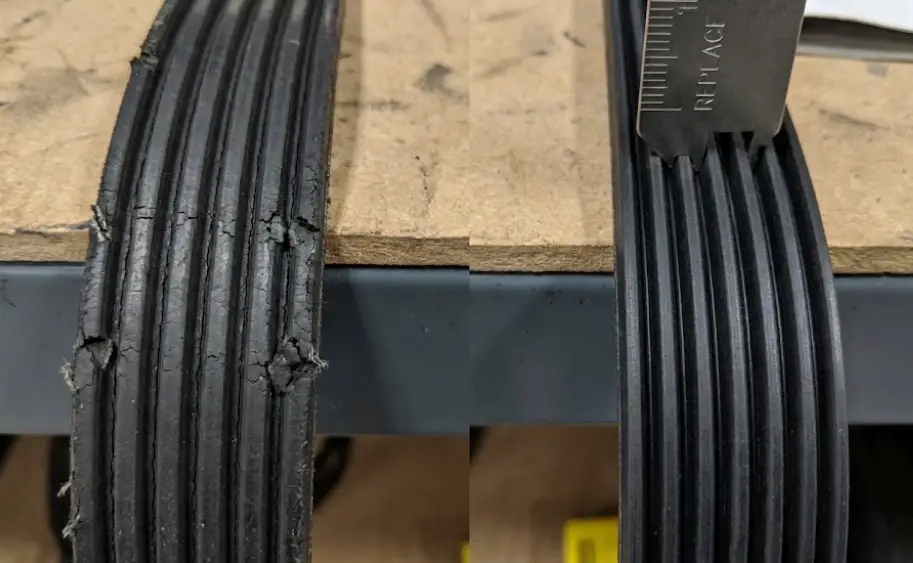
Early automotive drive belts were constructed from Neoprene (chloroprene rubber). While durable, Neoprene suffered from heat degradation and ozone cracking, typically requiring replacement every 30,000 to 50,000 miles. In the late 1990s and early 2000s, the automotive industry, including Chrysler, shifted to Ethylene Propylene Diene Monomer (EPDM) synthetic rubber.
EPDM offers superior resistance to heat, oxidation, and ozone, allowing modern Hemi belts to last between 60,000 and 100,000 miles. However, this durability creates a diagnostic blind spot. Unlike Neoprene, which visually cracked as it aged, EPDM belts typically fail through material loss in the rib valleys. As the belt wears, the "V" profile of the ribs becomes wider, causing the belt to "bottom out" in the pulley grooves. This loss of wedging force leads to slippage, heat generation, and component failure, often without any external visual signs of cracking. Consequently, technicians must use a belt wear gauge rather than visual inspection to determine the service life of a modern Hemi belt.
The Physics of Tension and Damping
The 5.7L Hemi utilizes an automatic belt tensioner, a device that applies a calibrated spring force to the belt to maintain friction against the pulleys. However, its secondary function—damping—is equally critical. The firing pulses of a V8 engine create torsional vibrations at the crankshaft. Without a damper, the belt would whip violently during each power stroke. The tensioner’s internal damping mechanism absorbs these fluctuations.
On the 5.7L Hemi, the tensioner is a common failure point. When the damping element wears out, the tensioner arm begins to oscillate or "flutter". This oscillation hammers the belt and the accessory bearings, leading to premature failure of the alternator or water pump. Diagnostics often reveal that a "chirping" noise is not the belt itself, but the tensioner arm reaching the end of its travel or the spring binding inside the housing.
The "Reverse Rotation" Water Pump
A critical aspect of the 5.7L Hemi belt routing is the water pump interface. The Hemi water pump is driven by the smooth backside of the serpentine belt. This indicates that the water pump rotates in the opposite direction of the crankshaft (counter-clockwise). This is a vital detail for routing: if a belt is routed incorrectly such that the grooved side contacts the water pump, the pump will rotate in the wrong direction (or slip massively), leading to immediate overheating and potential engine damage.
Detailed Routing Architectures: Ram Platform (1500/2500/3500)
The Ram truck platform hosts the widest variety of belt routing configurations due to the variances in steering systems (Hydraulic vs. Electric) and electrical demands (Standard vs. Dual Alternator).
Era 1: Hydraulic Power Steering (2003–2012 Ram 1500 / 2003–Present HD)
The "classic" Hemi belt routing applies to vehicles equipped with a hydraulic power steering pump. This includes all Ram 1500s from 2003 to 2012, and Ram 2500/3500 Heavy Duty trucks which retained hydraulic steering even after the 1500 switched to electric.
Routing Sequence (Hydraulic Setup):
- Alternator: Top passenger side. The belt wraps over the top.
- Power Steering Pump: Driver’s side, mid-block. The belt routes down from the AC compressor or idler, under the PS pulley.
- A/C Compressor: Top driver’s side.
- Water Pump: Center. Driven by the smooth back of the belt. The belt creates a "U" shape or "S" curve around the water pump depending on the specific year's idler placement.
- Crankshaft: Bottom center. The drive pulley.
- Tensioner: Passenger side, usually located between the alternator and the crank pulley.
- Idler Pulley: Often located high on the timing cover to guide the belt from the alternator to the AC compressor or water pump.
Era 2: Electric Power Steering (EPS) (2013–2018/Classic Ram 1500)
In 2013, the Ram 1500 switched to Electric Power Steering (EPS), eliminating the hydraulic pump pulley from the accessory drive. This change simplified the belt routing but created confusion for owners of 2013+ trucks who inadvertently look at diagrams for HD trucks (which still have the pump).
Routing Sequence (EPS Setup):
- Crankshaft: Drive source.
- Water Pump: The smooth side of the belt contacts the pump.
- Idler Pulley: Positioned to maintain belt wrap in the absence of the PS pump.
- A/C Compressor: Driver's side.
- Alternator: Passenger side.
- Tensioner: Passenger side.
Installation Nuance: For the 2013+ Ram 1500, the belt routing is often described as "lassoing the fan" first because the mechanical cooling fan (if equipped) obstructs direct access to the pulleys. The routing path generally goes:
- Crank -> Tensioner -> Alternator -> Idler -> A/C Compressor -> Water Pump -> Crank.
- Correction: Detailed analysis of snippet suggests a specific path: Lasso fan -> Idler (smooth) -> Alternator -> Radiator Fan/Water Pump -> Tensioner. This specific video emphasizes accessing the tensioner from below the vehicle for leverage.
Era 3: The eTorque Mild Hybrid (2019+ DT Ram 1500)
The introduction of the DT platform brought the eTorque system, which replaces the traditional alternator with a massive 48-volt Motor Generator Unit (MGU).
Routing Sequence (eTorque):
- Crankshaft Pulley: Main drive.
- Motor Generator Unit (MGU): Top passenger side (replaces alternator). The pulley is larger and more robust.
- Idler Pulleys: Multiple idlers are used to ensure extreme belt wrap around the MGU to prevent slippage during engine restart (auto start-stop events).
- Water Pump: Driven by the back of the belt.
- A/C Compressor: Driver's side.
- Tensioner: A heavy-duty, often dual-arm or specialized tensioner is used to handle the bi-directional torque (driving the engine vs. being driven by the engine).
Heavy Duty Dual Alternator Setup (Ram 2500/3500)
For HD trucks with the "Snow Plow Prep" or ambulance packages, a dual alternator setup is common.
Detailed Routing Architectures: SUV Platforms (Grand Cherokee & Durango)
The Jeep Grand Cherokee (WK/WK2) and Dodge Durango share the unibody architecture, which dictates a tighter engine bay and often different accessory positioning compared to the body-on-frame Ram trucks.
Jeep Grand Cherokee (WK: 2005–2010 / WK2: 2011–2021)
The 5.7L Hemi in the Grand Cherokee follows a routing path similar to the Ram but with tighter clearances.
Routing Sequence (WK/WK2 5.7L):
- Alternator: Top right.
- Power Steering: The WK (2005-2010) uses hydraulic steering. The WK2 (2011-2015) uses Electro-Hydraulic Power Steering (EHPS) which still utilizes a belt-driven pump in some configurations, but later models switched to full electric racks depending on trim and year.
- Tensioner Access: Due to the tight fan shroud, access is strictly from the top, often requiring the removal of the air intake tube.
- Path: Crank -> Tensioner -> Alternator -> Idler -> Power Steering/Idler -> A/C -> Water Pump -> Crank.
Comparison to Ram: While the engine is the same, the bracketry differs. The alternator on the Grand Cherokee is often mounted slightly differently to clear the hood line. A Grand Cherokee belt (e.g., Mopar 53013676AB) is not interchangeable with a Ram 1500 belt.
Dodge Durango (2011–Present)
The Durango 5.7L Hemi shares its FEAD layout almost entirely with the Jeep Grand Cherokee of the same vintage.
- Horsepower Variance: The Durango 5.7L is rated at 360 hp versus the Ram's 395 hp. While internal tuning differs, the accessory drive remains largely consistent with the Grand Cherokee counterpart.
- Routing Note: For 2011-2015 models with hydraulic steering, the pump is present. For 2016+ models with electric steering, the routing bypasses the pump location, utilizing an idler or altered belt length.
Technical Specifications: Torque, Tools, and Parts
Precision is non-negotiable when servicing the FEAD system. Over-torquing bolts into the aluminum timing cover can strip threads, while under-torquing leads to component liberation.
Torque Specifications Data Matrix
The following torque specs are compiled from factory service manuals and technical resources for Gen 3 Hemi engines (2009+).
| Component | Fastener Size | Torque (ft-lbs) | Torque (N·m) | Notes |
| Belt Tensioner to Block | M10 | 30 | 41 | Critical: Do not over-torque into aluminum timing cover. |
| Idler Pulley Bolt | M8 | 18 - 21 | 25 - 29 | Re-check after 50 miles if possible. |
| Alternator Mounting Bolts | M10 | 41 | 55 | - |
| Water Pump Bolts | M8 | 21 | 29 | Sequence tightening recommended. |
| Harmonic Balancer Bolt | M14 | 130 | 176 | Requires flywheel locking tool for removal/install. |
| A/C Compressor Bolts | M8 | 18 | 25 | - |
Tooling Requirements
- Tensioner Tool: A standard 3/8" drive ratchet or breaker bar is used for the tensioner. The square drive hole is cast into the tensioner arm.
- Clearance Tool: For Ram 1500s with mechanical fans, a "serpentine belt tool" (flat bar with 3/8" square drive adapter) is often required to slip between the fan and the engine block.
- Sockets: 15mm (Tensioner mounting bolt), 13mm (Idler pulleys), 16mm (Alternator/positive battery cable).
Part Cross-References (OEM vs. Aftermarket)
The debate between OEM (Mopar) and aftermarket (Gates, Dayco, Continental) is data-driven.
- Mopar (OEM): Best fitment and longevity.
- Ram 1500 (Non-eTorque): 4593852AB.
- Ram 1500 (eTorque): 5281514AA.
- Grand Cherokee 5.7L: 53013676AC.
- Gates: The FleetRunner (Green) series is preferred for HD applications due to its thicker EPDM construction and Aramid cord reinforcement.
- Standard 5.7L Belt: K060840 or K060841.
- Racing/Performance: RPM Series (e.g., K060840RPM) offers high modulus low stretch, but can be noisier.
- Dayco: Known for the "W" Rib Profile (Poly Rib). This design allows the belt to conform to worn pulleys better than flat-ribbed belts, potentially silencing chirps on older engines.
- Part Number: 5060840.
Metric Belt Sizing Guide: If part numbers fail, the "PK" number printed on the belt is the universal standard.
- 6PK2135: 6 Ribs, 2135mm Effective Length (Common for Ram 1500 w/ EPS).
- 6PK2455: 6 Ribs, 2455mm Effective Length (Common for Ram 2500 w/ Hydraulic Steering).
Diagnostics: The "Hemi Tick" vs. Belt Noise
Owners of the 5.7L Hemi often fear the "Hemi Tick," a phenomenon usually associated with failed lifter rollers or broken exhaust manifold bolts. However, the FEAD system can mimic this noise, leading to expensive misdiagnoses.
Distinguishing Sounds
- The Chirp: A rhythmic, high-pitched "bird chirp" that aligns with engine RPM. This is almost always belt misalignment or a dry bearing in an idler pulley. The sound occurs when the belt ribs slide down the side of a pulley groove rather than seating vertically.
- The Squeal: A loud, continuous screech under load (e.g., A/C engagement). This indicates slippage due to low tension or fluid contamination.
- The Rattle/Tick: A metallic clattering sound at idle. While this mimics a lifter tick, it is often the tensioner spring failing. As the internal damper wears, the tensioner arm bounces against its stops, creating a metallic rhythm.
Diagnostic Procedures
- The Water Spray Test: With the engine running, spray a fine mist of water onto the ribbed side of the belt.
- Noise Disappears: It is a belt alignment or wear issue. The water acts as a temporary lubricant.
- Noise Gets Louder: It is a tension issue. The water reduces friction, causing the slipping belt to slip even more.
- The Stethoscope Test: Place a mechanic's stethoscope probe on the tensioner body (carefully avoiding the moving belt). A failing tensioner will transmit a loud, chaotic clacking sound. If the sound is smooth, move the probe to the alternator and water pump to check for bearing growl.
- Visual Tensioner Check: Observe the tensioner arm while the engine is idling. It should be relatively steady. If it is vibrating or "dancing" visibly, the internal damper has failed, and the tensioner must be replaced.
Step-by-Step Replacement Procedures
Scenario A: Ram 1500 5.7L (2013-2018)
Tools: 3/8" Ratchet, 15mm socket (if removing tensioner), Flathead screwdriver (for intake clips).
- Preparation: Engine off, cool. Disconnect negative battery cable.
- Tension Release: Locate the tensioner on the passenger side. Access is best from underneath the truck if the fan shroud is tight, or from above if you have a long tool. Insert the 3/8" ratchet into the square hole on the tensioner arm.
- Rotation: Rotate the tensioner clockwise (downward) to relieve tension.
- Removal: Slip the belt off the water pump pulley (smooth pulley) first, as it has no ribs to fight against.
- Inspection: Spin the idler, tensioner, and water pump pulleys. Any roughness necessitates replacement.
- Installation:
- Feed the new belt down around the crankshaft pulley.
- Route up to the Alternator and A/C compressor.
- Ensure the belt is routed correctly around the Idler.
- Final Step: Hold the tensioner in the "release" position and slip the belt over the smooth Water Pump pulley last.
- Verification: Check all ribs are seated. Start engine and listen for noise.
Scenario B: eTorque Ram 1500 (2019+)
Warning: The tension on the eTorque belt is significantly higher than standard belts.
- Documentation: Take a photo of the routing around the MGU.
- MGU Tensioner: The tensioner for the eTorque system is robust. Use a long breaker bar.
- Removal: Rotate the tensioner (typically counter-clockwise for this application, verify with stamp on tensioner body) and remove the belt from the MGU/Generator pulley first.
- Installation: Ensure the text on the belt faces outward and is legible (directional check). Route around the crank, water pump, and AC first. Use a second person to help guide the belt over the MGU while the tensioner is fully retracted.
Advanced Modifications: Bypassing and Deletes
In specialized scenarios—such as trail fixes, drag racing, or component seizure—owners may need to bypass standard components.
A/C Compressor Bypass
If the A/C compressor clutch seizes, the pulley stops turning, and the belt snaps. To drive the truck home, the A/C compressor can be bypassed.
- Routing Modification: The belt routes from the idler directly to the power steering (or alternator depending on year), skipping the A/C pulley entirely.
- Belt Size: For a 5.7L Ram 1500, a belt length of approximately 43.3 inches (1100mm) (6PK1100) is often cited for emergency bypass, though this varies by idler configuration.
- Dorman Bypass Pulley: For a permanent delete, Dorman produces a "dummy" pulley that bolts in place of the A/C compressor, allowing the use of the stock belt size.
Power Steering Delete (Drag Racing)
On older Hemi engines used in drag racing, the hydraulic power steering pump is often removed to reduce parasitic drag. This requires a significantly shorter belt and often a custom tensioner bracket to maintain wrap on the crankshaft and alternator.
Market Analysis: Cost and Value
Replacement Cost Analysis (2025 Estimates)
Replacing a serpentine belt is a low-cost maintenance item if done DIY, but labor costs can inflate the price at dealerships.
- DIY Cost:
- Belt Only: $25 - $75 (depending on brand and eTorque status).
- Kit (Belt + Tensioner + Idler): $100 - $200.
- Professional Repair:
- Labor: $85 - $124 (approx. 1 hour labor).
- Total Dealership Cost: $130 - $184 for a standard replacement.
- eTorque Note: Costs for eTorque belt replacement are significantly higher due to the expensive OEM belt ($89+ MSRP) and the complexity of the high-tension system.
The "Kit" Value Proposition
Industry data suggests that if a belt has failed due to mileage (e.g., 90,000 miles), the tensioner and idler pulleys are likely near the end of their fatigue life as well. The internal spring of the tensioner cycles millions of times. Buying a "component kit" (Belt + Tensioner + Idler) is highly recommended. Brands like Continental and Gates sell these pre-packaged kits (e.g., Gates ACK060841) which often cost less than buying the parts individually and prevent the need to re-open the hood in 5,000 miles when a pulley bearing fails.
Frequently Asked Questions
Q1: Can a bad serpentine belt cause my 5.7 Hemi to misfire?
A: Indirectly, yes. While the belt does not control spark or fuel, a slipping belt can cause the alternator to output inconsistent voltage. Modern vehicle electronics, including the PCM and ignition coils, are sensitive to voltage fluctuations. Furthermore, severe slippage can cause harmonic vibrations that may confuse the knock sensors or crankshaft position sensor, potentially triggering a false P0300 (Random Misfire) code.
Q2: What is the difference between a "Standard" and "Heavy Duty" belt?
A: Heavy-duty belts (like the Gates FleetRunner green belt) use Aramid (Kevlar) cords instead of polyester cords and a thicker EPDM compound. They are designed to resist stretching under high heat and high load (shock loads from plowing or towing). For a standard daily driver, they are overkill and can sometimes squeal more on startup due to the harder compound, but they are virtually indestructible.
Q3: My belt squeaks only in the morning. Why?
A: This is known as "Morning Sickness." It is typically caused by high humidity or dew condensing on the belt and pulleys overnight. As the belt glides over the moisture, it slips slightly (chirp). Once the engine warms up and the moisture evaporates, the noise stops. However, this is an early warning sign that the belt tension is marginal (weak tensioner) or the belt ribs are glazed.
Q4: Can I reuse a serpentine belt?
A: If the belt is relatively new (e.g., removed to replace an alternator), yes. However, direction matters. A used belt has "bedded in" to the pulleys in a specific direction. If you reinstall it running the opposite way, the rib wear pattern will not match the pulley grooves, leading to immediate noise and rapid wear. Always mark the direction of rotation with chalk before removing a used belt.
Q5: Is the 5.7L Hemi an "Interference" engine regarding the serpentine belt?
A: No. The serpentine belt is an accessory belt, not a timing belt. If it breaks, the engine will stop running due to overheating (water pump stop) and battery drain (alternator stop), but the pistons will not hit the valves. The camshaft is driven by a separate internal timing chain.
Conclusion
The 5.7L Hemi serpentine belt system is a testament to the evolution of automotive engineering. It has transitioned from a hydraulic-centric design supporting rudimentary accessories to a high-voltage hybrid interface capable of launching a 5,000-pound truck from a stoplight.
For the owner, the message is clear: respect the interval. The silence of EPDM rubber is deceptive; it does not crack to warn you of its demise. Regular inspection of the tensioner alignment marks, the use of a wear gauge, and the proactive replacement of idler pulleys are the keys to reliability. Whether you are driving a 2003 Ram workhorse or a 2024 eTorque luxury hauler, the serpentine belt remains the unsung hero keeping the Hemi heartbeat strong.
![2015 RAM 1500 AC Recharge Port Location & Identification [2026]](https://truckguider.com/wp-content/uploads/2026/03/2015-ram-1500-ac-recharge-port-featured.webp)


![Ram 1500 Rear Bumper Replacement: A Technical: Step-by-Step Guide [2026]](https://truckguider.com/wp-content/uploads/2026/03/featured-1e1e2ac8-768x768.webp)