Death Wobble Dodge Ram 2500 Front End Diagram: Fix Guide

A death wobble front suspension dodge ram 2500 front end diagram illustrates the critical relationship between the track bar, drag link, and steering stabilizer. To resolve violent shaking, identify play in the track bar bushings or ball joints and ensure every fastener is tightened to the exact factory torque spec.
📌 Key Takeaways
- The track bar is the most critical component to inspect for lateral movement.
- A steering stabilizer only masks the wobble; it does not fix the underlying cause.
- Incorrect torque on mounting bolts is a leading cause of suspension oscillation.
- Visual diagrams help distinguish between T-style and Y-style steering linkages.
- Use the diagram to check for worn ball joints and tie rod ends during inspection.
Experiencing the violent, uncontrolled shaking of the steering wheel known as the death wobble is a terrifying rite of passage for many heavy-duty truck owners. To effectively diagnose and repair this phenomenon, having a detailed death wobble front suspension dodge ram 2500 front end diagram is essential. This guide provides a comprehensive visual and technical breakdown of the steering and suspension geometry that maintains your vehicle’s stability. By the end of this article, you will be able to identify every critical component, understand their mechanical relationships, and execute a diagnostic plan to restore your truck’s handling and safety.
Understanding the Main Front End Diagram Components
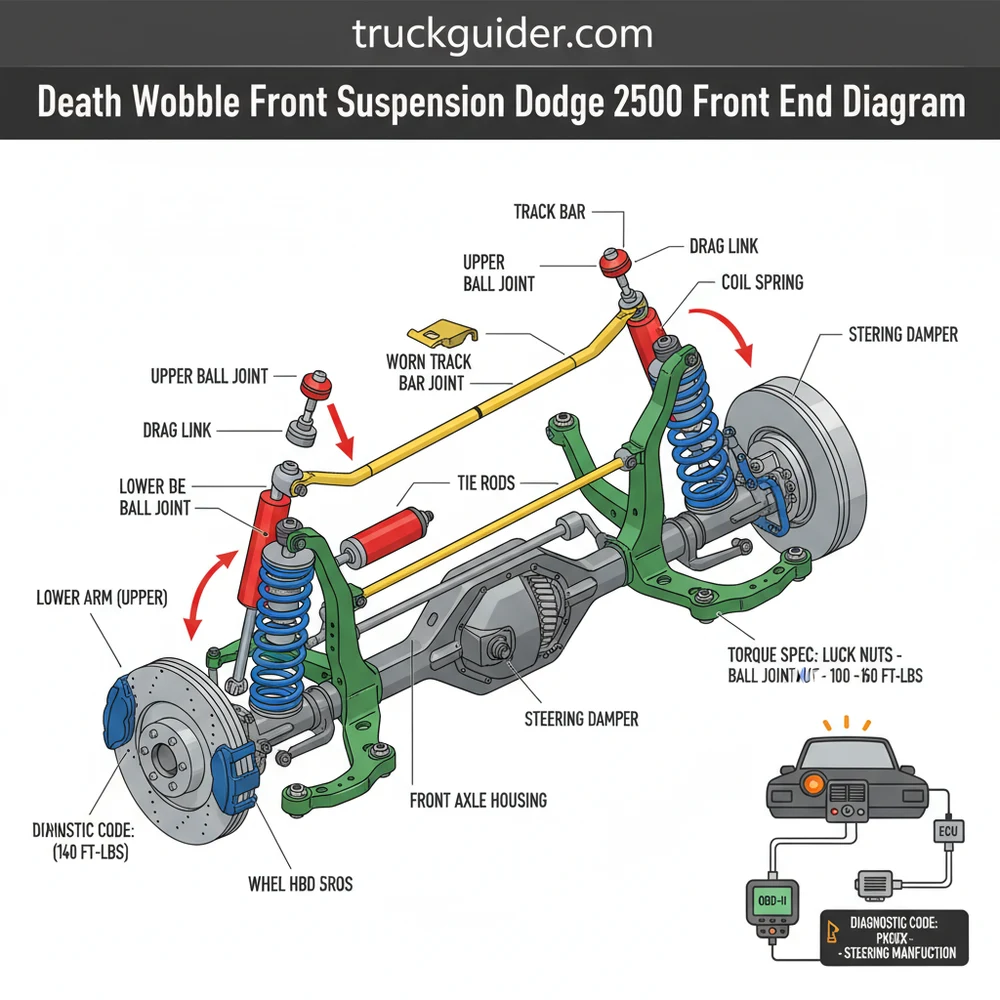
The front end of a heavy-duty truck like the Dodge Ram 2500 utilizes a solid front axle supported by a multi-link coil spring suspension. This design is rugged and capable of handling immense loads, but it relies on tight tolerances across several moving parts. When you look at a death wobble front suspension dodge ram 2500 front end diagram, you are essentially looking at a system of triangles designed to keep the axle centered while allowing for vertical travel and steering input.
The primary elements found in the diagram include the track bar, the drag link, the tie rod, and the control arms. The track bar is arguably the most critical component for preventing lateral movement. It connects the frame of the truck to the axle. If the bushings on either end of the track bar wear out, the axle can shift side-to-side, which is the foundational movement of the death wobble. In many diagrams, this is highlighted as the first point of failure.
Following the track bar, you will see the steering linkage. In most of these trucks, the steering follows a “T-style” or “Y-style” configuration. The drag link connects the pitman arm (attached to the steering box) to the passenger-side steering knuckle. The tie rod then connects the two steering knuckles together. This ensures both wheels turn in unison. If there is play in any of these ball joints, the steering system loses its ability to dampen road forces, leading to harmonic oscillation.
(Visualize: A front-view schematic showing the Track Bar crossing the axle, the Drag Link connecting to the Pitman Arm, the Tie Rod connecting the knuckles, and the Upper/Lower Control Arms stabilizing the axle housing.)
Furthermore, the diagram will detail the upper and lower control arms. These four arms (two per side) control the “caster” and “pinion angle” of the axle. If the bushings in these arms perish, the axle can rotate forward or backward during braking or hitting a bump, further contributing to instability. Lastly, the steering stabilizer—essentially a horizontal shock absorber—is shown bridging the axle and the steering linkage to soak up minor vibrations before they reach the steering wheel.
While many owners attempt to fix the death wobble by simply replacing the steering stabilizer, this is often a temporary mask. A stabilizer is designed to dampen vibration, not to hold the axle in place. If your track bar or ball joints are failing, a new stabilizer will quickly wear out as it tries to fight the mechanical play in the system.
Step-by-Step Guide to Interpreting the Diagram and Inspecting Your Front End
📤 Share
💾 Download
Reading a death wobble front suspension dodge ram 2500 front end diagram is the first step toward a DIY repair. However, applying that visual information to your vehicle requires a systematic approach. Follow these steps to diagnose your truck safely and accurately.
- Perform a “Dry Park” Test: This is the most effective way to use your diagram in real-time. With the truck’s engine running and the wheels on the ground, have an assistant turn the steering wheel back and forth rapidly from the 10 o’clock to 2 o’clock position. While they do this, crawl under the front of the truck (staying clear of the tires) and look for any movement in the joints identified on your diagram. Any clunking or lateral “pop” at the track bar mount is an immediate sign of failure.
- Inspect the Track Bar Bushings: Referencing your diagram, locate the frame-side mount and the axle-side mount of the track bar. During the dry park test, if the bar moves independently of the bolt or the bracket, the bushing is shot. This is the number one cause of the death wobble.
- Verify the Steering Linkage Integrity: Locate the drag link and tie rod ends. Look for vertical or horizontal “play” in the ball joints. If you see the joint jumping inside its socket while the steering wheel turns, it must be replaced. Check the boots for tears, as lost grease leads to rapid wear.
- Check Ball Joint Tolerance: To check the upper and lower ball joints (the pivots that allow the wheels to turn), you must jack up the front axle and secure it on jack stands. Use a pry bar under the tire and lift upward. If the knuckle moves up and down significantly, your ball joints are worn beyond their service limit.
- Consult the Torque Spec Table: Use your diagram as a reference for re-assembly. Suspension components are under extreme stress and require specific tightening values. For example, a track bar bolt often requires over 150-200 lb-ft of torque depending on the specific model. Under-torqued bolts will lead to the death wobble returning almost immediately.
- Evaluate Control Arm Bushings: Look at the four control arms connecting the axle to the frame. Inspect the rubber bushings for cracking, dry rot, or off-center positioning. If the axle can shift forward or backward, it changes the caster angle, making the steering “darty” and prone to oscillation.
- Check for Frame Cracks: In older or high-mileage trucks, look closely at where the steering box and the track bar bracket meet the frame. Stress from the death wobble can actually crack the metal, which requires professional welding to repair.
Never attempt to work under a vehicle supported only by a floor jack. Heavy-duty trucks weigh several tons; always use appropriately rated jack stands placed on a level, concrete surface before performing a physical inspection of the front suspension.
Integrating Mechanical and Electronic Diagnostics
📤 Share
💾 Download
While the death wobble is primarily a mechanical failure of the suspension, modern heavy-duty trucks are integrated with electronic systems that may respond to these events. When the front end undergoes violent shaking, the wheel speed sensors may send erratic data to the ECU. This can trigger a check engine light or a traction control warning on your dashboard.
Using an OBD-II scanner to pull a diagnostic code can sometimes reveal if the steering angle sensor has lost its calibration due to the severity of the wobble. If you see codes related to the “Stability Control System” or “Steering Angle Sensor Performance,” it is a sign that the mechanical vibration has confused the electronic sensors. While the ECU cannot fix a worn track bar, clearing these codes and recalibrating the sensors after a mechanical repair is a vital final step.
Furthermore, while you are under the hood or under the chassis using your death wobble front suspension dodge ram 2500 front end diagram, it is wise to perform a general health check. For instance, ensure your coolant flow is unobstructed and that your accessory belt is not showing signs of fraying. While these are engine-related, the severe vibrations from a death wobble can occasionally loosen unrelated components, such as radiator hose clamps or even stress the timing chain guides in extremely high-mileage engines if the RPMs fluctuate wildly during the event.
Common Issues and Troubleshooting the Death Wobble
Even with a perfect death wobble front suspension dodge ram 2500 front end diagram, troubleshooting can be tricky because the issue is often a combination of small wear across multiple parts. The most frequent problem users encounter is the “parts cannon” approach—replacing parts at random without a proper diagnosis.
- ✓ Track Bar Flex: Even if the bolts are tight, the bar itself may flex if it is an inferior aftermarket unit. Ensure the bar is rigid and the bushings are high-durometer polyurethane or solid rubber.
- ✓ Tire Imbalance: A tire that is out of balance or has a slipped belt is often the “trigger” that starts the wobble. The suspension play allows the vibration to escalate.
- ✓ Caster Angle: If you have a leveled or lifted truck, your caster angle may be too low. This reduces the “return to center” force, making the front end unstable.
- ✓ Steering Box Play: Over time, the internal gears of the steering box wear down. If you have “dead space” in your steering wheel, the box may need adjustment or replacement.
You should seek professional help if you discover frame damage, if the diagnostic code on your OBD-II scanner indicates an internal failure of the electronic power steering rack (on newer models), or if you lack the heavy-duty tools required to meet the high torque spec requirements of these components.
Tips and Best Practices for a Permanent Fix
To ensure the death wobble never returns, follow these pro-level recommendations for maintenance and component selection. The goal is to move beyond the standard diagram and build a more robust front end than what the factory provided.
When replacing front end parts, always upgrade to an adjustable track bar. This allows you to perfectly center the axle under the truck, which is essential if you have installed a leveling kit. Standard diagrams show a fixed bar, but an adjustable one provides the precision needed for a wobble-free ride.
Always prioritize high-quality, greasable components. Many factory parts are “sealed for life,” which often means a shorter lifespan in harsh environments. Look for tie rod ends and ball joints with grease zerks. Regular lubrication every 5,000 miles (during your oil change) will purge contaminants and extend the life of the joint significantly.
Regarding cost-saving advice: do not skimp on the alignment. Even if you carefully measure your tie rod lengths during replacement, a professional alignment using a laser-guided rack is the only way to ensure your toe-in and caster settings are within the narrow window required to prevent oscillation. A misaligned truck will chew through expensive tires and put unnecessary stress on your new suspension parts.
Finally, keep a maintenance log. Note the date and mileage of when you verified the torque spec of every major bolt. Because these trucks vibrate naturally due to the diesel engine, bolts can occasionally back out. Checking the track bar torque every 10,000 miles is a simple habit that can prevent a catastrophic death wobble event in the future. By combining the visual data from a death wobble front suspension dodge ram 2500 front end diagram with these rigorous maintenance standards, you can enjoy a smooth, controlled driving experience for hundreds of thousands of miles.
In summary, resolving the death wobble involves a blend of mechanical inspection, understanding the geometric relationships within the steering system, and ensuring all fasteners meet their designated tension. Whether you are troubleshooting a check engine light or replacing a worn drag link, your success depends on a methodical approach and the right information.
Frequently Asked Questions
Where is the track bar located?
The track bar is located behind the front axle, running diagonally from the driver-side frame mount to the passenger-side axle mount. On a death wobble front suspension dodge ram 2500 front end diagram, it is the primary bar responsible for centering the axle and preventing side-to-side movement.
What does the front end diagram show?
The diagram shows the assembly of the solid front axle, including the pitman arm, drag link, tie rods, and steering damper. It helps users visualize how steering input is transferred to the wheels and identifies where bushings and ball joints are located to aid in troubleshooting mechanical play.
How many connections does the steering linkage have?
The Ram 2500 steering linkage typically has four main pivot points or ball joints. This includes the connection at the pitman arm, the drag link-to-knuckle connection, and the tie rod ends. Maintaining the integrity of these four points is essential to prevent steering wheel oscillation at high speeds.
What are the symptoms of a bad steering stabilizer?
Symptoms include excessive vibration through the steering wheel and a ‘loose’ steering feel. While a failing stabilizer won’t trigger a check engine light or a diagnostic code in the ECU, it will fail to dampen the oscillations that eventually lead to the dreaded and dangerous death wobble effect.
Can I replace the ball joints myself?
Yes, ball joint replacement is a common DIY task, but it requires a specialized ball joint press and significant physical effort. You must follow the diagram to ensure proper seating and always use a torque wrench to ensure the fasteners are secured to the manufacturer’s specific safety standards.
What tools do I need for this suspension repair?
You will need a heavy-duty jack, jack stands, a torque wrench, and a pickle fork or tie rod puller. While you might use an OBD-II scanner to check the ECU for unrelated issues, this mechanical repair requires traditional hand tools to address the physical wear in the front end.
![2012 Ram 2500 Leveling Kit Guide: Best Fits & Tire Sizes [2026]](https://truckguider.com/wp-content/uploads/2026/03/2012-ram-2500-leveling-kit-featured-768x403.webp)