
Differential Fluid Change Cost 2026: Exhaustive Price Guide, Specs & DIY Manual

In the comprehensive landscape of automotive maintenance, the differential often occupies a paradoxical position: it is mechanically essential yet frequently neglected until the point of catastrophic failure. While engine oil changes have become a ritualistic aspect of vehicle ownership, ingrained through decades of marketing and dashboard reminders, the fluid that lubricates the final drive—the differential—often remains unchanged for the vehicle’s lifespan.
This oversight is economically dangerous, particularly for owners of light-duty trucks and SUVs who rely on these components for towing, hauling, and off-road negotiation.
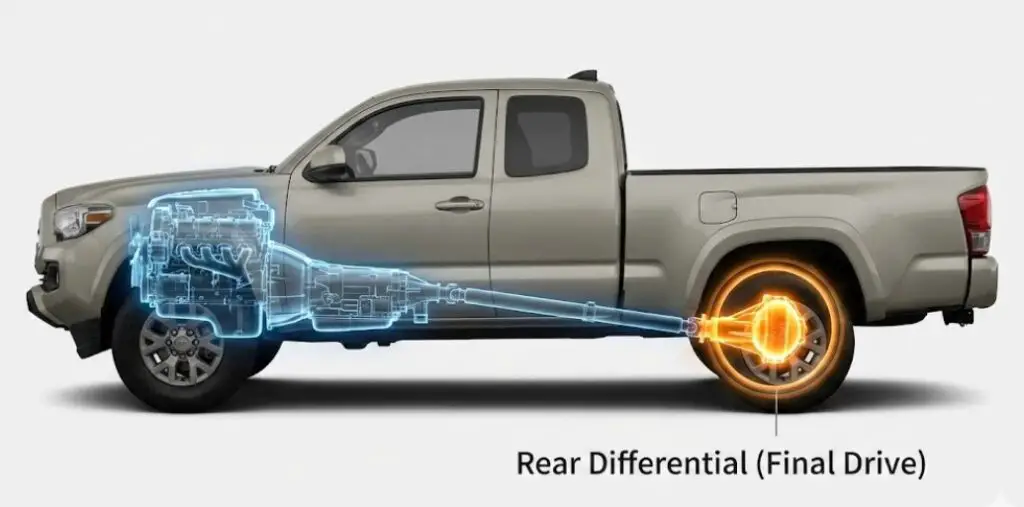
The differential serves as the final gear reduction in the vehicle’s powertrain, translating the rotational energy of the driveshaft into the transverse rotation of the axles while allowing the wheels to rotate at different speeds during turns. This mechanical necessity subjects the internal components—specifically the ring and pinion gears—to immense shear forces and extreme pressure.
The lubricant tasked with protecting these surfaces, known as gear oil or differential fluid, must withstand conditions far more severe than those found in the engine crankcase.
For the 2025 model year and the preceding decade of truck production, the landscape of differential maintenance has shifted dramatically. The introduction of complex electronic locking differentials, the ubiquity of synthetic low-viscosity fluids driven by Corporate Average Fuel Economy (CAFE) standards, and the escalating labor rates at dealerships have transformed a simple maintenance task into a complex economic decision. This report provides an exhaustive analysis of the costs associated with differential fluid changes, dissecting the pricing structures of dealerships, independent mechanics, and quick-lube franchises.
Furthermore, it offers a granular technical breakdown of the specific requirements for the market’s leading trucks—the Ford F-150, Chevrolet Silverado 1500, Ram 1500, and Toyota Tacoma—to empower owners with the knowledge required to optimize their maintenance budgets and extend the operational longevity of their vehicles.
Differential Fluid
Change Cost Analysis
Most truck owners ignore their differentials until it’s too late. A $120 maintenance job can save you a $2,500 rebuild. Here is the data-driven breakdown of costs, intervals, and DIY savings.
Fluid & Gasket Only
Parts & Labor Included
Full Differential Rebuild
Who Should Do The Job?
The price gap between doing it yourself and visiting a dealership is significant. Differential service is labor-intensive but technically simple.
-
✓
DIY Savings You save approx. 65% by supplying your own synthetic gear oil.
-
!
Independent Shops Good middle ground. Ensure they use the correct friction modifier for Limited Slip Diffs (LSD).
-
i
Dealerships Highest cost, but guaranteed OEM fluid and documented service history for warranty.
Service Cost Comparison (USD)
Based on national averages for a standard RWD truck rear differential.
The Invoice Breakdown
Shop Bill Components
When you pay a shop $150+, you aren’t just paying for oil. You are paying for the lift time, the messy disposal of toxic old fluid, and shop overhead.
Labor (55-65%)
Mechanics charge 0.5 to 1.0 hours per axle.
Fluids & Parts (30-35%)
Synthetic 75W-90 or 75W-140 is pricey ($15-$25/qt).
Disposal & Fees (5-10%)
Environmental fees for recycling old gear oil.
When Should You Change It?
Fluid breaks down due to heat and shearing forces between gears. “Lifetime Fluid” is often a marketing myth. Here is the realistic service curve.
Severe Duty (15k – 30k Miles)
Towing heavy loads, off-roading (water submersion risk), or frequent steep grades.
Normal Use (30k – 60k Miles)
Daily commuting, highway driving, light payload usage.
Extended/Synthetic (up to 100k)
Some manufacturers claim 100k+ with high-end synthetic, but risk increases significantly.
Warning Signs: Don’t Ignore These
Whining Noise
A pitch that changes with speed. Usually indicates low fluid or worn ring gears.
Vibration
Shuddering during turns or acceleration. Often means LSD clutch packs are slipping.
Burning Smell
Thick, acrid sulfur smell. Indicates fluid has overheated and lost lubrication properties.
Leaks
Oily spots on the driveway under the rear axle. Check the differential cover gasket.
The DIY Workflow
Saving that $100 isn’t hard if you have a socket set and a drain pan. Here is the general process.
Prep & Drain
Drive to warm fluid. Remove fill plug FIRST (crucial!). Then remove drain plug or cover.
Clean & Seal
Clean magnet on plug. Scrape old gasket. Apply RTV sealant or new gasket.
Fill
Pump in new gear oil until it weeps out the fill hole. Add friction modifier if needed.
© 2026 TruckGuider Infographics
Tribology and Mechanics: Understanding the “Why” Behind the Cost
To accurately assess the value proposition of a differential fluid change, one must first understand the tribological environment inside the axle housing. The cost of service is not merely a fee for labor and liquid; it is an investment in the prevention of metal-to-metal contact under extreme loads.
The Hypoid Gear Challenge
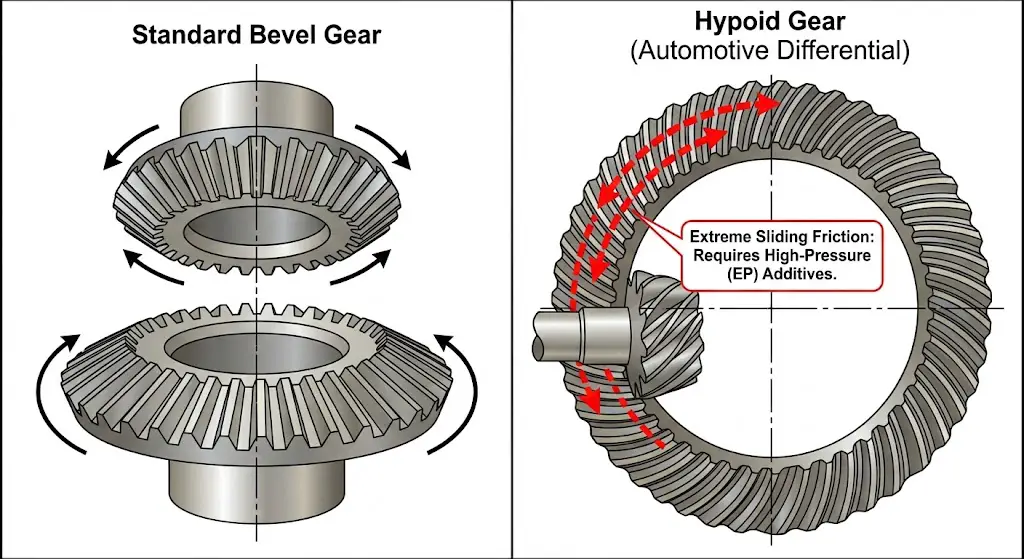
Unlike the transmission or engine, which may use spur or helical gears, the automotive differential almost exclusively utilizes hypoid gears. In a hypoid gear set, the axis of the pinion gear is offset from the center of the ring gear. This geometric arrangement allows the driveshaft to be positioned lower in the chassis, reducing the intrusion of the transmission tunnel into the passenger cabin and lowering the vehicle’s center of gravity.
However, this offset creates a unique mechanical challenge: sliding friction. In standard gear sets, the teeth primarily roll across each other. In hypoid gears, the teeth slide longitudinally across the mating surface while rotating. This sliding action wipes standard lubricants off the metal surface, creating a condition of boundary lubrication where the fluid film can easily rupture. To combat this, differential fluid is formulated with robust Extreme Pressure (EP) additives, typically sulfur and phosphorus compounds. These additives are chemically active; under the heat and pressure of the gear mesh, they react with the metal surface to form a sacrificial film (iron sulfide or iron phosphide) that prevents the gears from welding together.
Over time, these additives are depleted. The sulfur-phosphorus compounds are consumed in the process of protecting the gears, and the base oil undergoes oxidation due to heat cycles. When the fluid breaks down, it loses its ability to maintain the necessary film strength, leading to the rapid scoring of the ring and pinion gears—a failure mode that manifests as the tell-tale “whine” or “howl” often misdiagnosed as wheel bearing noise.
Viscosity and the CAFE Influence
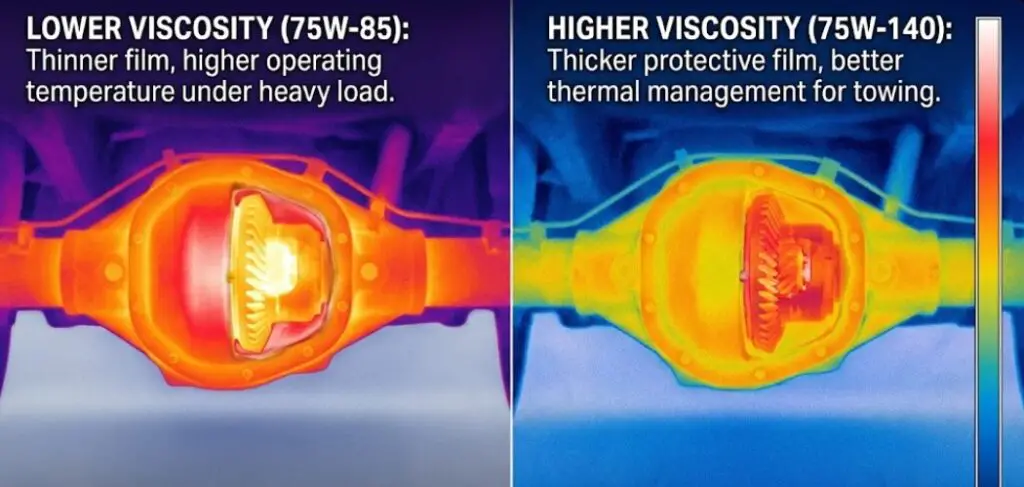
A significant driver of confusion and cost in the 2025 market is the shift in viscosity specifications. For decades, 75W-90 was the industry standard for light-duty trucks. It provided a balance of cold-flow protection (the “75W” rating) and high-temperature film strength (the “90” rating).
However, in the relentless pursuit of fuel efficiency mandated by federal CAFE standards, manufacturers have largely transitioned to lower viscosity fluids, such as 75W-85. While the difference appears nominal, the reduction in fluid drag contributes a fractional increase in miles per gallon (MPG). For the vehicle owner, this creates a dilemma. The 75W-85 fluids are often proprietary or harder to source in the aftermarket compared to the ubiquitous 75W-90, driving up the cost of materials at dealerships. Furthermore, many automotive engineers and mechanics argue that for trucks engaged in heavy towing, the thinner 75W-85 fluid provides less protection against thermal shear than the heavier 75W-140 fluids used in heavy-duty applications. This has led to a market segmentation where informed owners often deviate from the owner’s manual in favor of higher-protection fluids, risking warranty disputes for the sake of mechanical longevity.
Synthetic vs. Mineral Composition
The market has almost entirely moved toward synthetic base stocks (Group III, IV, or V oils) for differential applications. Synthetic oils offer superior shear stability, meaning the long molecular chains that provide viscosity are less likely to be physically torn apart by the grinding action of the gears.
- Mineral Gear Oil: Typically costs $7–$10 per quart. It requires changing every 15,000 to 30,000 miles and is prone to thermal breakdown at temperatures exceeding 250°F.
- Synthetic Gear Oil: Typically costs $15–$30 per quart. It can remain stable for 50,000 to 100,000 miles and maintains flow characteristics in sub-zero temperatures.
Economic Analysis of Service Costs (2025 Market Data)
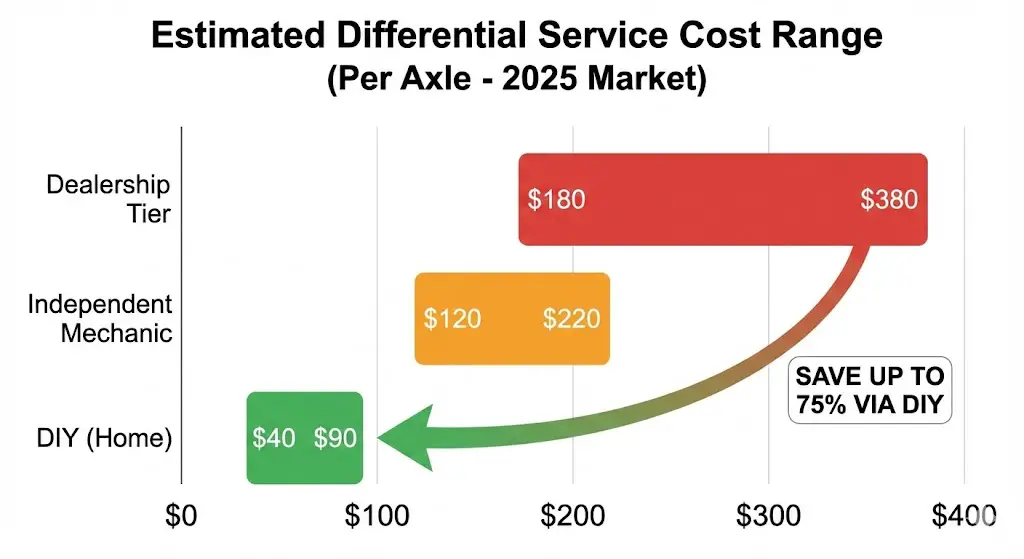
The cost of a differential fluid change varies wildly depending on the service provider, the region, and the specific vehicle requirements. Our research identifies three primary pricing tiers, plus the DIY option.
Tier 1: The Dealership Experience
Dealerships represent the highest cost tier, leveraging their status as the “official” service provider to command premium prices.
- Average Cost: $180 – $380 per axle.
- Combined Service (Front & Rear): $360 – $700.
- Total Drivetrain (Diffs + Transfer Case): $600 – $900.
Cost Drivers:
- Labor Rates: In 2025, dealership labor rates have climbed to between $150 and $220 per hour. Differential service is typically book-rated at 1.0 to 1.5 hours per axle, even if the actual procedure takes a technician 30 minutes.
- OEM Fluid Markup: Dealerships charge list price for OEM fluids. For example, Toyota Genuine Differential Gear Oil LT can retail for over $50 per liter. A rear differential requiring 4 liters can incur $200 in fluid costs alone before labor is added.
- Bundled Inspections: Dealers often justify the higher price by including a “multi-point inspection.” While valuable, this effectively forces the customer to pay for a vehicle check-up disguised as a fluid change cost.
Tier 2: Independent Mechanics
Independent shops offer a balance of expertise and value, often utilizing high-quality aftermarket fluids that meet OEM specifications without the branding markup.
- Average Cost: $120 – $220 per axle.
- Combined Service: $350 – $550.
Cost Drivers:
- Labor Rates: Independent shops typically charge $100 – $160 per hour.
- Bulk Fluids: Independents often purchase high-quality synthetic gear oil (e.g., Valvoline, BG, Amsoil) in bulk kegs, allowing them to charge significantly less per quart than the dealership’s bottled rate.
- Flexibility: Independents are more willing to use customer-supplied parts or deviate from strict OEM procedures (e.g., using a high-performance 75W-140 in a truck used for towing, rather than the stock 75W-85).
Tier 3: Quick-Lube Franchises (Jiffy Lube, Valvoline)
Chain establishments focus on speed and volume, offering the lowest barrier to entry but often the highest risk of improper service.
- Average Cost: $90 – $160 per axle.
- Valvoline Instant Oil Change: Claims savings of 30-50% versus dealerships, with service times averaging 15 minutes.
Risks & Considerations:
- Suction Method: Quick lubes almost exclusively use suction pumps to extract old fluid through the fill hole. This method often fails to remove heavy metal particles and sludge that settle at the bottom of the housing.
- Universal Fluids: There is a high risk of these shops using a “universal” synthetic gear oil. While generally acceptable, these fluids may lack the specific friction modifiers required for certain limited-slip differentials (like Ram’s Anti-Spin) or may act incorrectly in G80 locking differentials used by GM.
- Upsell Pressure: The business model relies on upselling additional services (air filters, wipers) to increase the ticket value.
Tier 4: The DIY Advantage
For the owner willing to invest sweat equity, the DIY route offers the most significant savings and the highest quality control.
- Total Cost (Rear Axle): $40 – $90.
- Total Cost (Front & Rear): $80 – $150.
Breakdown of DIY Economics:
- Synthetic Gear Oil (3-4 Quarts): $45 – $80. Premium brands like Red Line, Amsoil, or Royal Purple cost $20-$25/qt, while Super Tech or Valvoline can be found for $12-$15/qt.
- Gaskets/Seals: $5 – $25. A generic RTV tube costs $8, while a reusable LubeLocker gasket costs ~$25.
- Tool Amortization: A hand pump ($10) and torque wrench ($40) pay for themselves after a single use.
- Savings: A DIY owner saves approximately $200 to $400 per service cycle compared to dealership pricing.
Table 1: Comparative Cost Matrix – Differential Fluid Service (Per Axle)
| Service Provider | Labor Cost (Est.) | Parts/Fluid Cost (Est.) | Total Estimated Cost | Service Duration | Pros | Cons |
| Dealership | $120 – $200 | $80 – $180 | $200 – $380+ | 1.5 – 2 Hours | OEM Fluid, Warranty Records, Certified Techs | Most expensive, slow turnaround |
| Independent Shop | $80 – $120 | $50 – $80 | $130 – $200 | 1 Hour | Balanced cost, trusted mechanics, aftermarket options | Varies by shop quality, appointment needed |
| Quick Lube | $60 – $90 | $40 – $60 | $100 – $160 | 20 Mins | Fast, no appointment needed | “Universal” fluids, suction method (less thorough) |
| DIY (Home) | $0 | $40 – $90 | $40 – $90 | 45 Mins | Cheapest, full control over fluid quality, inspection | Messy, requires tools, fluid disposal required |
Vehicle-Specific Analysis: The Big Four
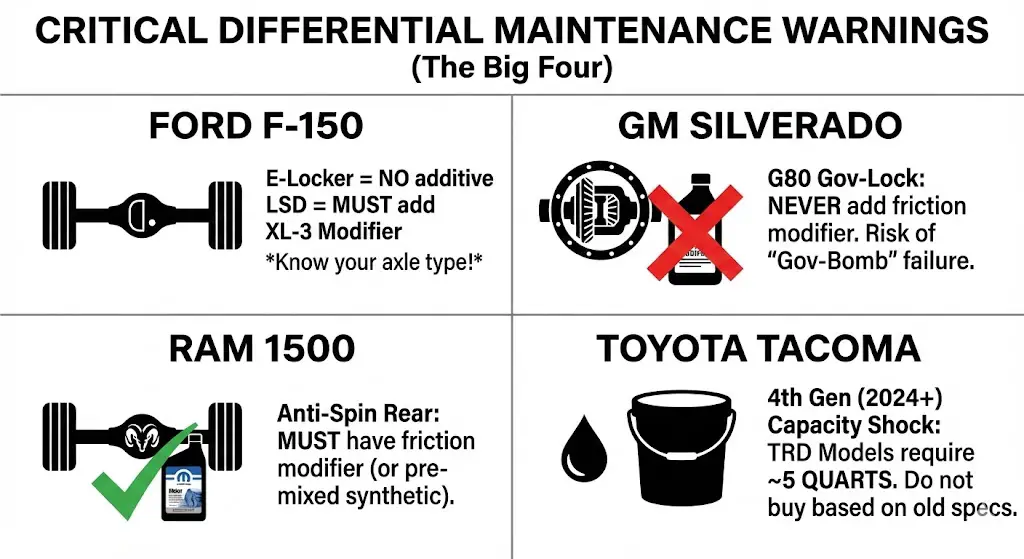
The “average” cost is a statistical abstraction. Real-world costs are dictated by the specific fluid capacities and technical requirements of the vehicle in question. The following sections provide a deep dive into the four most common trucks in the North American market.
Ford F-150 (2015 – 2025 Models)
As the best-selling vehicle in North America, the F-150 sets the standard for maintenance procedures. The 13th and 14th generation trucks utilize robust rear axles, primarily the Super 8.8″ and the 9.75″.
- Fluid Specification: Motorcraft SAE 75W-85 Premium Synthetic Hypoid Gear Lubricant (XY-75W85-QL).
- Capacities:
- Front Axle (8.8″): Approximately 1.7 to 2.1 quarts.
- Rear Axle (Super 8.8″): Approximately 2.0 to 2.1 quarts.
- Rear Axle (9.75″ – Heavy Duty/EcoBoost): Approximately 2.8 to 3.0 quarts.
The Friction Modifier Nuance (E-Locker vs. LSD):
A critical distinction for F-150 owners is the type of rear differential installed.
- Electronic Locking Differential (E-Locker): This is the most common option on FX4 and Max Tow packages. It uses a mechanical locking collar activated by an electromagnetic solenoid. When unlocked, it functions as an open differential. It does NOT require a friction modifier. Adding one is unnecessary but generally harmless.
- Limited Slip Differential (LSD): Found on some older or base models, this uses clutch packs to transfer torque. It REQUIRES 4oz of XL-3 Friction Modifier. Without this additive, the clutches will stick and slip aggressively, causing a “chatter” or vibration during tight turns.
Chevrolet Silverado 1500 / GMC Sierra 1500 (2019 – 2025)
General Motors trucks present a unique maintenance scenario due to the prevalence of the G80 Governor Lock differential.
- Fluid Specification: DEXRON 75W-85 Synthetic Gear Oil.
- Capacities:
- Front: ~1.6 quarts.
- Rear: ~2.6 quarts. Note: The 2019+ redesign introduced two rear axle variants—the “SU7” (manufactured by American Axle & Manufacturing, AAM) and the “SU8” (manufactured by GM). While fluid capacities are similar, the gaskets and drain plug torque specs differ.
Critical Warning: The G80 “Gov-Bomb”
The G80 is an automatic locking differential that uses a flyweight mechanism to engage. It is NOT a clutch-type limited-slip differential in the traditional sense.
- The Rule: DO NOT ADD FRICTION MODIFIER.
- The Reason: Friction modifiers reduce the coefficient of friction. In the G80, the locking mechanism relies on specific friction levels to engage the cam plate. Making the fluid “too slippery” with additives can delay engagement, leading to shock loading that can shatter the governor weights or gears—hence the nickname “Gov-Bomb”. Owners must use standard GL-5 synthetic gear oil without additional LS additives.
Ram 1500 (2019 – 2025 “DT” Generation)
Ram trucks, distinct from their HD counterparts, utilize ZF-sourced axles in the newer DT generation. Ram explicitly markets its towing capability, and its fluid specifications reflect this heavy-duty focus.
- Fluid Specification:
- Rear: 75W-140 Synthetic. This heavier weight fluid provides a thicker oil film at high temperatures, offering superior protection under heavy towing loads compared to the 75W-85 used by Ford and GM.
- Front: 75W-85 or 75W-90.
- Capacities:
- Rear: Approximately 2.2 to 2.9 quarts, depending on the specific axle ratio and housing size.
The Anti-Spin Requirement:
Ram utilizes a clutch-based limited-slip differential branded as “Anti-Spin.” Unlike the GM G80, this system REQUIRES a friction modifier.
- DIY Strategy: Rather than buying generic oil and a separate bottle of Mopar additive, many owners opt for premium synthetics like Amsoil Severe Gear 75W-140 or Royal Purple Max Gear, which come pre-mixed with the necessary friction modifiers. This simplifies the fill process and ensures the correct chemical ratio.
Toyota Tacoma (3rd Gen vs. 4th Gen)
The Toyota Tacoma is currently in a transitional phase between the outgoing 3rd Generation (2016-2023) and the new 4th Generation (2024+). This has created significant confusion in the maintenance community regarding fluid capacities.
- 3rd Gen (2016-2023):
- Rear Capacity: 3.0 to 4.0 quarts (depending on whether it has the 8.0″ or 8.75″ rear end).
- 4th Gen (2024+ TNGA-F Platform):
- The Confusion: The 4th Gen Tacoma introduces a new, massive rear axle for the TRD Off-Road, TRD Pro, and manual transmission models (the 9.5″ axle).
- Capacity Shock: This new axle holds significantly more fluid than its predecessor—approximately 4.5 to 5.0 quarts (or 4.5 Liters).
- The Risk: Owners relying on 3rd Gen knowledge who purchase only 3 or 4 quarts will find themselves unable to complete the service. It is imperative for 2024+ TRD owners to purchase at least 5 quarts of fluid.
- Dealer Pricing: Toyota dealers are notorious for quoting high prices ($300-$600) for differential services. This is partly due to the exorbitant cost of “Toyota Genuine Differential Gear Oil LT,” which can retail for $50/liter. Switching to an equivalent Ravenol or Eurol 75W-85 can save 50% on material costs while strictly adhering to Toyota’s GL-5 specifications.
Table 2: 2025 Truck Differential Specifications Summary
| Vehicle Model | Front Diff Fluid | Rear Diff Fluid | Rear Capacity (Approx.) | Friction Modifier Rule |
| Ford F-150 | 75W-85 GL-5 | 75W-85 GL-5 | 2.0 – 3.0 Qts | NO for E-Locker; YES for LSD |
| Chevy Silverado 1500 | 75W-85 GL-5 | 75W-85 GL-5 | 2.6 Qts | NEVER (G80 Gov-Lock) |
| Ram 1500 | 75W-85 GL-5 | 75W-140 GL-5 | 2.2 – 2.9 Qts | YES (Anti-Spin) |
| Toyota Tacoma (4th Gen) | 75W-85 GL-5 | 75W-85 GL-5 | 4.5 – 5.0 Qts (TRD) | NO (TRD E-Locker) |
The DIY Economics and Implementation Guide
For the vehicle owner reviewing the cost analysis, the disparity between the dealer price ($380) and the DIY price ($90) presents a compelling case for self-maintenance. This section outlines the practical execution of a differential fluid change, highlighting critical tools and procedural safeguards.
Essential Tooling and Capital Investment
The “barrier to entry” for this task is low. A one-time investment of approximately $50 in tools will serve the owner for the life of the vehicle.
- Fluid Pump ($10 – $15): Unlike engine oil, differential fluid cannot be poured directly from the bottle. The fill hole is located on the side of the housing, often obstructed by the spare tire, exhaust, or fuel tank. A “bottle pump” that screws onto the quart container is mandatory for a clean fill.
- Torque Wrench ($30 – $50): Differential housings are often made of cast aluminum or iron. Overtightening the drain or fill plugs can crack the housing—a catastrophic mistake that turns a $50 maintenance job into a $2,000 axle replacement. Torque specs typically range from 15 to 30 ft-lbs; precision is key.
- Socket Set: A standard 3/8″ drive metric socket set is usually sufficient. Note that some newer Fords and Toyotas use a 10mm or 12mm hex bit (Allen key) rather than a standard hex bolt head.
Gasket Technology: RTV vs. LubeLocker
When a differential lacks a drain plug (common on older GM and Ford axles), the entire rear cover must be removed to drain the fluid. This requires resealing the cover upon installation.
- RTV (Room Temperature Vulcanizing) Silicone: The traditional method. It is cheap ($8/tube) but messy. It requires meticulous cleaning of the mating surfaces and a “curing time” of 1-24 hours before fluid can be added.
- LubeLocker Gaskets: A modern aftermarket solution. These are rubber-coated metal gaskets with elastomer beading. They install dry (no sealant), require no scraping, and seal instantly. While they cost more (~$25), the time savings and reliability make them the preferred choice for enthusiasts.
Step-by-Step Procedure and “The Golden Rule”
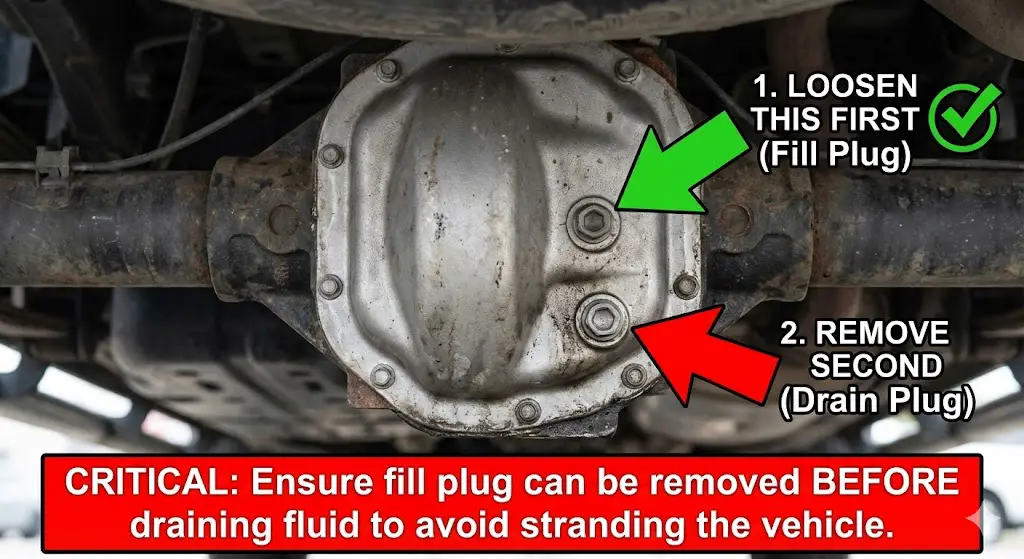
The procedure is conceptually simple but contains one critical failure point.
The Golden Rule: ALWAYS remove the Fill Plug before the Drain Plug.
Reasoning: These plugs are exposed to road salt, water, and corrosion. They often seize. If an owner successfully removes the drain plug, drains the fluid, and then discovers the fill plug is seized, the vehicle is stranded with a dry differential. By loosening the fill plug first, one ensures the ability to refill the unit before committing to the drain.
Operational Sequence:
- Preparation: Drive the vehicle for 10-15 minutes. Warm fluid flows faster and carries suspended contaminants out more effectively.
- Access: Locate the fill and drain plugs. On the rear axle, the fill plug is typically on the driver’s side of the differential pumpkin.
- Drain: Place a catch pan underneath. Remove the fill plug first (Golden Rule), then the drain plug. If no drain plug exists, loosen the bottom differential cover bolts and carefully pry the cover open to drain.
- Inspection:
- Fluid Condition: “Milky” fluid indicates water intrusion (a major issue). Deep black fluid is normal oxidation.
- Magnet Check: Most drain plugs have a magnet. A collection of fine grey paste (metal filings) is normal wear. Large chunks or chips indicate gear failure.
- Clean & Seal: Wipe the magnet clean. Install a new crush washer on the drain plug and torque to spec. If removing the cover, clean the surface and install the new gasket.
- Refill: Use the bottle pump to inject fluid until it begins to weep out of the fill hole.
- Note: Some manufacturers (like GM) specify a level slightly below the fill hole (e.g., 6mm below). However, for general maintenance, filling until a slight dribble occurs is widely accepted as safe, provided the vehicle is level.
- Finalize: Install the fill plug and torque to spec.
Conclusion: The Strategic Value of Maintenance
The analysis of the 2025 differential fluid market leads to a clear conclusion: Differential maintenance is a high-leverage activity for truck ownership.
The economic argument is undeniable. By performing this service independently, an owner can save upwards of $600 on a full 4WD drivetrain service (Front Diff, Rear Diff, Transfer Case) while ensuring the use of premium synthetic fluids rather than the bulk products often used by low-cost service centers. Even for those who prefer professional service, understanding the specific requirements—such as the prohibition of friction modifiers in GM’s G80 or the massive capacity of the new Tacoma TRD axle—empowers the consumer to ask the right questions and avoid costly errors.
Furthermore, the “lifetime fluid” narrative promoted by manufacturers should be viewed with skepticism. In the context of “Severe Service”—which includes towing, hauling, and city driving—differential fluid is a consumable that degrades. Changing it every 30,000 to 50,000 miles is not merely an expense; it is a cost-effective insurance policy against the premature failure of the vehicle’s final drive system.
![How Many Miles Is a Quarter Tank of Gas? (Full Guide) [2026]](https://truckguider.com/wp-content/uploads/2026/03/how-many-miles-is-a-quarter-tank-of-gas-featured.webp)
![Ram 2500 Fuel Tank Size: Specs & Fitment Guide [2026]](https://truckguider.com/wp-content/uploads/2026/03/ram-2500-fuel-tank-size-featured.webp)