How Many Miles Is a Quarter Tank of Gas? (Full Guide) [2026]

To determine your range on a quarter tank, multiply your total tank capacity by 0.25 and then by your average MPG. While a quarter tank usually offers 50 to 100 miles of driving distance, this varies significantly based on vehicle efficiency and road conditions.
🎯 Key Takeaways
- Calculate range by multiplying (Tank Size ÷ 4) by your vehicle’s MPG.
- Most sedans get 75–100 miles, while large SUVs may get less.
- Fuel gauges are estimates and often include a hidden reserve buffer.
- Heavy acceleration and stop-and-go traffic drastically reduce your remaining mileage.
- Driving consistently on low fuel can damage your vehicle’s fuel pump.
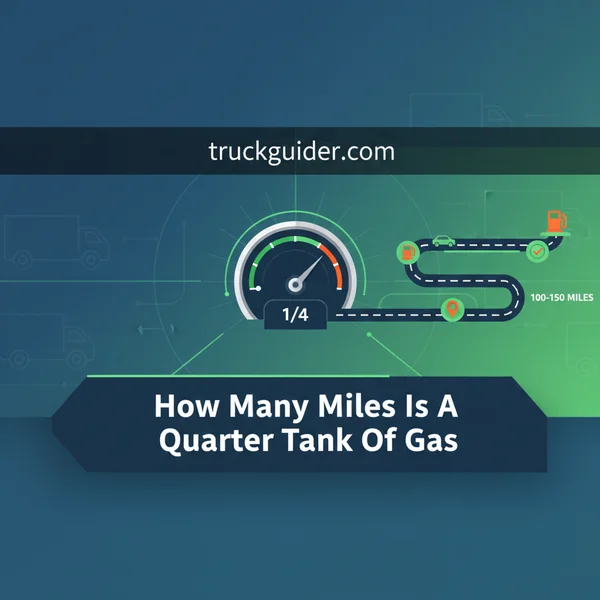
On average, a quarter tank of gas will take you between 75 and 125 miles. This range varies significantly because every vehicle has a different fuel tank capacity and a different rate of fuel consumption. To find your specific number, you must multiply your vehicle’s total fuel capacity by 0.25 and then multiply that result by your average miles per gallon (MPG). For example, if you have a 16-gallon tank and get 25 MPG, your quarter-tank range is exactly 100 miles.
Knowing this number is practically essential for trip planning and vehicle maintenance. Relying on a vague “low fuel” light is risky because those lights are calibrated differently by every manufacturer. By calculating your exact quarter-tank range, you can avoid the stress of “range anxiety” during long highway stretches. Furthermore, keeping at least a quarter tank helps protect your fuel pump, which relies on the surrounding gasoline to stay cool and lubricated while it operates.
Factors Influencing Your Quarter-Tank Driving Range
Your driving range is not a static number; it fluctuates based on several mechanical and environmental factors. While the math provides a baseline, real-world conditions will often pull that number up or down. Understanding these variables helps you adjust your expectations when the needle hits the quarter mark.
📤 Share
💾 Download
Total Fuel Tank Capacity and the “Reserve” Factor
The biggest factor is the physical size of your gas tank. A subcompact car might have a 10-gallon tank, meaning a quarter tank is only 2.5 gallons. Conversely, a heavy-duty pickup truck might have a 36-gallon tank, where a quarter tank is a substantial 9 gallons. You also have to account for the reserve capacity. Most manufacturers design fuel gauges to show “Empty” when there are still 1 to 2 gallons left in the tank to prevent you from getting stranded. This means your “quarter tank” reading on the dashboard might actually represent a slightly higher volume of fuel than a literal mathematical quarter of the total capacity.
- Compact Cars: Typically 10–13 gallon tanks.
- Mid-size Sedans: Typically 15–18 gallon tanks.
- Full-size SUVs/Trucks: Typically 25–30+ gallon tanks.
- Hybrid Vehicles: Often have smaller tanks (10–12 gallons) but higher efficiency.
Real-Time MPG Variability
Your average MPG isn’t just a number on a sticker; it changes every time you drive. If you are stuck in stop-and-go city traffic, your engine consumes more fuel to move the car’s mass from a standstill, lowering your range. On the highway, where you maintain a steady speed in a higher gear, your range increases. Additionally, external factors like tire pressure, cargo weight, and even wind resistance play a role. If you are towing a trailer or carrying a roof rack, your quarter tank might only last two-thirds as long as it normally would on a clear, flat highway.
Estimated Mileage Comparison by Vehicle Type and MPG
To give you a better idea of where your vehicle stands, it helps to look at common configurations. Since most modern vehicles fall into specific categories of efficiency, you can estimate your range by looking at how many gallons a quarter tank represents for your specific vehicle class. The following data highlights the drastic difference between a fuel-efficient hybrid and a gas-guzzling performance vehicle.
Quarter-Tank Range Estimation Table
This table assumes a literal 25% calculation of the tank size. Use these figures as a starting point for your own calculations.
| Tank Size (Gallons) | Quarter Tank (Gallons) | 20 MPG Range | 30 MPG Range | 40 MPG Range |
|---|---|---|---|---|
| 12 Gallons (Compact) | 3.0 gal | 60 miles | 90 miles | 120 miles |
| 16 Gallons (Sedan) | 4.0 gal | 80 miles | 120 miles | 160 miles |
| 20 Gallons (SUV) | 5.0 gal | 100 miles | 150 miles | 200 miles |
| 26 Gallons (Truck) | 6.5 gal | 130 miles | 195 miles | 260 miles |
Breaking Down the Averages
As you can see from the data above, a compact car with a 12-gallon tank and high efficiency (40 MPG) actually has a similar quarter-tank range to a large sedan with a 16-gallon tank and moderate efficiency (30 MPG). This is why you cannot rely on a friend’s estimate for their car when driving yours. If you drive a large truck with a 26-gallon tank, even at a lower efficiency of 20 MPG, your quarter tank actually holds more potential mileage (130 miles) than a small car getting better gas mileage. However, the cost to refill that quarter tank will be significantly higher. Always check your owner’s manual to confirm your exact tank capacity before performing these calculations.
- High-Efficiency Hybrids: Often exceed 150 miles on a quarter tank despite small tanks.
- Standard Commuter Cars: Usually hover around the 100-mile mark.
- Performance/Luxury Cars: Often have large tanks but low MPG, resulting in roughly 80–90 miles per quarter tank.
Understanding Fuel Gauge Accuracy and Reserve Buffers
It is important to remember that your fuel gauge is not a precision scientific instrument. While modern sensors are better than they used to be, the reading on your dashboard is still an estimate. Most fuel gauges are designed to be non-linear, meaning the top half of the tank often lasts longer than the bottom half.
The Non-Linear Nature of Fuel Gauges
Many drivers notice that the needle stays on “Full” for a long time and then seems to drop rapidly once it passes the halfway mark. This is often intentional. Manufacturers know that drivers feel better when the tank stays full longer. However, once you hit that quarter-tank mark, the needle may move toward empty much faster than you expect. This psychological buffer means your “last quarter” might actually represent less than 25% of your usable fuel.
The Hidden “Reserve” Tank
Most vehicles are designed with a reserve capacity. When your gauge hits empty, there is usually about one to two gallons left in the tank to prevent you from being immediately stranded. While this is a helpful safety net, you should never rely on it. Some key things to keep in mind about your gauge accuracy include:
- Tank Shape: Fuel tanks are often irregularly shaped to fit around the chassis, making it hard for a float-style sensor to be perfectly accurate at every level.
- Incline Sensitivity: Parking or driving on a steep hill can shift the fuel to one side, causing your gauge to read higher or lower than the actual level.
- Mechanical Wear: In older cars, the sending unit in the tank can become “dead” in certain spots, providing a stuck or flickering reading.
External Variables That Impact Fuel Efficiency and Distance
The math you do in your head for a quarter tank can change in an instant based on your environment. Even if you usually get 100 miles out of a quarter tank, a change in conditions can slash that number significantly. Understanding these variables helps you avoid a call to a tow truck.
Your Driving Style and Terrain
How you move the car matters just as much as what you are driving. If you are stuck in stop-and-go city traffic, you are burning fuel to move a heavy object from a dead stop repeatedly, which is the least efficient way to drive. Conversely, maintaining a steady speed on a flat highway maximizes your range. If your remaining quarter tank needs to get you over a mountain pass, expect your mileage to drop by 20% or more due to the engine working harder against gravity.
Vehicle Load and Weather Conditions
External factors act like a “tax” on your fuel supply. The more work the engine has to do, the fewer miles you get per gallon. Consider these common range-killers:
- Extreme Temperatures: Using the air conditioning in 100-degree heat or the heater in freezing weather puts extra load on the engine and battery.
- Aerodynamics: Carrying a roof rack or even driving into a strong headwind increases drag, forcing the car to burn more fuel to maintain speed.
- Excess Weight: A car loaded with four passengers and luggage will burn through a quarter tank much faster than a car with just a driver.
- Tire Pressure: Under-inflated tires increase rolling resistance, which quietly siphons away your fuel efficiency.
Wrapping Up: Know Your Vehicle’s Limits
While the average car can travel between 75 and 125 miles on a quarter tank of gas, this number is a moving target. Factors like your vehicle’s specific MPG, your driving habits, and even the accuracy of your fuel sensor play a massive role in how far you can actually go. Relying on the “quarter tank” mark as your signal to find a station is the best way to protect your fuel pump and ensure you never end up stranded.
To stay ahead of the game, take a moment this week to check your owner’s manual for your total tank capacity and start tracking your trip odometer between fill-ups. Don’t wait for the low-fuel light to blink! Aim to refill when you hit that quarter mark to keep your engine healthy and your commute stress-free. Safe travels!
❓ Frequently Asked Questions
How many miles can a 12-gallon tank car go on a quarter tank?
A car with a 12-gallon tank has 3 gallons remaining at the quarter-tank mark. If the vehicle averages 30 MPG, you can expect to drive approximately 90 miles before the tank is completely empty.
Why does my mileage vary so much between highway and city driving?
Highway driving is more efficient because the engine operates at a steady, optimized RPM without frequent braking. City driving requires more energy to overcome inertia during stops and starts, lowering the distance you can cover on a quarter tank.
Can I trust the ‘miles to empty’ display in my car?
These displays are estimates based on your most recent driving habits and may not account for sudden changes in terrain or load. They are generally accurate but should be used as a guide rather than a literal guarantee.
Does towing a trailer affect how far a quarter tank goes?
Yes, towing adds significant weight and aerodynamic drag, which can cut your fuel efficiency by 30% to 50%. On a quarter tank, a truck that usually gets 100 miles might only cover 50 to 60 miles while towing.
What exactly is the ‘reserve’ fuel in a gas tank?
Most manufacturers design fuel tanks with a small reserve, usually 1 to 2 gallons, that is not fully reflected on the fuel gauge. This acts as a safety buffer to prevent drivers from being stranded the moment the needle hits empty.
Does cold weather impact my quarter-tank range?
Cold weather increases engine friction and can affect tire pressure, both of which decrease fuel economy. You will likely see a 10% to 15% decrease in range during winter months compared to temperate weather.
![Steering Shaft Replacement Cost: 2024 Pricing & Labor Guide [2026]](https://truckguider.com/wp-content/uploads/2026/03/steering-shaft-replacement-cost-featured.webp)
![Program Dodge Ram Key Fob Without Original: DIY Guide [2026]](https://truckguider.com/wp-content/uploads/2026/03/program-dodge-ram-key-fob-without-origin-featured.webp)