
Dodge Dakota 6 Lug Pattern Specifications And Wheel Fitment Guide [2026]

Understanding the specific wheel geometry of the Dodge Dakota is essential for maintaining both the vehicle’s aesthetic appeal and its structural integrity. As a mid-size truck that redefined the segment, the Dakota relies on a precise hub-and-wheel interface to manage payload and towing capacities. Owners of the 1991–2004 Dodge Dakota often face challenges when sourcing replacement wheels due to the truck’s unique and somewhat rare 6-lug bolt pattern, which differs significantly from its competitors and even its own predecessor. This complete guide provides expert-level specifications, technical data, and professional fitment advice to ensure you select the most reliable and compatible wheel components for your 6-lug Dakota.
Identifying the Dodge Dakota 6 Lug Pattern Applications and Years
📤 Share Image
The Dodge Dakota’s transition to a 6-lug configuration was a calculated engineering move by Chrysler to bridge the gap between compact and full-size truck capabilities. This comprehensive understanding begins with the 1991 model year. Prior to this, the 1987–1990 models utilized a 5-lug pattern (5×114.3mm) which, while common, proved insufficient for the increasing Gross Vehicle Weight Ratings (GVWR) that Dodge intended for the platform. By introducing the 6-lug design, engineers increased the surface area of the hub-to-wheel mating surface and distributed clamping force across six points rather than five, significantly improving load capacity and hub strength.
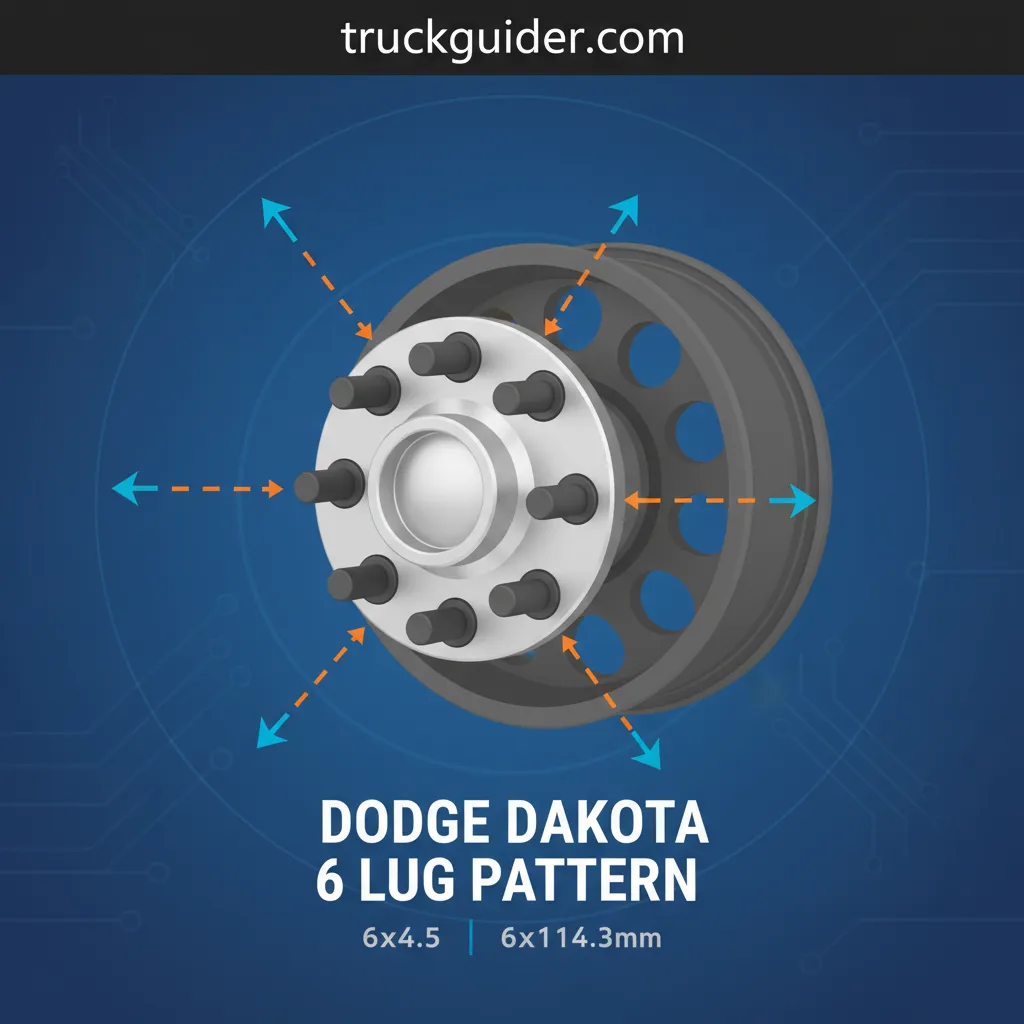
During the 1991–2004 production run, which encompasses the latter half of the first generation and the entirety of the second generation, the 6×114.3mm (6×4.5 inch) bolt circle became the standard across all trims. Whether you are servicing a base model 2WD work truck, a 4WD Sport, or the high-performance 1998 Dodge Dakota R/T 5.9L, the bolt pattern remains a fixed constant. The R/T models, in particular, utilized this 6-lug pattern to handle the increased torque of the Magnum V8, often paired with 17×9 inch factory aluminum wheels that required specific backspacing to clear the flared fenders.
The lineage ended abruptly in 2005 with the launch of the third-generation Dakota. In an effort to align the Dakota more closely with the Ram 1500 parts bin, Dodge shifted the third-gen (2005–2011) models to a 5×139.7mm (5×5.5) configuration. This makes the 1991–2004 era unique. With approximately 1.5 million units produced during this 14-year window, the 6-lug Dakota remains a significant presence in the trusted secondary market and among enthusiasts who value the chassis’ robust quality.
Generation Comparison Statistics
1991-2004 Pattern
Units Produced
Fixed Hub Bore
Technical Dimensions of the 6×114.3mm (6×4.5) Bolt Pattern
In the professional wheel industry, precision is the difference between a smooth ride and catastrophic hardware failure. The Dakota’s pattern is expressed both in metric (6×114.3mm) and imperial (6×4.5 inches). While “6×4.5” is the common shorthand in domestic parts catalogs, the metric 114.3mm is the precise engineering standard. To verify this pattern on a vehicle or a loose wheel, measure from the center of one wheel stud to the center of the stud directly opposite it across the hub. This diameter must equal exactly 4.5 inches.
The Critical Hub Bore Specification
One of the most overlooked aspects of Dakota fitment is the 71.5mm hub bore. The Dodge Dakota is a hub-centric design, meaning the center of the wheel rests on a machined lip on the hub, which centers the wheel and supports the vehicle’s weight. Many aftermarket wheels are manufactured with a larger 73.1mm or 78mm bore to fit multiple applications. If you install these without quality hub-centric rings, you shift the entire load onto the wheel studs. This “lug-centric” setup is a common pitfall that leads to persistent vibrations and, in extreme cases, sheared studs under heavy load.
Wheel Studs and Offset
The 6-lug Dakota typically utilizes 1/2″-20 UNF wheel studs. However, certain heavy-duty or late-production 2003–2004 sub-models may feature different hardware profiles depending on the axle package. It is vital to confirm thread pitch before purchasing new lug nuts. Furthermore, factory wheel offsets generally range from +12mm to +25mm. A lower offset pushes the wheel outward (wider stance), while a higher offset tucks it into the wheel well. When selecting aftermarket wheels, staying within 10mm of the factory offset ensures that the scrub radius remains within acceptable limits for the front suspension geometry.

Cross-Compatibility and Aftermarket Wheel Selection
The search for the perfect wheel often leads owners to look at other vehicle platforms. The most notable overlap for the 6×114.3mm pattern is the Nissan platform, including the Frontier (2005+), Xterra, and Pathfinder. However, an expert warning is necessary: the Nissan hub bore is significantly smaller at 66.1mm. This means that while the lug holes will line up perfectly, a Nissan wheel physically cannot slide onto a Dakota hub without professional machining to enlarge the center bore. This is often more costly and risky than simply purchasing Dakota-specific wheels.
Conversely, the 1998–2003 Dodge Durango is a 1:1 match. Because the Durango was built on the Dakota chassis during these years, their wheels are completely interchangeable. This is a reliable strategy for owners looking to upgrade from steel wheels to factory alloys without spending a fortune on aftermarket options. When venturing into the aftermarket, trusted brands like Fuel Off-Road, Method Race Wheels, and American Racing continue to support the 6×4.5 pattern with dedicated fitments that account for the 71.5mm bore.
Never force a Nissan wheel onto a Dakota hub. The 66.1mm bore is 5.4mm too small for the Dakota’s 71.5mm hub. Forcing the fitment will damage the hub assembly and prevent the wheel from seating flush against the brake rotor, creating a high risk of wheel separation.
Installation Standards and Torque Requirements for 6-Lug Hubs
The safety of your 6-lug assembly depends on two factors: the tightening sequence and the final torque value. Professional technicians strictly adhere to a star pattern to ensure the wheel seats evenly against the rotor hat. Tightening one side of the wheel completely before moving to the other can cause the wheel to “cock” slightly, leading to run-out and vibration.
📋
Professional Mounting Guide
Use a wire brush to remove rust and debris from the hub face and the back of the wheel. Even a thin layer of corrosion can prevent proper seating.
Tighten lug nuts by hand in a 1-4-5-2-3-6 sequence. This ensures the wheel is centered on the hub before full force is applied.
Use a calibrated torque wrench to reach 100 lb-ft (range 85–115 lb-ft). Avoid impact wrenches for final tightening as they can stretch the threads of the 1/2″-20 studs.
It is also crucial to match the lug nut seating type to the wheel. Factory steel wheels often use a flanged or flat seat, whereas almost all aftermarket aluminum wheels require a 60-degree conical (acorn) seat. Using the wrong hardware will lead to the nuts loosening over time. Industry standards and professional best practices mandate a re-torque of all 6 lugs after the first 50–100 miles of driving following any wheel removal.
Common Modifications: Spacers, Adapters, and Lift Kits
Because the 6×114.3mm pattern limits wheel choices compared to the ubiquitous 6×139.7mm (6×5.5) Chevy/Toyota pattern, many Dakota owners turn to wheel adapters. A high-quality adapter can convert your 6×4.5 hub to 6×5.5, opening up thousands of wheel options. However, this is an area where quality must take precedence over price. Only use adapters machined from 6061-T6 billet aluminum. These components act as an extension of your hub and must be able to withstand the same lateral forces.
Billet Aluminum Construction
Adapters made from 6061-T6 aircraft-grade aluminum provide the necessary tensile strength for towing and off-roading without adding excessive unsprung weight.
Scrub Radius Management
Typical adapters add 1.0 to 1.5 inches of thickness. This widens the track but changes the scrub radius, which may increase steering effort and wear on ball joints.
When installing lift kits—specifically suspension lifts that include new upper control arms or spindles—wheel backspacing becomes critical. A 6-lug wheel with too much “positive” offset may cause the tire sidewall to rub against the new suspension components. In these cases, a wheel with a lower offset (closer to 0mm or even negative) is required to push the assembly outward. Always measure the distance between the tire and the closest suspension point at full steering lock before concluding the installation is safe.
When using adapters, you effectively have 12 lug nuts per wheel. You must check the torque on the nuts holding the adapter to the hub, which requires removing the wheel. Do this every time you rotate your tires to ensure the adapter remains perfectly flush.
The 1991–2004 Dodge Dakota’s 6-lug pattern is a hallmark of a truck built for durability. By adhering to these professional specifications and sourcing quality hardware, you ensure that your vehicle remains both safe and capable. Whether you are performing a simple wheel swap or a major suspension overhaul, the technical data contained in this guide serves as the foundation for a successful project.
In summary, the 1991–2004 Dodge Dakota utilizes a specific 6×114.3mm (6×4.5) bolt pattern with a 71.5mm hub bore. Proper wheel selection must account for hub-centricity and load ratings to ensure professional-grade safety. Furthermore, adhering to correct torque sequences and specifications is non-negotiable for maintaining hub longevity. For the best results, always consult with a certified wheel specialist or use a professional fitment calculator before finalizing your purchase of 6-lug aftermarket wheels.
Frequently Asked Questions
What is the 6 lug pattern on a Dodge Dakota?
The 6-lug pattern found on 1991 to 2004 Dodge Dakota models is officially 6×114.3mm. In the United States, this is also commonly referred to by its imperial equivalent, the 6×4.5-inch pattern. This specific spacing was chosen to provide a more robust connection for the truck’s mid-size chassis and increased payload capacities.
Will Nissan 6-lug wheels fit a Dodge Dakota?
While many Nissan trucks, such as the Frontier and Xterra, share the 6×114.3mm bolt pattern, they are generally not a direct fit. Nissan wheels typically feature a 66.1mm center bore, which is too small to fit over the Dakota’s 71.5mm hub. Professional machining would be required to enlarge the Nissan wheel’s center bore for a safe fit.
What is the hub bore size for a 6-lug Dodge Dakota?
The hub bore for all 6-lug Dodge Dakotas produced between 1991 and 2004 is 71.5mm. When selecting aftermarket wheels, it is vital to choose wheels with a bore of at least 71.5mm. If the wheel has a larger bore, professional hub-centric rings should be used to ensure the wheel remains centered on the hub.
Can I convert my 6-lug Dakota to a 5-lug pattern?
Yes, this is possible through the use of high-quality wheel adapters or by swapping hubs from compatible 5-lug Dakota years (though this is technically complex). Most owners choose 6061-T6 billet aluminum adapters that convert the 6×114.3 pattern to more common patterns like 5×114.3 or 5×127, allowing for a wider selection of wheels.
What are the factory torque specs for Dakota 6-lug wheels?
For the 6-lug Dodge Dakota, the recommended torque for lug nuts is generally between 85 and 115 lb-ft, depending on the specific year and stud size. It is critical to use a calibrated torque wrench and follow a star-pattern sequence to prevent warping the brake rotors or over-stressing the wheel studs.
![3.6 Pentastar Oil Type & Capacity Guide (2011: Specs & Fitment Guide [2026]](https://truckguider.com/wp-content/uploads/2026/03/3-6-pentastar-oil-type-featured.webp)
![Paint Code Px8: Diagnosis & Repair [2026]](https://truckguider.com/wp-content/uploads/2026/03/featured-cf60a646-768x768.webp)
![2015 Ram 2500 Lug Pattern: Bolt Pattern & Torque Specs [2026]](https://truckguider.com/wp-content/uploads/2026/03/2015-ram-2500-lug-pattern-featured.webp)
![Head Gasket Leak Oil Color: Diagnosis & Repair [2026]](https://truckguider.com/wp-content/uploads/2026/03/head-gasket-leak-oil-color-featured.webp)
![Dodge Ram 2500 Interior [2026]](https://truckguider.com/wp-content/uploads/2026/03/featured-583ae4d5-768x768.webp)
![2022 Ram 2500 Tradesman Guide: Specs & Fitment Guide [2026]](https://truckguider.com/wp-content/uploads/2026/03/2022-ram-2500-tradesman-featured.webp)