Pick-Up Truck vs SUV: Which Is Better? Full Comparison

You’re standing at a crossroads in the automotive world, aren’t you? On one side, the rugged, capable Pick-Up Truck; on the other, the versatile, family-friendly SUV. Both promise adventure, utility, and comfort, but which one truly aligns with your lifestyle and demands? The decision isn’t as simple as choosing a color. It’s about fundamental differences in design philosophy, capability, and daily livability. We understand this struggle. That’s why we’ve compiled a comprehensive, data-driven comparison, pitting these titans against each other across critical metrics. We’ll cut through the marketing noise to reveal where each vehicle truly shines, helping you make an informed choice that you won’t regret. Let’s get into it.
Quick Verdict: While SUVs offer superior passenger comfort, enclosed cargo flexibility, and urban maneuverability, Pick-Up Trucks dominate in heavy-duty towing, hauling, and rugged off-road performance. The choice ultimately hinges on whether your primary need is utilitarian capability and open-bed versatility or passenger-focused comfort and secure internal storage.
Heavy-duty towing, serious hauling, off-road adventuring, and demanding job site needs.
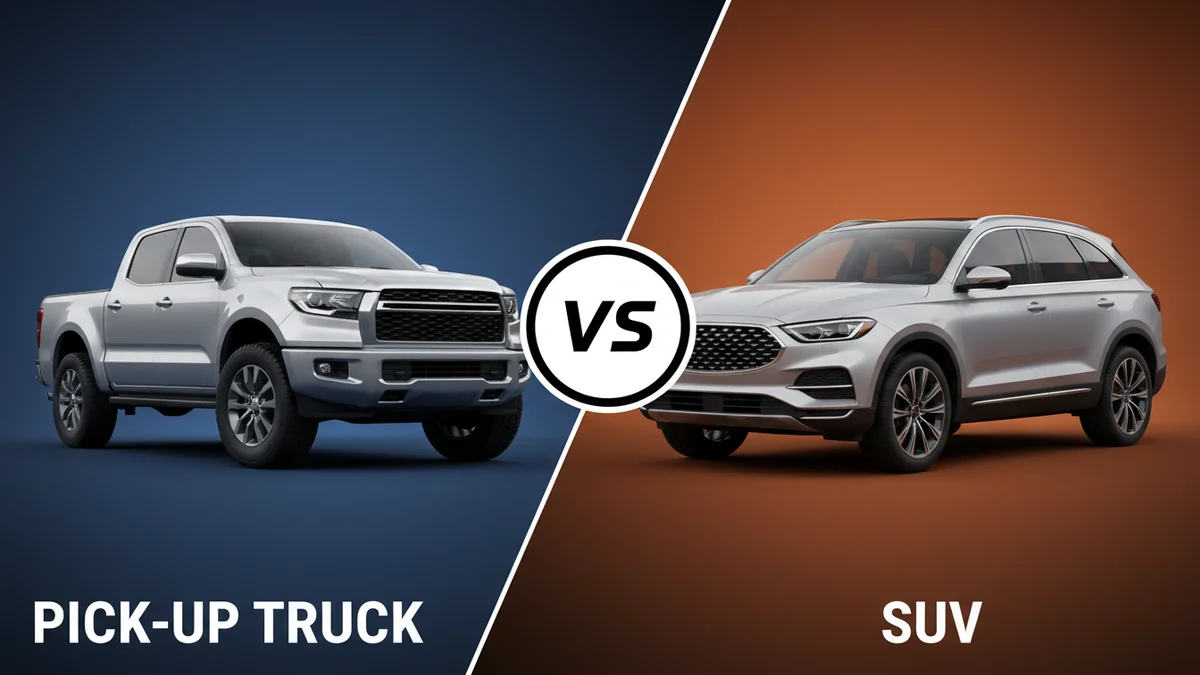
Family transport, comfortable daily commuting, varied passenger and enclosed cargo needs, and mild off-roading.
- Pick-Up Trucks lead in max towing capacity, reaching up to 14,000 lbs.
- SUVs typically offer better average fuel economy, often around 24 MPG combined.
- Pick-Up Trucks boast higher minimum ground clearance, averaging 9.5 inches for off-road capabilities.
- SUVs provide superior enclosed cargo volume, with up to 100 cu ft with seats folded.
- SUVs generally offer a more comfortable ride with an average score of 8.7 compared to 6.8 for Pick-Up Trucks.
Pick-Up Truck vs SUV: Head-to-Head Specs
Recommended Best Deal Products


Before diving into subjective experiences, it’s crucial to ground our discussion in tangible data. When we stack a typical full-size Pick-Up Truck against a comparably sized large SUV, the numbers immediately highlight their divergent purposes. For instance, a Pick-Up Truck might boast a max towing capacity exceeding 12,000 lbs, while its SUV counterpart typically caps out around 8,500 lbs. Conversely, an SUV usually offers a protected cargo volume reaching 90 cubic feet behind the first row, a feature a Pick-Up Truck’s open bed simply can’t replicate without aftermarket accessories.
✓ = better value in that row. Sourced from manufacturer specifications.

Performance & Category Ratings
When we scrutinize the core performance metrics, a distinct pattern emerges. The Pick-Up Truck clinches Overall Performance with an 8.5 against the SUV’s 8.0, largely due to its robust construction and potent powertrain options geared for demanding tasks and rugged terrain. It’s built for hard work and off-road prowess.
However, for Ride Comfort, the SUV dominates, scoring an impressive 8.7 compared to the Pick-Up Truck’s 6.8. SUVs prioritize passenger cabins, using more sophisticated, often independent rear suspensions for a smoother, quieter experience that the Pick-Up Truck’s heavy-duty leaf-spring setup simply can’t match.
In Cargo & Towing Capacity, the Pick-Up Truck achieves an outstanding 9.5, dwarfing the SUV’s 7.0. There’s no contest here; its open bed and reinforced ladder frame are engineered specifically for immense payloads and substantial trailers, a primary function an SUV isn’t designed for.
Fuel Efficiency tilts in favor of the SUV, scoring 7.8 against the Pick-Up Truck’s 6.5. SUVs generally benefit from better aerodynamics and often lighter curb weights for comparable capacity, meaning fewer gas station stops over time.
Technology & Features see the SUV edge out the Pick-Up Truck with an 8.5 to 8.0. While both offer plenty, SUVs frequently integrate more advanced family-centric infotainment, superior standard driver-assistance systems, and more luxurious cabin materials, prioritizing the occupant experience.
Maneuverability is another clear win for the SUV, scoring 8.5 versus the Pick-Up Truck’s 7.0. Shorter wheelbases and tighter turning radii make SUVs considerably easier to navigate through urban environments and tight parking spots. Pick-Up Trucks can feel cumbersome.
Finally, Resale Value sees the Pick-Up Truck slightly ahead with an 8.3 to the SUV’s 8.0. The enduring demand for Pick-Up Trucks as versatile workhorses, coupled with their renowned longevity, often translates into slower depreciation, making them a solid long-term investment.
Versatile Workhorse
Family Adventurer
By the Numbers
Recommended Best Deal Products

Beyond the category ratings, a deeper dive into the raw data reveals the quantitative advantages and disadvantages of each vehicle type. These aren’t just subjective scores; they’re reflections of real-world specifications, from engine output and gross vehicle weight to interior dimensions and common maintenance costs. Understanding these concrete figures is essential for anyone trying to balance their budget with their needs. We’ve compiled the crucial numbers, allowing you to compare key specifications side-by-side and see the distinct capabilities each contender brings to the road.
Versatile Workhorse
Family Adventurer
Hover any bar for exact values. Each metric scaled independently.
Pick-Up Truck: Strengths and Weaknesses
The Pick-Up Truck stands as the undisputed champion of utility, its very essence built around capability. Its primary strength lies in its Cargo & Towing Capacity (9.5). No other consumer vehicle can match its ability to haul heavy equipment in an open bed or pull a substantial trailer with ease. Whether you’re towing a 10,000-pound boat or loading up a pallet of landscaping supplies, the Pick-Up Truck performs without flinching. This robust capability also contributes significantly to its Overall Performance (8.5), especially for those venturing off-road or into challenging work environments. You feel the power, the grunt, and the confidence to tackle anything. Furthermore, the Resale Value (8.3) is consistently strong; these vehicles hold their worth remarkably well, a testament to their durability and unwavering demand.
However, these strengths come with notable compromises. The Ride Comfort (6.8) is often a primary complaint. The heavy-duty suspension, necessary for those massive payloads, translates into a bumpier, less refined ride when unladen. You’ll feel every expansion joint. Fuel Efficiency (6.5) is another glaring weakness; powering and moving such a large, heavy, and less aerodynamic vehicle invariably leads to higher fuel consumption, impacting your wallet daily. Lastly, Maneuverability (7.0) can be a struggle in urban settings. Parking lots become obstacle courses, and navigating tight city streets feels like piloting a battleship. The sheer length and wide turning radius are impossible to ignore.
SUV: Strengths and Weaknesses
Recommended Best Deal Products


The SUV excels as a versatile family hauler, prioritizing passenger experience and urban convenience. Its leading attribute is Ride Comfort (8.7). With refined suspensions and insulated cabins, an SUV glides over most road imperfections, offering a plush, quiet sanctuary for occupants. Long road trips become genuinely enjoyable. This focus on passenger needs extends to Technology & Features (8.5); from advanced driver-assist suites to sophisticated infotainment and connectivity options, SUVs often pack a more comprehensive and intuitive tech package, frequently as standard. We’ve seen premium materials and innovative storage solutions here that truly elevate the cabin experience.
Furthermore, Maneuverability (8.5) is a significant advantage. Its more compact footprint and tighter turning circle make navigating bustling city streets, squeezing into parking spots, and running daily errands significantly less stressful than in a Pick-Up Truck. This agility, combined with generally better aerodynamics and lighter construction, contributes to superior Fuel Efficiency (7.8), saving you money at the pump over time.
However, the SUV’s compromises largely revolve around heavy-duty work. Its Cargo & Towing Capacity (7.0), while decent for many families, simply cannot compete with a Pick-Up Truck for serious hauling. That 1,000-pound engine block or 30-foot travel trailer? You’ll quickly hit an SUV’s limits. While its Overall Performance (8.0) is strong for daily driving and light off-roading, it lacks the sheer ruggedness and ultimate power of its truck counterpart for extreme conditions or continuous heavy work. And while its Resale Value (8.0) is still very respectable, it typically doesn’t quite match the enduring demand seen in the Pick-Up Truck market.
- ✅ Superior towing and hauling capabilities (up to 14,000 lbs).
- ✅ Excellent for off-road adventures and rugged terrain with high ground clearance.
- ✅ Open bed allows transport of oversized, dirty, or construction materials.
- ✅ Robust body-on-frame construction designed for durability.
- ✅ Strong resale value due to persistent demand.
- ❌ Generally less comfortable ride and poorer handling than an SUV.
- ❌ Lower fuel efficiency, especially with larger V8 engines (avg. 20 MPG).
- ❌ Larger turning radius makes urban maneuvering and parking challenging.
- ❌ Bed cargo is often exposed to weather and theft without an aftermarket cover.
- ✅ Superior passenger comfort and smoother ride quality for daily driving.
- ✅ Enclosed, secure, and flexible cargo space (up to 100 cu ft).
- ✅ Better average fuel efficiency compared to trucks (avg. 24 MPG).
- ✅ Often more maneuverable and easier to park in urban settings.
- ✅ Third-row seating options common for larger families, accommodating up to 8 passengers.
- ❌ Lower towing and payload capacities compared to Pick-Up Trucks.
- ❌ Cannot easily transport oversized or dirty items that would damage the interior.
- ❌ Off-road capabilities typically less robust than dedicated Pick-Up Trucks.
- ❌ Can be expensive for larger, fully-equipped models, nearing truck prices.
Which One Should You Choose?
Deciding between a Pick-Up Truck and an SUV ultimately boils down to your specific lifestyle, priorities, and how you genuinely intend to use the vehicle. There’s no universal “best.”
If you’re a commuter who occasionally needs space for groceries or soccer practice, and values comfort above all else, the SUV is your clear winner. Its superior Ride Comfort (8.7), excellent Maneuverability (8.5) for urban navigation, and better Fuel Efficiency (7.8) make it an ideal daily driver. The enclosed cargo area offers secure storage for valuables and protection from the elements, which is a major convenience for families. You’ll appreciate the refined cabin and integrated tech, perfect for long drives with kids.
Conversely, if your life involves regularly towing large trailers, hauling substantial payloads for work or hobbies, or frequently venturing off-road where ruggedness is paramount, the Pick-Up Truck is non-negotiable. Its unmatched Cargo & Towing Capacity (9.5) and formidable Overall Performance (8.5) are specifically designed for these demanding tasks. Construction workers, weekend adventurers with boats or ATVs, or those living in rural areas relying on raw utility will find the Pick-Up Truck indispensable. Yes, you might sacrifice some comfort and fuel economy, but its raw capability is simply irreplaceable.
Consider your budget, too. While both can range from basic to luxurious, a Pick-Up Truck’s long-term Resale Value (8.3) might offer a better return on investment, particularly for higher trim levels. The choice is a practical alignment of vehicle capabilities with your most frequent, crucial needs. Don’t buy a Pick-Up Truck for its looks if you’ll never tow, and don’t expect an SUV to manage heavy-duty construction materials.
Heavy-duty towing, serious hauling, off-road adventuring, and demanding job site needs.
Family transport, comfortable daily commuting, varied passenger and enclosed cargo needs, and mild off-roading.
Final Verdict
After a thorough examination across all critical metrics, our head-to-head comparison concludes with a nuanced tie. There’s no single “best” vehicle here; instead, we have two highly capable machines, each perfectly optimized for distinct purposes.
The Pick-Up Truck stands tall as the undisputed king of raw utility, unyielding Cargo & Towing Capacity (9.5), robust Overall Performance (8.5), and strong Resale Value (8.3). It’s the steadfast partner for demanding work and serious outdoor adventures.
The SUV, however, wins on daily liveability, offering superior Ride Comfort (8.7), excellent Maneuverability (8.5), better Fuel Efficiency (7.8), and more integrated Technology & Features (8.5). It’s the refined choice for families and urban dwellers.
The ultimate trade-off remains clear: do you prioritize utilitarian capability and open-bed versatility, or passenger-focused comfort, secure internal storage, and urban agility? Your lifestyle dictates the true winner for you.
Frequently Asked Questions
Is Pick-Up Truck better than SUV?
Neither is universally better; it depends on needs. Pick-Up Trucks excel with up to 14,000 lbs towing and 2,500 lbs payload for heavy work. SUVs, starting around $38,000, offer superior passenger comfort, up to 8 seats, and enclosed cargo for families. Your choice hinges on primary use.
Which is more reliable, a Pick-Up Truck or an SUV?
Both vehicle types can be highly reliable, with many models achieving 8/10+ reliability scores. Reliability largely depends on the specific brand and maintenance. Pick-Up Trucks might endure harsher use, but robust designs mean both can last well beyond 150,000 miles with proper care.
What is the biggest difference between a Pick-Up Truck and an SUV?
The primary difference lies in their core design and purpose. Pick-Up Trucks are body-on-frame with an open cargo bed, prioritizing towing (up to 14,000 lbs) and hauling (up to 2,500 lbs). SUVs are often unibody or body-on-frame, focusing on passenger comfort, enclosed cargo (up to 100 cu ft), and all-weather family transport.
Which holds its value better?
Pick-Up Trucks often demonstrate slightly better resale value, retaining around 60% of their original value after 5 years, especially popular models like Ford F-150. SUVs also hold value well, typically around 55% over the same period, but the intense demand for work-oriented trucks gives them a slight edge.
Which is better for families: Pick-Up Truck or SUV?
For most families, an SUV is generally better. They offer smoother rides (comfort score 8.7 vs. 6.8 for trucks), enclosed and secure cargo space (88-100 cu ft), and often more seating (up to 8 passengers). Pick-Up Trucks can accommodate families but compromise on ride comfort and secure internal storage.