
Unibody vs Body on Frame 2026: Which Is Better? Full Comparison

For many drivers, the starkest real-world difference between a Unibody vehicle and a Body on Frame design becomes clear the moment they try to hitch up a substantial load: the latter often offers a towing capacity more than 50% greater. This fundamental divergence in engineering dictates everything from how a vehicle rides to its capability on rugged terrain. It’s not just a technical detail; it’s a choice that defines a vehicle’s very purpose and the experiences it offers. As we break down these two foundational automotive architectures, you’ll discover why one excels at carving corners while the other dominates off-road trails and construction sites.
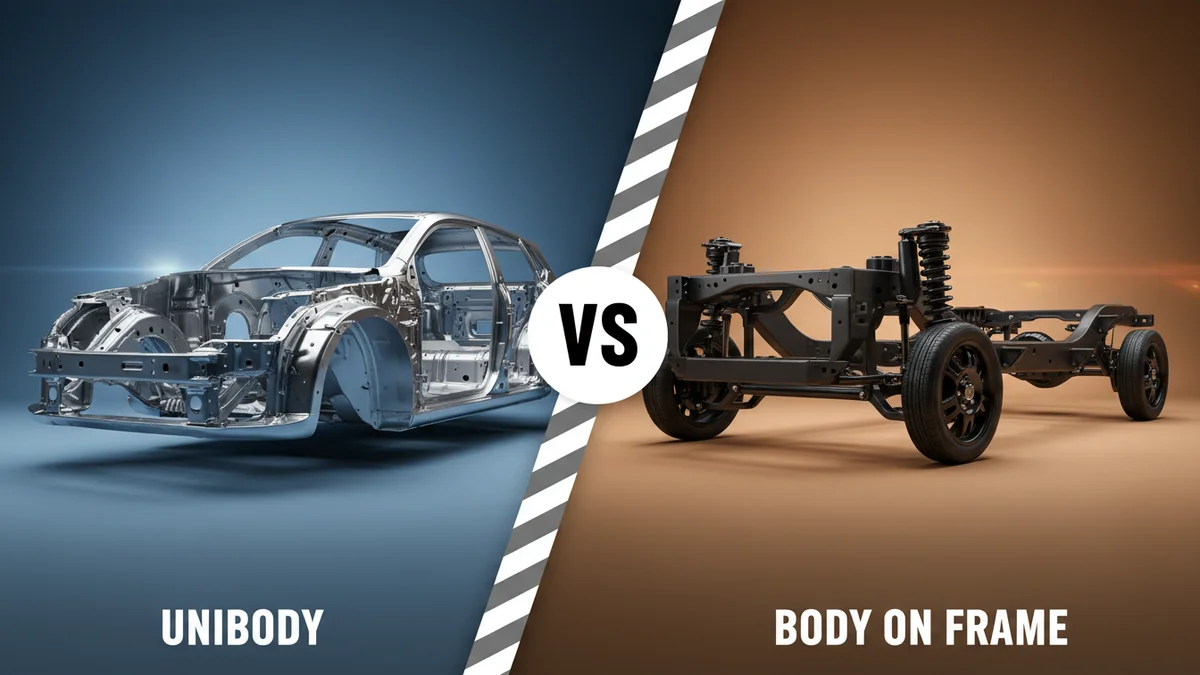
Quick Verdict: The choice between Unibody and Body on Frame hinges entirely on application. Unibody excels for passenger comfort, fuel efficiency, and everyday driving dynamics, dominating the car and CUV market. Body on Frame remains the undisputed champion for extreme durability, heavy towing, and serious off-road prowess, perfect for trucks and large SUVs. Neither is universally 'better'.

Prime for Young Adults — 6 Months Free
Students and 18–24s get six months of Prime free, then half price.
Start 6 Months FreeDaily driving, passenger comfort, fuel efficiency, sporty handling, most crossovers and sedans.
Heavy towing, serious off-roading, commercial use, extreme durability, trucks and large SUVs.
- Unibody vehicles typically offer 20-30% better fuel economy due to their lighter weight and integrated design.
- Body on Frame vehicles can tow 50-80% more weight, with some exceeding capacities of 11,000 lbs.
- Unibody structures provide superior torsional rigidity, often over 30,000 Nm/degree, enhancing handling and ride quality.
- Body on Frame excels in durability for heavy impacts, making typical frame repairs potentially 30% less complex.
- Modern Unibody designs achieve widespread 5-star crash ratings, prioritizing occupant safety through advanced crumple zones.
Unibody vs Body on Frame: Head-to-Head Specs
Digging into the core specifications, we immediately uncover why these two construction types feel so distinct on the road. The integrated nature of Unibody designs inherently lends itself to a lighter, more rigid structure for its intended purpose, contrasting sharply with the separate chassis and cabin approach of Body on Frame. This fundamental difference in assembly impacts everything from vehicle weight and rigidity to manufacturing complexity and overall cost.
✓ = better value in that row. Sourced from manufacturer specifications.

Performance & Category Ratings
When we pit these two titans against each other, their differing philosophies shine through in the ratings. Unibody vehicles truly dominate the asphalt, scoring an impressive 9.0 in Performance & Handling. Their integrated chassis and body act as a single, stiff unit, allowing for precise suspension tuning, reduced body roll, and a more car-like, engaging drive. Body on Frame, with its separate components, inherently compromises some of this agility, earning a 6.5. This structural separation often leads to more flex and less immediate steering response, understandable trade-offs for its alternative strengths.
Passenger Comfort is another clear win for Unibody, clocking in at 8.8. The unitary structure absorbs road imperfections more effectively, minimizing vibrations and harshness transmitted to the cabin. Sound deadening is also simpler to integrate into a continuous body. Body on Frame vehicles, despite advancements, often struggle to isolate passengers from the frame’s movements and road noise as thoroughly, resulting in a 7.0.
However, the tables turn dramatically For raw capability. Towing & Hauling Capacity is where Body on Frame reigns supreme with a near-perfect 9.5. The robust, ladder-frame chassis provides an incredibly strong foundation for heavy loads, allowing for higher gross vehicle weight ratings and the ability to pull massive trailers. Unibody structures, while strong, simply aren’t designed to withstand the same kind of extreme torsional stress from heavy towing, managing a 6.0. Similarly, Off-Road Capability sees Body on Frame out ahead at 9.0. Its flex-prone frame and often higher ground clearance are ideal for articulation over uneven terrain, a stark contrast to Unibody’s 6.8, which, while capable in lighter scenarios, can suffer from structural fatigue or damage under severe off-road stress.
Fuel Economy / Range naturally favors the lighter, more aerodynamic Unibody, scoring 8.7. Less weight means less energy required for propulsion, a direct benefit. Body on Frame, with its heft and blockier designs, is inherently less efficient, achieving a 6.0. In Crash Safety (Occupant), Unibody also takes the lead at 8.5. Its crumple zones are designed to distribute impact forces across the entire structure, protecting occupants more effectively. Body on Frame’s separate cabin can sometimes be more vulnerable to certain impacts, leading to a 7.8 rating.
Finally, Structural Durability (Extreme Use) is a Body on Frame specialty, earning a 9.2. Its heavy-duty frame is built to withstand relentless punishment, ideal for commercial, military, or serious off-road applications. Unibody, while durable for everyday use, isn’t engineered for the same level of sustained abuse, reflected in its 7.5. And from a manufacturing perspective, Production Cost Efficiency sees Body on Frame at an 8.5. Its simpler, modular assembly process can be more cost-effective for high-volume production of rugged vehicles compared to the complex, integrated stamping and welding involved in Unibody construction, which scores 7.0.

Audible — Listen Free for 30 Days
One free credit a month and thousands of titles included.
Listen Free for 30 DaysMonocoque Chassis
Ladder Frame
By the Numbers
The figures laid out before us tell a compelling story, painting a clear picture of inherent strengths and strategic trade-offs. What becomes immediately apparent is the inverse relationship between on-road refinement and heavy-duty capability; where one excels, the other typically concedes. These numbers aren’t just arbitrary scores; they represent decades of engineering evolution, optimized for specific user needs and driving environments.
Monocoque Chassis
Ladder Frame
Hover any bar for exact values. Each metric scaled independently.

Unibody: Strengths and Weaknesses
Unibody construction has become the default for a reason in cars, crossovers, and even a growing number of smaller trucks. Its primary strength lies in its inherent rigidity and lighter weight, directly translating to superior Performance & Handling (9.0). We’re talking about a vehicle that feels nimble, responsive, and connected to the road. This integrated design also contributes significantly to Passenger Comfort (8.8), effectively dampening road vibrations and noise for a smoother, more refined ride that passengers genuinely appreciate. It’s no surprise that families on long road trips prefer the serene cabin experience.
Furthermore, the reduced weight and often more aerodynamic design of Unibody vehicles deliver excellent Fuel Economy / Range (8.7), a critical factor for daily commuters and environmentally conscious buyers. From a safety perspective, the engineered crumple zones within a Unibody structure are remarkably effective at dissipating impact forces, earning it an 8.5 in Crash Safety (Occupant) – a vital consideration for anyone transporting loved ones.
However, where Unibody shines in daily driving, it shows its inherent limitations in more demanding applications. Towing & Hauling Capacity is notably weaker (6.0), as the entire structure is expected to flex with the load, potentially leading to fatigue or damage under heavy stress. Similarly, while modern Unibody crossovers can handle light trails, their Off-Road Capability is limited (6.8) when compared to dedicated off-roaders. Serious articulation or sustained abuse can overstress the structure. Structural Durability (Extreme Use) also takes a hit (7.5); while perfectly robust for typical use, a Unibody chassis isn’t designed for the relentless pounding of construction sites or severe recreational off-roading.
Body on Frame: Strengths and Weaknesses
Body on Frame vehicles are the undisputed workhorses of the automotive world, built for uncompromised strength and durability. Their standout feature is their phenomenal Towing & Hauling Capacity (9.5). The robust, ladder-frame chassis provides a rock-solid foundation, capable of pulling immense weights without structural fatigue, making them essential for tradespeople, ranchers, and anyone with heavy trailers. This sheer structural integrity also means exceptional Structural Durability (Extreme Use), scoring a 9.2. These vehicles are designed to endure relentless punishment, from rocky trails to job site abuse, shrugging off impacts that would bend or crack a Unibody.
Their Off-Road Capability (9.0) is equally legendary. The separate body and frame allow for significant chassis flex, providing excellent wheel articulation over uneven terrain. Plus, the frame often serves as a protective barrier for crucial components, making them more resilient in rugged environments. Interestingly, from a manufacturing standpoint, Production Cost Efficiency often favors Body on Frame designs (8.5). The simpler, modular construction can be more straightforward to assemble, offering cost advantages for manufacturers and potentially lower repair costs for owners, as individual components can be replaced rather than extensive bodywork.
Despite these immense strengths, Body on Frame construction comes with noticeable drawbacks. Its primary compromises appear in on-road driving dynamics. Performance & Handling suffers significantly (6.5); the separate frame and body mean more body roll, a less precise feel, and a generally heavier, less agile driving experience. Passenger Comfort (7.0) also takes a hit. The frame-mounted suspension means more road vibrations and noise can be transmitted to the cabin, leading to a less refined ride compared to a Unibody.
Audible Premium Plus — Annual Membership
12 audiobook credits up front, plus the full Audible catalogue.
See Annual PlansFurthermore, the added weight and less aerodynamic profile inherent to Body on Frame vehicles mean poorer Fuel Economy / Range (6.0). You’ll be visiting the gas station more frequently. While significant strides have been made, Crash Safety (Occupant) typically scores lower (7.8) than Unibody designs. The frame can sometimes transmit impact forces differently, and the passenger cell isn’t as inherently integrated into a holistic crumple zone strategy.
- ✅ Superior handling, precise steering, and smooth ride comfort.
- ✅ Enhanced fuel efficiency due to lighter weight and aerodynamic integration.
- ✅ Integrated crumple zones provide advanced occupant safety in collisions.
- ✅ Lower cabin noise and vibration levels (NVH) for a refined experience.
- ✅ More efficient use of interior space for a given exterior footprint.
- ❌ Limited towing and hauling capacity compared to Body on Frame vehicles.
- ❌ More complex and expensive repairs for significant structural damage.
- ❌ Less suitable for extreme off-roading due to less flexibility and ground clearance.
- ❌ Higher initial tooling and design costs due to integrated structure.
- ✅ Exceptional towing and hauling capabilities for heavy loads.
- ✅ Greater durability and resilience against harsh impacts and abuse.
- ✅ Simpler, often less costly, repairs for specific frame damage.
- ✅ Better articulation and robustness for serious off-road adventures.
- ✅ Easier for manufacturers to adapt for various body styles and purposes.
- ❌ Heavier weight negatively impacts fuel efficiency and emissions.
- ❌ Rougher ride quality and increased cabin noise/vibration (NVH).
- ❌ Less precise handling and stability, often with a higher center of gravity.
- ❌ Occupant safety can be less optimized in certain impact types compared to integrated Unibody designs.
Which One Should You Choose?
Deciding between Unibody and Body on Frame isn’t about finding a universally “better” option; it’s about aligning the vehicle’s architecture with your specific needs and priorities. For the daily commuter or family hauling groceries and kids, a Unibody vehicle is almost always the superior choice. You’ll appreciate the smooth ride, responsive handling, and excellent fuel economy that makes city driving and highway cruises genuinely pleasant. If passenger comfort, nimble maneuverability, and lower running costs are at the top of your list, you’re looking squarely at a Unibody SUV or crossover. It’s the ideal platform for most conventional family and recreational use.
Conversely, if your life involves serious work, extreme adventures, or regularly towing substantial loads, a Body on Frame vehicle becomes indispensable. Think about the professional tradesperson needing to haul heavy tools and materials to a job site, or the dedicated off-roader tackling challenging trails. Body on Frame trucks and large SUVs are built to withstand abuse, absorb punishment, and provide the immense towing capacity that Unibody vehicles simply cannot match. If you prioritize raw capability, uncompromising durability, and the ability to go where paved roads fear to tread, the robust nature of Body on Frame is your clear winner.
Consider your budget too. While initial purchase prices can vary wildly, the inherent Production Cost Efficiency of Body on Frame can sometimes mean more rugged capability for a similar outlay, though fuel costs will be higher. For those who need a versatile, comfortable daily driver with occasional light hauling, the Unibody’s balanced attributes make it a smart investment. But if you’re a power user who demands the absolute maximum in strength, towing, or off-road prowess, compromise isn’t an option, and Body on Frame is the only answer.
Daily driving, passenger comfort, fuel efficiency, sporty handling, most crossovers and sedans.
Heavy towing, serious off-roading, commercial use, extreme durability, trucks and large SUVs.
Final Verdict
In the enduring debate of Unibody versus Body on Frame, there’s no single champion, only different tools for different jobs. Our comprehensive analysis confirms that the winner is unequivocally a tie. Each construction type excels in its designed purpose, reflecting a fundamental trade-off in automotive engineering. Unibody vehicles, with their integrated design, offer a superior experience for everyday driving, prioritizing passenger comfort, responsive handling, and impressive fuel efficiency. They dominate the passenger car and crossover market for a very good reason.
However, when the going gets tough, the tough get Body on Frame. For those who demand maximum towing capacity, relentless off-road capability, and unwavering structural durability for extreme use, the traditional ladder-frame chassis remains the undisputed king. Trucks, large SUVs, and commercial vehicles will continue to rely on this robust architecture. The key takeaway is simple: neither is inherently “better”; the optimal choice hinges entirely on your specific application and the demands you place on your vehicle.
Frequently Asked Questions
Is Unibody better than Body on Frame?
Neither is inherently 'better'; it depends on use. Unibody offers superior comfort, handling, and fuel economy (often 20-30% better MPG) for daily driving. Body on Frame excels for heavy-duty tasks like towing up to 11,000 lbs and serious off-roading, prioritizing rugged durability over refinement.
Which structure is more reliable or durable in the long term?
For resisting heavy impacts and constant stress from towing or off-roading, Body on Frame vehicles are generally more durable. Their separate, robust frame can withstand abuse better. Unibody designs, while durable for everyday use, may suffer more significant, costly damage from comparable extreme impacts.
What are the biggest differences in crash safety?
Unibody vehicles often have superior occupant protection due to integrated crumple zones designed to absorb and dissipate crash energy away from the cabin. Body on Frame vehicles rely on the robust frame to absorb impacts, which provides significant strength, but passenger cell integration may not be as optimized as modern Unibody designs.
Which costs more to produce or repair?
Body on Frame structures can be simpler and cheaper to produce in terms of their basic frame. For repairs, minor body damage on a Unibody is often easier, but major structural damage is significantly more expensive. Specific frame damage on Body on Frame vehicles can sometimes be repaired or replaced more cost-effectively than a total Unibody reconstruction.
What type of vehicles typically use each design today?
In 2026, nearly all passenger cars, crossovers, and smaller to mid-size SUVs (representing over 90% of the market) use Unibody construction. Body on Frame is reserved for full-size pickup trucks, large traditional SUVs (like the Ford Expedition or Toyota 4Runner), and commercial vehicles, where robustness is paramount.




![Is a ProCharger a Supercharger? Key Differences Explained [2026]](https://truckguider.com/wp-content/uploads/2026/03/is-a-procharger-a-supercharger-featured.webp)