Truck Engine Replacement Parts SD Info: Blocks, Studs & Fuel

Rebuilding or repairing a Super Duty truck engine demands exact component matching. Sourcing replacement parts for SD platforms requires navigating strict production splits, engine generation updates, and critical hardware differences that standard catalogs often overlook.
Whether you are swapping a worn assembly or replacing stressed fuel and valvetrain components, minor mid-year manufacturing changes dictate fitment. The following technical specifications, assembly comparisons, and sourcing protocols provide the exact data needed to order correct parts and execute a lasting overhaul.

Prime for Young Adults — 6 Months Free
Students and 18–24s get six months of Prime free, then half price.
Start 6 Months Free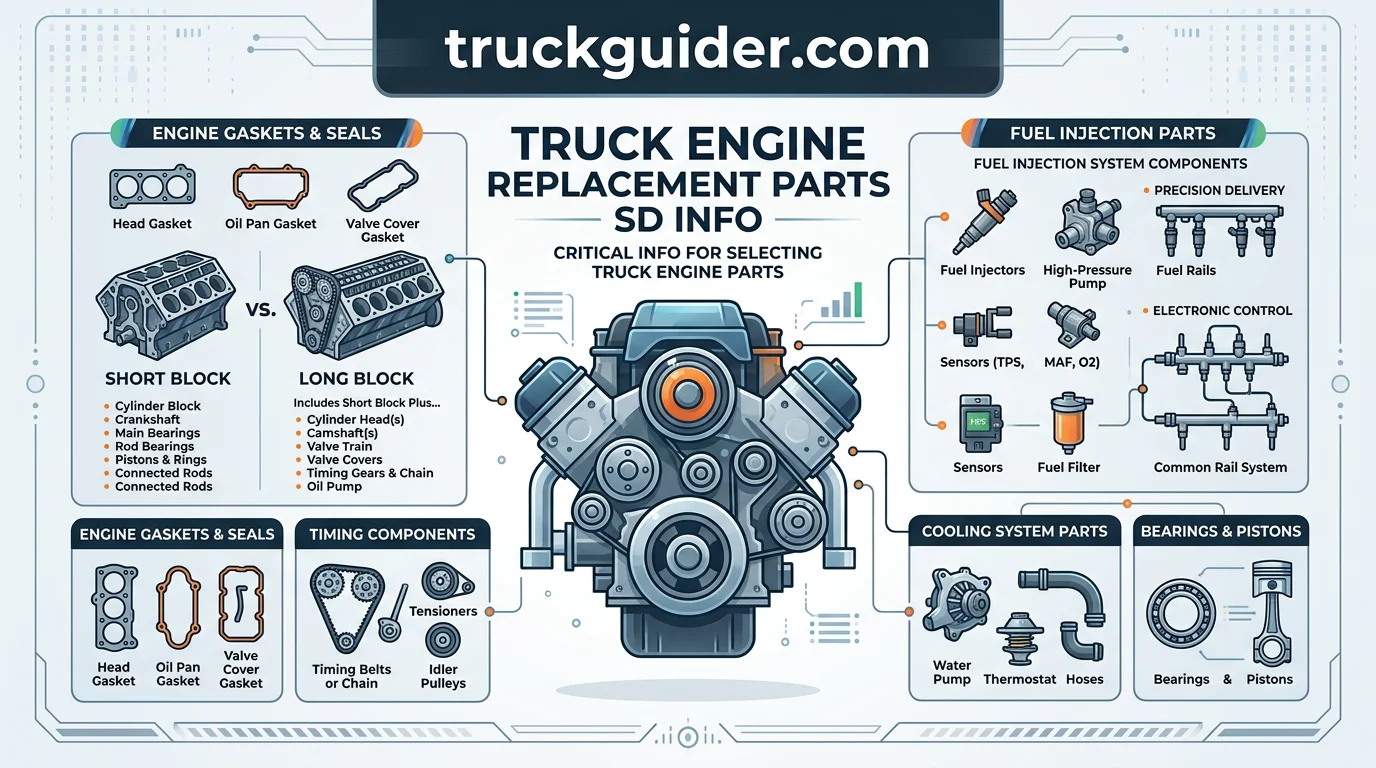
Truck Engine Replacement Parts SD Info: Core Powertrain Overview
Recommended Best Deal Products


Ford Super Duty platforms (F-250 through F-550) rely on severe-duty powertrains built to withstand high sustained loads. The V8 layout serves as standard configuration for heavy-duty pickup platforms, engineered to endure heavy payload hauling and commercial fleet duty cycles that accelerate thermal fatigue and mechanical wear.

Power Stroke Diesel Engine Series Architecture
Power Stroke diesel engine platforms have evolved significantly across generations to balance strict emissions regulations with high output demands. Modern iterations rely on compacted graphite iron or dense cast-iron blocks, designed specifically to maintain structural rigidity against severe in-cylinder combustion pressures during demanding commercial operations.

These high-torque duty cycles place substantial stress across the rotating assembly, crankshaft main journals, and valvetrain. Consequently, diesel replacement assemblies must match rigid structural standards to handle sustained thermal cycling and elevated boost levels without risking cylinder wall distortion or bearing failure.
Displacement Variants Across Super Duty Generations
Engine displacement spans 6.0 to 7.3 liters depending on production generation and fuel type. The primary diesel lineage covers the legacy 6.0L, the twin-turbocharged 6.4L, and the current 6.7L Power Stroke platforms, while the modern gasoline lineup includes the 6.8L and 7.3L pushrod V8 engines.
Component selection and physical packaging differ substantially across these architectures. For example, comparing a 6.7L Power Stroke diesel platform to a 7.3L Godzilla gas V8 engine replacement footprint illustrates completely different engineering layouts: the diesel integrates reverse-flow cylinder heads with an inboard turbocharger, while the 7.3L gas block utilizes a simplified cam-in-block design.
Sourcing SD Truck Engine Replacement Parts: VIN and Build Date Info
Decoding the 8th VIN Digit for Powertrain Fitment
The 8th character of the Vehicle Identification Number (VIN) designates the factory engine code and is mandatory for accurate fitment. This specific character defines the original engine family, displacement, induction type, and emissions calibration, eliminating guesswork between heavy-duty platforms that share identical exterior sheet metal and chassis configurations.
Always cross-reference this VIN digit with physical engine tags to verify original equipment. Look for manufacturer barcode labels on the exterior valve covers or locate the stamped serial pad on the rear side of the cylinder block, which proves whether a past owner installed an earlier or later revision.
Vehicle registration year often diverges from true engine manufacturing dates. A truck titled in 2005 may contain an engine assembled in late 2004. Sourcing replacement parts based strictly on registration documents often results in receiving obsolete or physically incompatible components.

Audible — Listen Free for 30 Days
One free credit a month and thousands of titles included.
Listen Free for 30 DaysWhy Mid-Generation Engine Build Dates Dictate Component Choice
Mid-generation updates frequently change internal part designs, making production build date critical alongside model year. Factory revisions regularly alter hydraulic routes, sensor locations, and gasket profiles mid-cycle, creating early- and late-production variations within a single year that cannot share internal components without extensive modifications.
A clear example is the mid-2004 6.0L Power Stroke redesign changing high-pressure oil pump (HPOP) and water pump impeller designs. Early-2004 engines require a 90mm water pump and cast-iron swash-plate HPOP, whereas late-2004 iterations switch to a 100mm pump assembly and redesigned branch tube connectors.
Long Block vs Short Block Replacement Assemblies: Essential Facts
Recommended Best Deal Products


Short Block Scope and Rotating Assembly Specs
A short block includes only the crankcase and rotating assembly. This foundational package contains the machined engine block casting, balanced crankshaft, main bearings, connecting rods, wrist pins, and fitted piston assemblies with pre-gapped rings.
Opting for a short block requires transferring all auxiliary and top-end hardware. Technicians must clean, inspect, and reinstall the camshaft, valvetrain, timing components, and cylinder heads, verifying deck flatness and bearing clearances manually during assembly.
Long Block Value: Assembled Valvetrain and Factory Tolerances
A long block adds remanufactured cylinder heads, camshafts, and valvetrain hardware directly to the balanced rotating foundation. These timed sub-assemblies arrive with pre-set valve lash, torqued fasteners, and synchronized camshaft-to-crankshaft timing gears.
Choosing between configurations requires calculating labor savings of a pre-assembled long block against machine shop costs to resurface salvaged heads. Sublet cleaning, crack testing, line boring, and deck resurfacing for pre-run cylinder heads frequently add $700 to $1,400 in direct supplier expenses.
Factoring in an extra 10 to 16 bench hours to assemble a short block on an engine stand often erases the initial purchase delta, making long blocks a faster, lower-risk solution for high-mileage fleet trucks.
How to Interpret Assembly Specifications and Scope
This comparison outlines standard baseline inclusions across commercially remanufactured heavy-duty gas and diesel engine lines. “Included” denotes components that arrive pre-installed, measured, and torqued to factory specifications under controlled remanufacturing clean-room conditions.
Audible Premium Plus — Annual Membership
12 audiobook credits up front, plus the full Audible catalogue.
See Annual Plans“Not Included” identifies systems that require transferring from the existing core or purchasing separately as new replacement parts. All transferred components must be hot-tanked, non-destructively crack tested, and precision-measured prior to reinstallation.
The “Typical Bench Assembly Required” row measures professional shop hours strictly dedicated to engine stand dressing before bay installation begins. Labor varies significantly by platform architecture; overhead camshaft (OHC) diesel designs demand more setup hours than conventional pushrod configurations. Verify for exact configuration parameters and manufacturer build sheets before selecting an assembly level.
Critical Fuel System SD Truck Engine Replacement Parts and Info
High-Pressure Fuel Pump (HPFP) Failure Modes
Catastrophic high-pressure fuel pump failure contaminates the entire fuel delivery circuit, requiring complete system flushing or replacement. As the primary mechanical drive of modern diesel injection, any internal component breakdown upstream instantly distributes debris across the entire high-pressure circuit.
A prime example is CP4 pump roller failure shedding micro-metal particulates throughout the entire fuel rail and injector network. When the pump roller lifter loses lubrication or turns against the camshaft lobe, it shaves metallic glitter directly into the pressurized fuel supply.
Because these abrasive micro-particles lodge inside non-serviceable passages, technicians must follow the mandate to replace rails, injectors, and lines after catastrophic pump breakdown. Attempting to flush contaminated fuel rails or transfer lines risks recirculating leftover metal, destroying replacement pumps and injectors within minutes.
Common Rail Injector Tolerance and Fuel Delivery Pressures
Modern diesel engines rely on extreme hydraulic forces to atomize fuel cleanly. Fuel delivery pressures operate between 20,000 and 36,000 psi depending on common-rail generation. Managing common-rail pump operating pressures reaching up to 36,000 psi demands flawless line fittings and structurally reinforced distribution manifolds.
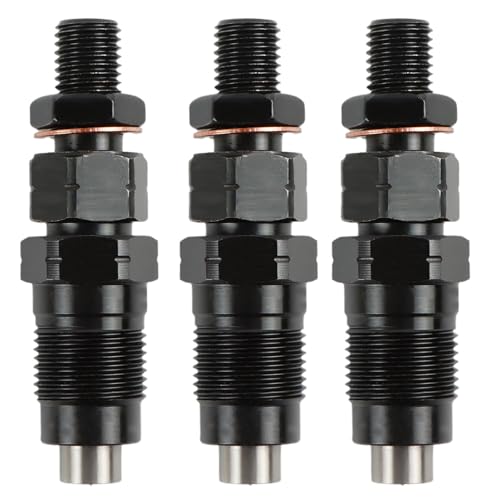
Direct injectors operate with internal moving clearances tighter than two microns. At these intense velocities, direct injector precision requirements and calibration coding are vital. Microscopic wear or orifice erosion skews fuel delivery curves, causing uneven cylinder pressures and elevated exhaust gas temperatures.
Consequently, replacement common rail injectors feature factory-assigned alphanumeric calibration codes etched on their bodies. Technicians must program these individual compensation values into the engine control module (ECM) during installation, ensuring matched fuel trim adjustments across all cylinders.
Valvetrain and Cylinder Head Fasteners: TTY Bolts vs Head Studs
Recommended Best Deal Products


The Mechanics of Torque-to-Yield (TTY) Fastener Yield Points
Torque-to-yield (TTY) cylinder head bolts operate by stretching through elastic deformation into their plastic yield phase during installation. This engineered yield point allows OEM assembly lines to achieve uniform clamping force across the deck without relying on friction-sensitive torque measurements.
Because Torque-to-yield (TTY) cylinder head bolts permanently stretch during factory installation and cannot be safely reused, discarding them during any head removal is mandatory. A reused stretch bolt cannot maintain proper clamping tension, which leads to gasket relaxation, coolant intrusion, and premature cylinder head warping.
Aftermarket High-Tensile Studs for Head Gasket Durability
In high-load work trucks and tuned diesel platforms, stock fasteners often fail to control peak combustion forces. A widespread example is head gasket failure on a 6.0L Power Stroke due to factory TTY bolt stretch under high cylinder pressures, where extreme cylinder pressure overcomes OEM bolt tension and allows combustion gases to breach the fire ring.
High-tensile aftermarket head studs eliminate this failure mode by operating strictly within their elastic range. Studs provide higher clamping force and can be reused during rebuilds, utilizing premium alloy steel rated above 220,000 psi tensile strength to maintain gasket seal integrity under severe towing and tuning loads.
Furthermore, studs thread into the engine block hand-tight, meaning rotational torque is applied solely to the fine-pitch nut on top. This configuration eliminates the twisting torsional stress common to standard bolts, ensuring that tightening energy converts directly into downward, uniform clamping load across the entire fire ring.
Cooling and Oil System Component Guide to Prevent Repeat Failures
Replacing a heavy-duty engine assembly requires overhauling its supporting thermal exchange systems. Reusing compromised heat exchangers or worn coolant circulation hardware introduces trapped debris and thermal stress directly into the fresh block.
Diagnosing Oil Cooler Delta and Preventing Contamination
The engine oil cooler regulates engine oil temperature via heat exchange with engine coolant. When coolant passages narrow from silicate drop-out or sludge, heat transfer efficiency collapses, degrading the lubricant’s protective film.
Technicians monitor this restriction by measuring operating temperatures on fully warmed road tests. A temperature split exceeding 15°F between Engine Oil Temperature (EOT) and Engine Coolant Temperature (ECT) signaling oil cooler clogging confirms severe flow restriction.
Failing to flush or replace the oil cooler following internal mechanical failure circulates metal debris into the new engine assembly. Microscopic bearing shrapnel embeds permanently in the cooler matrix, quickly contaminating new rod and main bearings upon initial startup.
EGR Cooler Integrity and Water Pump Flow Capacity
Extreme thermal expansion and restricted coolant supply frequently cause internal EGR cooler cracking. These fractures allow pressurized coolant to leak directly into the intake tract and combustion chambers, causing white exhaust smoke and cylinder wash.
Combusted glycol mixtures coat downstream exhaust sensors and trigger rapid DPF soot accumulation. This contamination prematurely loads the particulate filter substrate, driving continuous active regenerations and escalating exhaust backpressure against the replacement engine.
Water pump performance standards must be verified to ensure full volumetric flow through both coolers. Inspect replacement or reused pumps for impeller cavitation, eroded vane fins, and bearing runout to eliminate localized hotspots across cylinder head passages.
Navigating Core Charge Policies and Remanufactured Parts Details
High-value replacement components like long blocks, high-pressure fuel pumps, and turbochargers carry steep core deposits to ensure inventory continuity. Remanufactured high-value parts mandate the return of an intact, equivalent core to recoup deposit charges, which sustains the manufacturer’s precision rebuilding supply chain.
Core Return Inspection Standards and Common Deductions
Securing a 100% core refund requires meeting strict mechanical standards. Remanufactured long blocks require crack-free castings and rotated assemblies that turn 360 degrees freely by hand. Returned cores must be complete, drained of all engine fluids, and returned in the original delivery crate.
Physical flaws lead to immediate financial deductions or outright rejections. For example, a buyer risks having a $1,000 core deposit forfeited because of a cracked engine block or broken turbo exhaust housing ear. Fuel pumps face full forfeiture if internal scoring, stripped fittings, or bio-fuel rust contamination are detected.
Warranty Coverage: Motorcraft OEM vs Remanufactured Units
Coverage structure depends on the builder’s tier. A replacement warranty ranges from 1 to 3 years depending on OEM vs remanufactured source. Motorcraft OEM factory remanufactured assemblies typically deliver a 3-year, unlimited-mileage warranty that pays for parts and approved labor rates across nationwide dealership service centers.
Independent aftermarket remanufacturers usually limit protection to 1-year or 2-year coverage with strict mileage ceilings. These aftermarket warranties rarely cover installation labor, require lengthy third-party failure evaluations, and frequently deny coverage if pre-lube guidelines or oil change records are missing.
Avoiding Costly Truck Engine Replacement Parts SD Info Pitfalls
Mandatory Single-Use Hardware and Seals
Rebuilding or dressing an engine requires strict hardware replacement protocols. Reusing TTY head bolts or single-use high-pressure fuel jumper tubes leads to gasket blowout or catastrophic fuel leaks. High-pressure fuel lines deform permanently upon initial torque to seal reliably; retorquing an old line invites dangerous 30,000 PSI fuel spray.
Always replace injector copper crush washers, combustion O-rings, and oil rail seals during assembly. Reusing flattened copper washers permits combustion blowby into injector bores, eroding cylinder head seats, overheating injector bodies, and contaminating return fuel circuits.
Pre-Lubrication and Contamination Control for VGT Turbos
Variable Geometry Turbochargers (VGT) require meticulous pre-assembly priming alongside brand-new oil supply tubes. Turbocharger dry-start bearing destruction caused by failing to pre-lube the center cartridge oil port will destroy a replacement unit within seconds. Pre-fill the center housing with clean oil and manually rotate the compressor wheel prior to line connection.
Always discard coked or restricted factory turbo feed pipes. Internal carbon buildup starves new bearings under boost, even if the exterior line appears intact.
Overlooking oil and fuel contamination during installation damages high-tolerance common-rail parts. Enforce strict fluid flush protocols on the charge-air cooler, lines, and reservoirs to eliminate residual metallic debris before cranking a new long block.
Key Takeaways
-
✓
Check the VIN 8th digit and engine build date to distinguish mid-year emission and fuel system revisions. -
✓
Select long block assemblies over short blocks if cylinder heads or valvetrain hardware show heat fatigue. -
✓
Replace torque-to-yield (TTY) cylinder head bolts with high-tensile ARP head studs to eliminate gasket blowout risks. -
✓
Install a new oil cooler and flush high-pressure fuel rails whenever replacing a failed long block assembly. -
✓
Review remanufactured core return policies to avoid deductions for cracked castings or missing external brackets.
❓ Frequently Asked Questions
1
What is the main difference between short block and long block truck engine replacement parts?
A short block contains only the engine block, crankshaft, connecting rods, and pistons. A long block adds cylinder heads, camshafts, and valvetrain assemblies. Choosing a long block reduces installation labor, guarantees factory timing alignment, and ensures all internal components share identical wear baselines.
2
How does the engine build date affect sourcing SD truck engine replacement parts?
Heavy-duty truck manufacturers frequently introduce mid-year engineering revisions affecting fuel rails, EGR coolers, oil passages, and sensor connectors. Sourcing parts strictly by model year often results in mismatched components. Checking both the 10th VIN character and the valve cover build date sticker ensures correct fitment.
3
Why is replacing head bolts with head studs recommended during SD engine rebuilds?
Factory torque-to-yield (TTY) head bolts stretch during installation to maintain clamp load, but high boost and cylinder pressures can lift the heads. High-tensile aftermarket head studs provide superior tensile strength, do not stretch beyond yield, and significantly decrease the risk of blown head gaskets.
4
What are the benefits of replacing the oil cooler during an engine swap?
Residual metal shavings and bearing debris from an engine failure often settle inside oil cooler micro-channels. Standard flushing cannot reliably remove these contaminants. Installing a new oil cooler guarantees clean lubrication flow to the replacement engine, preventing catastrophic bearing damage within the first few hundred miles.
5
How can I avoid unexpected deductions on remanufactured engine core returns?
Ensure the old engine matches the replacement configuration, contains all required brackets, and is completely drained of oil and coolant. Core charge policies deduct credit for cracked outer blocks, damaged crank snouts, or missing manifolds. Use the vendor’s designated shipping crate to avoid transit damage disputes.
6
How do I determine the exact engine build date on a Super Duty to order correct parts?
Locate the primary engine identification decal on the driver-side valve cover or stamped into the engine block casting above the oil filter, which records the exact day, month, and year of assembly independent of vehicle chassis manufacture.
![Ram 1500 Single Cab Short Bed Performance, Specifications, [2026]](https://truckguider.com/wp-content/uploads/2026/03/featured-7450283a.webp)