Toyota Tacoma Payload Capacity Chart by Year 1995 to 2026

Toyota Tacoma payload capacity varies widely by model year and configuration. Across the 1995 to 2026 lineup, published maximum payload ratings range from roughly 1,400 pounds to more than 2,000 pounds on certain older configurations.
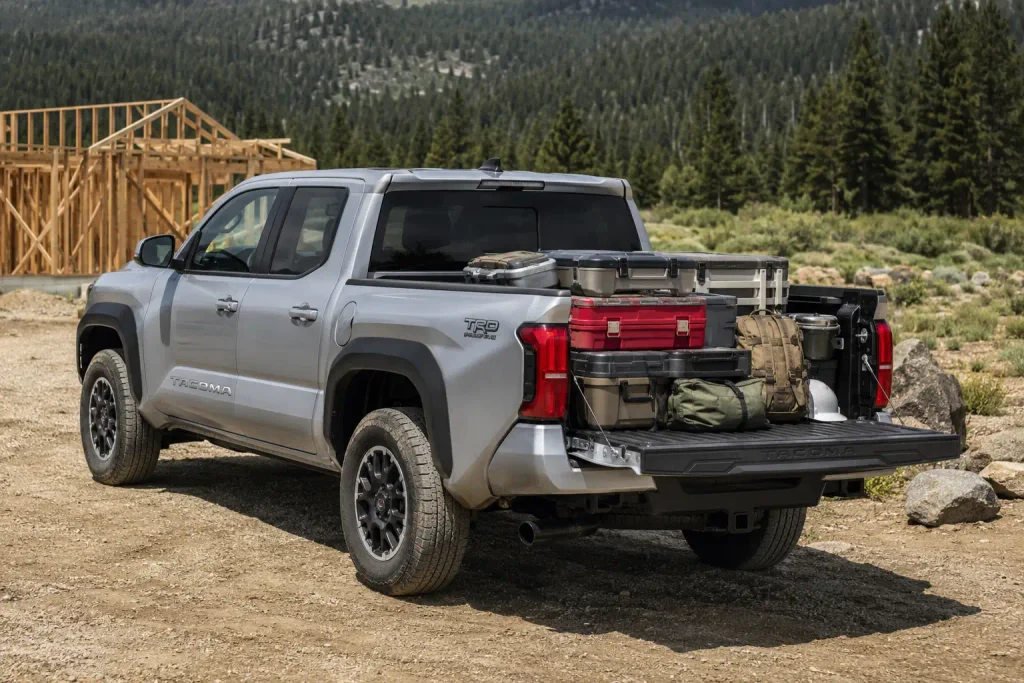
The current 2026 Tacoma carries up to 1,705 pounds, while Toyota’s 2024 redesign briefly pushed the published maximum to about 1,709 pounds.

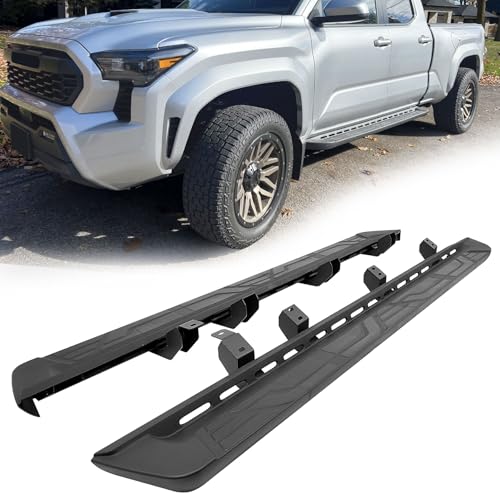

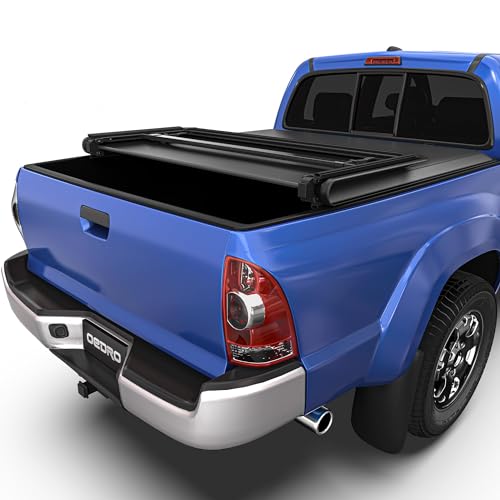
Those maximums do not apply to every Tacoma. Cab style, 2WD or 4WD, engine, transmission, trim, bed length, factory equipment, passengers, and accessories all change how much weight an individual truck can carry. If you are comparing bed lengths, our Tacoma bed dimensions guide lists the 5-foot and 6-foot dimensions by generation.
Toyota Tacoma Maximum Payload by Year
Published model-year maximums from 1995–2026. Longer bars indicate higher maximum payload capacity.
- 19951,800 lb
- 19961,815 lb
- 19971,914 lb
- 19981,889 lb
- 19991,929 lb
- 20002,069 lb
- 20012,069 lb
- 20022,065 lb
- 20032,005 lb
- 20042,005 lb
- 20051,785 lb
- 20061,685 lb
- 20071,685 lb
- 20081,620 lb
- 20091,570 lb
- 20101,620 lb
- 20111,510 lb
- 20121,400 lb
- 20131,535 lb
- 20141,440 lb
- 20151,550 lb
- 20161,620 lb
- 20171,620 lb
- 20181,620 lb
- 20191,620 lb
- 20201,620 lb
- 20211,685 lb
- 20221,685 lb
- 20231,685 lb
- 20241,709 lb
- 20251,705 lb
- 20261,705 lb
Important: These values are the highest published payload figures for each model year. Your exact Tacoma may have a lower rating based on cab, drivetrain, engine, trim, options, and installed equipment. Always check the Tire and Loading Information label on the driver’s door jamb.
Toyota Tacoma Payload Capacity Chart for 32 Model Years
The Toyota Tacoma payload capacity chart below lists the highest documented payload rating found for each model year. Treat these figures as model-year reference maximums, not the rating of every Tacoma built that year.
| Model Year | Generation | Maximum Payload |
|---|---|---|
| 2026 | 4th Gen | 1,705 lbs |
| 2025 | 4th Gen | 1,705 lbs |
| 2024 | 4th Gen | 1,709 lbs |
| 2023 | 3rd Gen | 1,685 lbs |
| 2022 | 3rd Gen | 1,685 lbs |
| 2021 | 3rd Gen | 1,685 lbs |
| 2020 | 3rd Gen | 1,620 lbs |
| 2019 | 3rd Gen | 1,620 lbs |
| 2018 | 3rd Gen | 1,620 lbs |
| 2017 | 3rd Gen | 1,620 lbs |
| 2016 | 3rd Gen | 1,620 lbs |
| 2015 | 2nd Gen | 1,550 lbs |
| 2014 | 2nd Gen | 1,440 lbs |
| 2013 | 2nd Gen | 1,535 lbs |
| 2012 | 2nd Gen | 1,400 lbs |
| 2011 | 2nd Gen | 1,510 lbs |
| 2010 | 2nd Gen | 1,620 lbs |
| 2009 | 2nd Gen | 1,570 lbs |
| 2008 | 2nd Gen | 1,620 lbs |
| 2007 | 2nd Gen | 1,685 lbs |
| 2006 | 2nd Gen | 1,685 lbs |
| 2005 | 2nd Gen | 1,785 lbs |
| 2004 | 1st Gen | 2,005 lbs |
| 2003 | 1st Gen | 2,005 lbs |
| 2002 | 1st Gen | 2,065 lbs |
| 2001 | 1st Gen | 2,069 lbs |
| 2000 | 1st Gen | 2,069 lbs |
| 1999 | 1st Gen | 1,929 lbs |
| 1998 | 1st Gen | 1,889 lbs |
| 1997 | 1st Gen | 1,914 lbs |
| 1996 | 1st Gen | 1,815 lbs |
| 1995 | 1st Gen | 1,800 lbs |
Toyota’s official 2023 brochure lists up to 1,685 pounds for certain 2WD Access Cab configurations. The 2016 brochure lists a maximum of 1,620 pounds, establishing the starting point for the third-generation Tacoma.
For second-generation trucks, payload changed much more from year to year. Published configuration data shows maxima of 1,785 pounds in 2005, 1,685 in 2007, 1,620 in 2008, 1,570 in 2009, 1,620 in 2010, 1,510 in 2011, and 1,400 in 2012.
Older first-generation trucks can show surprisingly high numbers because lighter work-oriented configurations paired a relatively low curb weight with a useful Gross Vehicle Weight Rating. For example, documented 2000 and 2001 configurations reach roughly 2,069 pounds.
The number that matters for loading your own truck is still the payload shown by its factory loading information.
4 Toyota Tacoma Generations Compared for Payload
Tacoma payload changed with each redesign, but newer does not automatically mean higher payload. Added cab space, 4WD hardware, off-road equipment, hybrid components, and comfort features all add curb weight.
| Tacoma Generation | Model Years | Main Engines | Peak Payload Pattern |
|---|---|---|---|
| First Generation | 1995 to 2004 | 2.4L I4, 2.7L I4, 3.4L V6 | Up to about 2,069 lbs |
| Second Generation | 2005 to 2015 | 2.7L I4, 4.0L V6 | Up to about 1,785 lbs |
| Third Generation | 2016 to 2023 | 2.7L I4, 3.5L V6 | Up to 1,685 lbs |
| Fourth Generation | 2024 to 2026 | 2.4L i-FORCE, i-FORCE MAX | Up to about 1,709 lbs |
First Generation Tacoma
The 1995 to 2004 Tacoma was smaller and lighter than later models. Regular Cab, Xtracab, PreRunner, 2WD, and 4WD configurations created large differences in curb weight and payload.
Several work-oriented PreRunner and four-cylinder versions passed the 2,000-pound mark around 2000 to 2004. The 2002 model, for example, has documented configurations reaching about 2,065 pounds.
Second Generation Tacoma
Toyota enlarged the Tacoma for 2005. Engine choices became the 2.7L four-cylinder and 4.0L V6, while Regular Cab, Access Cab, and Double Cab configurations remained available at different points.
Payload varied considerably. A 2005 four-cylinder 4WD configuration reached 1,785 pounds, while later Double Cab and X-Runner versions could carry substantially less.
Third Generation Tacoma
The third generation arrived for 2016 with the 2.7L four-cylinder and new 3.5L V6. Toyota’s 2016 specifications list payload values from roughly 1,120 to 1,620 pounds, depending on cab, engine, transmission, and drivetrain.
By 2021 through 2023, certain lighter 2WD Access Cab configurations reached 1,685 pounds. Toyota’s 2023 specifications show that heavier Double Cab and 4WD trims can sit hundreds of pounds below that headline rating.
Fourth Generation Tacoma
Toyota redesigned the Tacoma again for 2024 around the turbocharged 2.4L i-FORCE engine family. Buyers can also get the i-FORCE MAX hybrid, which produces 326 combined horsepower and 465 lb-ft of torque.
Our Toyota Tacoma 2.4L turbo specs guide covers the fourth-generation powertrain in more detail.
Toyota initially announced a maximum payload of 1,709 pounds on TRD Off-Road for the redesigned 2024 truck. A later 2024 specification table shows individual configurations from about 1,230 to 1,705 pounds, demonstrating how equipment changes the final rating.
Toyota lists the 2025 and 2026 Tacoma at up to 1,705 pounds.
How Cab Drivetrain and Trim Change Tacoma Payload
Model year alone cannot tell you how much your Tacoma can carry. Two trucks from the same year may have noticeably different payload ratings.


Cab Configuration
A lighter Regular Cab, Xtracab, Access Cab, or XtraCab configuration often has more payload available because the truck starts with less curb weight.
Double Cab trucks add a larger cab, rear seating, doors, interior structure, and equipment. Those features consume part of the truck’s Gross Vehicle Weight Rating before cargo enters the bed.
Two Wheel Drive and Four Wheel Drive
Four-wheel-drive hardware adds weight through the transfer case, front differential, driveshafts, axles, skid plates, and related components.
Toyota’s 2023 table provides a clear example. Certain four-cylinder Access Cab trucks are rated at 1,685 pounds in 4×2 form and 1,445 pounds in 4×4 form.
That is a 240-pound difference before passengers or cargo are added.
Engine and Powertrain
More power does not automatically create more payload.
The fourth-generation i-FORCE MAX hybrid adds an electric motor, battery, and related hardware. Toyota’s 2024 specification table shows payload ratings changing substantially across standard i-FORCE and hybrid configurations.
Trim and Factory Equipment
TRD Pro, Trailhunter, Limited, and TRD Off-Road models may carry heavier suspension, skid plates, wheels, tires, seats, recovery hardware, and other equipment.
Toyota’s own specification tables show why trim should never be ignored when comparing Tacoma payload capacity.
How to Find Your Exact Tacoma Payload Rating
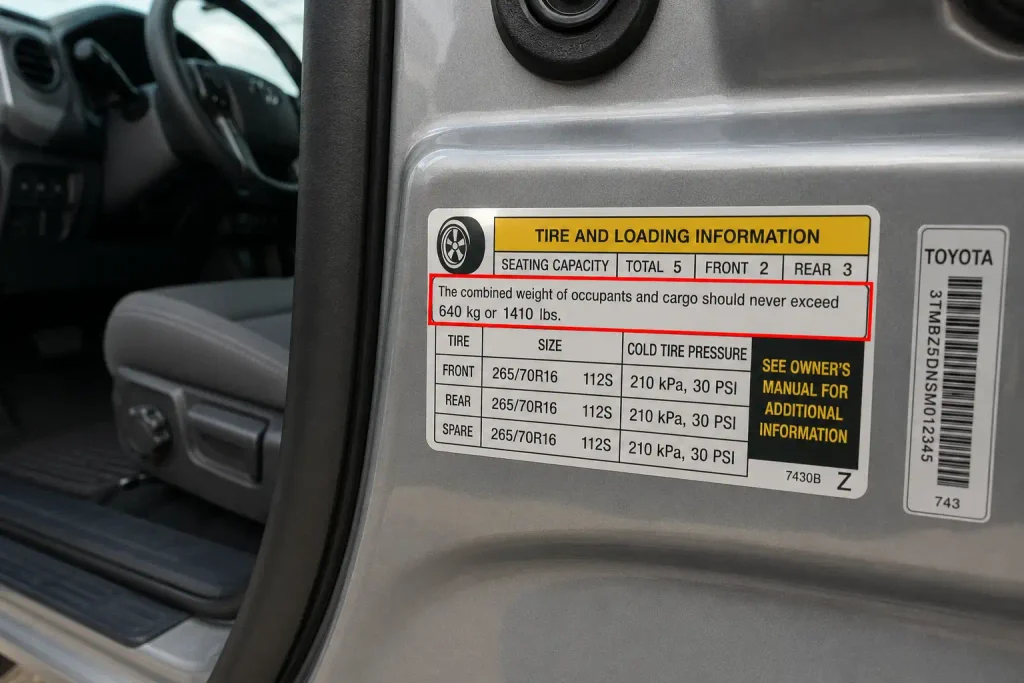
The factory loading label on your Tacoma is more useful than a generic model-year maximum.
Use these four steps before loading the truck.
- Open the driver’s door and inspect the door jamb.
- Locate the Tire and Loading Information label.
- Find the statement showing the combined allowable weight of occupants and cargo.
- Use that truck-specific value when calculating your available payload.
Do not assume a 2023 Tacoma can carry 1,685 pounds simply because that is the model-year maximum. Your Double Cab 4WD may have a much lower factory rating.
The same rule applies to trucks equipped for towing. If you are unsure about factory tow equipment, our guide on how to tell if a Tacoma has the tow package covers the hardware and documentation to check.
GVWR, or Gross Vehicle Weight Rating, is the maximum allowed loaded weight of the truck.
Curb weight is the truck’s weight before passengers and cargo, based on the configuration and equipment included in that specification.
A simplified payload calculation is:
Payload capacity = GVWR minus curb weight
The factory loading label should still be your primary reference because installed options can change the truck’s as-built weight.
How Passengers Cargo and Accessories Reduce Tacoma Payload
Payload starts disappearing before you put anything heavy in the bed.
The driver, passengers, tools, bed racks, tonneau covers, recovery gear, camping equipment, aftermarket bumpers, and other permanently installed accessories all add weight to the truck.
Consider a Tacoma with a factory payload rating of 1,400 pounds.


| Added Load | Example Weight |
|---|---|
| Driver | 190 lbs |
| Passenger | 150 lbs |
| Toolbox and tools | 180 lbs |
| Bed rack | 120 lbs |
| Camping gear | 250 lbs |
| Total added load | 890 lbs |
| Payload remaining | 510 lbs |
These are example weights for explaining the calculation, not factory Tacoma accessory specifications.
If you carry tools regularly, choosing a Toyota Tacoma toolbox is only one part of the decision. Check the toolbox’s actual shipping or installed weight and subtract it from available payload.
A 120-pound rack does not increase what the truck is rated to carry. It uses 120 pounds of the rating before you load gear onto it.
How Trailer Tongue Weight Uses Tacoma Payload
A Tacoma can reach its payload limit before reaching its advertised tow rating.
Trailer tongue weight pushes down on the hitch and becomes part of the load carried by the truck. Passengers, cargo, hitch equipment, and accessories are competing for the same available carrying capacity.
For example, assume a Tacoma has 1,300 pounds of available payload. If passengers and cargo use 700 pounds, only 600 pounds remain before accounting for the trailer’s tongue weight and hitch equipment.
This is why towing capacity and payload capacity must be checked together.
For model-year towing limits, see our Toyota Tacoma towing capacity chart by year. It covers 1995 through 2026 and explains the engine, cab, drivetrain, and tow-package variables behind the headline numbers.
Toyota lists the current Tacoma at up to 6,500 pounds of towing capacity, but the truck’s payload limit still applies while towing.
5 Common Tacoma Payload Mistakes to Avoid
1. Using the Maximum for Every Tacoma
The largest number in a brochure belongs to a specific configuration.
A 1,705-pound maximum does not mean every 2026 Tacoma has a 1,705-pound payload rating.
2. Forgetting Passenger Weight
People ride inside the truck, but their weight still counts against the load the Tacoma can carry.
Four adults can consume several hundred pounds before anything enters the bed.
3. Ignoring Aftermarket Equipment
Steel bumpers, sliders, winches, larger tires, camper shells, bed racks, skid plates, and tool storage all add weight.
Heavy off-road builds can reduce remaining payload significantly.
4. Treating Payload as Bed Capacity Only
Payload is not simply the maximum weight you can place in the pickup bed.
It covers the allowable load added to the truck, including occupants and cargo.
5. Ignoring Trailer Tongue Weight
Towing does not create a separate weight allowance.
The portion of trailer weight supported at the hitch uses the truck’s available payload, so towing and payload calculations must be considered together.
What Payload Number Should Tacoma Owners Use
Use the payload value attached to your individual Tacoma whenever that information is available.


The year-by-year Toyota Tacoma payload capacity chart is useful for comparing generations and finding the upper end of a model year’s capability. It should not replace the factory loading label when you are deciding whether a real load is within limits.
For shopping, compare the year and configuration first. For loading, use the truck-specific label, account for people and installed equipment, then subtract everything else you plan to carry.
5 Toyota Tacoma Payload Capacity Questions
What Is the Maximum Payload of a Toyota Tacoma?
The 2026 Toyota Tacoma has a maximum published payload of 1,705 pounds. Toyota lists the same maximum for 2025, while the initial 2024 launch material cited up to 1,709 pounds.
Your specific truck may have a substantially lower rating.
Which Toyota Tacoma Has the Highest Payload?
Some first-generation Tacoma configurations have the highest figures in the 1995 to 2026 dataset. Documented 2000 and 2001 work-oriented configurations reach about 2,069 pounds, exceeding later-generation headline ratings.
Those trucks are very different from modern Double Cab 4WD models, so compare configuration as well as model year.
Does Tacoma Payload Include Passengers?
Yes. Passenger weight consumes part of the Tacoma’s available carrying capacity.
Cargo, permanently installed accessories, tools, occupants, and hitch load must all be considered when checking the truck’s weight limits.
Does Towing Reduce Toyota Tacoma Payload?
Trailer tongue weight uses available truck payload because that load is carried through the hitch.
A Tacoma can therefore remain below its maximum trailer rating while running out of payload once passengers, cargo, accessories, and tongue weight are combined.
Where Do I Find My Tacoma Payload Rating?
Check the Tire and Loading Information label around the driver’s door opening.
Use the allowable occupant-and-cargo figure printed for that individual truck instead of assuming the maximum number from a Tacoma brochure applies to your configuration.