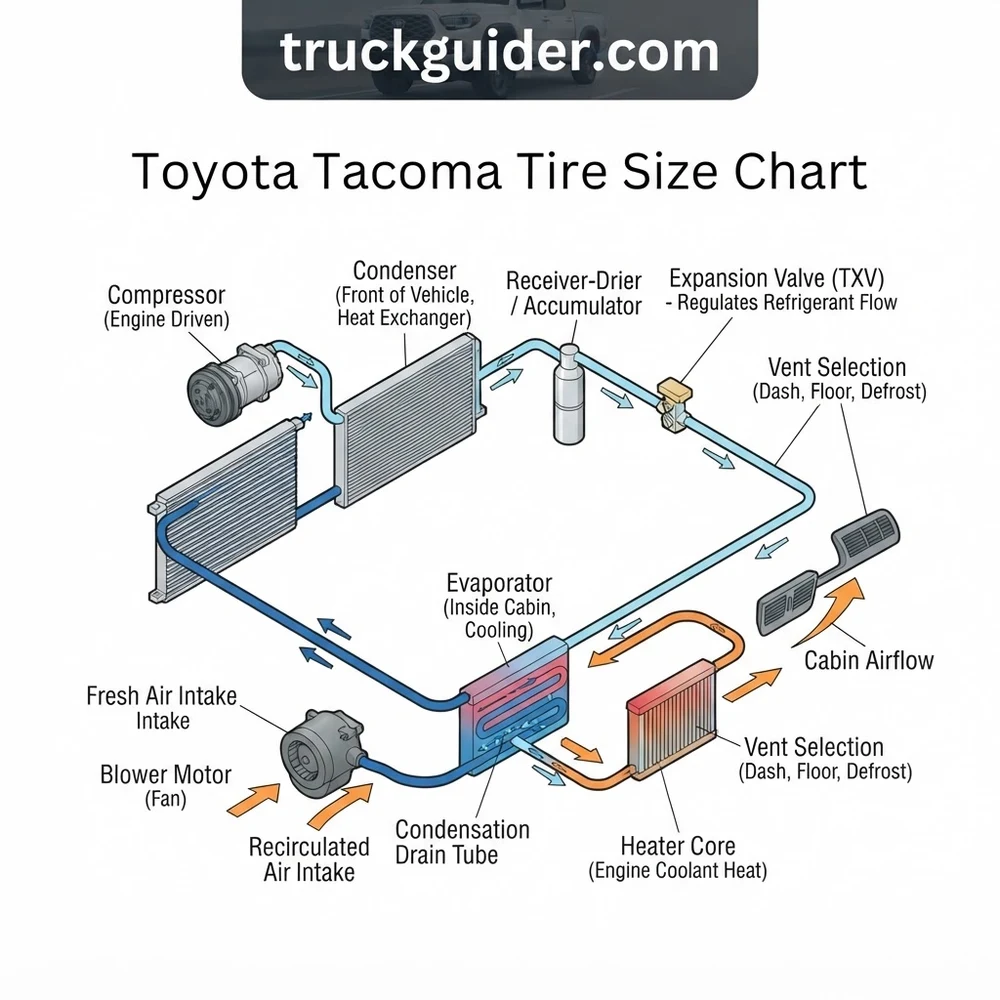
Toyota Tacoma HVAC Component Breakdown & 2026 Troubleshooting Guide

The Tacoma HVAC system regulates cabin climate via a belt-driven compressor, a front-mounted condenser, and a dash-housed evaporator. Monitor refrigerant pressure at the high (150-250 psi) and low (25-40 psi) service ports. The blower motor is located behind the glove box, accessible by removing the cabin air filter housing.
📌 Key Takeaways
- Refrigerant capacity for 2026 models is typically 18-20 oz of R-1234yf.
- Blower motor resistor failure is the most common cause of fan speed issues.
- Always evacuate refrigerant using recovery equipment before opening the loop to prevent atmospheric release.
- Compressor clutch engagement voltage must be 12V DC; check the magnetic clutch relay if the compressor remains dormant.
- Consult a certified technician if the system shows signs of internal debris or metal contamination.
Optimizing the handling, aesthetic, and off-road capability of a Toyota Tacoma begins with understanding the physical constraints imposed by the chassis and drivetrain. Selecting the correct wheel and tire package requires more than mere visual preference; it demands a deep dive into the technical interplay between suspension geometry, wheel offset, and clearance thresholds. As you modify your vehicle, maintaining the delicate balance of the onboard systems—including the HVAC assembly, where the blower motor and evaporator operate in close proximity to the firewall—remains paramount. This guide provides the technical data necessary to navigate tire fitment without compromising your truck’s reliability or mechanical integrity.



[DIAGRAM_PLACEHOLDER: A technical cross-sectional HVAC diagram showing the blower motor, evaporator housing, and condenser lines, alongside a diagram showing Tacoma wheel well clearance, body mount proximity, and suspension control arm angles.]
Toyota Tacoma Tire Size Chart and Chassis Geometry
Understanding the Toyota Tacoma tire size chart requires an appreciation for the relationship between the tire sidewall and the fixed components of the truck’s chassis. The factory wheel well is engineered for specific tire diameters and widths; exceeding these dimensions forces a mechanical conflict with the body mount, the upper control arms (UCA), and the pinch weld. When calculating fitment, one must account for the dynamic movement of the suspension. A tire that clears while stationary may strike the frame or internal heat exchanger lines during full articulation.
The following table outlines the correlation between common Tacoma tire sizes and the necessary clearance interventions required for a stable operating environment:
| Tire Metric | Fitment Class | Required Modification |
|---|---|---|
| 265/70R16 | OEM Standard | None |
| 265/75R16 | Moderate | Minor heat gun liner trim |
| 285/75R16 | Aggressive | Body Mount Chop & UCA upgrade |
| 315/70R17 | Extreme | Full gusset and firewall clearance |
Mechanical Interference and Clearance Constraints
When evaluating tires larger than 32 inches, the upper control arm often becomes the primary friction point. OEM control arms lack the clearance for wider, aggressive-tread tires at full lock. Furthermore, the HVAC components located deep within the engine bay, specifically the refrigerant lines running toward the evaporator, should be inspected if you are performing extreme fender trimming or firewall modifications. While these lines are generally protected, heavy body work near the wheel well liner can inadvertently introduce vibrations that stress the condenser or damage the return duct insulation if the liner is not properly secured post-modification. Always ensure that aftermarket tire installations do not impede the airflow pathways essential for the condenser’s cooling performance.
For all Tacoma models from 2005 to the present, ensure your tire load range matches the GVWR of your specific configuration. An E-rated tire provides higher puncture resistance but increases unsprung weight, which can lead to premature wear on steering rack bushings and ball joints.
Evaluating Toyota Tacoma Tire Fitment and Suspension Upgrades
Before committing to a specific tire size, you must calculate the backspacing requirements of your wheels. In the context of the Tacoma, the wheel offset is the deciding factor in whether your tire clears the suspension components or moves outward into the fender flare. A lower offset (e.g., 0mm or negative offset) pushes the wheel away from the hub, increasing the scrubbing radius. While this improves clearance for the control arm, it places significant stress on the wheel bearings and requires careful attention to the wheel well liner and front bumper valance.
Systematic Fitment Calibration Steps
1. Measure the current ride height from the center of the hub to the fender lip to ensure your lift kit provides the advertised clearance.
2. Verify the wheel backspacing; a 4.5-inch backspace is generally considered the “sweet spot” for 285mm wide tires on a Tacoma to avoid frame rubbing.
3. Check the speedometer error margin; moving to a larger diameter tire will result in a lower indicated speed than your actual ground speed. Use a digital calibration tool to adjust the ECU parameters accordingly.
4. Inspect the blower motor and HVAC air handler mounting points if you intend to perform extreme firewall clearance work, as the inner cabin environment can be affected by structural alterations near the blower assembly.
5. Torque all lug nuts to the OEM specification of 83 ft-lbs (113 Nm) using a calibrated torque wrench in a star pattern to prevent hub distortion.


Typical Toyota Tacoma lug nut torque is 83 ft-lbs. Always verify against your specific year’s manual, as some TRD Pro variations with different alloy wheel compositions may have specific seating requirements.
Managing Common Toyota Tacoma Tire Size Chart Complications
Running oversized tires inevitably introduces mechanical stressors. The most cited issue is “rubbing,” which typically occurs at the body mount located behind the front tires. The body mount chop (BMC) is a common solution, but it must be performed with precision to maintain the structural integrity of the frame. Improperly executed cuts can lead to localized heat buildup, which is particularly concerning when working in proximity to the refrigerant lines and the air handler intake path. If you notice a clicking sound or abnormal vibrations under the dash, inspect your wheel well liners to ensure they have not shifted and are not interfering with the secondary HVAC airflow ducts that route air to the footwells.
Addressing Component Wear and Structural Integrity
Excessive unsprung weight from large, aggressive tires accelerates the degradation of your vehicle’s cooling and electrical systems. Heavy tires increase the load on the engine, which in turn elevates operating temperatures. Ensure your condenser is free of debris to maintain maximum efficiency. If the vehicle is running hotter than standard, verify that the condenser cooling fan is cycling correctly. Furthermore, check the return ducting if you notice a reduction in cabin airflow, as significant vibrations from oversized tires can occasionally dislodge interior ducting fasteners over time.
Never cut into the frame or firewall without first identifying the location of AC refrigerant lines. A breach in the high-pressure refrigerant system will cause immediate compressor failure and poses a severe safety hazard to the technician.
The following table summarizes diagnostic checks for common mechanical symptoms linked to wheel and tire upgrades:
| Symptom | Potential Cause | Corrective Action |
|---|---|---|
| High-pitched whistling | Leaking return duct or seal | Reseal duct junctions |
| Vibrations at idle | Compressor mount stress | Check mounting bolt torque |
| Rubbing at full lock | Insufficient backspacing | Install spacers or change wheels |
| Weak HVAC airflow | Blocked blower intake | Clear debris from housing |
Toyota Tacoma Tire Size Chart Questions Answered
Does a larger tire size affect the Tacoma HVAC compressor load?
While the tire size itself does not directly connect to the AC compressor, the resulting change in gear ratios and engine load requires the cooling system to work harder. If your engine is operating at higher RPMs to compensate for large tires, your condenser and evaporator must be functioning at peak efficiency to maintain cabin comfort.



Why is the body mount chop necessary for tires above 32 inches?
The body mount is a structural component of the Tacoma frame. Tires with an outer diameter greater than 32 inches will contact the rear portion of this mount during steering, especially when the suspension is compressed. Cutting this area is required to prevent catastrophic tire damage and loss of steering control.
Can wheel offset damage the blower motor?
No, wheel offset does not physically touch the blower motor. However, aggressive offset choices can lead to excessive vibration transfer through the chassis. Over time, these vibrations can loosen the mounting hardware for internal components like the air handler and blower motor, leading to noise or mechanical failure.
What is the recommended tire pressure for off-road use?
For trail use, it is common to drop tire pressure to 18-20 PSI to increase the footprint and traction. However, this increases the risk of tire debeading. Always carry an onboard air compressor to return tires to the recommended OEM street pressure (typically 30-35 PSI) before driving at highway speeds to avoid damaging the tire sidewall and potentially stressing the suspension joints.
How do I calibrate my speedometer after upgrading?
Most Tacoma owners utilize an OBD-II plug-in calibrator. Simply input the new tire diameter into the device, which communicates with the vehicle’s ECU to adjust the speedometer readout. Failure to do this will result in inaccurate odometer tracking and improper transmission shift points, potentially leading to increased heat in the transmission cooler, which shares space with the engine cooling circuit near the condenser.
Step-by-Step Guide to Understanding the Toyota Tacoma Tire Size Chart
Identify – Inspect the compressor pulley and wiring for signs of oil leaks or loose connections.
Locate – Access the blower motor by removing the passenger-side glove box and cabin air filter tray.
Reference – Use a manifold gauge set to check high and low-side refrigerant pressures against the chart.


Connect/Route – Secure all refrigerant lines away from rotating assemblies to prevent friction-based leaks.
Verify – Test blower motor speed functionality and verify compressor clutch engagement with 12V power.
Troubleshoot – If cooling fails, check the AC relay and evaporator drainage tube for clogs or electrical faults.