Toyota Tundra Years to Avoid, Ranked by Recalls and Owner Complaints

The Toyota Tundra years to avoid are 2022 to 2024 first, then 2007, then 2000 to 2003 in salt-belt states. Each of those years carries a major engine, driveline or frame problem backed by NHTSA recalls.


The safest used buys are 2014 to 2021 trucks with the 5.7L i-FORCE V8 and a clean recall record.
That ranking comes from NHTSA’s recall database and complaint counts for every model year from 2000 to 2026, pulled in November 2026, plus Toyota service bulletins. Each year below lists the exact recall numbers, so you can check any VIN before you buy.
Tundra Years to Avoid at a Glance for 2000 to 2026


Not every bad year is bad for the same reason. Some years have one serious engine defect, while others collect smaller recalls that a dealer has already fixed.
| Model Years | Generation and Engine | Main Problem | Verdict |
|---|---|---|---|
| 2022 to 2024 | 3rd gen, 3.4L V35A twin-turbo V6 | Main bearing debris recalls 24V-381, 25V-767 and 26V-320, plus camshaft recall 26V-750 on 2022 and 2023 | Avoid unless recall work is documented |
| 2007 | 2nd gen, first year | Early 5.7L camshaft failures, slip yoke recall, frame rust settlement | Avoid or inspect hard |
| 2008 | 2nd gen | Frame rust settlement, accelerator pedal recalls | Inspect frame closely |
| 2000 to 2003 | 1st gen, 4.7L V8 or 3.4L V6 | Rear cross member corrosion recall in 20 states and DC | Avoid in salt-belt trucks |
| 2004 to 2006 | 1st gen | Lower ball joint and passenger air bag inflator recalls | Buy only with recall proof |
| 2012 | 2nd gen, 5.7L | Secondary air injection failures, worst-rated year on CarComplaints | Check for P2440 or P2442 codes |
| 2014 to 2021 | 2nd gen, 5.7L i-FORCE V8 | Fewest NHTSA complaints of any Tundra era | Best used buys |
| 2025 to 2026 | 3rd gen | New camshaft recall 26V-750 filed November 2026 | Wait for the remedy |
The summary data visual below sorts the same years by generation, so you can match the verdict to the truck on the lot.
Tundra Years to Avoid by Generation
Verdicts based on NHTSA recalls and complaint counts checked in November 2026
1st Generation
3.4L or 4.0L V6, 4.7L V8
2nd Generation
4.0L V6, 4.6L, 4.7L or 5.7L V8
3rd Generation
3.4L V35A twin-turbo V6
Sources: NHTSA recall and complaint records for each model year, Toyota service bulletins and CarComplaints.com.
Why 2022 to 2024 Tundra Years Top the Avoid List
The third-generation Tundra launched for 2022 with the 3.4L V35A twin-turbo V6, sold as the i-FORCE and the i-FORCE MAX hybrid. Its biggest problem is machining debris left inside some engines at the factory.
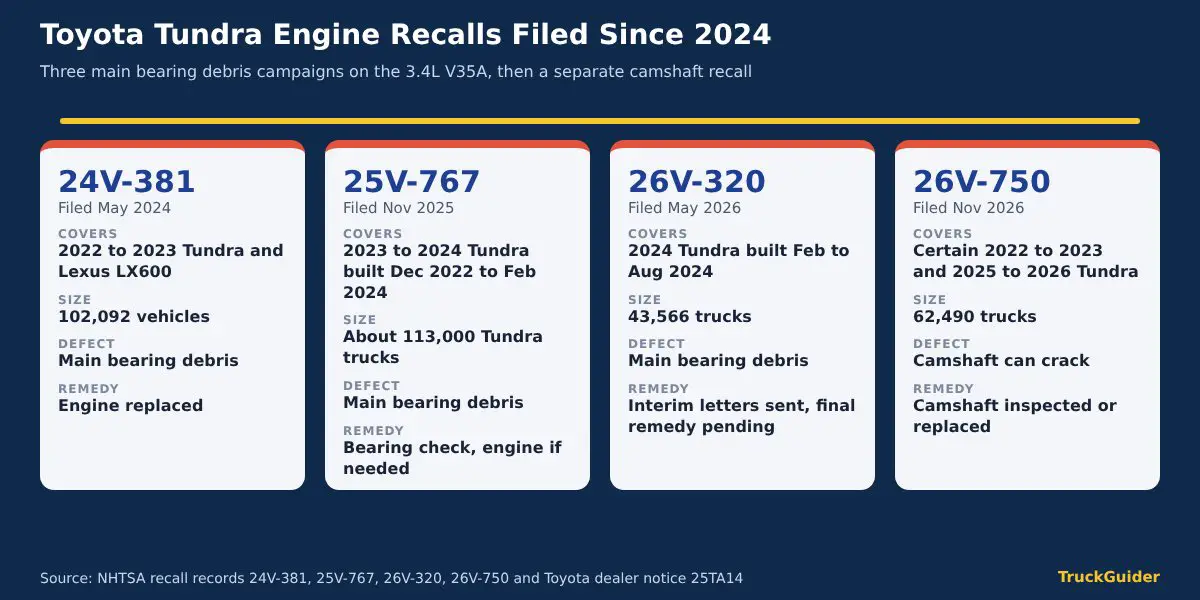
Toyota first recalled 102,092 2022 and 2023 Tundra and Lexus LX600 vehicles under NHTSA recall 24V-381 in May 2024. Debris can damage the main bearings, which can stall the engine and cut drive power. The remedy was a full engine replacement.
Two Recall Expansions After 2024
In November 2025, Toyota expanded the campaign as 25V-767 to cover about 113,000 more 2023 and 2024 Tundra trucks built from late December 2022 to mid-February 2024. In May 2026, recall 26V-320 added 43,566 more 2024 trucks built from early February to early August 2024, according to NHTSA.
For the expanded recalls, the Toyota dealer recall notice filed with NHTSA lists the warning signs as engine knocking, rough running, a no-start, or a loss of motive power.
Under 25V-767, dealers inspect the number 1 main bearing with diagnostic software and drive data, then replace the engine if needed. Owners covered by 26V-320 have received interim letters only, and Toyota will send more once the final remedy is ready.
Engine Complaints in NHTSA Data


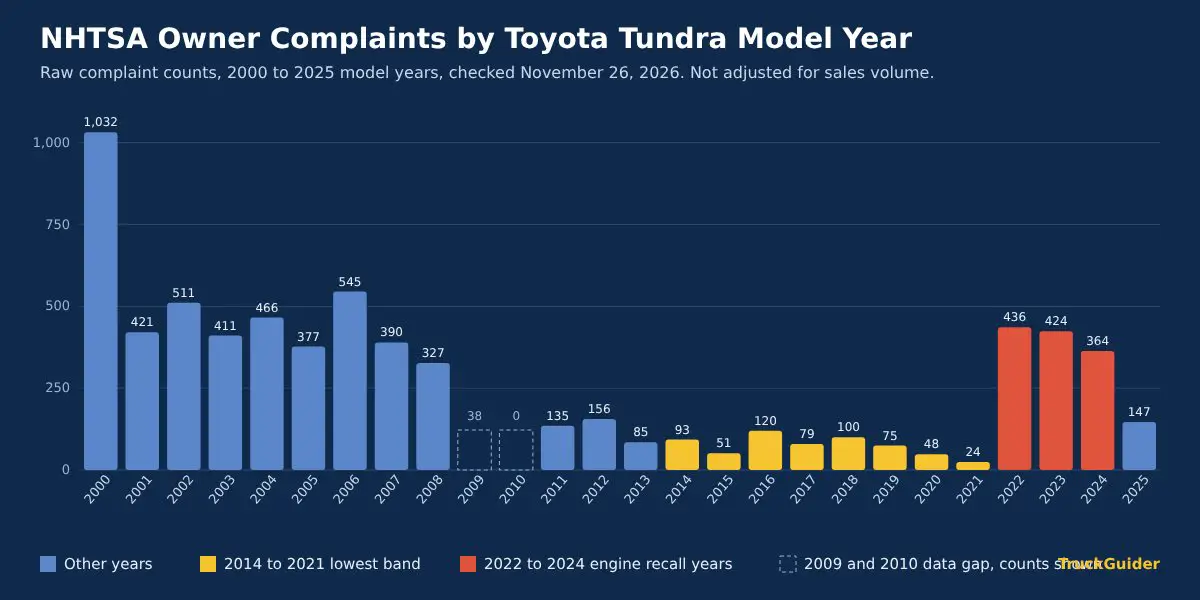
NHTSA complaint counts back the recall data. As of November 2026, owners filed 436 complaints for the 2022 Tundra, 424 for 2023 and 364 for 2024, and the engine was the top component every year.
The 2022 and 2023 totals are the highest of any model year since 2006, even though these trucks have been on the road for far fewer years. Older years have had two decades to collect complaints.
Smaller Fixes and Service Bulletins
The same trucks carry several smaller recalls. Recall 22V-445 covers 2022 rear axle flange nuts that can loosen, and 24V-125 adds transmission software for 2022 to 2024 trucks that can roll in neutral.
Toyota also issued a 2022 tech tip for turbo wastegate actuator codes such as P0243 and P0247, and bulletin T-SB-0110-22, dated December 15, 2022, for a pop or clunk on first start in 2022 and 2023 trucks. Both documents are posted in NHTSA’s service bulletin library. Ask the seller for dealer paperwork on every one.
What Went Wrong With the 2007 Tundra
The 2007 Tundra was the first year of the second generation and the first with the 5.7L i-FORCE V8. First-year trucks carried the most problems of that generation.
Cars.com, citing a May 2007 USA Today report, said early 5.7L engines suffered camshaft failures traced to an outside supplier’s part. Toyota replaced the full engine on affected trucks, so ask whether a 2007 5.7L had that work done.
Driveline and Pedal Recalls for 2007
NHTSA recall 07V-579 covers 2007 four-wheel-drive trucks with improperly heat-treated slip yokes. A broken yoke can drop the propeller shaft onto the road or into the fuel tank.
The 2007 to 2010 Tundra also falls under the 09V-388 floor mat and 10V-017 accelerator pedal recalls. Both address a pedal that can stick open.
Frame Rust on 2007 and 2008 Trucks
Cars.com reported in November 2016 on Toyota’s $3.4 billion frame rust settlement, a class action covering 2007 and 2008 Tundra pickups, 2005 to 2010 Tacoma and 2005 to 2008 Sequoia models. The settlement funded frame inspections and replacements.
The 2008 Tundra shares that frame concern but not the early camshaft reports. A 2008 truck with a replaced or rust-free frame is a far safer bet than a 2007 truck with no records.
How Rust Shaped the 2000 to 2003 Tundra
The first-generation Tundra earned its durable reputation with the 4.7L 2UZ-FE V8. Its weak point is corrosion, not the engine.
NHTSA recall 09V-444 covers 2000 to 2003 Tundra trucks sold or registered in 20 cold-weather states and Washington, D.C. The rear cross member can rust badly enough to drop the spare tire or damage the rear brake lines and proportioning valve.
The 2000 model year also has the most NHTSA complaints of any Tundra, with 1,032 on file, and structure is the top category at 530. Crawl under any 2000 to 2003 truck from the salt belt before you talk price.
Where First-Generation Frames Rust


Start at the rear cross member above the spare tire, then follow the frame rails forward to the spring hangers. Salt-belt trucks usually show the worst scale in those areas first.
How to Test a Suspect Frame
Tap the rear cross member, spring hangers and brake line brackets with a hammer. Flaking scale, holes or soft spots mean the frame needs a professional inspection before purchase.
3 Recalls and 1 Common Failure on the 2004 to 2006 Tundra
Late first-generation trucks have fewer structural complaints, but three recall groups need proof of completion and one failure is common. None of them is a reason to walk away if the work is documented.
Lower Ball Joints
Recall 07V-013 replaces front lower ball joints on 2004 to 2006 Tundra trucks. A worn joint can separate from the steering knuckle and cause a loss of control.
Passenger Air Bag Inflators
NHTSA lists several passenger air bag inflator recalls for 2003 to 2006 trucks, including 15V-285, 19V-741 and a new campaign, 26V-748, filed on November 12, 2026, for 2005 and 2006 models.
Aftermarket Ball Joints
Recall 22E-002 covers certain Moog, NAPA and ACDelco replacement ball joints sold for 2004 to 2006 Tundra trucks. Check the brand on any truck that already had its ball joints replaced.
Secondary Air Pumps
CarComplaints lists 2005 secondary air pump failure as the single most reported Tundra problem on its site. A failed pump sets a check engine light and can put the truck into a reduced-power mode.
Why CarComplaints Rates 2012 as the Worst Tundra
CarComplaints rates the 2012 Tundra as its worst model year, even though 2007 has more complaints on the site. Its top 2012 entry is a failed air injection pump, at an average reported cost of $2,900 around 78,000 miles.
Toyota bulletin T-SB-0143-14, dated November 7, 2014, confirms the pattern on 2012 and 2013 Tundra trucks with the 3UR 5.7L. Debris or ice in the air switching valve can trigger codes P2440 and P2442, and the fix starts with an ECM reprogram.
A related bulletin, T-SB-0079-16 for the 2014 to 2016 4.6L Tundra, says the same codes can drop the truck into limp mode near 25 mph in sub-freezing weather. Toyota covers that repair under its federal emission warranty of 96 months or 80,000 miles.
Best Tundra Years to Buy Used From 2014 to 2021
The 2014 to 2021 Tundra is the strongest used choice. Most use the 5.7L i-FORCE V8 with a six-speed automatic, 2014 to 2019 trucks also offered a 4.6L V8, and NHTSA complaints stay low across the whole run.
Complaint counts as of November 2026 are 93 for 2014, 51 for 2015, 120 for 2016, 79 for 2017, 100 for 2018, 75 for 2019, 48 for 2020 and 24 for 2021. Compare that with more than 360 for each of 2022, 2023 and 2024.
Recalls Still Worth Checking
Low complaints do not mean zero recalls. Recall 21V-920 covers power steering gear leaks on 2007 to 2021 trucks. Recall 21V-688 covers 2018 to 2021 headlight circuits that can power both beams at once and overheat a connector.
Specs and Towing Still Worth Checking
Our Toyota 5.7 i-FORCE V8 specs guide covers oil capacity and output for these years. Model-year towing limits are in the Toyota Tundra towing capacity chart by year.
Should You Buy a 2025 or 2026 Tundra
The 2025 Tundra shows fewer complaints so far, with 147 on file in November 2026. A new problem arrived on November 12, 2026, when Toyota filed recall 26V-750 for engine camshafts.
NHTSA lists 62,490 trucks in that recall, covering certain 2022 and 2023 trucks plus 2025 and 2026 trucks. It does not cover 2024 models. A camshaft may have been made incorrectly and can crack, then snap, which can stall the engine. Owner letters are expected to start mailing on December 28, 2026.
What the 2025 and 2026 Camshaft Recall Means
If you shop a 2025 or 2026 truck now, ask the dealer to run the VIN for 26V-750 and get the inspection done before delivery. The same check applies to 2022 and 2023 trucks.
What the 2027 Refresh Changes
The Toyota press release for the 2027 Tundra lists new styling, a 14-inch screen, Toyota Safety Sense 4.0 and a new Trailhunter package. It does not list any engine hardware changes, so the engine recall history above still matters when 2027 trucks reach used lots.
How to Check Any Tundra in 5 Steps
Run these five checks on any used Tundra, whatever the year.
- Enter the 17-digit VIN at NHTSA’s recall lookup and note every open campaign.
- Ask Toyota or the selling dealer for a printed service history with completed recall work.
- On 2022 to 2024 trucks, confirm the 24V-381, 25V-767 or 26V-320 work order and whether the engine was replaced, and on 2022 and 2023 trucks also check 26V-750.
- On 2000 to 2008 trucks, inspect the frame and rear cross member in daylight, on a lift if possible.
- Scan for stored codes, with extra attention to P2440, P2442 and turbo wastegate codes.
Our Toyota Tundra generations chart helps you confirm which generation and engine a listing really has.
3 Limits of Tundra Complaint Counts
NHTSA complaint totals are useful, but they need context before you rank one year against another.
Raw Counts Are Not Rates
The counts are not adjusted for how many trucks Toyota sold each year. A high-volume year can show more complaints without being less reliable per truck.
Time on the Road Matters
Older trucks have had up to 26 years to collect complaints. That makes the 2022 to 2024 totals more alarming, not less.
Some Years Have Data Gaps
NHTSA’s complaint data returned only 38 complaints for 2009 and none for 2010 when we checked. We treat both years as data gaps, not proof of perfect reliability.
Your Tundra Years to Avoid Shortlist Before You Buy
The Toyota Tundra years to avoid come down to three groups. Skip 2022 to 2024 trucks without documented engine recall work, be careful with a 2007, and walk away from rusty 2000 to 2003 salt-belt trucks.
For the best value, shop 2014 to 2021 trucks with the 5.7L i-FORCE V8 and run every VIN for open recalls. On 2022, 2023, 2025 and 2026 trucks, the 26V-750 camshaft recall is one more item to clear before you sign.
For 2004 to 2006 trucks, ask for ball joint and air bag recall paperwork. On a 2012, scan for P2440 and P2442 before you agree on a price, since a failed air injection pump can be an expensive repair.
5 Common Questions About Tundra Years to Avoid
What Is the Worst Toyota Tundra Year
The 2022 to 2024 Tundra is the worst group on NHTSA data, with recalls for main bearing debris and 364 to 436 complaints per year. CarComplaints rates 2012 as its single worst year because of air injection pump failures, which cost owners about $2,900 on average.
Is the 2022 Tundra Engine Reliable
Many 2022 V35A engines fall under recall 24V-381 for machining debris that can fail the main bearings. A 2022 truck with a documented engine replacement or completed inspection is a safer buy than one with no records. Also check camshaft recall 26V-750.
Which Tundra Years Have Frame Rust Problems
The 2000 to 2003 Tundra has rear cross member corrosion recall 09V-444 in 20 cold-weather states and Washington, D.C. Toyota’s frame rust settlement also covers 2007 and 2008 Tundra trucks. Inspect the rear cross member, spring hangers and brake line brackets on any of these years before you buy.
What Are the Most Reliable Tundra Years
The 2014 to 2021 Tundra with the 5.7L i-FORCE V8 has the lowest NHTSA complaint counts, from 24 to 120 per year. Check those trucks for recall 21V-920 on the power steering gear and, on 2018 to 2021 models, headlight recall 21V-688.
Does the 2025 Tundra Have Engine Recalls
Yes, recall 26V-750, filed November 12, 2026, covers certain 2025 and 2026 Tundra camshafts that can crack and snap. Dealers will inspect the camshaft and replace it if needed, free of charge. Owner letters are expected from December 28, 2026.