
How to Flush a Heater Core on a Ram/Dodge Truck: Complete Guide 2026

A truck heater core flush is the right first move when your cabin heat goes weak or disappears entirely. Before you spend $500 to $2,300 on a professional replacement. If your engine temperature gauge is reading normal, your coolant level is full, and both heater hoses at the firewall are hot to the touch, the core itself is most likely clogged with sediment, rust, or debris.
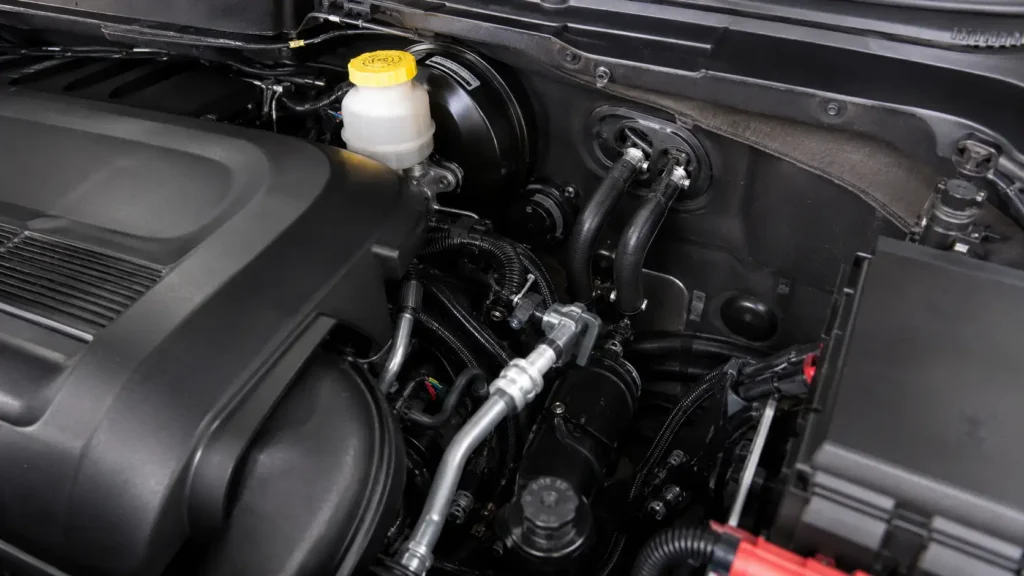
Ram 1500 and Ram 2500 owners deal with this more than most. Threads on RamForum.com document a recurring casting-sand clogging problem on 2013–2018 generation trucks, where fine factory particles settle into the narrow heater core passages over time. The fix is a thorough back-flush, done correctly in both directions, with the right coolant type afterward.
This guide covers how to confirm the problem, locate your hoses, complete the 7-step flush, and choose the correct coolant for Ram, Ford, and GMC trucks so the core does not re-clog within days of your repair.
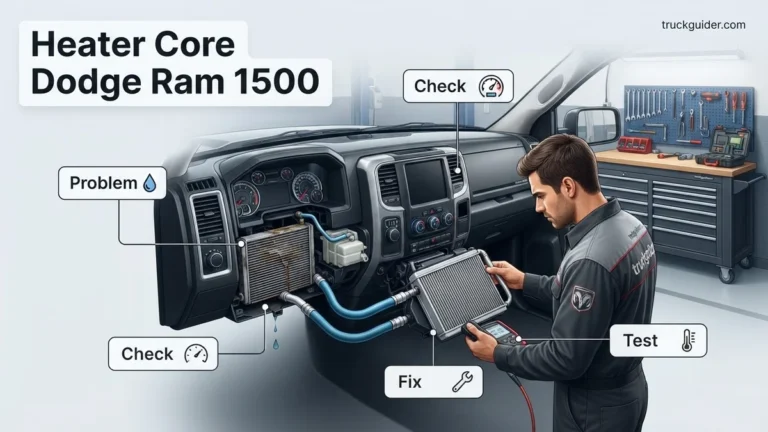
Truck heater core flush: complete DIY guide covering symptoms, 7-step flush process, flush vs replace decision, coolant type by truck, and cost comparison
Recommended Best Deal Products


Truck Heater Core Flush — Complete DIY Guide
Ram 1500 & 2500 · Ford F-150 & F-350 · GMC Sierra · Chevy Silverado
- Both hoses hot, output still weak
- Heat returned but faded after 1–2 weeks
- No coolant smell or loss
- Up to 2–3 flush attempts on 2013–2018 Ram
- Two full back-flushes: no improvement
- Sweet smell continues after flushing
- Coolant level keeps dropping
- Damp passenger-side floor or fogged glass
4 Signs Your Truck Heater Core Needs a Flush
Before disconnecting any hoses, verify the heater core is the actual problem. Several other components produce similar symptoms, including a failing thermostat, low coolant, or a broken blend door actuator. Check these four signs first.
You can also review our dedicated guide on clogged heater core symptoms and diagnosis for a deeper breakdown of each sign before you start the job.
Weak or Lukewarm Air From Vents
The cabin barely warms up even after the engine reaches full operating temperature. Both heater hoses at the firewall feel hot to the touch, but airflow from the vents is only slightly warm. This temperature difference between hose heat and vent output points to restricted flow through the core. That is the classic clog symptom.
Heat on One Side of the Cab Only
Ram 1500 and Ram 2500 trucks with dual-zone climate control sometimes deliver heat only to the passenger side while the driver’s side stays lukewarm. Multiple RamForum threads confirm this is caused by a half-clogged heater core, where one set of passages is restricted while the other still flows. A flush resolves this in most cases.
Sweet Smell Coming From the Vents
Coolant has a distinctly sweet odor. If you smell it through your vents with the heat on, the heater core may be seeping coolant vapor into the cabin. A flush can temporarily slow minor seepage, but an active leak means the core needs replacement, not just flushing.
Coolant Level Dropping With No External Leak
If your reservoir level keeps dropping and there is no puddle under the truck, the heater core may be leaking coolant onto the cabin floor. Check under the passenger-side dash for moisture or a damp carpet. A flush will not fix this. Replacement is the only solution at this stage.
What You Need Before Starting a Heater Core Flush
Recommended Best Deal Products


Prep everything before you touch the truck. A mid-job trip to the auto parts store with a half-drained cooling system is avoidable.
- Garden hose with adjustable nozzle: set to a low-pressure, gentle spray only; high pressure can damage the core’s delicate fins
- Drain pan: coolant is toxic to pets and cannot be poured down a storm drain. Capture all runoff.
- Prestone AS105 Total Cooling System Cleaner (22 oz, ASIN B00B99U088, ~$14.97): the most widely recommended chemical flush on Ram forums; non-acidic, safe for aluminum cooling system components
- Fresh coolant (correct type for your truck, covered in Section 7 below)
- Distilled water: not tap water. Tap water minerals accelerate corrosion in modern aluminum cooling systems
- Hose clamp pliers or flathead screwdriver
- Funnel, rags, and a bucket
- Safety glasses and nitrile gloves
The coolant type note is the most critical item on this list. Using the wrong coolant after a flush on a 2013+ Ram is the single most common reason cores re-clog within weeks. Full details are in the coolant section below.
Where to Find Heater Core Hoses on Ram, Ford, and GMC Trucks
On every major pickup truck, the heater core hoses exit through the firewall on the passenger side of the engine bay. The challenge Ram owners run into is identifying which hose is the inlet and which is the return. Back-flushing through the wrong port does nothing useful.
Ram 1500 and Ram 2500 Hose Location
On the Ram 1500 5.7L Hemi V8 and the Ram 2500 6.7L Cummins Turbo Diesel, two hoses exit the firewall near the passenger side. The top hose is the inlet. It runs to the black pipe on the water pump. The bottom hose is the return. It runs to the silver pipe on the water pump. This routing is confirmed across multiple RamForum and RamForumZ threads covering the 2009–2019 generation trucks.
If you are unsure, run the engine to full operating temp, then carefully touch both hoses. The inlet hose will always be noticeably hotter than the return when the system is flowing properly.
Ford F-150 and F-350 Hose Location
On Ford F-Series trucks, the heater hoses exit the firewall on the passenger side and route back toward the engine’s coolant outlet and water pump. The inlet is typically the hose connected to the engine’s coolant outlet. It will be hotter at operating temp. The return runs back to the water pump. Apply the temperature test on a warm engine if the routing is unclear on your specific year.
GMC Sierra and Chevy Silverado Hose Location
Sierra and Silverado trucks follow the same firewall exit pattern on the passenger side. The inlet connects to the engine side and the return routes back to the water pump. Use the temperature test on a warm engine: the inlet is always hotter. If both hoses feel equally hot, restricted flow confirms the flush is needed.
How to Flush a Truck Heater Core in 7 Steps
Recommended Best Deal Products

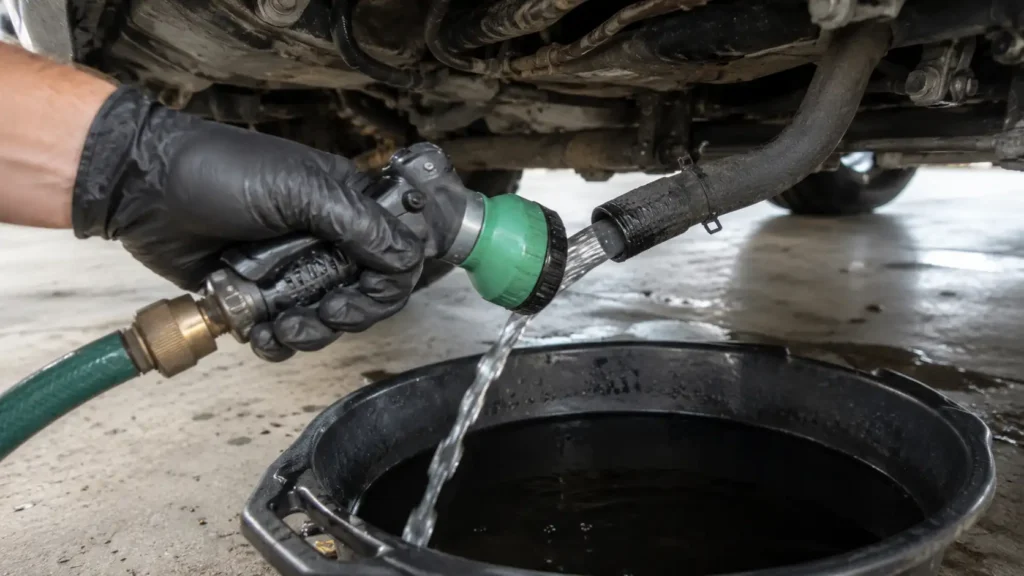
The flush itself takes 30 to 45 minutes once supplies are in hand. Work with a fully cooled engine, not one that has been running.
1. Let the Engine Cool Completely
Wait a minimum of 2 hours after the engine was last running. Coolant under pressure is scalding. Do not rush this step.
2. Drain the Coolant
Open the radiator petcock or lower radiator hose and drain into your pan. On Ram trucks, see the radiator drain plug location guide for exact petcock placement by generation.
3. Disconnect Both Heater Core Hoses
Release the clamps and pull both hoses free at the firewall. Have rags ready. Photograph the hose positions before removing them so you reconnect them correctly.
4. Forward Flush With Garden Hose
Insert the garden hose into the inlet port (top hose on Ram). Run water at low pressure until the output from the return port runs clear. Flush for at least 2 to 3 minutes.
5. Reverse Flush Through the Return Port
Move the garden hose to the return port and flush backward through the core. This dislodges casting sand and debris that forward flushing alone leaves behind. Repeat until water runs clear from both directions.
6. Chemical Flush (If Needed)
If water alone does not restore flow, run Prestone AS105 through the core per label directions, then flush thoroughly with distilled water. Do not use CLR: it can damage aluminum heater core passages.
7. Reconnect, Refill, and Burp the System
Reconnect hoses in original positions. Refill with the correct 50/50 coolant and distilled water mix. Run the engine with heat on full blast. On Ram 1500 and 2500 trucks, rev lightly to ~1,000 RPM to purge air pockets. These engines take several minutes to fully bleed after a coolant refill. Watch the reservoir level and top off as needed.
After the flush, test the system before declaring it fixed. With the engine at full operating temp, both hoses should be hot and vent output should be noticeably warmer than before. If heat is still weak, see the next section.
When to Flush vs When to Replace Your Heater Core
The flush is always the right first step. But knowing when to stop flushing and move to replacement saves time and money.
Keep flushing if:
- Both hoses are hot but output is still weak. Sediment may need a second pass.
- Heat returned briefly but faded after a week or two. Casting sand in 2013–2018 Ram trucks is known to resettle; multiple owners on RamForum report needing 2 to 3 flushes before the core clears fully.
- No coolant smell, no leaks, no coolant loss
Move to replacement if:
- Two full back-flushes produced no improvement
- Sweet smell continues through the vents after flushing
- Coolant level keeps dropping with no external leak
- Passenger-side floor mat is damp or the windshield fogs internally with the heat on
On cost: a DIY flush runs $30 to $75 in materials. A professional flush at an independent shop typically costs $80 to $200. Replacement is a different conversation entirely. RamForum members report dealer quotes of $1,600 to $2,300 for a Ram 2500 6.7L Cummins Turbo Diesel heater core replacement, which requires significant dash disassembly. Independent shops generally run $500 to $1,000 depending on labor rates.
Which Coolant Type to Use After Flushing Your Ram Truck
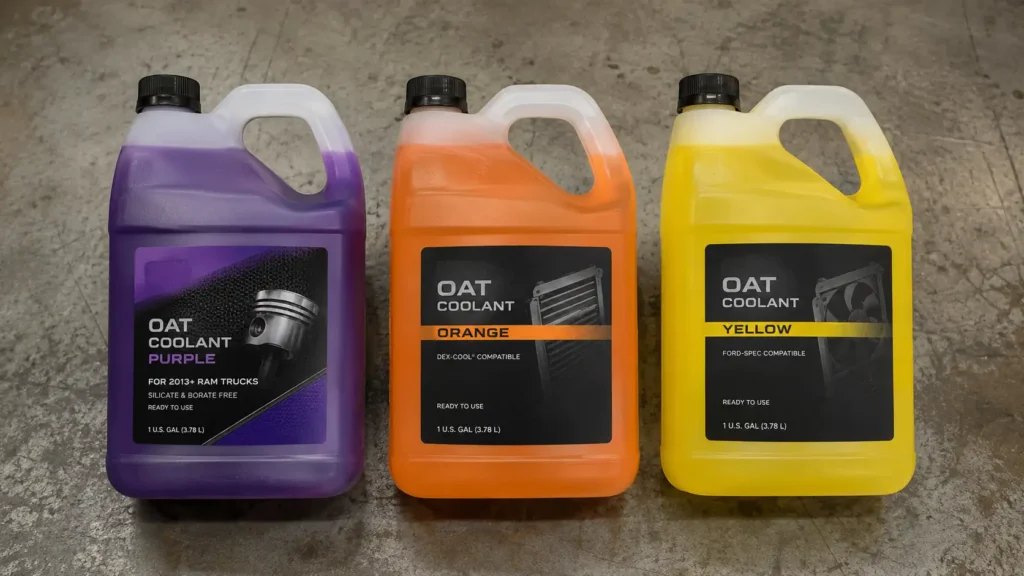
The most common reason a heater core re-clogs within days of flushing is the wrong coolant type being added after the job. This is the one step most generic guides skip entirely.
Ram trucks changed coolant specifications in 2013. Using the wrong type, or mixing two incompatible types, creates a gel-like substance that blocks the heater core, thermostat housing, and radiator passages. A clean flush undone by the wrong coolant is a frustrating and avoidable outcome.
- 2013 and newer Ram 1500 and Ram 2500: Mopar OAT Purple coolant, meeting spec MS-12106 / MS-90032. Forum and spec documentation confirm Dodge switched from HOAT to OAT for the 2013 model year. Prestone All Vehicles OAT and PEAK 10X OAT are commonly used alternatives.
- Pre-2013 Ram 1500 and Ram 2500 (2009–2012): HOAT (Hybrid Organic Additive Technology). Do not mix HOAT with OAT. The inhibitor packages react and form a gel.
- Ford F-150 and F-350: Ford-spec yellow OAT coolant (Motorcraft Gold). Check your reservoir cap or owner’s manual for the exact spec.
- GMC Sierra and Chevy Silverado: Dex-Cool OAT (orange). Never mix Dex-Cool with green IAT coolant.
Always verify your specific year in the owner’s manual or on the coolant reservoir cap label before refilling. If two coolant types have already been mixed in your system, a full machine flush at a shop is needed before adding fresh coolant. A DIY drain-and-fill will not remove enough of the old fluid to prevent re-gelling.
The correct coolant spec is directly tied to thermostat life and water pump health as well. Our guide on Ram 1500 thermostat location and OAT vs HOAT coolant selection covers the full cooling system context for Ram owners.
Keep Your Truck Heater Core Clear With Annual Maintenance
A heater core flush is one of the most cost-effective maintenance jobs a truck owner can do. At $30 to $75 in DIY materials, it directly avoids the $500 to $2,300 cost of a replacement, and on Ram 1500 and Ram 2500 trucks, it addresses a documented weak point before it becomes a cold-weather emergency.
The two rules that prevent repeat clogging: flush the full cooling system every 2 to 3 years to remove sediment before it settles into the narrow heater core passages, and always use the correct OAT or HOAT coolant type for your specific year. Mixing coolant types is the fastest way to undo a clean truck heater core flush.
If heat still does not return after two complete back-flushes, a replacement core is the practical next step, not a third flush.
Frequently Asked Questions About Truck Heater Core Flushing
How do I know if my truck heater core is clogged or just leaking?
A clogged core produces weak or lukewarm heat with no coolant smell and no coolant loss. A leaking core produces a sweet smell from the vents, foggy windows, or a damp passenger-side floor mat with an unexplained drop in coolant level. Leaks require replacement; clogs respond to flushing.
How many times can I flush a heater core before replacing it?
Two full back-flushes in both directions is the standard threshold. RamForum members with casting-sand issues on 2013–2018 Ram 1500 trucks report some cores needed 2 to 3 flushes before clearing fully. If heat does not return after two attempts, the core likely needs replacement.
What happens if I use the wrong coolant after a heater core flush on a Ram truck?
Mixing HOAT and OAT coolant types causes the inhibitor packages to react and form a gel that blocks the heater core, thermostat housing, and radiator passages. On 2013+ Ram trucks, always use Mopar OAT Purple or an OAT-compatible equivalent meeting spec MS-12106. Using the wrong type can re-clog a freshly flushed core within days.
Can I flush a heater core without draining the radiator first?
Yes. If you are flushing only the heater core by disconnecting the two firewall hoses and running a garden hose through in both directions, you do not need to drain the radiator first. The hoses are isolated once disconnected. Draining is only required if you are doing a full cooling system flush at the same time.
How long does a truck heater core flush take to do yourself?
Plan for 30 to 45 minutes for the flush itself, plus 2 hours of engine cool-down time before starting. Add another 15 to 20 minutes for coolant refill and the air burp procedure. Total time from start to finish on a Ram 1500 or Ram 2500 is typically 3 to 4 hours including the mandatory cool-down period.
![2019 Ram 2500 Bolt Pattern: Specs & Fitment Guide [2026]](https://truckguider.com/wp-content/uploads/2026/03/2019-ram-2500-bolt-pattern-featured.webp)
![2022 Ram 2500 Running Boards [2026]](https://truckguider.com/wp-content/uploads/2026/03/2022-ram-2500-running-boards-featured.webp)
![2022 RAM 2500 Tire Size Guide: Complete Specs Guide [2026]](https://truckguider.com/wp-content/uploads/2026/03/2022-ram-2500-tire-size-featured.webp)