
U010C Code 6.7 Cummins: The Ultimate Repair & Warranty Guide 2026

The modern diesel pickup truck is less a mechanical beast of burden and more a mobile data center, where torque and horsepower are the products of millions of computational decisions made every second. In the ecosystem of the Ram Heavy Duty lineup equipped with the legendary 6.7L Cummins turbodiesel, no relationship is more critical—or more fragile—than the one between the Powertrain Control Module (PCM) and the Variable Geometry Turbocharger (VGT).
This relationship is defined by a digital handshake occurring over the J1939 Controller Area Network (CAN) bus. When that handshake is broken, the diagnostic trouble code U010C is generated.
While a simple alphanumeric string on a scanner, U010C represents a catastrophic severance of the vehicle’s central nervous system. It is technically defined as “Lost Communication With Turbocharger/Supercharger Control Module ‘A’,” but its implications ripple through every subsystem of the truck. It disables the exhaust brake, derates engine power to a “limp” state, alters transmission shift points, and leaves owners of $80,000 towing rigs stranded on the shoulders of highways.
This comprehensive dossier, prepared for TruckGuider.com, is designed to be the ultimate authority on this specific failure. It moves beyond superficial “quick fixes” to explore the fluid dynamics of variable geometry turbocharging, the metallurgy of solder fatigue in high-vibration environments, and the complex economics of repair versus replacement. We will dissect the “X99”
warranty extension that has shifted the liability landscape for thousands of owners and provide a granular, voltage-drop-verified diagnostic protocol that distinguishes between a $5 fuse failure and a $3,500 turbocharger replacement. This report is optimized for the semantic search patterns of technicians, fleet managers, and enthusiasts seeking not just an answer, but understanding.
U010C
Lost Communication With Turbocharger Control Module “A”
Found prominently in 6.7L Cummins engines (Ram 2500/3500), this code signifies a breakdown in the J1939 CAN Bus dialogue between your Engine Control Module (ECM) and the Variable Geometry Turbo (VGT) Actuator.
Why is my truck in Limp Mode?
The U010C code is rarely a mechanical failure of the turbo itself. Instead, it is a communication failure. The VGT actuator is an electronic device mounted to the side of your Holset turbo. It adjusts the exhaust vanes to build boost or provide exhaust braking. When the ECM sends a command and gets “silence” in return (due to broken wires, dead circuit board, or low voltage), it throws U010C and defaults to a safe position, resulting in zero boost and severe power loss.
The Real Culprits
Based on community data and service reports for 2013+ Ram Trucks.
While the VGT Actuator is the most common failure point (due to heat cycling frying the circuit board), almost a third of all U010C codes are caused by simple wiring issues or weak batteries affecting the CAN bus voltage.
Insight: Don’t buy a $1,000 actuator before checking your $200 batteries and $0 wires.
Diagnostic Workflow
Follow this prioritized logic path to save time and money. Do NOT jump straight to replacement.
Load Test Batteries
The Cummins intake heater draws massive amperage. Weak batteries cause voltage dips that disrupt CAN signals.
The “Wiggle Test”
With the engine running, wiggle the harness near the turbo and firewall. If the idle changes or code clears, you have a broken wire.
Ohm Out J1939
Measure resistance at the diagnostic port. You should see 60 Ohms (two 120 Ohm resistors in parallel).
Actuator Replacement
If wiring and power are good, the actuator circuit board is likely fried. Proceed to replacement.
Financial Impact & Repair Options
The cost of fixing a U010C code varies wildly depending on the root cause and whether you choose OEM or aftermarket solutions. A full turbo replacement is rarely necessary for this specific code unless the mechanical vanes are seized.
Cost Analysis
- Wiring Repair (DIY) ~$20 – $50
- City Diesel / Reman Actuator ~$600 – $900
- OEM Actuator (Part Only) ~$1,200
- Dealer Full Turbo Replace $3,500+
Battery Voltage vs. CAN Stability
The J1939 Datalink is highly sensitive to voltage fluctuations. This chart illustrates how a drop in system voltage (e.g., during cold cranking) correlates with communication errors.
*Data represents typical CAN bus behavior where stability degrades significantly below 10.5V.
© 2026 TruckGuider Infographics
The Operational Theory of Variable Geometry Turbocharging
To truly diagnose the U010C code, one must first appreciate the engineering marvel that is the Holset VGT system. The transition from fixed-geometry turbos to VGTs was driven by the collision of two opposing forces: the driver’s demand for instant torque and the federal government’s demand for Tier 4 emissions compliance.
The Fluid Dynamics of the Holset HE300VG
The 6.7L Cummins engine (specifically in 2013+ chassis cabs and pickups) utilizes the Holset HE300VG turbocharger. Unlike a traditional turbo with a fixed exhaust housing size, the VGT can alter its internal geometry to mimic a small turbo for response or a large turbo for peak power.
- The Sliding Nozzle Ring: The core mechanism involves a sliding nozzle ring that moves axially over the turbine wheel. This ring is connected to a series of vanes.
- Velocity vs. Volume: At low engine speeds (RPM), the actuator pushes the nozzle ring to narrow the exhaust gas path. This constricts the flow, forcing the exhaust gas to accelerate violently as it hits the turbine wheel. This high-velocity stream spins the turbo instantly, eliminating the “lag” associated with older diesels.
- Thermal Management: Beyond performance, this ability to constrict flow allows the engine management system to artificially increase backpressure. This is crucial for “active regeneration” of the Diesel Particulate Filter (DPF), raising exhaust gas temperatures (EGTs) to over 1,000°F to oxidize soot, even when the truck is idling or moving slowly.
The Role of the Electronic Actuator (The “Smart” Node)
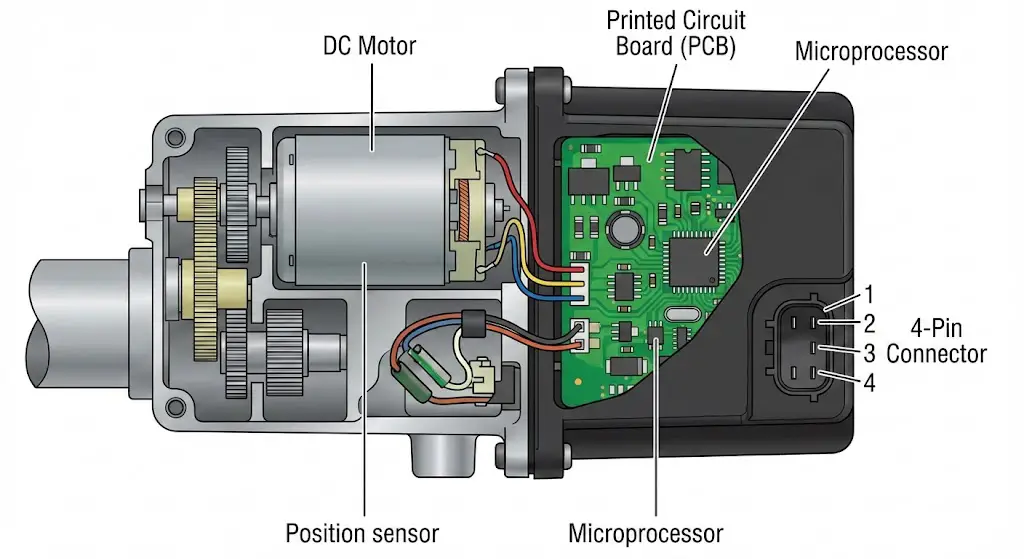
The component at the center of the U010C controversy is the electronic actuator mounted to the side of the turbocharger. It is not merely a solenoid that opens or closes; it is a sophisticated, standalone computer.
- Integrated Intelligence: The actuator housing contains a high-torque DC motor, a position sensor (Hall Effect or potentiometer), and a printed circuit board (PCB) with its own microprocessor.
- The Feedback Loop: The main Engine Control Module (ECM) does not directly power the motor. Instead, it sends a digital command (e.g., “Move to 85% closure”). The actuator’s internal processor receives this, calculates the current needed to drive the motor, moves the gear, verifies the new position via its internal sensor, and then sends a digital report back to the ECM confirming the move.
- The Timeout: The U010C code is generated when the ECM sends a command or a “roll call” request and receives silence in return. If the data packet is missing for a calibrated amount of time (often less than one second), the ECM declares the actuator “Missing in Action”.
The J1939 CAN Bus Architecture
The communication medium is the SAE J1939 Controller Area Network. This is a two-wire system consisting of a twisted pair of yellow and green wires: CAN High and CAN Low.
- Differential Signaling: To prevent electrical interference from the noisy diesel engine environment, the network uses differential signaling. A “0” or “1” is not determined by the absolute voltage on one wire, but by the difference in voltage between the two. This makes the signal robust against voltage spikes from injectors or alternators.
- The Bus Topology: The turbo actuator is a “node” on this bus, daisy-chained with other smart modules like the NOx sensors, the Mass Air Flow (MAF) sensor, and the Transmission Control Module. A failure in the wiring upstream can take down multiple nodes, which is a key diagnostic clue we will explore later.
Evolution of the Hardware: 2007.5 to Present
The physical implementation of this system has evolved, creating distinct failure patterns for different model years.
- Generation 1 (2007.5 – 2012): Holset HE351VE: This unit featured an actuator that was integrated deeply into the bearing housing and cooled by engine coolant. Failures here were often mechanical, involving the internal sector gear stripping or coolant seals failing and drowning the electronics.
- Generation 2 (2013 – Present): Holset HE300VG: This generation moved to a “half-shell” design. The electronics (the black plastic box) are bolted to a mechanical gear housing, which is then bolted to the turbo. While this made the actuator theoretically easier to replace, the location exposes the Printed Circuit Board (PCB) to extreme thermal cycling, leading to the “solder fatigue” epidemic that plagues modern Ram owners.
The Driver’s Experience of U010C
When the U010C code sets, the driver rarely needs a scanner to know something is wrong. The truck’s behavior changes instantly, often in frightening ways depending on the driving scenario.
The “Dead Pedal” and Loss of Boost
The most immediate symptom is a profound loss of power. The 6.7L Cummins relies on the turbocharger to force air into the cylinders to match the fuel injection. Without the turbo’s variable vanes creating low-end response, the engine is effectively a naturally aspirated 6.7L engine trying to move an 8,000lb truck.
- The Physics of the Failure: If the communication is lost while the vanes are in the “open” (low boost) position, the truck will have massive lag. It may take 5-10 seconds of full throttle to build enough RPM to generate boost naturally. This makes merging onto highways or crossing intersections dangerous.
- Limp Mode Derate: Recognizing the loss of air control, the ECM enters a protective strategy. It limits the fuel injection quantity (pulse width) to prevent “rolling coal” (black smoke) and to prevent Exhaust Gas Temperatures from skyrocketing. This is why the truck feels like it has hit a wall.
The Disappearance of the Exhaust Brake
For those who tow heavy 5th wheels or hotshot trailers, the VGT is not just a power adder; it is a safety device. The exhaust braking function works by closing the vanes to roughly 95%, creating massive backpressure in the manifold that fights the pistons, retarding the vehicle’s speed.
- The Silent Button: When U010C is active, the exhaust brake switch on the dashboard may light up, or it may refuse to engage. Regardless of the light, the physical braking force is gone.
- Implications: A driver descending a 6% grade with a 15,000lb load relying on the exhaust brake will suddenly find themselves accelerating. They must immediately rely on the service brakes (rotors/pads), risking brake fade and loss of control. This safety criticality is why U010C is considered a severe fault.
The Cluster Light Show
The instrument cluster provides the first visual confirmation of the failure.
- Malfunction Indicator Lamp (MIL): The standard yellow engine block icon illuminates.
- Electronic Throttle Control (ETC) Light: A red lightning bolt between inverted parentheses often flashes. This indicates a fault in the torque management system. Since the turbo is a primary torque management variable, its loss triggers the ETC warning.
- Message Center: In 2013+ trucks with the premium cluster, a “Service Electronic Braking System” or “Service Turbo” message may appear briefly.
The Cascade of Sympathetic Codes
A scan tool will rarely show only U010C. The loss of the actuator triggers a domino effect of logic failures in the ECM, resulting in a “cluster” of codes that can confuse inexperienced technicians.
- P003A: Turbocharger Boost Control Module Position Exceeded Learning Limit. The ECM tried to calibrate the turbo (find the open/closed stops) and the actuator didn’t move or moved too far.
- P00AF: Turbocharger Boost Control Module Performance. A general rationality code meaning “The boost I commanded is not the boost I got.”.
- P0234: Turbocharger Overboost Condition. If the vanes failed in the closed position, the turbo will over-speed at high RPM, risking physical explosion of the compressor wheel.
- P0102 / P0103: Mass Air Flow (MAF) Circuit Low/High. As we will discuss in the electrical diagnostics section, the MAF sensor shares a power feed with the turbo actuator. A short in one often kills the other’s power source, triggering both codes simultaneously.
Root Cause Analysis: The Anatomy of Failure
Why does this happen? The “Parts Cannon” approach—simply buying a new actuator because the code says “Actuator”—is a financial gamble. The failure modes are distinct and require differential diagnosis.
The Mechanical Failure: Soot Stiction and Coke
The VGT mechanism operates in a hostile environment. It is bathed in exhaust gases that can reach 1,200°F and are laden with particulate matter (soot).
- The Stiction Cycle: Over time, especially on trucks that are idled extensively or driven gently (“grocery getters”), soot accumulates on the sliding nozzle ring and the guide vanes. If the EGTs never get high enough to burn this soot off (passive regeneration), it hardens into “coke”—a substance harder than asphalt.
- The Actuator’s Struggle: The electric motor in the actuator has a finite amount of torque. As the vanes get sticky, the motor must draw more amperage to move them. Eventually, the mechanical resistance exceeds the motor’s capacity.
- The Result: The plastic internal reduction gears may strip (shearing teeth), or the motor stalls. The internal processor detects this stall and shuts down to protect itself, ceasing communication. In this case, U010C is a symptom of a seized turbocharger, not a bad computer.
The Electronic Failure: Thermal Fatigue and Vibration
Even if the turbo vanes are mechanically free, the actuator electronics often fail due to their physical design and location.
- The “Half-Shell” Vulnerability: The 2013+ HE300VG actuator places the control board directly against the heat of the turbo. While liquid cooled, the thermal gradients are extreme.
- RoHS Compliance and Lead-Free Solder: Modern automotive electronics use lead-free solder, which is more brittle than traditional leaded solder. The intense vibration of the Cummins inline-six engine, combined with the thermal expansion and contraction of the aluminum housing, causes these solder joints to crack microscopically.
- Intermittent “Ghost” Codes: This is why many owners report the code appearing when the truck is hot but disappearing the next morning. The heat expands the board, opening the crack (breaking the circuit). Cooling shrinks it, restoring contact. This is the hallmark of PCB failure.
The Wiring Failure: The “Rub Points” and Fuse M21

The 6.7L Cummins wiring harness is heavy and complex. Over 100,000 miles of vibration, insulation wears through.
- The Oil Filter Location: There is a known harness rub point near the oil filter housing and the EGR crossover tube. If the 12V supply wire (Pink/Red) rubs against the block, it shorts to ground.
- The Fuse M21 Trap: On 2013-2018 trucks, Fuse M21 (20 Amp) in the Power Distribution Center (PDC) supplies power to both the VGT Actuator and the MAF Sensor. If the wiring shorts, or if the MAF sensor itself fails internally, Fuse M21 blows.
- The Diagnostic Error: The technician scans the truck, sees U010C, and replaces the $1,500 actuator. The truck still doesn’t run because the $5 fuse is blown. Or, they replace the fuse, and it blows again immediately because the short is in the MAF sensor, not the turbo. This shared circuit is a critical vulnerability in the electrical architecture.
The Network Failure: CAN Bus Integrity
The J1939 network relies on two 120-ohm terminating resistors at the physical ends of the bus to prevent signal reflection (echoes).
- Resistance Spec: The total resistance of the loop should be 60 Ohms (two 120-ohm resistors in parallel).
- The Failure: If a wire breaks or a connector pin corrodes (increasing resistance), the voltage differential between CAN High and CAN Low becomes unreadable. The “noise” on the line corrupts the data packets. The ECM stops hearing the turbo, and U010C is set. This is often caused by water intrusion into the connector plug.
Comprehensive Diagnostic Protocol
To distinguish between a $5 fuse, a $100 wiring repair, and a $3,500 turbo replacement, a structured diagnostic approach is mandatory. This protocol is designed for the advanced DIYer or professional technician.
Phase 1: The Non-Invasive Inspection (No Tools)
Before unbolting anything, check the basics.
- Battery Load Test: The 6.7L Cummins intake grid heater draws massive current (upwards of 200 Amps). If batteries are weak, system voltage can drop below 10V during cycling. This voltage dip can cause the VGT actuator’s microprocessor to crash or reboot, causing a temporary loss of communication. Always ensure batteries pass a true load test.
- Fuse M21 Verification: Open the fuse box. Locate Fuse M21 (2013-2018). Pull it and inspect.
- If Blown: Do not just replace. Unplug the MAF sensor and the Turbo Actuator. Replace fuse. Plug in only the Turbo. Key ON. Does it blow? If no, plug in MAF. Key ON. If it blows now, your MAF sensor is the killer, not the turbo.
- Connector Inspection: Unplug the 4-pin connector at the turbo. Look for “green death” (copper corrosion) or water intrusion. Check for “pin push-out” where a pin has retreated into the housing, making poor contact.
Phase 2: Electrical Verification (Multimeter Required)
We must prove that power, ground, and data are reaching the plug.
The Pinout (Holset HE300VG / HE351VE):
| Pin # | Description | Wire Color (Typical) | Expected Reading (Key ON) |
| 1 | Power (+12V Supply) | Pink / Red-Green | Battery Voltage (12.0V – 14.0V) |
| 2 | Ground | Black / Brown | < 0.1 Ohms to Chassis Ground |
| 3 | J1939 CAN High | Yellow (Twisted Pair) | 2.5V – 3.5V (Fluctuating) |
| 4 | J1939 CAN Low | Green (Twisted Pair) | 1.5V – 2.5V (Fluctuating) |
Test Procedure:
- Voltage Check: Set Multimeter to DC Volts. Probe Pin 1 (Red lead) and Pin 2 (Black lead).
- Requirement: You must see within 0.5V of actual battery voltage. If battery is 12.6V and plug is 11.0V, you have a high-resistance wire (corrosion) in the harness that cannot carry the amperage needed to move the motor.
- Terminating Resistance Check:
- Key OFF. Batteries Disconnected (Essential to prevent meter damage).
- Set Meter to Ohms. Probe between Pin 3 and Pin 4 on the vehicle harness side.
- Expected: ~60 Ohms. (This confirms the rest of the truck’s network is intact).
- Now, probe Pin 3 and Pin 4 on the Actuator Connector itself (the plastic receptacle on the turbo).
- Expected: 108 – 132 Ohms. This measures the internal terminating resistor of the actuator.
- Diagnosis: If this reads “OL” (Open Loop) or Infinite, the internal circuitry of the actuator is physically broken. The electronics are dead. Replace Actuator..
Phase 3: The Mechanical “Finger Sweep” (The Deal Breaker)

This is the single most important test. Installing a new actuator on a seized turbo will void the warranty and destroy the new part in minutes.
- Remove the Actuator:
- Drain approx. 2 gallons of coolant.
- Remove the four mounting bolts (Torx T25/T30 or 5mm Allen).
- Pull the actuator straight off.
- Locate the Sector Gear: You will see a toothed gear or a lever arm on the turbo bearing housing.
- The Test: Using one finger, try to move this gear/lever back and forth.
- Pass: It moves smoothly with very light resistance. You feel/hear a distinct metallic “clunk” at the fully open and fully closed stops.
- Fail: It is stuck frozen. It feels “gritty.” It moves part way and binds. It requires pliers to move.
- Implication: If it fails, YOU MUST REPLACE THE TURBOCHARGER. No actuator can overcome a seized nozzle ring. Chemical cleaning (spraying oven cleaner in the exhaust) is a temporary band-aid that rarely lasts more than a few weeks.
Economic Analysis: Repair Options and Market Solutions
Once the diagnosis is confirmed, the owner faces a financial decision. The market offers a spectrum of solutions, each with specific engineering merits and price points.
The OEM Path: Holset / Mopar Replacement
Buying the genuine part (e.g., Part Number 5494878RX or 68445522AA) is the default choice for warranty work.
- Cost: High. $800 – $1,500 for the part alone. Dealer labor adds $500+.
- Pros: Guaranteed fitment. Factory warranty support (usually 12 months).
- Cons: History of Repeat Failure. The OEM replacement is often the exact same design that failed originally. It still uses plastic internal gears and the same soldering process. Many owners report replacing OEM units 2 or 3 times over the life of the truck.
- Ideal For: Trucks under warranty or owners who demand “Genuine Mopar” parts for resale value.
5.2 The Engineering Upgrade: City Diesel Billet Actuator
Aftermarket firm City Diesel identified the OEM weaknesses and engineered a ground-up solution that has become the industry “Gold Standard”.
- The Difference:
- Billet Aluminum Housing: Superior heat dissipation compared to the OEM plastic/composite covers.
- Upgraded Motor: A larger, higher-torque motor that can power through light soot accumulation that would stall an OEM unit.
- Half-Shell Design: They typically sell just the electronic half, which bolts to the existing gear housing. This reduces waste and cost.
- “Self-Calibrating”: The firmware is designed to auto-detect the end stops on the first key cycle, theoretically removing the need for a scan tool (though verification is still recommended).
- Cost: ~$985 – $1,200.
- Pros: Extremely robust. Solves the root cause of weak motors and overheating electronics.
- Cons: More expensive than reman units. Requires splitting the actuator housing (a slightly more complex install).
The Budget Path: Remanufactured Units
Companies like Circuit Board Medics offer a service to rebuild your existing unit or exchange it.
- The Fix: They disassemble the core, remove the lead-free solder, and re-solder the board with high-temperature industrial leaded solder. They also replace capacitors prone to drying out.
- Cost: $500 – $800.
- Pros: Cost-effective. Addresses the specific “electronic connectivity” failure mode effectively.
- Cons: Does not upgrade the motor torque or the housing material. If your turbo is getting sticky, this unit may still struggle.
The “Nuclear Option”: Full Turbo Replacement (Fleece/BD)
If the mechanical sweep test failed, the turbo must go.
- Aftermarket Performance Turbos (e.g., Fleece Cheetah, BD Screamer): These are new Holset-based turbos with modified compressor wheels (63mm vs stock 60mm) and turbine wheels.
- Benefits: They flow more air, lowering EGTs. They often include a pre-installed, pre-calibrated actuator, making installation “drop-in.”
- Cost: $2,500 – $3,500.
- Verdict: If you plan to keep the truck for another 100k miles, this is the best value proposition, as it renews the entire forced induction system.
The X99 Warranty Extension: A Legal & Financial Lifeline
For owners of 2015 model year trucks (and potentially adjacent years based on build date), a critical piece of information can save thousands of dollars.
The Scope of Coverage
FCA (Stellantis) recognized the high failure rate of these components and issued the X99 Warranty Extension.
- Coverage: Specifically covers the 6.7L Cummins Turbocharger Actuator.
- Duration: Extended to 15 years or 150,000 miles (240,000 km in Canada) from the in-service date.
- Reimbursement: Crucially, if an owner has already paid for this repair out of pocket, they are eligible for reimbursement from FCA, provided they have receipts and the VIN matches the eligibility list.
Actionable Steps for Owners
- VIN Check: Do not guess. Call a Ram dealer or use the Mopar Owner’s Site.
- The “Actuator Only” Clause: Be aware that dealers are instructed to replace only the actuator. If your turbo vanes are mechanically seized (failed sweep test), the dealer may deny the warranty claim or charge you for the turbo assembly, covering only the actuator portion. This often leads to disputes at the service counter.
- Documentation: If applying for reimbursement, you need the original repair order showing the part number (e.g., 68445522AA) and proof of payment.
Step-by-Step Replacement & Calibration: The “AlfaOBD” Method
For years, replacing a VGT actuator was impossible for DIYers because the calibration required the dealer-only WiTech software. The emergence of AlfaOBD (a powerful Android-based diagnostic app) has democratized this repair.
Required Tools
- Fluid Management: Coolant drain pan, fresh OAT (Purple) or HOAT (Orange) coolant to match your year.
- Hardware: 10mm socket, T25/T30 Torx, 5mm Allen key, Torque wrench (in-lbs).
- Software: AlfaOBD App ($50) + OBDLink MX+ Bluetooth Adapter ($100-$140).
The Installation Procedure
Warning: Turbocharger components retain heat for hours. Do not attempt on a hot engine.
- Drain & Remove: Drain coolant. Remove electrical connector. Remove mounting bolts. Retain the old gear housing if using a “half-shell” replacement.
- Surface Prep: Clean the mating surface on the turbo bearing housing meticulously. Any grit will cause misalignment of the gears.
- The “Pre-Align” Trick (Crucial):
- Before bolting the new actuator to the turbo, connect the electrical plug to it while it is holding in your hand.
- Open AlfaOBD > Ram 2500 > Engine > Cummins 6.7.
- Select “VGT Pre-Align” or simply cycle the key to ON for 10 seconds.
- Why? The actuator gear needs to spin to its “installation index” position. If you bolt it down while the gear is in the wrong spot, you will crush the internal gears when you tighten the bolts.
- Install & Torque: Mount the actuator. Ensure the gears mesh smoothly; do not force it. Tighten bolts in a star pattern to approx. 50 in-lbs (Verify specific instructions with your part).
The Calibration Sequence
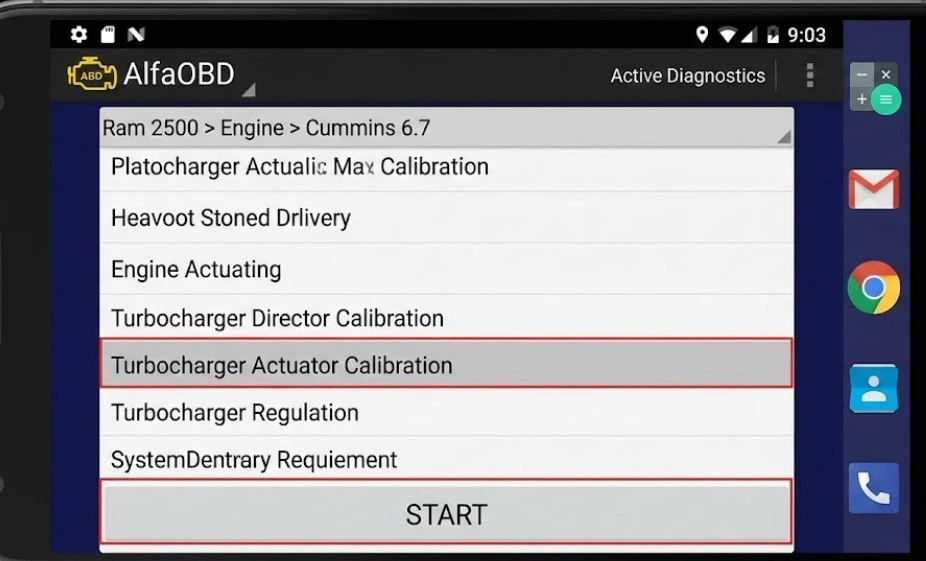
Once installed and coolant is refilled:
- Turn Key ON, Engine OFF.
- In AlfaOBD, go to Active Diagnostics (Hood up icon).
- Select “Turbocharger Actuator Calibration”.
- Start the procedure.
- Observation: You will hear the turbo actuator whining and “crunching” for about 30-60 seconds. This is the motor driving the vanes hard against the open and closed stops to learn the voltage values for 0% and 100% position.
- Completion: The app should display “Procedure Complete” or “Passed.”
- Verification: Start the engine. Check for U010C code. It should be gone. Monitor “VGT Position Desired” vs “VGT Position Actual” in the data stream. They should track each other closely (within 2-3%).
Prevention Strategy: How to Make Your VGT Last
Understanding that soot is the enemy allows for behavior modification to extend component life.
The “Use It or Lose It” Rule
The VGT vanes are like a muscle; if they aren’t exercised, they atrophy (stick).
- Exhaust Brake Protocol: Drive with the exhaust brake ON at all times, even when empty. Every time you let off the throttle, the actuator sweeps the vanes to the closed position. This constant motion scrapes soft soot deposits off the nozzle ring before they can harden into coke. This is the single most effective preventative measure.
Idle Management
- Avoid Wet Stacking: Idling a modern diesel at 700 RPM allows cylinder temperatures to drop below 300°F. Combustion becomes incomplete, producing wet, sticky soot.
- High Idle: If you must idle, engage the “High Idle” feature (using the cruise control buttons) to bring RPMs to 1,100+. This maintains cylinder heat and keeps the soot dry and burnable.
Electrical Hygiene
- Battery Maintenance: Replace batteries every 3-4 years proactively. The voltage spikes from weak batteries during grid heater cycling can damage the sensitive CAN bus transceivers on the actuator board.
- Clean Connections: Periodically inspect the actuator connector. Apply dielectric grease to the rubber seal (not the pins themselves) to keep moisture out.
Conclusion: The Decision Matrix
The U010C code is a defining moment in a Ram owner’s experience. It signals the collision of heavy-duty mechanics with fragile electronics. However, it is not a death sentence for the truck.
The Summary Logic for Owners:
- Check the basics: Load test batteries and inspect Fuse M21.
- Verify the harness: Use a multimeter to ensure the plug has power and data.
- Check the turbo: Perform the finger sweep test.
- If Turbo is Seized: Replace Turbocharger (Upgrade to Fleece/BD recommended).
- If Turbo is Free: Replace Actuator (City Diesel Billet upgrade recommended for longevity; OEM if under X99 warranty).
By following this engineering-grade protocol, owners can navigate the repair with confidence, ensuring that when the “check engine” light goes out, it stays out. The 6.7L Cummins is a million-mile engine; the VGT system is its Achilles heel, but with the right parts and knowledge, it can be forged into something just as durable.
Frequently Asked Questions
Q: Can I delete the turbo actuator and run a fixed turbo?
A: Technically, yes, but it requires significant modification. You would need to replace the VGT with a fixed-geometry turbo (like an S300 or S400 style), change the exhaust manifold (to a T3 or T4 flange), and—most importantly—re-tune the ECM. The stock ECU expects a VGT; without custom tuning (which has legal/EPA implications), the truck will not run correctly and will have constant check engine lights. For most street-driven trucks, fixing the VGT is the superior path.
Q: How long does the calibration process take?
A: The actual electronic calibration takes less than 2 minutes using AlfaOBD or a dealer tool. However, the physical installation of the actuator takes 2-4 hours depending on the mechanic’s skill level and how much coolant needs to be drained.
Q: My U010C code is intermittent. Can I ignore it?
A: No. An intermittent code is the warning shot. It usually means the solder joints are failing but still making contact when the engine is cold. Eventually, they will fail permanently, likely when the actuator is hot and under load (like towing up a hill). Ignoring it risks being stranded in “limp mode” with no power and no exhaust brake.
Q: Why does the City Diesel actuator cost more than the OEM one on Amazon?
A: The “OEM” actuators found on Amazon or eBay for $300-$500 are often counterfeit Chinese clones. A genuine Holset/Cummins actuator is typically $800+. The City Diesel unit (~$1,000) involves custom billet machining and upgraded American-made electronics. You are paying for the re-engineering that solves the factory design flaws.

![2022 Ram 2500 Fuel Filter [2026]](https://truckguider.com/wp-content/uploads/2026/03/2022-ram-2500-fuel-filter-featured.webp)

![Ram 1500 Single Cab Short Bed Performance, Specifications, [2026]](https://truckguider.com/wp-content/uploads/2026/03/featured-7450283a.webp)