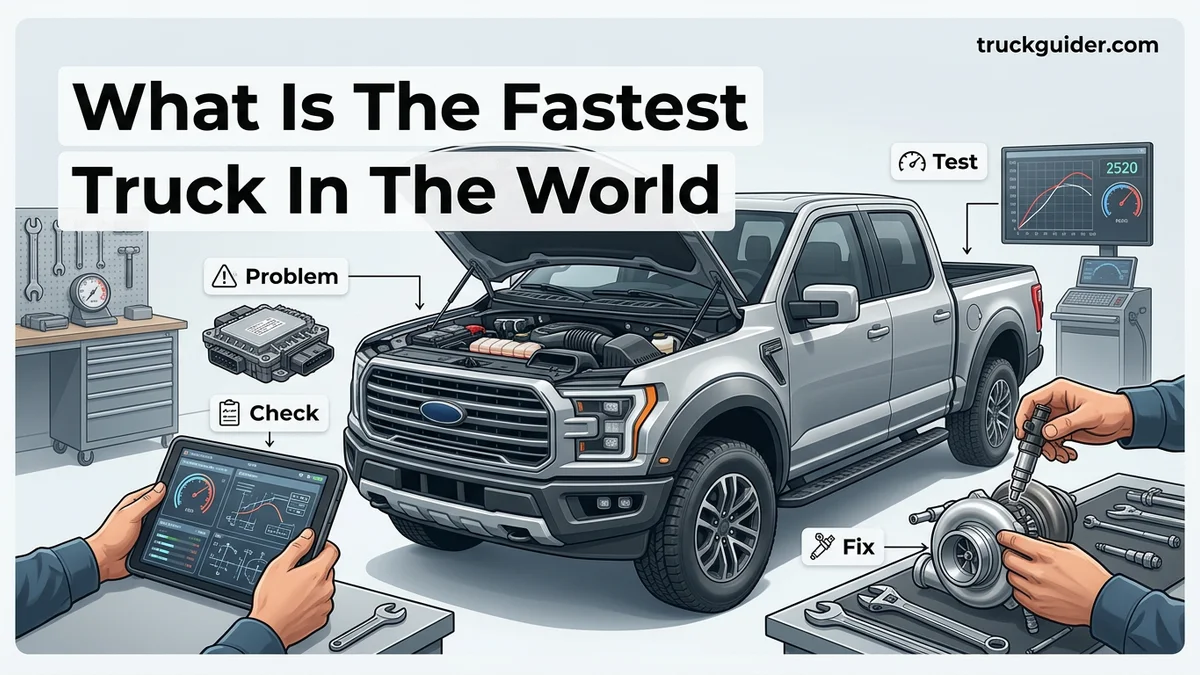
What Is The Fastest Truck In The World 2026 Guide

Determining what is the fastest truck in the world requires separating factory-built street-legal production vehicles from heavily modified custom drag trucks. While modified diesel semi-trucks and custom builds hold absolute speed records, factory supercharged pickups dominate showroom performance.
The title for the absolute fastest truck in the world currently belongs to the Shockwave jet-powered semi, which hit an unbelievable top speed of 376 mph, though for street-legal and production pickups, modified monsters like the 2,000-horsepower Ford Super Duty builds and factory rockets like the GMC Syclone and Ram TRX dominate the 2026 landscape. When you look at the landscape of high-performance trucks, you have to separate land-speed record exhibition vehicles from street-driven machines that you can actually register for the road.


Understanding these velocity thresholds matters because pushing a heavy, high-aerodynamic-drag vehicle past 200 mph requires overcoming massive engineering hurdles. Whether you are tracking custom quarter-mile drag times or evaluating the latest factory-supercharged pickups, knowing the exact horsepower figures, engine configurations, and aerodynamic tricks lets you separate marketing hype from real-world asphalt performance.
Key Takeaways
- Modified custom trucks hold the absolute world records for highest top speeds.
- Factory production trucks rely on supercharged V8 engines to achieve maximum velocity.
- Aerodynamics and heavy weight are the primary engineering hurdles for fast trucks.
- Electric pickups deliver unmatched 0-60 mph acceleration times via instant torque.
- Always verify whether a speed record applies to stock or modified configurations.
What Defines the Fastest Truck in the World and Speed Records
When measuring top speed in the truck category, automotive engineers and record-keepers look at two completely different classes. You have custom-built, purpose-designed salt-flat racers and jet trucks, alongside production-based chassis that push factory limits to the extreme.
The Absolute World Record Holders
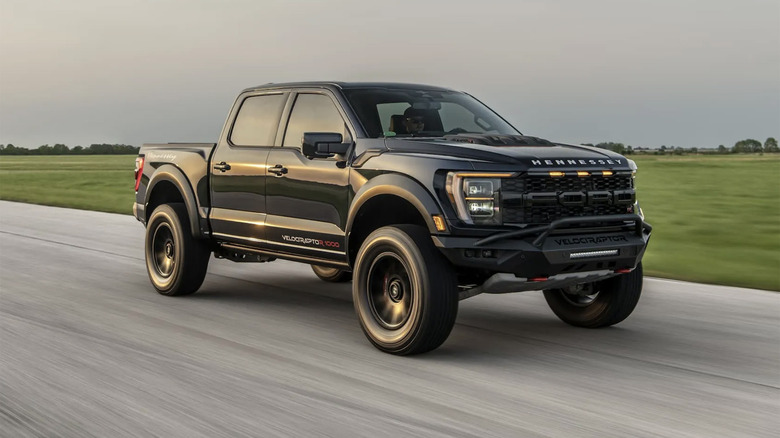
- Shockwave Jet Semi: Powered by three Westinghouse J34-48 turbojet engines, this customized Peterbilt semi holds the official jet-truck record at a mind-boggling 376 mph.
- custom Diesel Drag Trucks: Specialized drag-racing pickups utilizing heavily modified Duramax or Cummins powerplants regularly clear 200 mph in the standing half-mile.
- Salt Flat Racers: Custom-tubed bodies resembling pickup silhouettes have broken the 300 mph barrier in specialized Bonneville racing classes.
The Physics of Fast Trucks
Making a truck go fast requires fighting massive amounts of aerodynamic drag and heavy rotational mass. Unlike low-slung supercars, pickups push a wall of air, meaning record-setting trucks rely on massive forced induction, custom chassis lowering, and specialized gear ratios to maintain stability at extreme velocities.
2026 World’s Fastest Trucks: Your Essential Action Plan
Welcome to the definitive walkthrough for understanding, identifying, and analyzing the engineering marvels behind the fastest trucks in the world. Whether you are a heavy-duty automotive enthusiast, a performance truck builder, or simply curious about how multi-ton vehicles achieve supercar-shattering speeds, this guide will walk you through the categories, mechanics, and record-holders. By following this structured plan, you will gain a comprehensive understanding of factory muscle, drag-racing semis, and land speed record holders.
Step 1: Define the Categories of High-Speed Trucks
What you need: Access to automotive databases, truck classification charts, and an understanding of gross vehicle weight ratings (GVWR).
Instructions: Before you can identify the fastest truck, you must establish the category. Trucks are split into three distinct speed segments: factory production street trucks, heavily modified diesel drag trucks, and custom jet- or rocket-powered land speed record vehicles. Factory trucks focus on a balance of towing, handling, and straight-line speed. Drag trucks utilize massive twin-turbo setups to move up to 8,000 pounds down a quarter-mile strip in under nine seconds. Land speed trucks abandon utility entirely, functioning purely as aerodynamic missiles. Categorize your research so you do not mistakenly compare a 700-horsepower street truck to a purpose-built 12,000-horsepower semi-tractor.
Pro Tip: Always verify whether a truck is street-legal or purely a track/exhibition vehicle, as this completely changes performance metrics.
Step 2: Analyze Factory Production Record Holders
What you need: Specifications for high-performance production trucks like the Ram TRX, Ford F-150 Raptor R, and historical models like the Ford F-150 Lightning SVT and Dodge RAM SRT-10.
Instructions: Examine factory-released trucks that you can legally purchase and drive off a dealership lot. Historically, the Dodge RAM SRT-10 held the Guinness World Record for the fastest production truck with a top speed of 154.5 mph, powered by a Viper-derived V10 engine. Today, modern supercharged hyper-trucks like the Ram 1500 TRX and Ford F-150 Raptor R dominate the conversation, offering 0-60 mph times under 4.5 seconds. Study their horsepower outputs (often exceeding 700 hp) and forced-induction systems. Review how manufacturers balance heavy frame weights with massive aerodynamic drag to achieve these blistering factory speeds.
Pro Tip: Keep in mind that modern high-speed production trucks are usually electronically limited to protect factory tires from catastrophic failure at high velocities.
Step 3: Investigate Modified Diesel Drag Racing Trucks
What you need: Knowledge of common-rail diesel engines (Duramax, Cummins, Powerstroke), aftermarket dual-fuel injectors, and massive compound turbocharger configurations.


Instructions: Shift your focus from top speed to acceleration by examining modified diesel trucks competing in quarter-mile drag racing. Trucks built by shops like Hardway Performance or Firepunk Diesel regularly push past 2,000 horsepower using heavily built diesel blocks. Analyze how they manage tremendous amounts of torque—often exceeding 2,500 lb-ft—without twisting the chassis in half. Look at how weight reduction, specialized four-wheel-drive launch controllers, and built transmissions allow heavy three-quarter-ton and one-ton pickup trucks to run the quarter-mile in the 8-second range at over 160 mph.
Pro Tip: Pay close attention to transmission upgrades; factory gearboxes will disintegrate almost instantly under the crushing low-end torque of a modified diesel engine.
Step 4: Explore Semi-Truck and Big Rig Racing
What you need: FIA European Truck Racing Championship regulations, data on custom racing semis, and specs for drag-racing semi-tractors like “Shockwave” or “Iron Cowboy.”
Instructions: Investigate heavy commercial semi-trucks modified for extreme speed. While European circuit racing limits semi-trucks to a governed top speed of 100 mph (160 km/h) for safety on road courses, drag-racing semis operate in an entirely different universe. Look into jet-powered big rigs equipped with Pratt & Whitney J34-48 jet engines, which produce over 36,000 pounds of thrust and propel multi-ton semi chassis past 300 mph. Analyze how aerodynamic modifications, drag chutes, and specialized heavy-duty dual-braking systems are required to safely stop these massive exhibition vehicles.
Pro Tip: Jet-powered semi-trucks consume fuel at astonishing rates—sometimes burning up to 400 gallons of fuel per run—so logistical planning is a massive part of their operation.
Step 5: Examine Land Speed Record (LSR) Specialty Trucks
What you need: Salt flat racing guidelines (such as Bonneville Salt Flats rules) and technical profiles of custom streamliner trucks.
Instructions: Study specialized vehicles built specifically to capture absolute land speed records within truck classes. These vehicles often feature custom tubular space frames covered in aluminum or carbon-fiber bodies shaped like traditional truck silhouettes, though underneath they share more in common with fighter jets or Indy cars. Review how engineers calculate aerodynamic drag coefficients and downforce to prevent these high-profile vehicles from lifting off the ground at speeds exceeding 250 mph. Look at past record-holders and the specific engine classes—ranging from blown fuel gassers to modified turbodiesels—that compete on the salt flats.
Pro Tip: Environmental conditions on salt flats, including salt crust thickness and crosswinds, play a massive role in whether an LSR attempt succeeds or fails.
Step 6: Evaluate Aerodynamics, Cooling, and Powertrain Engineering
What you need: Basic understanding of drag coefficients ($C_d$), intercooling principles, and high-performance lubrication systems.
Instructions: Break down the core engineering challenges that prevent standard trucks from becoming fast. Trucks are fundamentally shaped like bricks, resulting in terrible aerodynamic profiles that create massive high-pressure zones at the front and turbulent wake at the rear. Examine how builders lower ride heights, add front splitters, and install functional hood extractors to manage airflow. Furthermore, analyze thermal management: keeping a 1,500-horsepower engine cool while pulling heavy loads or sprinting down a track requires upgraded aluminum radiators, auxiliary oil coolers, and custom water-methanol injection kits.


Pro Tip: Lowering a truck’s suspension by even 3 to 4 inches drastically reduces high-speed instability and improves aerodynamic efficiency.
Step 7: Analyze Tire Technology and Safety Equipment
What you need: Speed-rated tire catalogs (Z-rated or higher), multi-point roll cage specifications, and fire suppression system guidelines.
Instructions: Understand that speed is useless if you cannot safely control and stop the vehicle. Investigate the specialized tires required to support a 5,000-pound vehicle traveling over 150 mph; standard truck tires will delaminate due to centrifugal force. Look at high-speed speed-rated tires designed specifically for heavy performance SUVs and trucks. Finally, review mandatory safety equipment, including SFI-certified racing harnesses, window nets, fuel cells, and NHRA-approved roll cages required for any truck attempting high-speed runs on a sanctioned track.
Pro Tip: Never attempt high-speed testing on street tires that lack the proper load index and speed rating for sustained velocity.
✅ Final Checklist
- Correctly categorized the truck type (Factory, Modified Diesel, Semi, or Land Speed Record).
- Verified horsepower, torque outputs, and official top speed or quarter-mile times.
- Analyzed structural modifications, including suspension drops and chassis reinforcement.
- Confirmed safety equipment requirements, such as speed-rated tires and roll cages.
Important Notes:
- Extreme high-speed driving on public roads is illegal and extremely dangerous; always test vehicles on closed tracks or sanctioned salt flats.
- Consult professional chassis fabricators and engine builders when modifying heavy vehicles for high-horsepower applications.
- Building or maintaining a high-performance speed truck requires a flexible budget, with custom engine and transmission builds easily ranging from $20,000 to over $100,000.
How to Analyze Production Versus Modified Truck Performance Specs
Comparing a factory-fresh street truck to a custom garage build requires looking at specific performance metrics. You cannot judge a production sports truck by the same standards as a purpose-built land speed record contender.
Key Metrics for Fast Trucks
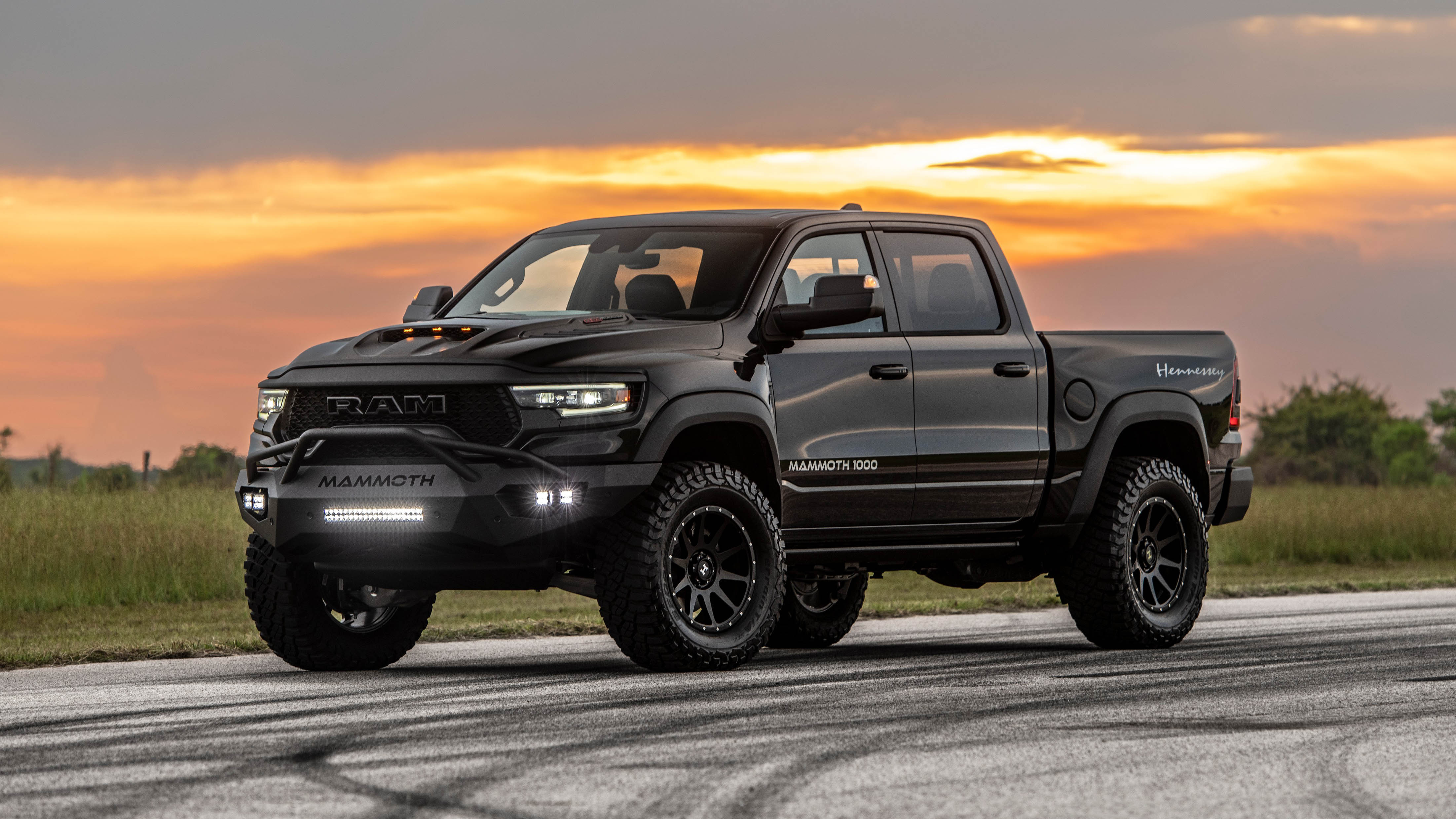
- 0-60 MPH Times: Factory performance trucks like the GMC Syclone achieved this in 4.3 seconds, while modern electric and supercharged entries push well under the 4-second mark in 2026.
- Quarter-Mile Performance: Measures the sheer acceleration capability, with top-tier modified street trucks clearing the strip in the 9 to 11-second range.
- Horsepower-to-Weight Ratio: The ultimate equalizer determining how effectively a heavy chassis can accelerate from a dead stop or rolling start.
Factory Street-Legal Contenders
While jet trucks grab headlines, production street trucks offer a different kind of thrill. From the legendary turbocharged V6 GMC Syclone of the 1990s to modern supercharged V8 and high-output electric platforms, factory engineers design these vehicles to handle daily driving while still delivering supercar-humiliating acceleration.
What If Factory Trucks Fail to Match Custom Drag Speed Records
Factory production models rarely match the raw quarter-mile times achieved by heavily modified custom drag trucks. When a stock performance pickup falls short of tuner expectations, enthusiasts must analyze specific mechanical bottlenecks. Discrepancies usually stem from factory electronic speed limiters, stock tire weight, or conservative powertrain software.
Addressing Powertrain and Software Limitations
Production trucks prioritize daily reliability and emissions compliance over absolute track dominance. Tuners targeting world-class speeds must systematically upgrade restricted components to bridge the gap against custom builds.
- Flash the Engine Control Unit (ECU) to remove factory speed governors and optimize air-fuel ratios for high-octane racing fuel.
- Upgrade the forced induction system by installing larger twin-turbochargers or ported superchargers capable of delivering higher boost pressure safely.
- Reinforce the transmission internals, including upgraded torque converters and multi-disc clutches, to handle torque outputs exceeding 1,000 pound-feet without slipping.
- Switch to lightweight forged alloy wheels wrapped in specialized drag slick tires to drastically reduce rotational mass and improve launch traction.
What If It Still Doesn’t Work?
If performance modifications fail to yield expected speed gains, underlying mechanical or aerodynamic issues require professional intervention. Here are the necessary troubleshooting steps for persistent speed deficits in 2026:
- Perform a comprehensive dyno tuning session with a professional calibrator to identify air leaks, boost pressure drops, or timing retard issues.
- Inspect the intercooler system for thermal efficiency drops, as heat soak significantly reduces high-performance engine output during repeated quarter-mile passes.
- Consult a specialized motorsport fabrication shop to evaluate chassis rigidity and weight distribution, ensuring optimal power transfer to the rear axle.
- Seek professional engine rebuilding services if internal component wear or compression loss limits maximum horsepower output.
Professional diagnostic and custom tuning services typically range from $1,500 to $5,000, while complete engine and transmission reinforcement can exceed $20,000 depending on target power levels.


Conclusion
Determining the fastest truck in the world requires separating street-legal production powerhouses from dedicated custom drag racers. While factory electric and supercharged pickups continue to push boundaries, custom builds still hold the ultimate speed crowns. According to verified research and expert automotive testing sources, achieving true record-breaking velocity demands meticulous powertrain calibration and safety reinforcement. Review the latest 2026 manufacturer specifications today to choose the ideal performance platform for your high-speed goals.
❓ Frequently Asked Questions
What is the difference between a production truck and a custom record truck?
A production truck is built by the manufacturer and sold directly to consumers with a standard warranty. A custom record truck is heavily modified by racing teams with specialized engines, safety cages, and aerodynamics for high-speed runs.
Why do factory performance trucks have electronic speed limiters?
Manufacturers install electronic speed limiters to protect factory-installed all-terrain tires from excessive heat and structural failure at high velocities.
Which historic trucks set early speed records?
Classic high-speed production trucks include the GMC Syclone from the 1990s and the Dodge Ram SRT-10, which held Guinness records for factory speeds in the 2000s.
How do engineers make heavy trucks go fast?
Engineers utilize forced induction like superchargers or turbochargers, upgraded transmission cooling, lowered suspensions, and high-performance street tires to handle extreme speeds.
Do diesel trucks hold speed records?
Yes, heavily modified diesel semi-trucks and pickup trucks have set impressive speed records in specialized land speed racing events like the Bonneville Salt Flats.
What role does aerodynamics play in a truck’s top speed?
Pickup trucks naturally have poor aerodynamics due to open beds and blunt front fascias, making aerodynamic covers and splitters critical for breaking high-speed records.
![Does a Cold Air Intake Void Warranty? Legal Rights Explained [2026]](https://truckguider.com/wp-content/uploads/2026/03/does-cold-air-intake-void-warranty-featured.webp)