2011 Ford F-150 Blend Door Actuator Reset in 5 Easy Steps

A 2011 Ford F-150 blend door actuator reset takes about five minutes and one fuse pull. The fix works when the HVAC control module has lost its stored door positions, which happens most often after a battery disconnect or a jump start.


The 2011 F-150 is a 12th generation truck, built on the 2009 to 2014 platform. Its climate system uses small electric motors to move the blend, mode, and recirculation doors.
When the module forgets where those doors sit, it drives the motors past their stops and the dash starts clicking. This guide gives you the exact fuse number, the exact wait times, and the honest limits of a reset.
5 Signs Your 2011 F-150 Blend Door Actuator Needs a Reset


Actuator trouble shows up in sound first and temperature second. A rhythmic click behind the dash is the classic early warning, and if it started right after a battery change, a reset has a good chance of fixing it.
Clicking Behind the Dash
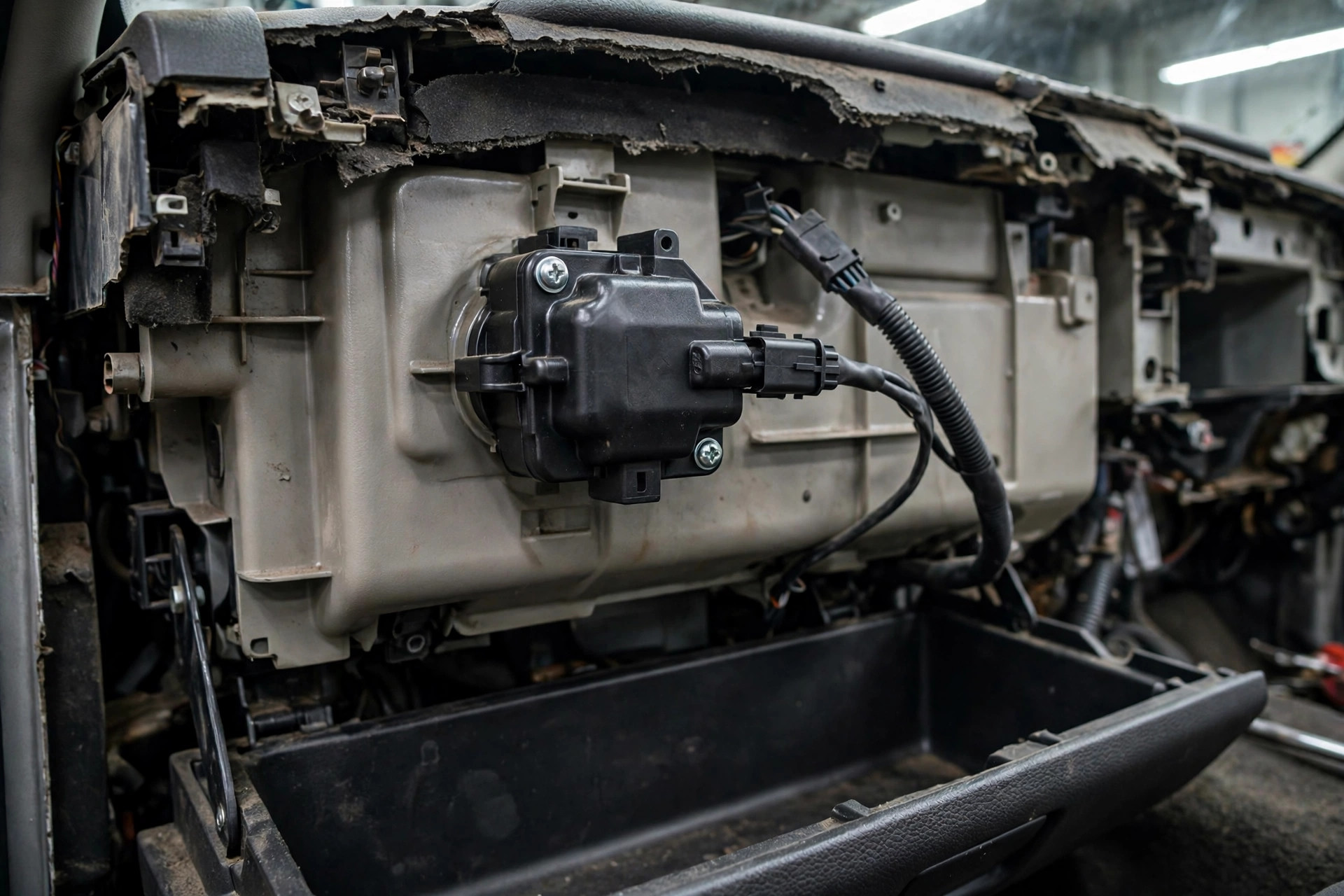
A steady tick or click from behind the center of the dash usually means stripped plastic gears inside the actuator. The motor keeps turning while the broken gear skips teeth, so the sound repeats in a rapid rhythm. Owner reports on iFixit describe the same clicking on 2011 trucks.
Place a fingertip on the actuator housing while someone turns the temperature knob. You will feel the failed unit vibrate with each click, which confirms the location before you order any part.
Stuck Temperature Setting


The air stays full hot or full cold no matter where you set the knob. The blend door cannot move because the module has lost its position data or the gears have stripped. A reset fixes the first cause only, so this symptom is a useful test of the relearn itself.
One Side Hot One Side Cold
Dual zone trucks have two temperature blend door actuators, one per side. When the driver side blows hot while the passenger side blows cold, only one actuator has failed or lost calibration.
Airflow Stuck on Defrost
Air that only comes from the windshield vents points to the mode door actuator, not the blend door. The system defaults to defrost when it cannot confirm the mode door position, which is a safety design. A reset can still help if the cause is lost calibration, and the same fuse 46 relearn covers the mode door too.
Clicking After a Battery Disconnect
A dead battery, a jump start, or routine battery work can wipe the HVAC module memory. Without its stored end stop positions, the module hunts for position on the next key cycle. This is the clearest case for a reset, because nothing is broken yet.
Symptoms alone do not tell you which of the four actuators is at fault. The location map below sorts that out.
Where the 2011 F-150 Blend Door Actuators Sit
The 2009 to 2014 F-150 carries four HVAC actuators, and each one does a different job. Mixing them up wastes money, because a mode actuator will not fix a temperature problem. Our guide to blend door actuator locations across trucks shows the same layout with diagrams if you want the full visual map.
| Actuator | Function | Location on a 2011 F-150 | Symptom When It Fails |
|---|---|---|---|
| Temperature blend door, passenger side | Mixes hot and cold air for the cabin | Behind the center stack, near the glove box | Clicking behind the dash, temperature stuck hot or cold |
| Temperature blend door, driver side | Mixes hot and cold air, driver zone only | Low on the HVAC housing, above the transmission tunnel | Driver side hot while passenger side stays cold |
| Mode door | Routes air to defrost, vents, or floor | Driver side of the housing, above the gas pedal | Airflow stuck on defrost, cannot switch to face vents |
| Recirculation door | Selects fresh air or cabin air | Top of the blower housing, behind the glove box | Clicking at key on, windows fog, outside smells enter |
Manual climate trucks have a single blend door actuator in the passenger side position. Dual zone automatic trucks add the driver side unit, so the actuator behind the radio controls passenger temperature while the lower unit controls driver temperature. The mode actuator sits high on the driver side, directly above the gas pedal, and the recirculation actuator hides behind the glove box.
Do not force any door or gear during access. A cracked blend door turns a small job into a dashboard removal. With the right actuator identified, the reset itself needs no tools beyond a fuse puller.
How to Reset the 2011 F-150 Blend Door Actuator in 5 Steps
This is the fuse 46 relearn, and it is the method Ford technicians use first. It cuts power to the climate controls module, which forces a full calibration sweep when power returns.
- Park and switch everything off. Turn the ignition off, set the parking brake, and switch the climate controls off. Keep the engine off and the key out until the procedure tells you to turn the key on.
- Find the passenger compartment fuse panel. The Smart Junction Box sits under the right hand side of the instrument panel, behind the passenger side kick panel trim. Pull the trim toward you and remove the fuse box cover.
- Pull fuse 46 and wait at least one minute. Fuse 46 is a 10A fuse for the climate controls module in the 2011 to 2014 panel layout. Use the fuse puller from inside the fuse panel cover. A blown fuse shows a broken metal strip inside, and it must be replaced with a fresh 10A fuse before you go on.
- Refit the fuse and turn the key to ON. Push fuse 46 firmly back into the same socket, then turn the ignition to ON without starting the engine. Do not touch any climate control knob or button from this point on.
- Wait about 30 seconds, then test every setting. The HVAC module sweeps the blend, mode, and recirculation doors through their full range to relearn the end positions. You will hear the actuators move behind the dash. Once the sweep finishes, start the engine and run the temperature from full hot to full cold, then switch through defrost, vents, and floor.
One warning matters more than the rest of this procedure. Ford renumbered the Smart Junction Box for the 2011 model year, so fuse 46 in a 2009 or 2010 F-150 protects a different circuit entirely.
The 2011 to 2014 fuse chart lists fuse 46 as a 10A climate controls module fuse, while the 2009 to 2010 chart lists it as the occupant classification sensor. Confirm the number against the chart in your own 2011 F-150 Owner’s Guide before pulling anything. The fuse pull method matches this F-150 blend door reset guide. A Ford technician answer for the 2011 F-150 states the same rule plainly. Remove the Body Control Module fuse 46 for at least one minute before refitting it.
Reset at a Glance


- Ignition off. Open the passenger compartment fuse panel behind the right hand kick panel.
- Pull fuse 46, 10A, climate controls module. Wait at least 1 minute.
- Refit fuse 46 in the same socket. Turn the key to ON, engine off.
- Wait about 30 seconds. Do not touch any climate control during the sweep.
- Test full hot to full cold, then defrost, vents, and floor.
Applies to: 2009 to 2014 Ford F-150, manual climate and dual zone automatic climate. Check the fuse chart first on 2009 and 2010 trucks, because fuse 46 differs there.
Caution: Never force a blend door or an actuator gear into position. A reset cannot fix stripped gears or a cracked door, and forcing parts only adds damage.
If the sweep runs and the temperature responds again, the reset worked and the job is done. If the clicking returns the moment you move the temperature knob, the fault is mechanical and the next sections cover your options.
3 Other Reset Methods That Work on 2009-2014 F-150s
The fuse 46 relearn is the fastest method and the one to try first. These three fallbacks each force the same recalibration through a different route, and each one is worth exactly one try.
Battery Disconnect Reset
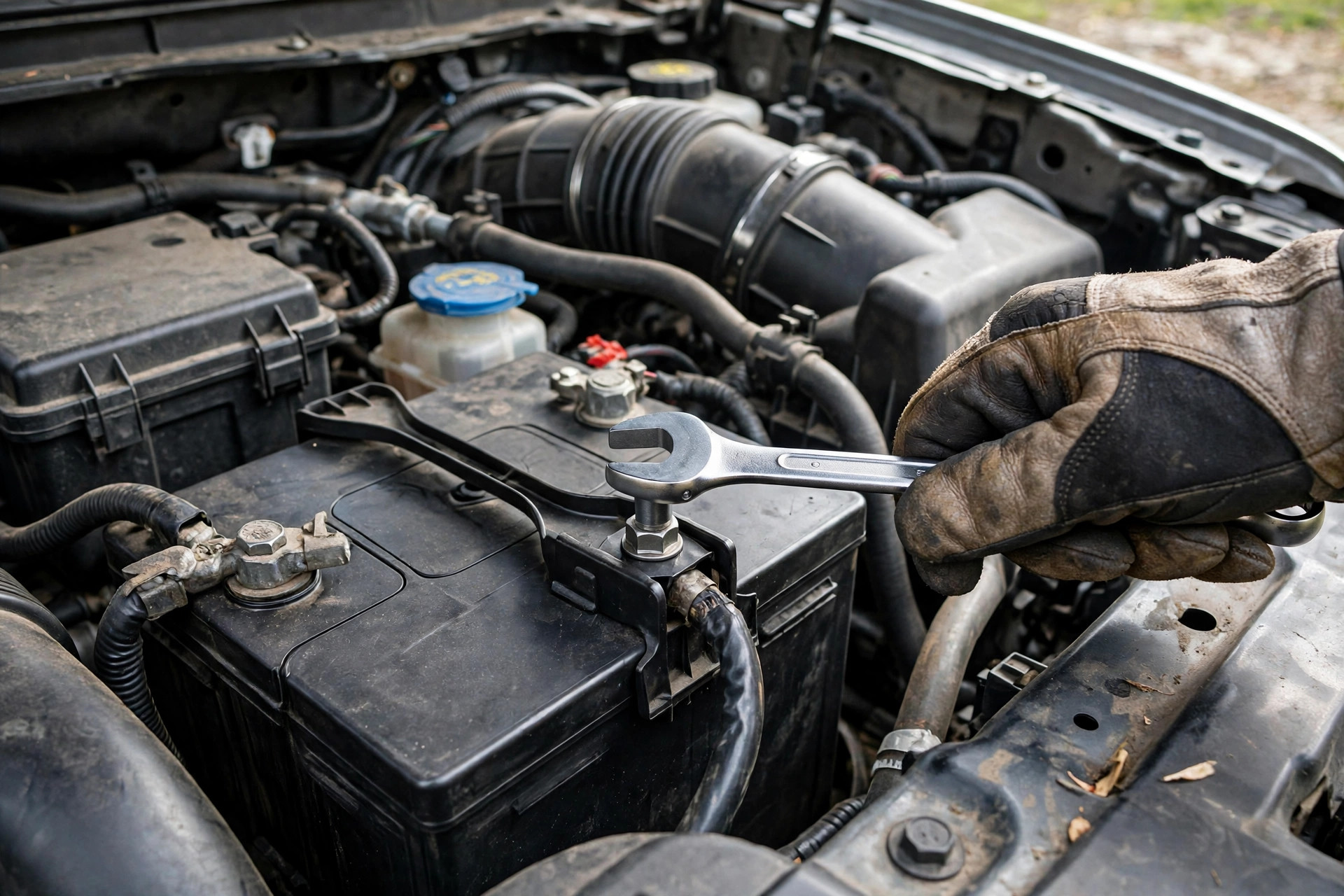
Disconnect the negative battery terminal first, using the black cable, and wait 10 to 15 minutes so every module fully discharges. Reconnect the negative terminal, turn the key to ON without starting the engine, and wait about 30 seconds with your hands off the climate controls while the doors sweep.
This method resets every module at once, so the radio presets and clock may need setting again afterward. A battery disconnect is also how many owners create this problem in the first place, so treat it as a fallback rather than routine maintenance.
Control Panel Button Sequence
Some repair guides describe a button sequence for manual climate trucks. With the ignition ON and the engine off, hold the OFF button and the front defrost button together for 5 to 10 seconds until the system starts a sweep. Leave the controls alone for about 60 seconds while it runs. Owners report mixed results, and the sequence is not documented in the 2011 Owner’s Guide, so try the fuse 46 method first.
Ignition Cycle Reset
Turn the key to ON without starting the engine, wait 10 seconds, then turn it off. Repeat that on and off cycle three times.
Then start the truck and let it idle for two minutes without touching the climate controls. Test the temperature from hot to cold afterward. This method is the gentlest of the three, and it sometimes clears a module that is confused rather than broken.
When none of these methods changes the symptom, the problem has moved past calibration. For broader air conditioning faults that a reset cannot touch, our Ford F-150 air conditioning troubleshooting guide covers low refrigerant, compressor faults, and weak airflow.
When a Reset Fails and Replacement Is the Fix
A reset only relearns door positions. It cannot regrow stripped gear teeth, and it cannot repair a cracked blend door. If the clicking continues after a full relearn, or if the temperature knob moves with no change in air temperature at all, the actuator or the door itself has failed mechanically.
The most common mechanical failure is stripped plastic gears inside the actuator. The motor spins, the gear skips, and the module never gets a stable position signal, so it keeps driving the motor and the clicking never stops.
A second failure is a cracked blend door, which lets the actuator over rotate and burn out its gears again. Owners who keep replacing the actuator without checking the door often find the new part fails within months.
Replacement cost depends heavily on which actuator failed, because access time varies from under an hour to most of a day. RepairPal estimates the 2011 F-150 HVAC blend door actuator replacement at 815 to 1,174 dollars on average, with labor at 769 to 1,128 dollars and parts at about 47 dollars, updated September 3, 2026. That figure reflects the book time for a buried actuator, while an accessible passenger side unit often costs far less at an independent shop.
| Repair Path | Typical Cost | What Drives the Price |
|---|---|---|
| DIY actuator replacement | About 25 to 60 dollars for the part | Actuator position, tools on hand, and one calibration relearn after install |
| Independent shop, accessible actuator | About 210 to 600 dollars | One to two hours of labor plus the part |
| Dealer or buried actuator | About 815 to 1,174 dollars | Dashboard work and book labor time, per RepairPal data updated September 3, 2026 |
Before ordering a part, confirm the exact number by VIN in the Ford parts catalog. The Ford workshop manual lists the right hand temperature blend door actuator under base part 19E616, but Motorcraft listings vary by climate system and position, and secondary sources disagree on the suffix. A wrong part will not calibrate, so the VIN check is worth the extra minute.
The same stripped gear clicking shows up on other trucks too, including the same clicking failure on a Ram 1500. Call a shop when the failed actuator sits behind the dashboard with no shortcut access. Get help too when the blend door itself is cracked, or when the truck needs a scan tool relearn that a fuse pull cannot trigger.
Reset Done Right Keeps Your 2011 F-150 Climate Working
A 2011 Ford F-150 blend door actuator reset is a five minute fuse pull, not a repair bill. Pull fuse 46, a 10A climate controls module fuse, wait at least one minute, refit it, and let the module sweep the doors for about 30 seconds with the controls untouched. That relearn fixes calibration loss from a battery disconnect and costs nothing but a few minutes.
When the clicking survives the relearn, the gears are stripped or the door is cracked, and no reset will save the part. Check the fuse chart for your exact model year, confirm the part by VIN, and get a shop involved when the actuator sits behind the dash. Start with the fuse pull tonight and you will know which side of that line your truck sits on.
5 Questions About the 2011 F-150 Blend Door Actuator Reset
Which Fuse Resets the Blend Door Actuator on a 2011 F-150
Fuse 46, a 10A fuse for the climate controls module, in the passenger compartment Smart Junction Box behind the right hand kick panel. Pull it for at least one minute, refit it, then turn the key to ON and wait about 30 seconds for the relearn sweep.
How Long Does the Relearn Take After the Reset
The calibration sweep itself takes about 30 seconds after you turn the key to ON. Add the one minute fuse pull and a few minutes of testing hot to cold and through each vent mode, so the whole job runs about five minutes.
Will Disconnecting the Battery Reset the Blend Door Actuator
Yes, disconnecting the negative terminal for 10 to 15 minutes forces the same relearn when you turn the key back on. A battery disconnect can also cause the calibration loss in the first place, so use the fuse 46 method first and keep the battery method as a fallback.
Why Does My 2011 F-150 Still Click After a Reset
Continued clicking after a full relearn means stripped plastic gears inside the actuator or a cracked blend door that lets the actuator over rotate. A reset only relearns positions, so a clicking actuator after a reset needs replacement, and the door itself should be checked before the new part goes in.
How Much Does a 2011 F-150 Blend Door Actuator Replacement Cost
RepairPal puts the average replacement at 815 to 1,174 dollars, with labor at 769 to 1,128 dollars and parts at about 47 dollars, updated September 3, 2026. An accessible passenger side actuator at an independent shop often runs 210 to 600 dollars, while a DIY part costs about 25 to 60 dollars.