2013 Ram 1500 5.7L HEMI: The Ultimate Technical Review & Buyer’s Guide 2026

The 2013 model year represents a watershed moment in the history of the Ram 1500 and, arguably, the light-duty pickup truck segment as a whole. While the “Ram” brand had officially separated from Dodge in the 2009/2010 restructuring, the 2013 refresh was the engineering consolidation of that identity, moving the vehicle decisively away from a purely utilitarian workhorse toward a dual-purpose luxury daily driver.
This was not merely a cosmetic facelift; it was a fundamental re-engineering of the powertrain and chassis dynamics that set the trajectory for the next decade of truck production.


For the automotive researcher, prospective buyer, or industry enthusiast, understanding the 2013 model is essential because it bridges the technological gap between the “old school” truck era—characterized by 4-speed or 6-speed transmissions, hydraulic power steering, and leaf springs—and the “modern” era of 8-speed transmissions, electric power steering (EPS), active aerodynamics, and air suspension.
The 2013 Ram 1500 was the first truck to successfully integrate these passenger-car technologies into a rugged body-on-frame platform without compromising its core utility.
The significance of the 2013 model year lies heavily in its powertrain options. While the legendary 5.7L HEMI V8 was a carryover engine, its integration with the ZF 8HP70 8-speed automatic transmission (branded as TorqueFlite 8) fundamentally altered the truck’s character. This combination addressed the two primary criticisms of V8 trucks: poor fuel economy and sluggish low-speed throttle response.
By keeping the engine in its optimal power band, Ram was able to offer a truck that was both faster and more efficient than its predecessors, challenging the supremacy of Ford’s burgeoning EcoBoost lineup.
Furthermore, the 2013 Ram 1500 introduced the segment-exclusive Active-Level™ Four-Corner Air Suspension. This system, adapted from the Jeep Grand Cherokee architecture, offered load-leveling capabilities and adjustable ride heights, promising a “magic carpet” ride that competitors utilizing traditional leaf springs could not match.
However, this complexity also introduced new variables regarding long-term reliability and maintenance costs, which this report will explore in exhaustive detail.
This report provides a granular analysis of the 2013 Ram 1500 equipped with the 5.7L HEMI V8. We will dissect the powertrain dynamics, analyze towing capabilities with mathematical precision, evaluate suspension engineering, and construct a detailed reliability profile based on over a decade of ownership data.
2013 RAM 1500
5.7L HEMI V8 LEGEND
The pivotal model year that changed the game. First-in-class 8-speed transmission, active air suspension, and the legendary Hemi power.
Why the 2013 Model Matters
The 2013 Ram 1500 wasn’t just a facelift; it was a revolution. It introduced the ZF 8-speed automatic transmission (TorqueFlite 8), which drastically improved fuel economy and towing capabilities compared to the aging 6-speed. Combined with the 5.7L Hemi, it offered a blend of power and refinement that competitors struggled to match at the time.
Class-Leading Power
In 2013, the Ram 1500’s 5.7L Hemi was a dominant force. While the Ford Coyote 5.0L and Chevy’s 5.3L Vortec were reliable, the Hemi offered superior raw output.
Towing: The Axle Ratio Factor
Not all Hemis tow the same. The rear axle gear ratio is the critical differentiator. To hit that 10,000+ lbs number, you need the 3.92 gears.
The 8-Speed Revolution
The introduction of the ZF 8HP70 8-speed transmission was the headline feature of 2013. Replacing the sluggish 65RFE 6-speed in upper trims, it kept the Hemi in its power band longer and significantly improved highway cruising efficiency.
- Rotary Shifter (Dial) introduced
- Faster, smoother shifts
- Improved MPG by ~15%
Common Reliability Issues
While the 5.7L Hemi is generally stout, the 2013 model year has specific known failure points. The “Hemi Tick” is the most notorious, often caused by broken exhaust manifold bolts.
Exhaust Manifold Bolts
Bolts snap due to heat cycles, causing a ticking noise on cold starts.
MDS Lifter Failure
Needle bearings in lifters can fail, potentially damaging the camshaft (The “Fatal Tick”).
TIPM Electrical
Totally Integrated Power Module issues can cause erratic fuel pump or starter behavior.
Trim Hierarchy
The 2013 lineup offered a configuration for every buyer.
- Tradesman Workhorse
- SLT / Big Horn Volume Seller
- Sport / R/T Street Perf.
- Laramie Luxury
- Longhorn / Limited Ultimate
Data Sources: Manufacturer Specifications (2013), EPA Fuel Economy Estimates, Consumer Reliability Reports.


Created for TruckGuider.com
Powertrain Engineering: The 5.7L HEMI V8 “Eagle”
At the core of the 2013 Ram 1500’s market appeal is the 5.7L HEMI V8. By 2013, this engine was in its “Eagle” revision, an update to the original Gen III HEMI introduced in 2003. The Eagle revision, introduced largely in 2009, brought Variable Valve Timing (VVT) and an active intake manifold to the platform, significantly broadening the torque curve compared to earlier iterations.
Engine Architecture and Technical Specifications
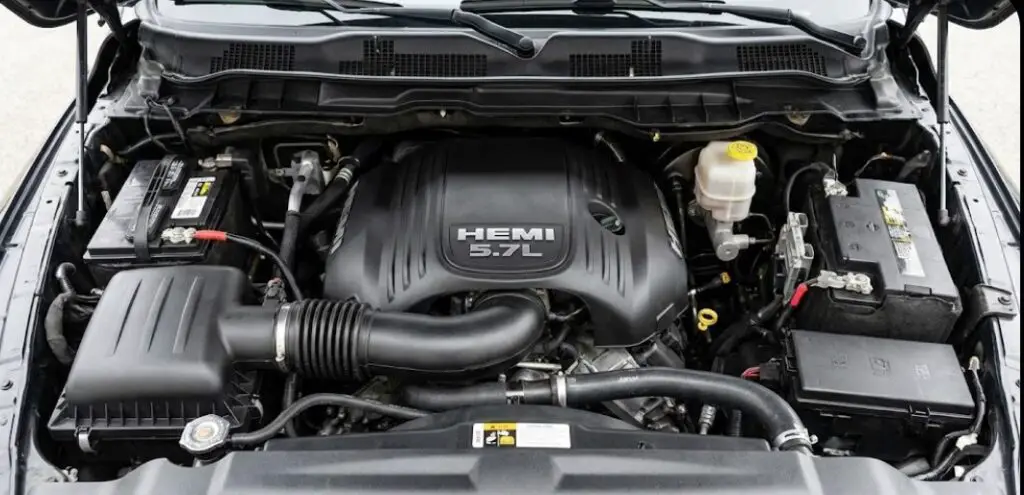
The 5.7L HEMI (Hemispherical) engine is a 90-degree V8 block that utilizes a pushrod valvetrain configuration. Unlike the overhead cam (OHC) designs favored by Ford (in the 5.0L Coyote) and Toyota (in the 5.7L i-FORCE), the pushrod design keeps the engine compact and lowers the center of gravity. The “Eagle” update refined the cylinder head design to improve flow and combustion efficiency, raising the compression ratio and optimizing the squish area for better flame propagation.
Detailed Specifications Matrix :
| Feature | Specification | Technical Notes |
| Engine Configuration | 90° V8, Liquid Cooled | Cast Iron Block, Aluminum Heads |
| Displacement | 5.7 Liters (345 cu. in.) | 3.92 in. bore x 3.58 in. stroke |
| Valvetrain | OHV, 16 Valves | 2 valves per cylinder, hydraulic roller lifters |
| Horsepower | 395 hp @ 5,600 RPM | Best-in-class naturally aspirated V8 (2013) |
| Torque | 407 lb-ft @ 3,950 RPM | 90% of torque available from 2,000 RPM |
| Compression Ratio | 10.5:1 | Requires knock sensors for 87 octane usage |
| Fuel Injection | Sequential Multi-Port (SMPI) | Electronic, returnless system |
| Variable Valve Timing | Yes (VVT) | Cam-in-block phasing |
| Cylinder Deactivation | Yes (MDS) | 4-cylinder mode under light load |
| Oil Capacity | 7 Quarts (with filter) | 5W-20 viscosity required for MDS function |
| Redline | 5,800 RPM | Limited by valvetrain mass |
Performance Analysis: The 395 horsepower output places the 2013 Ram 5.7L HEMI competitively against its contemporaries. Specifically, it outperformed the 2013 Ford F-150 5.0L Coyote (360 hp) and the 2013 Chevy Silverado 5.3L Vortec (315 hp) by significant margins. It even rivaled Ford’s twin-turbo 3.5L EcoBoost (365 hp) in raw horsepower, although the EcoBoost maintained an advantage in low-end torque delivery.
The inclusion of Variable Valve Timing (VVT) is a critical differentiator for the Eagle HEMI. Unlike Dual Overhead Cam (DOHC) engines that can vary intake and exhaust timing independently, the HEMI’s single camshaft design phases the entire cam. This means intake and exhaust events are advanced or retarded together. The ECU advances timing at low RPMs to increase torque and retards it at high RPMs to increase peak horsepower. This flexibility allows the engine to pull significantly harder from a stoplight compared to the pre-2009 non-VVT HEMIs, making it well-suited for the heavy curb weight of a modern crew cab truck.
The Multi-Displacement System (MDS)

A defining, and often polarizing, feature of the 5.7L HEMI in the 2013 Ram 1500 is the Multi-Displacement System (MDS). This fuel-saving technology is designed to deactivate four of the eight cylinders (cylinders 1, 4, 6, and 7) during light-load driving conditions, such as steady-state highway cruising or coasting down a gradient.
Mechanism of Action:
The MDS system relies on specialized hydraulic lifters for the deactivating cylinders. Under normal V8 operation, oil pressure is unrestricted, and the lifters function as standard hydraulic roller lifters, transferring the camshaft lobe’s motion to the pushrods. When the Engine Control Unit (ECU) determines that engine load is sufficiently low, it activates four solenoids located in the engine valley. These solenoids redirect oil pressure to the sides of the specific MDS lifters.
This pressurized oil collapses an internal pin mechanism within the lifter. Once the pin is disengaged, the outer body of the lifter continues to move up and down with the camshaft lobe, but the inner plunger (which contacts the pushrod) remains stationary. This effectively “disconnects” the valves from the camshaft. With both intake and exhaust valves closed, the trapped exhaust gases in the cylinder act as an air spring, compressing and expanding with no net loss of energy (other than friction), while the fuel injectors for those cylinders are cut off.
Operational Nuances and Ownership Impact:
While effective at squeezing out an extra 1 to 3 MPG on the highway, the MDS system is a frequent topic of technical debate regarding long-term reliability.
- NVH Management: Running a V8 as a V4 creates inherent imbalance and vibration. To counteract this, 2013 Ram 1500s are equipped with active vibration dampers and rigorous sound insulation to mask the transition. Most drivers cannot feel the switch, though an “ECO” light on the dash usually signifies its activation.
- Oil Viscosity Sensitivity: The MDS system is hydraulically actuated and calibrated specifically for 5W-20 oil viscosity. Using thicker oil (e.g., 10W-30 or 15W-40) can impede the speed of the solenoid actuation, leading to “check engine” lights or sluggish transition between V4 and V8 modes. It is critical for owners to adhere to the 5W-20 specification.
- Reliability Concerns: The “Hemi Tick”—a notorious issue discussed later in the Reliability section—is often colloquially blamed on the MDS lifters. The theory suggests that the collapsing mechanism can fail or get stuck, or that the reduced oil flow to the needle bearings during deactivation cycles can lead to premature wear. While definitive proof linking MDS solely to lifter failure is debated, many enthusiasts opt to disable MDS via aftermarket tuners to keep all eight cylinders firing and fully lubricated at all times.
Thermal Management and Active Grille Shutters
The 2013 update included a suite of thermal management technologies aimed at improving efficiency. Foremost among these are the Active Grille Shutters. Located behind the front grille but in front of the radiator, these shutters are controlled by the ECU based on vehicle speed and coolant temperature.
- Aerodynamic Mode: At highway speeds, if cooling demands are met, the shutters close. This diverts airflow around the truck rather than through the turbulent engine bay, reducing aerodynamic drag (Cd) by approximately 3-5%.
- Warm-Up Mode: On cold starts, the shutters close to restrict airflow to the radiator, allowing the engine to reach operating temperature faster. This improves heater performance for the cabin and reduces the time the engine spends in a fuel-rich “warm-up” cycle.
- Cooling Mode: Under heavy loads, such as towing or low-speed city driving in hot weather, the shutters open fully to maximize airflow through the cooling stack.
Transmission Revolution: The Tale of Two Gearboxes
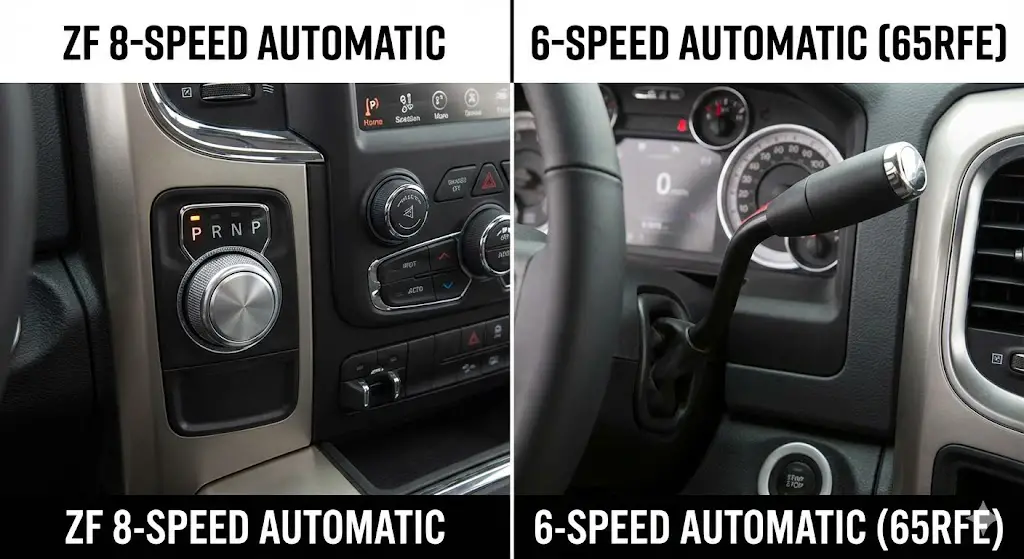
The 2013 model year is historically significant because it offered two distinct automatic transmission options for the 5.7L HEMI, creating a bifurcated ownership experience. Identifying which transmission a specific truck has is the single most critical step for any potential buyer, as it radically alters the performance, fuel economy, and towing behavior of the vehicle.
The Game Changer: ZF 8HP70 (TorqueFlite 8)
2013 marked the introduction of the ZF 8-speed automatic transmission to the Ram 1500, branded by Chrysler as the “TorqueFlite 8.” This transmission is widely regarded as one of the best longitudinal automatic transmissions ever built and is shared with luxury vehicles from BMW, Audi, and Land Rover.
Identification: The 8-speed is exclusively paired with the Rotary E-Shift Dial mounted on the dashboard to the right of the steering wheel. If the truck has a rotary dial, it has the 8-speed ZF transmission.
Engineering Advantages:
- Gear Ratio Spread: The ZF 8HP70 offers a massive gear ratio spread. It features a very short 4.71:1 first gear (compared to 3.00:1 in the 6-speed), which allows for aggressive launch torque multiplication. This masks the lack of low-end torque inherent in naturally aspirated V8s compared to turbo competitors. Conversely, it has two overdrive gears (0.84 and 0.67), allowing for low-RPM highway cruising.
- Shift Speed: The internal design utilizes four planetary gearsets and five shift elements (multi-disc clutches and brakes). By keeping the drag torque low and optimizing hydraulic pressure, the 8HP70 can execute shifts in 200 milliseconds, rivaling dual-clutch transmissions in speed while maintaining the smoothness of a torque converter automatic.
- Thermal Management: The transmission fluid is heated by engine coolant to bring it up to operating temperature quickly (reducing viscous friction) and cooled via a dedicated heavy-duty cooler during towing.
Performance Impact: Real-world testing reveals that 8-speed models are consistently faster and more efficient. 0-60 mph times for the 8-speed models typically clock in the high 6-second range (e.g., 6.9s), roughly 0.5 to 1.0 seconds faster than identical trucks equipped with the 6-speed. Furthermore, the EPA ratings for the 8-speed 4×2 Hemi are 15 city / 22 highway, a substantial improvement over the 14/20 rating of the 6-speed.


The Carryover: 65RFE 6-Speed Automatic
Many 2013 Ram 1500s, particularly lower trims (Tradesman, Express) or early production builds, were equipped with the older 65RFE 6-speed automatic transmission.
Identification:
This transmission uses a traditional column shifter or a console-mounted stick shifter. It does not use the rotary dial.
Technical Context:
The 65RFE is essentially a software-reprogrammed version of the old 5-speed 545RFE that had been in use since the early 2000s. The “6-speed” designation was achieved by enabling a “prime” gear that was previously only used during kick-down in the 5-speed logic.
- Ratios: The gear spacing is wide and uneven. The drop in RPM between gears (particularly 2nd to 3rd) is significant, often causing the engine to fall out of its power band when towing heavy loads up grades.
- Reliability: While mechanically robust, the 65RFE feels sluggish compared to the ZF unit. It lacks the “skip-shift” capability of the 8-speed (which can drop from 8th to 4th instantly) and relies more on the torque converter slipping to maintain momentum, generating more heat.
Buyer’s Insight:
Given the choice, the ZF 8-speed is the superior option in every metric: acceleration, towing control, fuel economy, and resale value. The 6-speed should only be considered if the purchase price is significantly lower or if the buyer prefers the column shifter layout.
Transfer Case Variations: BorgWarner 44-44 vs. 44-45
Ram utilized two different transfer cases in 2013, a detail often overlooked but crucial for off-road performance.
- BorgWarner 44-44 (On-Demand):
- Trims: Big Horn, Laramie, Sport, Longhorn, Limited.
- Modes: 2WD, 4WD Auto, 4WD Lock, 4WD Low.
- Operation: This is a “clutch-based” torque-on-demand system. In “4WD Auto,” the front driveshaft is engaged, but torque is not sent to the front wheels until rear wheel slip is detected by the wheel speed sensors. The system then electromagnetically clamps a clutch pack to transfer power.
- Criticism: Even in “4WD Lock,” the system relies on the clutch pack. Under extreme load (e.g., deep mud or rock crawling), the clutch can slip or overheat. It does not provide a true 50/50 mechanical lock.
- BorgWarner 44-45 (Part-Time):
- Trims: Tradesman, Express, Outdoorsman.
- Modes: 2WD, 4WD Lock, 4WD Low.
- Operation: This is a traditional mechanical transfer case. When engaged, it mechanically locks the front and rear driveshafts together.
- Advantage: This system is preferred for serious off-road use or plowing because it provides a positive, non-slip connection. However, it cannot be used on dry pavement without causing driveline bind (“crow hop”).
Towing and Payload Capabilities
Towing capacity for the 2013 Ram 1500 5.7L is not a monolithic figure; it varies wildly based on Axle Ratio, Cab Configuration, and Transmission. A common misconception is that “all Hemis tow 10,000 lbs.” This is dangerously incorrect. A poorly optioned Hemi Ram may have a lower tow rating than a V6 model.
The Axle Ratio Factor
The Rear Axle Ratio is the primary mechanical lever for towing capacity.
- 3.21 Axle Ratio: Known as the “Fuel Economy” gear. The lower numerical ratio keeps engine RPMs low at highway speeds.
- Effect: Significantly reduces torque multiplication at the wheels.
- Max Towing: Typically capped around 6,500 – 8,000 lbs.
- Insight: A 5.7L Hemi with 3.21 gears is essentially a light-duty cruiser. It will struggle to accelerate a heavy trailer and will hunt for gears on inclines.
- 3.55 Axle Ratio: The “Balanced” gear.
- Effect: A middle ground offering decent towing and acceptable MPG.
- Max Towing: Generally 8,500 – 9,500 lbs.
- Availability: Often found in the Outdoorsman trim or as a standalone option on others.
- 3.92 Axle Ratio: The “Max Tow” gear.
- Effect: High torque multiplication. Engine RPMs will be higher at cruising speeds (approx. 200-300 RPM higher than 3.21), but the truck will move loads with much less strain.
- Max Towing: 10,000 – 10,450 lbs.
- Requirement: If you plan to tow over 7,000 lbs regularly, the 3.92 axle is mandatory for transmission longevity and driving comfort.
Official Towing Capacity Data Matrix
The following table synthesizes data from 2013 Ram towing guides to illustrate the variance.
| Cab Style | Drive | Engine | Transmission | Axle Ratio | Max Towing (lbs) | Max Payload (lbs) |
| Regular Cab 8′ Box | 4×2 | 5.7L HEMI | 6-Speed Auto | 3.92 | 10,450 | 1,690 |
| Regular Cab 6’4″ | 4×4 | 5.7L HEMI | 8-Speed Auto | 3.21 | 6,350 | 1,440 |
| Quad Cab 6’4″ | 4×2 | 5.7L HEMI | 8-Speed Auto | 3.92 | 10,250 | 1,610 |
| Quad Cab 6’4″ | 4×4 | 5.7L HEMI | 8-Speed Auto | 3.21 | 6,350 | 1,440 |
| Quad Cab 6’4″ | 4×4 | 5.7L HEMI | 8-Speed Auto | 3.92 | 10,350 | 1,440 |
| Crew Cab 5’7″ | 4×4 | 5.7L HEMI | 8-Speed Auto | 3.21 | 6,350 | 1,380 |
| Crew Cab 5’7″ | 4×4 | 5.7L HEMI | 8-Speed Auto | 3.92 | 10,150 | 1,380 |
The Payload Predicament
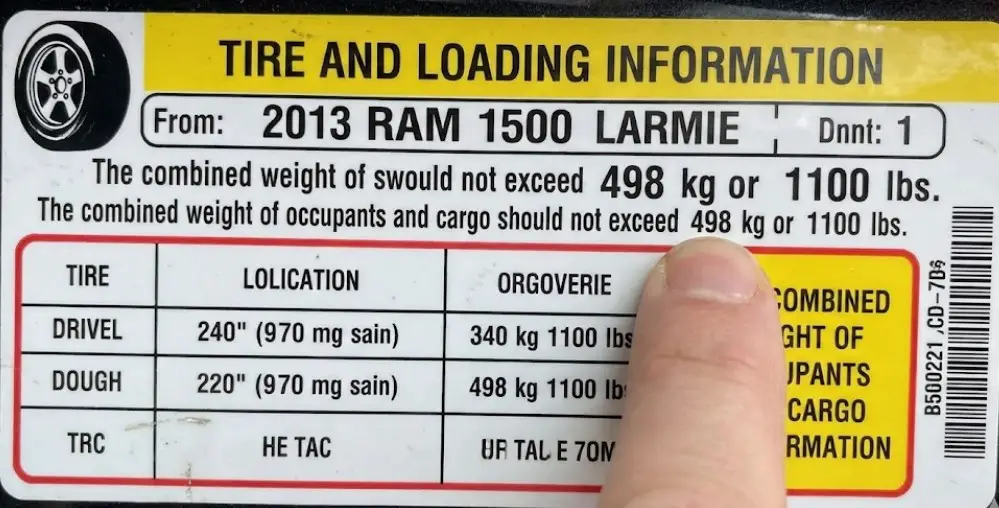
While the towing numbers are competitive, the Payload Capacity of the 2013 Ram 1500 is often its Achilles’ heel. Payload includes the driver, passengers, cargo in the bed, and the tongue weight of the trailer.
- The Problem: High trim levels (Laramie, Longhorn) are heavy due to luxury features (sunroofs, heated seats, air suspension). This weight eats directly into the GVWR (Gross Vehicle Weight Rating).
- Real World Scenario: A 2013 Ram 1500 Laramie Crew Cab 4×4 may have a door sticker payload of only 1,100 lbs.
- Driver + Passenger: 350 lbs.
- Hitch & Gear: 100 lbs.
- Remaining for Tongue Weight: 650 lbs.
- Result: You can legally tow only a ~6,500 lb trailer (assuming 10% tongue weight), far below the advertised “10,000 lb” towing capacity. Buyers must check the yellow tire and loading sticker on the driver’s door jamb for the specific truck’s limit.
Chassis Dynamics: The Suspension Revolution

Five-Link Coil Rear Suspension
In a radical departure from industry standards, Ram (then Dodge) abandoned the traditional leaf spring rear suspension in 2009 in favor of a multi-link coil spring rear suspension. 2013 saw further refinement of this system.
- Geometry: The live rear axle is located by four trailing arms (two upper, two lower) and a Panhard bar (track bar) to control lateral movement. Coil springs support the weight, and shock absorbers dampen the motion.
- Benefits: This setup virtually eliminates the “bed hop” and jittery ride associated with empty pickup trucks on washboard roads. It provides superior lateral stiffness compared to leaf springs (which can flex side-to-side), resulting in best-in-class cornering stability and steering precision.
- Towing Trade-off: Coil springs are generally linear in their compression rate, whereas leaf packs are progressive. This means the Ram 1500 can sag more noticeably under heavy tongue weight compared to a Silverado or F-150. Using a Weight Distribution Hitch (WDH) is critical to restoring front axle geometry when towing with this truck.
Active-Level™ Four-Corner Air Suspension
2013 introduced the segment-exclusive air suspension option. This system replaces the steel coil springs with pneumatic air springs (air bags) at all four corners, fed by a compressor and reservoir tank system.
Operational Modes:
- Normal Ride Height: Standard ground clearance (8.7 inches) for everyday driving.
- Aero Mode: At highway speeds, the system automatically lowers the truck 0.6 inches (front) and 0.7 inches (rear). This reduces the frontal area and turbulent airflow under the chassis, improving fuel economy by up to 1%.
- Off-Road 1: Lifts the truck 1.2 inches for added clearance over obstacles (up to 25 mph).
- Off-Road 2: Lifts the truck 2.0 inches for maximum clearance (up to 10.7 inches) for severe terrain (low speed only).
- Entry/Exit Mode: Lowers the truck 2.1 inches below normal height to allow passengers to step in easily and to lower the bed height for loading cargo.
System Architecture:
The system is a “closed loop” nitrogen-based system. Nitrogen is used because it is less susceptible to moisture expansion/contraction than atmospheric air. However, over time, leaks can allow atmospheric air (and humidity) to enter. This leads to the infamous “freezing” issues discussed in the Reliability section.
Trim Level Hierarchy and Equipment Guide
The 2013 Ram 1500 lineup is extensive, catering to every demographic from fleet operators to ranch owners. Understanding the trim hierarchy is essential for valuing a used unit.


| Trim Level | Primary Focus | Key Features & Equipment |
| Tradesman | Work/Fleet | Vinyl flooring, black bumpers/grille, 17″ steel wheels, spray-in liner (often). Usually 6-speed auto/3.6L or 4.7L standard, 5.7L optional. |
| Express | Youth/Entry Sport | Monochromatic body-color bumpers/grille, 20″ wheels, dual exhaust tips. Basic interior (often cloth bench, no touchscreen). Popular “Hemi value” package. |
| HFE | High Fuel Efficiency | 3.6L V6 only. Active grille shutters, stop-start, tonneau cover. Not available with Hemi. |
| SLT | Volume Retail | Chrome bumpers, cloth seats, power windows/locks/mirrors. The “blank canvas” for option packages like Big Horn. |
| Big Horn / Lone Star | Value Luxury | (Lone Star is Texas-only). Leather-wrapped steering wheel, 20″ chrome wheels, Uconnect 8.4″ touchscreen, power driver seat, 115V outlet. |
| Outdoorsman | Hunter/Fisher | Two-tone paint (usually with grey lower), skid plates, 3.92 axle standard (often), heavy-duty shocks, limited-slip differential. |
| Sport | Street Performance | Body-color monochrome exterior, projector headlights (black bezels), LED tail lights, 8-speed standard (mostly), premium cloth/leather hybrid buckets, console shifter (if 6-speed) or rotary (8-speed). |
| R/T | Sport Truck | Regular Cab 2WD only. 4.10 axle ratio, 22″ forged wheels, sport hood, high-stall converter. |
| Laramie | Luxury | Chrome mesh grille, two-tone paint option, leather heated/ventilated seats, memory seats, premium audio (Alpine), dual-zone climate. |
| Laramie Longhorn | Western Luxury | Premium “Natura” leather with laser etching, real walnut wood trim, saddle-bag pockets on seat backs, unique filigree instrument cluster, spray-in liner. |
| Laramie Limited | Ultimate Luxury | Subtle chrome usage, all-black premium leather interior, air suspension standard, body-color bumpers (sometimes), all available options included. |
Reliability Profile and Common Problems
Despite its critical acclaim and robust engineering, the 2013 Ram 1500 5.7L has developed a well-documented list of common failure points over the last decade. Prospective buyers must inspect these areas carefully.
The “Hemi Tick” Phenomenon
The “Hemi Tick” is a catch-all term used in forums to describe a tapping noise from the engine. However, there are two distinct mechanical failures that cause this, with vastly different repair implications.
Type A: Exhaust Manifold Bolt Failure (Most Common)
- The Cause: The 5.7L engine uses an aluminum cylinder head and a cast-iron exhaust manifold. These two metals have different coefficients of thermal expansion. As the engine heats up and cools down thousands of times, the manifold expands and contracts at a different rate than the head, shearing the heads off the rear manifold bolts (typically cylinders 7 and 8, near the firewall).
- The Symptom: A loud ticking or tapping noise on a cold start (resembling a lifter noise). As the engine warms up (1-2 minutes), the manifold expands, sealing the gap against the gasket, and the noise quiets down or disappears.
- The Fix: Removing the manifold, extracting the broken studs (often difficult), and replacing the gasket and bolts. Using aftermarket shorty headers can permanently solve this by providing a thicker flange.
- Cost: $400 – $900 depending on labor difficulty (drilling out studs).
Type B: Lifter/Camshaft Failure (Severe)
- The Cause: The roller bearings on the hydraulic lifters can fail due to lubrication issues (often debated to be linked to long idle times or MDS activation). When the roller seizes, it drags across the camshaft lobe instead of rolling, grinding the lobe down (wiping the cam).
- The Symptom: A persistent, rhythmic ticking or tapping that does not go away when the engine is warm. It may be accompanied by a misfire code (P030X) or rough idle.
- The Fix: Major engine surgery. Removing heads, replacing the camshaft and all lifters.
- Cost: $2,500 – $4,500.
Air Suspension System Failure
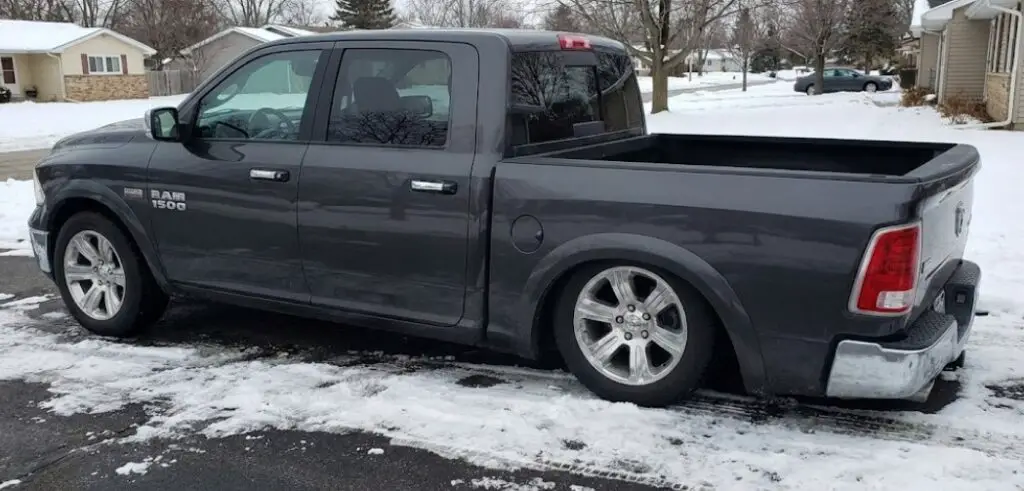
The Active-Level air suspension is a significant liability in cold climates.
- Moisture Ingress: As seal integrity degrades with age, moisture enters the nitrogen system. In freezing temps, this moisture freezes inside the valve block or lines.
- Result: The truck may get stuck in “Aero” or “Entry” mode, riding on the internal bump stops. This results in a jarring, suspension-less ride. Alternatively, a fuse (F99 40A) may blow as the compressor overworks itself.
- The Fix: Replacing individual components is expensive (Compressor: $800+, Air Springs: $400 each). Many owners opt to install a Coil Spring Conversion Kit (approx. $1,200 parts + labor) to permanently delete the air ride and return to standard steel springs.
Electrical: TIPM Issues
The Totally Integrated Power Module (TIPM) is the fuse box/computer that controls the truck’s electronics. It is notorious for internal relay failures.
- Fuel Pump Relay: The most common failure. The internal relay for the fuel pump welds itself stuck in the “on” position (draining the battery) or the “off” position (crank, no start).
- Symptoms: Erratic door locks, windows not working, horn honking randomly, or stalling while driving.
- The Fix: A TIPM bypass cable (cheap workaround) or a rebuilt TIPM board ($300 – $500).
Electric Power Steering (EPS)
2013 was the first year Ram switched to EPS.
- Issue: Circuit board contamination in early units caused sudden loss of power steering assist while driving.
- Status: There are open investigations and TSBs regarding this. It is a safety-critical check.
Water Leaks
- Third Brake Light: The gasket on the cab-mounted third brake light dries out, allowing water to leak into the headliner and stain the rear seat.
- Rear Cab Vents: The pressure relief vents behind the rear seats can leak, filling the storage bins under the rear seat with water.
Competitive Landscape (2013 Model Year)
To understand the 2013 Ram 1500’s value, it must be contextualized against its arch-rivals: the Ford F-150 and Chevrolet Silverado 1500.
| Feature | 2013 Ram 1500 (5.7L) | 2013 Ford F-150 (5.0L / 3.5L Eco) | 2013 Chevy Silverado (5.3L) |
| Transmission | 8-Speed (ZF) / 6-Speed | 6-Speed | 6-Speed |
| Horsepower | 395 hp | 360 hp (5.0L) / 365 hp (Eco) | 315 hp |
| Torque | 407 lb-ft | 380 lb-ft (5.0L) / 420 lb-ft (Eco) | 335 lb-ft |
| Rear Suspension | 5-Link Coil | Leaf Spring | Leaf Spring |
| Ride Quality | Best in Class | Truck-like (stiff empty) | Truck-like (stiff empty) |
| Interior Quality | Excellent (Uconnect 8.4) | Good (MyFord Touch laggy) | Dated (GMT900 gen) |
| Towing Max | 10,450 lbs | 11,300 lbs (EcoBoost) | 9,600 lbs (typical 5.3) |
Analysis:
- Vs. Ford: The Ford 3.5L EcoBoost is the towing king of 2013, offering massive low-end torque that rivals a diesel. However, the Ram 5.7L/8-speed combo is faster unladen and offers a significantly better daily driving experience due to the coil suspension and superior interior materials. The Ford 5.0L is a reliable engine but lacks the Ram’s low-end punch.
- Vs. Chevy: The 2013 Silverado was the final year of the “GMT900” generation. It feels significantly older than the Ram. Its 5.3L engine (315 hp) is severely outclassed by the Hemi (395 hp). Unless a buyer specifically wants the proven simplicity of the Chevy LS engine architecture, the Ram is the superior truck in almost every performance metric for this model year.
Buying Guide and Inspection Checklist
Pre-Purchase Inspection (PPI) Walkthrough
- Cold Start Check: Ensure the engine is cold (touch the exhaust manifold carefully). Ask the seller not to run it before you arrive. Start it and listen immediately at the wheel wells. Ticking that fades = Manifold Bolts (bargaining chip). Ticking that stays = Lifters (Walk away).
- Air Suspension Test: If equipped, cycle the suspension from Normal to Off-Road 1, then down to Entry/Exit. It should move smoothly without loud compressor grinding. Check for uneven ride height.
- Transmission Check: Verify it has the Rotary Dial (8-speed). Test shifting from P to D and R. Drive at 30-40 mph and feel for “clunking” on downshifts (common software issue, usually fixed with a flash, but can indicate wear).
- Drive 4WD: Engage 4WD Auto and 4WD Lock on a loose surface (gravel/dirt). Listen for grinding.
- Check Payload Sticker: Open driver door. Look for “Tire and Loading Information.” Read the “Combined weight of occupants and cargo should not exceed XXX kg or XXX lbs.” Ensure this number meets your towing needs (Tongue weight + Family).
Market Value (2025/2026 Context)
- Value Sweet Spot: A 2013 Ram 1500 Laramie or Sport with ~100,000 miles typically trades between $13,000 and $16,000.
- Bargain: Tradesman or Express models can be found for $8,000 – $11,000, offering high performance for a low price, though often with the 6-speed transmission.
Conclusion
The 2013 Ram 1500 5.7L Hemi remains a compelling proposition in the used truck market. Its combination of the 395-horsepower Hemi, the excellent ZF 8-speed transmission, and the coil-spring rear suspension creates a driving experience that still feels modern over a decade later. It successfully bridged the gap between “work truck” and “luxury family hauler” in a way its competitors didn’t match until years later.
For the savvy buyer, the key is specificity: seeking out the 8-speed transmission (Rotary Dial), verifying the axle ratio fits their towing needs (3.92 for towing, 3.21 for commuting), and carefully inspecting for the “Hemi Tick” and air suspension issues. A well-maintained 2013 Ram 1500 is not just a used truck; it is a high-performance machine that offers 80% of the utility of a brand-new pickup for 20% of the price.
![2023 Ram 1500 Classic Tradesman: Full Specs & Data [2026]](https://truckguider.com/wp-content/uploads/2026/03/2023-ram-1500-classic-tradesman-featured.webp)
![2015 RAM 1500 AC Recharge Port Location & Identification [2026]](https://truckguider.com/wp-content/uploads/2026/03/2015-ram-1500-ac-recharge-port-featured.webp)
![U1424 Code Ram 1500: Causes, Symptoms, and AGS Solutions [2026]](https://truckguider.com/wp-content/uploads/2026/03/u1424-code-ram-1500-featured-768x403.webp)