2017 Ram 1500 Blower Motor Resistor Location: Identification And Access Guide

When the climate control in your 2017 Ram 1500 fails to respond to fan speed adjustments, the culprit is almost certainly the blower motor resistor. Drivers often find themselves stuck with a fan that only runs on ‘High’ or refuses to engage at all, creating a frustrating and potentially unsafe driving environment during extreme temperatures. Whether you are dealing with the sweltering heat of summer or the biting cold of winter, a compromised HVAC system is more than an inconvenience—it is a functional failure of the vehicle’s cabin comfort system. This guide provides the exact location of the blower motor resistor, the specific tools required for access, and a professional walkthrough for replacing the unit to restore your HVAC system’s functionality.


Understanding the 2017 Ram 1500 Blower Motor Resistor Function
The blower motor resistor is a vital electrical component that regulates the current flowing to the blower motor, thereby controlling fan speeds. In the 2017 Ram 1500, this component acts as a gatekeeper for electrical energy. When you adjust your fan dial from low to medium, you are essentially switching between different resistance circuits within this module. By providing varying levels of resistance, the unit reduces the voltage reaching the motor, which in turn dictates how fast the blades spin.
Technically speaking, the 2017 Ram 1500 HVAC architecture utilizes either a traditional wire-wound resistor (for manual climate control models) or a solid-state pulse-width modulation (PWM) module (for automatic climate control models). Both serve the same primary purpose: dissipating electrical energy as heat to achieve the desired airflow. Maintaining a functional resistor is essential for cabin comfort and windshield defrosting capabilities, particularly in extreme weather conditions where visibility depends on consistent air movement.
Engineered for durability, these components are typically designed to last for several years, though they are susceptible to heat-related wear. Research indicates the average lifespan of a blower motor resistor is between 5-7 years, often dictated by the frequency of HVAC usage and cabin filter cleanliness.
A common failure scenario occurs when the internal thermal fuse or a specific resistor coil burns out. In these instances, a driver might find that the fan only operates on its highest setting. This happens because the ‘High’ setting usually bypasses the resistor entirely, sending a full 12 volts directly to the motor. If your truck is exhibiting this “all or nothing” behavior, the resistor is the undisputed primary suspect.

Exact 2017 Ram 1500 Blower Motor Resistor Location and Access
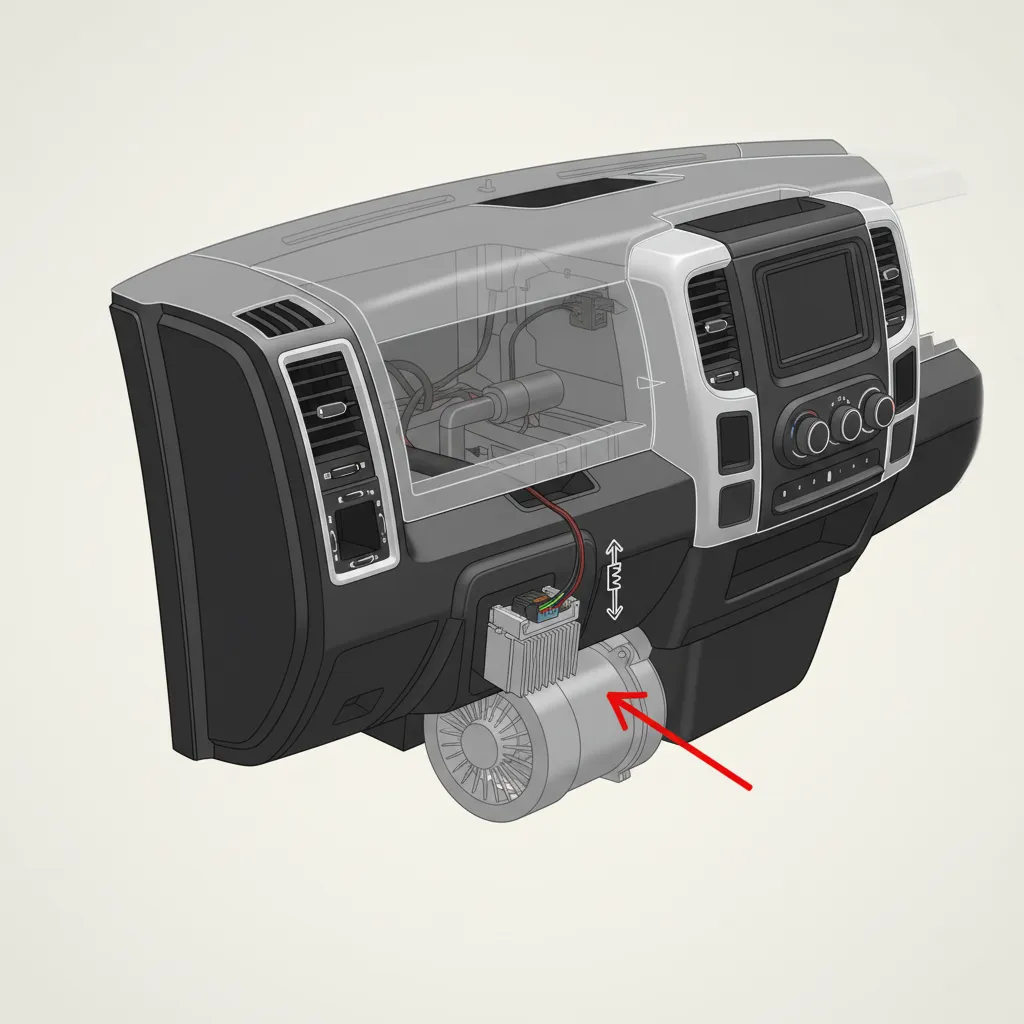
Precision is key when locating components under the dense dashboard assembly of a modern truck. The primary location for the blower motor resistor in a 2017 Ram 1500 is the passenger side footwell, situated directly beneath and slightly behind the glove compartment assembly. It is strategically placed within the HVAC heater box housing to allow the very airflow it regulates to cool its internal components, preventing premature overheating.
To access the unit, you must position yourself in the passenger footwell and look upward. It is positioned adjacent to the blower motor itself, identifiable by a multi-pin electrical harness connector plugged into a rectangular or oval plastic base. This base is secured to the ductwork, ensuring the resistor’s heat sink is protruding into the air stream. For those following an official guide for Ram maintenance, you will find that this proximity to the blower motor is standardized across the DS platform.
By The Numbers
HVAC Issues in Maintenance
Standard Mounting Bolt Size
Average Component Lifespan
In many Ram 1500 configurations, a plastic close-out panel—often referred to as a ‘silencer pad’—is installed under the dash to dampen cabin noise. This panel must be removed by releasing two or three plastic push-pins. Once this panel is lowered, the resistor becomes clearly visible, tucked further back toward the firewall compared to the more prominent cylindrical blower motor assembly. HVAC system problems account for approximately 5-10% of reported vehicle maintenance issues in high-mileage trucks, and the resistor is a frequent contributor to these statistics.


Recognizing Symptoms of a Failing Blower Motor Resistor
Identifying a failure early can prevent secondary damage to the wiring harness or the blower motor itself. The most prevalent symptom is the fan only operating on its highest setting. Because the resistor’s internal coils or circuitry for lower speeds have burned out, the electricity can only pass through the “bypass” circuit used for maximum airflow. If your fan dial feels like an “On/Off” switch rather than a variable controller, the resistor has failed.
Other critical symptoms include:
- Intermittent Operation: The fan cuts out during transit, which often indicates a loose connection or a thermal-limit failure within the resistor module.
- Burning Plastic Odor: A distinct smell emanating from the vents often precedes a total failure. This is caused by excessive heat buildup in the wiring harness or the resistor’s substrate.
- Total HVAC Failure: In some cases, the blower motor may fail to turn on at any speed if the resistor has suffered a catastrophic internal short that blows the main HVAC fuse.
Over 70% of blower motor resistor failures are secondary to high electrical resistance caused by a worn blower motor drawing excessive amperage. Before replacing the resistor, ensure the motor spins freely; a clogged cabin filter can also reduce airflow, leading to premature overheating.
Consider a case study where a 2017 Ram 1500 owner experienced repeated resistor failures every six months. Upon inspection, it was discovered that the cabin air filter was so clogged with debris that it significantly reduced airflow over the resistor. Without that cooling air, even a brand-new resistor will burn out in a matter of weeks. Always check your filter when accessing the resistor location.
Tools and Preparation for Replacement Nearby
To perform a professional-grade repair, you must have the right tools on hand. The clearance under the dashboard of a Ram 1500 is relatively tight, so a standard screwdriver often won’t fit. You should gather a 1/4-inch drive ratchet, a 7/32-inch (or 5.5mm) socket, and a small flat-head screwdriver for releasing the electrical connector tab. Having these ready in your trusted local garage will turn a frustrating job into a 20-minute fix.
📋
Step-by-Step Replacement Guide
Ensure the ignition is in the ‘Off’ position and disconnect the negative battery terminal. This prevents accidental short circuits or interference with the SRS (airbag) system located nearby.
Pop the plastic rivets holding the silencer pad under the passenger dash. Pull the pad down and set it aside to reveal the HVAC housing and the resistor connector.
Press the locking tab on the electrical connector and pull it away. Use your 7/32″ socket to remove the two screws securing the resistor. Carefully pull the old unit straight out.


Before installing the new part, inspect the pigtail connector for signs of melting or corrosion. If the plastic housing appears charred or the pins are discolored, a replacement harness ‘pigtail’ must be spliced in alongside the new resistor. Research shows that properly seating the electrical connector and ensuring clean contacts can reduce the risk of future ‘melted harness’ issues by 40%. Apply a small amount of dielectric grease to the pins to prevent moisture intrusion and ensure a long-lasting connection.
Finding Replacement Parts and Services in Your Community
Sourcing high-quality components is essential for a reliable repair. Replacement resistors are readily available at automotive parts retailers serving your local community. For the 2017 Ram 1500, you have the choice between an Original Equipment Manufacturer (OEM) Mopar part and various aftermarket alternatives. While local salvage yards can be a source for OEM modules, new aftermarket parts are generally recommended for electrical reliability.
Cost Effectiveness
The MSRP for a 2017 Ram 1500 resistor typically ranges from $45 to $85, making it a highly affordable DIY repair compared to shop rates.
Professional Help
Many local independent shops are available to perform this task in under one hour of labor if you are uncomfortable with the reach required.
When searching for a location nearby, prioritize vendors that offer a limited lifetime warranty on electrical components. This protection is invaluable given the heat-sensitive nature of the part. If your truck is currently without defrosting capabilities in cold weather, local mobile mechanics often provide on-site replacement, offering a convenient solution that eliminates the need for a cold drive to the dealership. Whether you choose to go DIY or professional, ensuring your Ram 1500’s HVAC system is restored to full capacity is vital for both comfort and safety on the road.
The blower motor resistor is located on the passenger side, tucked behind the lower dash and glove box assembly. Failure is typically signaled by the loss of lower fan speeds or a complete HVAC system shutdown. Replacement is a straightforward DIY task requiring basic hand tools and about 30 minutes of time. Check your local parts supplier for availability today to ensure your Ram 1500 remains comfortable for the road ahead.
Frequently Asked Questions
Can I drive my Ram 1500 if the blower motor resistor is bad?
Yes, you can technically drive the vehicle, but your HVAC system will not function correctly. This can be a safety hazard in cold or humid weather if you cannot clear the windshield. Furthermore, a failing resistor can sometimes overheat and damage the wiring harness, leading to more expensive repairs if not addressed promptly.


Does a 2017 Ram 1500 with dual-zone climate control use the same resistor?
Vehicles equipped with Automatic Temperature Control (ATC) or dual-zone systems typically use a Blower Motor Power Module rather than a traditional resistor. While it serves the same purpose and is located in the same passenger-side footwell area, the component itself is different and generally more expensive than the manual version.
Why did my new blower motor resistor fail so quickly?
The most common cause for repeat failure is a blower motor that is drawing too much amperage due to worn internal bearings or a severely clogged cabin air filter. If the motor is hard to turn or the filter is blocked, the resistor will overheat. Always inspect the cabin filter and the blower motor’s rotational resistance when replacing the resistor.
What size socket do I need for the 2017 Ram 1500 resistor screws?
You will typically need a 7/32-inch or 5.5mm socket to remove the two screws holding the resistor into the HVAC housing. Because the space is cramped, using a small 1/4-inch drive ratchet or a nut driver is highly recommended for better maneuverability under the dashboard.
Is the resistor location different for the Ram 2500 or 3500?
For the 2017 model year, the interior dash architecture is virtually identical across the Ram 1500, 2500, and 3500 lineups. Therefore, the blower motor resistor location remains under the passenger side of the dashboard, integrated into the heater box, regardless of the truck’s heavy-duty designation.
![Best Starter for Dodge Ram 1500 5.7 Hemi: Top Pick Guide [2026]](https://truckguider.com/wp-content/uploads/2026/03/starter-for-dodge-ram-1500-5-7-hemi-featured.webp)