
P0520 Dodge Ram 1500: Diagnose & Fix [2026]

The P0520 code on a Dodge Ram 1500 indicates a malfunction in the engine oil pressure sensor circuit, which often triggers a Check Engine light or an erratic pressure gauge. While the sensor is located behind the alternator on 5.7L Hemi engines, it is significantly more difficult to reach on the 3.6L Pentastar, where it sits beneath the intake manifold.
🎯 Key Takeaways
Recommended Best Deal Products


- Takeaway 1:P0520 confirms an electrical circuit fault, not necessarily low oil pressure.
- Takeaway 2:The 5.7L Hemi sensor is located behind the alternator for relatively easy access.
- Takeaway 3:The 3.6L Pentastar requires removing the intake manifold to reach the sensor.
- Takeaway 4:Always use an OEM Mopar sensor to avoid compatibility and voltage issues.
- Takeaway 5:Faulty wiring or connector corrosion is a common secondary cause of this code.
If your Dodge Ram 1500 is displaying a P0520 trouble code, your engine control module (ECM) has detected a circuit malfunction within the oil pressure sensor. For most Ram owners, this translates to an erratic oil pressure gauge that either stays pinned at maximum pressure or drops to zero, often accompanied by a “Check Engine” light and an audible chime. While it can be alarming to see low oil pressure readings, on the 5.7L Hemi and 3.6L Pentastar engines, the P0520 code is almost always an electrical failure of the sensor itself rather than a mechanical oil pump failure.
📤 Share
Fixing this code is critical because your truck’s computer uses oil pressure data to manage vital engine functions. On Hemi-equipped Rams, the Multi-Displacement System (MDS) relies on specific oil pressure thresholds to deactivate cylinders for fuel economy. If the sensor sends a faulty signal, the MDS will stop functioning, and your truck may disable the remote start feature as a safety precaution. Addressing the P0520 code immediately ensures your engine protection systems are actually monitoring your oil levels correctly while restoring your truck’s full drivability.
Understanding the P0520 Code and Its Symptoms
The P0520 code is specifically defined as “Engine Oil Pressure Sensor/Switch Circuit Malfunction.” Unlike other codes that might suggest the oil pressure is simply too high or too low, P0520 indicates that the ECM is receiving a voltage signal that is physically impossible under normal operating conditions. This usually means the internal ceramic disc or the electrical connector inside the sensor has cracked or shorted out. In the Dodge Ram 1500, this is a high-failure item due to the heat cycles the sensor endures in the engine bay.

📤 Share
Common Symptoms to Watch For
Because the P0520 code is electrical, the symptoms are often more “digital” than “mechanical.” You won’t usually hear engine knocking or ticking, but you will see clear signs on your instrument cluster. Common indicators include:
- Gauge Fluctuations: The oil pressure needle may swing wildly from 0 to 99 PSI without any change in engine RPM.
- The “Check Gauges” Warning: This light often flashes on the dashboard alongside the Check Engine light.
- Loss of Remote Start: Most Ram 1500s will disable the remote start feature if an active oil circuit code is stored in the computer.
- MDS Issues: On 5.7L Hemi engines, you may notice the “ECO” light no longer illuminates, and the engine may feel slightly less smooth during highway cruising as it fails to switch to four-cylinder mode.
- Pinned Readings: The most common symptom is the digital readout staying stuck at a specific high number (like 99 PSI) regardless of whether the engine is idling or under load.
Sensor Locations: 5.7L Hemi vs. 3.6L Pentastar Engines
Recommended Best Deal Products


The difficulty of fixing a P0520 code on a Dodge Ram 1500 depends entirely on which engine you have. The 5.7L Hemi and the 3.6L Pentastar have completely different sensor locations, requiring different tools and varying amounts of “tear-down” time. Knowing exactly where to look will save you hours of searching behind the engine block.
The 5.7L Hemi Location (Behind the Alternator)
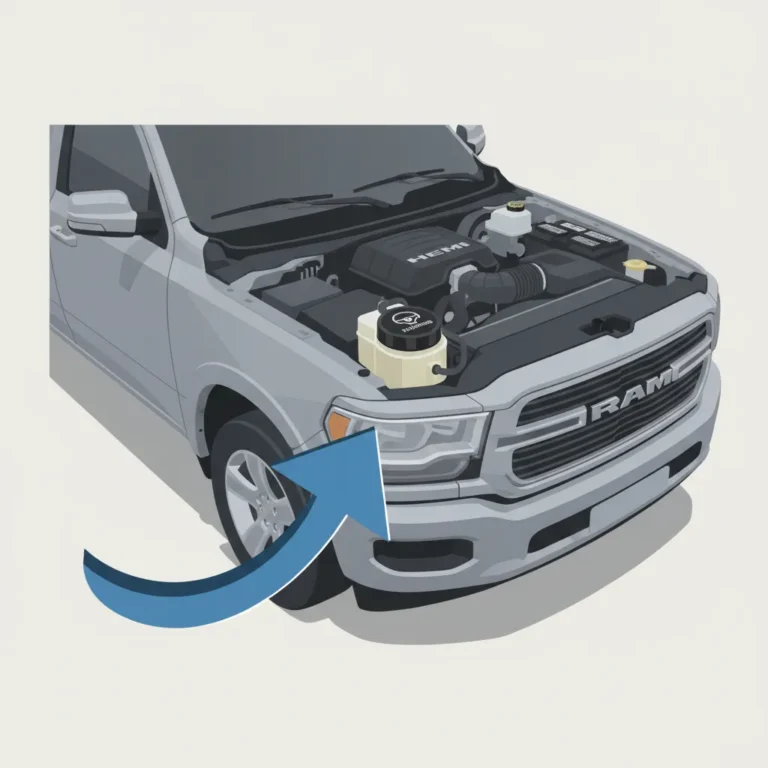
On the 5.7L Hemi engine, the oil pressure sensor is located on the front of the engine block, but it is not immediately visible. It is tucked directly behind the alternator on the passenger side. To see it, you generally have to look through the gap between the alternator and the water pump. Because of the tight clearance, you cannot simply reach in and unscrew it with a standard wrench. You must remove the alternator to gain enough “swing room” for the specialized oil pressure sensor socket. This location is preferred by DIYers because while you have to remove a major component, you do not have to open up the engine’s intake system.
The 3.6L Pentastar Location (The Intake Manifold Valley)
The 3.6L Pentastar engine presents a much larger challenge. The oil pressure sensor is located at the back of the oil filter adapter housing, which sits deep in the “V” of the engine valley. It is buried underneath both the upper and lower intake manifolds. You cannot see this sensor from the engine bay without significant disassembly. If you own a Pentastar-equipped Ram, replacing this sensor involves removing the air intake tube, the upper plenum, and the lower intake runners. Since you are going this deep, most mechanics recommend replacing the entire oil filter housing assembly, as they are prone to leaking oil into the valley alongside the sensor failure.
Visual Identifiers for the Sensor
Regardless of the engine, the sensor itself is a small, cylindrical component with a plastic electrical connector on one end and a threaded metal bolt on the other. On the Ram 1500, the connector is typically a three-pin weather-pack style. Look for a wire harness with a red sliding locking tab; this is the most distinct visual marker that you have found the correct sensor. On the 5.7L Hemi, the wire harness usually approaches from the top, while on the 3.6L, it is tucked toward the firewall near the back of the engine block.
- 5.7L Hemi: Front-facing, hidden by the alternator, requires a 1-1/16 inch or 27mm deep socket.
- 3.6L Pentastar: Top-down access, located at the rear of the engine valley, requires manifold removal.
- Common Connector: Look for the red locking tab on the harness to avoid breaking the plastic clips during removal.
Diagnostic Testing and Electrical Troubleshooting Tips
Before you run out and buy a new sensor, it is critical to determine if the P0520 code is being triggered by a hardware failure or a “glitch” in the communication line. Since this code specifically points to a circuit malfunction, the problem often lies in the three wires connecting the sensor to the Power Control Module (PCM).
Inspecting the Wiring Harness and Connectors
The Dodge Ram engine bay is a high-heat environment, which can cause the plastic housing on the sensor connector to become brittle over time. A common issue for Ram owners is oil leaking through the sensor itself and “wicking” into the electrical connector. If you see oil inside the plug, the sensor’s internal seal has failed, and cleaning it is usually only a temporary fix. Additionally, check for:
- Corrosion: Green or white crust on the metal pins inside the connector.
- Frayed Wires: Look for areas where the wiring harness might be rubbing against the engine block or the firewall.
- Voltage Check: Using a multimeter, you should verify a 5-volt reference signal from the PCM when the key is in the “on” position.
Using Live Data for Faster Diagnosis
A high-quality OBD-II scanner can save you hours of physical labor. By accessing the Live Data stream, you can watch the oil pressure readings in real-time. If the scanner shows a “fixed” reading (like a constant 99 PSI or 0 PSI) regardless of engine RPM, the circuit is likely open or shorted. If the pressure fluctuates wildly and doesn’t match the mechanical gauge on your dashboard, the sensor’s internal diaphragm is likely faulty. This digital confirmation ensures you aren’t removing the intake manifold for no reason.
Estimated Repair Costs and Part Selection Advice
Recommended Best Deal Products


The total cost to fix a P0520 error on a Dodge Ram 1500 can vary significantly depending on whether you are doing the work yourself or taking it to a professional shop. While the part itself is relatively inexpensive, the labor involved—especially on the 5.7L Hemi—adds up quickly.
Breakdown of Potential Expenses
If you choose to visit a dealership or an independent mechanic, expect to pay for 2 to 3 hours of labor. Because the sensor is located behind the alternator or under the intake manifold (depending on your specific model year), the “reach” is the most expensive part of the job.
- Replacement Part: Typically ranges between $30 and $75.
- Professional Labor: Usually ranges from $250 to $450 depending on local shop rates.
- DIY Total: Under $100, though it requires specific tools like a 1 1/16-inch oil pressure switch socket.
Why OEM Parts Matter for This Repair
While it is tempting to save $20 by purchasing an unbranded sensor online, Ram 1500 owners frequently report that aftermarket sensors fail within weeks of installation. The PCM in these trucks is notoriously picky about electrical resistance. Using a genuine Mopar sensor is the best way to ensure the P0520 code stays away for good. Furthermore, if your truck requires pulling the intake manifold to reach the sensor, you do not want to do that job twice because of a cheap part failure.
Conclusion: Getting Your Ram 1500 Back on the Road
Dealing with a P0520 code is a rite of passage for many Dodge Ram 1500 owners. While the “Check Engine” light is frustrating, the fix is usually straightforward once you identify whether the sensor or the wiring is at fault. By using live data for diagnosis and sticking with high-quality Mopar replacement parts, you can resolve the issue and protect your engine from inaccurate oil pressure readings.
Your next step should be to scan your truck to confirm the code and inspect the wiring harness for any obvious signs of oil soaking or heat damage. Don’t let a small sensor issue turn into a major headache—address it today and keep your Hemi running strong!
💬 Quick Questions & Answers
Can I drive my Ram 1500 with a P0520 code?
Yes, but you won’t have an accurate oil pressure reading, which could hide a real engine-threatening pressure drop.
Where is the oil pressure sensor on a 5.7 Hemi?
It is located on the front of the engine block, tucked directly behind the alternator.
What is the most common cause of P0520?
A failed internal diaphragm or electrical short within the oil pressure sensor itself is the most frequent cause.
Will a P0520 code affect my Hemi’s MDS system?
Yes, the Multi-Displacement System (MDS) relies on oil pressure data and may stop functioning if this code is active.
What socket size do I need for the sensor?
Most Dodge Ram 1500 models require a 1-1/16 inch (27mm) deep-well oil pressure switch socket.
❓ Frequently Asked Questions
Is P0520 a common issue for Dodge Ram 1500 trucks?
Yes, it is a very common issue, particularly in models built between 2011 and 2018. The sensor is a known high-failure item due to heat and vibration near the engine block.
How much does it cost to fix a P0520 code at a shop?
Expect to pay between $150 and $250 for a 5.7L Hemi, but costs can jump to $400-$600 for a 3.6L Pentastar due to the extensive labor required to remove the intake manifold.
What is the difference between P0520 and P0522?
P0520 is a general circuit malfunction, meaning the computer sees an irrational signal. P0522 specifically indicates ‘Low Voltage,’ which usually points to a short to ground or a dead sensor.
Why is it recommended to replace the oil cooler on the 3.6L during this repair?
The oil pressure sensor on the 3.6L engine is located on the oil filter adapter housing; since these housings are prone to leaking, many owners replace the entire assembly while the intake is already removed.
Could a simple oil change fix the P0520 code?
While unlikely, extremely dirty oil or the wrong oil viscosity can occasionally cause erratic sensor readings. However, P0520 is almost always an electrical circuit failure within the sensor itself.
What happens if the wiring harness is the problem instead of the sensor?
If the wiring is frayed or corroded, the code will return immediately after sensor replacement. It is vital to inspect the connector for oil ‘wicking’ or broken pins during the repair.
![1997 Dodge Ram 1500 Dashboard Replacement: Complete Fix Guide [2026]](https://truckguider.com/wp-content/uploads/2026/03/1997-dodge-ram-1500-dashboard-featured.webp)