2019 Ford F-150 2.7 EcoBoost Specs: Towing, Payload and Dimensions

The 2019 Ford F-150 2.7 EcoBoost makes 325 hp and 400 lb-ft of torque. It tows up to 9,000 lbs and carries up to 2,470 lbs of payload when properly equipped. Those headline numbers only tell part of the story, because every rating changes with cab, bed, drive, axle ratio and tow package.


This guide lists the verified specs in one place: engine numbers, towing and payload charts by configuration, dimensions for every cab and bed, and MPG figures. Every figure comes from Ford documents or EPA data, and every max rating names the package it needs.
2019 Ford F-150 2.7 EcoBoost Specs at a Glance


The second generation 2.7L EcoBoost V6 sits in the middle of the 2019 F-150 engine lineup. It pairs a twin-turbo V6 with the 10-speed automatic transmission. Ford offered it on XL, XLT and Lariat trims only.
Its peak torque arrives low in the rev range, which is why this small V6 tows far beyond its size. The table below lists the core engine specs. The infographic after it gives the headline figures for quick reference.
| Spec | 2019 F-150 2.7L EcoBoost V6 |
|---|---|
| Engine | 2.7L EcoBoost twin-turbo V6 (Gen 2) |
| Horsepower | 325 hp at 5,000 rpm |
| Torque | 400 lb-ft at 2,750 rpm |
| Transmission | 10-speed SelectShift automatic (10R80) |
| Drive | 4×2 or 4×4 |
| Trims | XL, XLT, Lariat |
| Oil capacity | 6.0 qt SAE 5W-30 with filter, FL-2062 filter |
| Fuel | Regular unleaded; 23 gal standard, 26 gal on SuperCrew, 36 gal with Max Trailer Tow Package |
The 325 hp figure stayed the same as the first generation engine. Ford raised torque from 375 lb-ft to 400 lb-ft for 2018, and the 2019 truck keeps that gain.
That torque peak at 2,750 rpm is what makes the 2.7L feel strong when pulling a trailer from a stop. Now that the headline numbers are clear, the next question is what this truck can actually tow in each configuration.
How Much Can the 2019 2.7 EcoBoost Tow
The 2019 F-150 2.7 EcoBoost tows up to 9,000 lbs. That max rating needs the 3.73 axle ratio and the 2.7L EcoBoost Payload Package.
One setup that reaches it is a SuperCrew 4×2 with the 6.5-ft bed. Most trucks tow less, because cab, bed, drive and axle ratio all move the number.
Ford publishes these ratings by configuration in the Ford 2019 RV and Trailer Towing Guide. Use the table to find the rating for the exact truck you own or plan to buy.
| Cab and Bed | Drive | Axle Ratio | Package | Max Trailer Weight | GCWR |
|---|---|---|---|---|---|
| SuperCrew, 5.5-ft bed | 4×2 | 3.55 | None | 7,700 lbs | 12,800 lbs |
| SuperCrew, 5.5-ft bed | 4×2 | 3.73 | None | 8,200 lbs | 13,300 lbs |
| SuperCrew, 6.5-ft bed | 4×2 | 3.73 | Payload Package (622) | 9,000 lbs | 14,100 lbs |
| SuperCrew, 5.5-ft bed | 4×4 | 3.55 | None | 7,600 lbs | 12,900 lbs |
| SuperCrew, 5.5-ft bed | 4×4 | 3.73 | None | 8,000 lbs | 13,300 lbs |
| SuperCrew, 5.5-ft bed | 4×4 | 3.73 | Payload Package (622) | 8,900 lbs | 14,300 lbs |
| Regular Cab, 6.5-ft bed | 4×2 | 3.55 | None | 7,600 lbs | 12,300 lbs |
| Regular Cab, 6.5-ft bed | 4×2 | 3.73 | None | 8,500 lbs | 13,200 lbs |
Trailer Tow Package Requirements
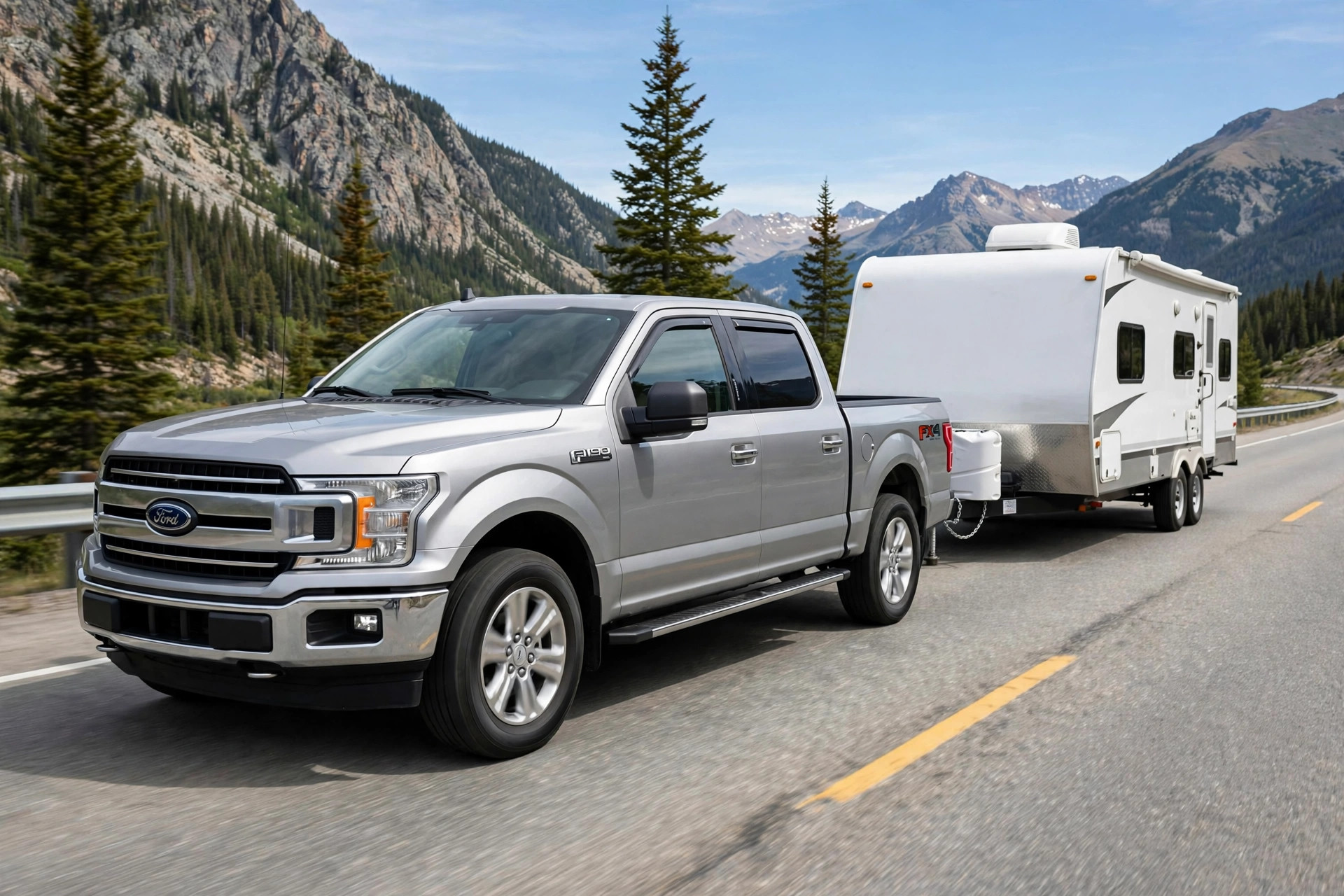
Ford caps bumper-only towing at 5,000 lbs.
Any trailer above that weight needs the Trailer Tow Package or the Max Trailer Tow Package, plus a weight-distributing hitch for the max ratings. The Max Trailer Tow Package adds a Class IV hitch receiver, an auxiliary transmission oil cooler, a stronger front stabilizer bar and the 36-gallon fuel tank.
Without the package, the same truck is limited to 5,000 lbs no matter what the engine can pull. Check the build sheet or the window sticker before you trust a tow rating on a used truck.
Axle Ratio and GCWR


The axle ratio is the single biggest lever on the towing chart. Moving from the 3.55 axle to the 3.73 axle adds 400 to 900 lbs of trailer capacity on the same cab and bed, depending on the setup.
The 3.73 axle also raises the Gross Combined Weight Rating (GCWR), which is the max weight of the truck, trailer, cargo and passengers combined.
GCWR matters as much as the trailer number. A truck can sit under its max trailer weight and still exceed GCWR once passengers and bed cargo go in.
Bumper Towing Limit
The 5,000 lb bumper limit catches many buyers by surprise. A 6,000 lb trailer needs the tow package and a weight-distributing hitch even though the engine rating looks far higher. Tongue weight should sit near 10 percent of the loaded trailer weight.
For year-by-year Ford towing figures beyond 2019, our Ford F-150 towing capacity chart by year covers 2013 through 2023. Towing limits are only half the story, so the next section covers what the truck can carry in the bed.
2019 F-150 2.7 EcoBoost Payload by Configuration
The 2019 F-150 2.7 EcoBoost carries up to 2,470 lbs of payload. That max rating needs the 2.7L EcoBoost Payload Package (code 622), offered only on XL and XLT trims. Every option and trim step up in weight cuts payload.
Payload covers passengers, cargo and tongue weight combined. A heavy trailer tongue eats payload fast, so check the towing number and the payload number together.
| Configuration | Max Payload | Notes |
|---|---|---|
| Regular Cab 4×2, 8-ft bed, with Payload Package (622) | 2,470 lbs | Max rating; XL and XLT only |
| SuperCab XL 4×2, 8-ft bed | 1,800 lbs | XL trim |
| SuperCab XL 4×2, 6.5-ft bed | 1,840 lbs | XL trim |
| SuperCrew XL 4×2, 6.5-ft bed | 1,820 lbs | XL trim |
| SuperCrew XL 4×2, 5.5-ft bed | 1,710 lbs | XL trim |
Heavier trims carry less payload than the XL examples above. A Lariat adds leather, sound deadening and power equipment, and each pound of truck weight comes straight off payload. Four-wheel drive cuts payload too.
The door-jamb label on your exact truck is the final authority. It lists the payload for that truck as built, with its options fitted.
Our Ford F-150 payload capacity by engine guide breaks the same numbers down across every 2019 engine. Payload also depends on the size of the truck itself, which the next section covers.
2019 Ford F-150 Dimensions for Every Cab and Bed
The 2019 F-150 came in three cabs and three bed lengths: Regular Cab with a 6.5-ft or 8-ft bed, SuperCab with a 6.5-ft or 8-ft bed, and SuperCrew with a 5.5-ft or 6.5-ft bed.
Overall length runs from 209.3 inches on the shortest Regular Cab to 250.5 inches on the longest SuperCab. Width stays 79.9 inches across the range, excluding mirrors. The table below lists wheelbase, length, width, height and ground clearance for each setup.
| Cab and Bed | Wheelbase | Overall Length | Width | Height (4×2) | Ground Clearance (4×2) |
|---|---|---|---|---|---|
| Regular Cab, 6.5-ft bed | 122.4 in | 209.3 in | 79.9 in | 75.5 in | 8.8 in |
| Regular Cab, 8-ft bed | 141.1 in | 227.9 in | 79.9 in | 75.1 in | 8.6 in |
| SuperCab, 6.5-ft bed | 145.0 in | 231.9 in | 79.9 in | 75.5 in | 8.7 in |
| SuperCab, 8-ft bed | 163.7 in | 250.5 in | 79.9 in | 75.5 in | 8.7 in |
| SuperCrew, 5.5-ft bed | 145.0 in | 231.9 in | 79.9 in | 75.6 in | 8.5 in |
| SuperCrew, 6.5-ft bed | 156.8 in | 243.7 in | 79.9 in | 75.7 in | 8.4 in |
Heights are for 4×2 trucks with no options, and actual height varies with trim and options.
The bed itself is 50.6 inches wide between the wheelhouses, so a standard 4×8 sheet of plywood fits flat. Cargo box volume is 52.8 cu ft for the 5.5-ft bed, 62.3 cu ft for the 6.5-ft bed and 77.4 cu ft for the 8-ft bed.
Front leg room is 43.9 inches in every cab. Rear leg room is 33.5 inches in SuperCab and 43.6 inches in SuperCrew. Wheelbase and weight shape every towing rating.
What Changed in the 2019 2.7 EcoBoost Engine
The 2019 truck uses the second generation 2.7L EcoBoost, launched for the 2018 model year. It differs from the 2015 to 2017 version even though horsepower stayed at 325. The changes sit inside the block, the fuel system and the transmission.
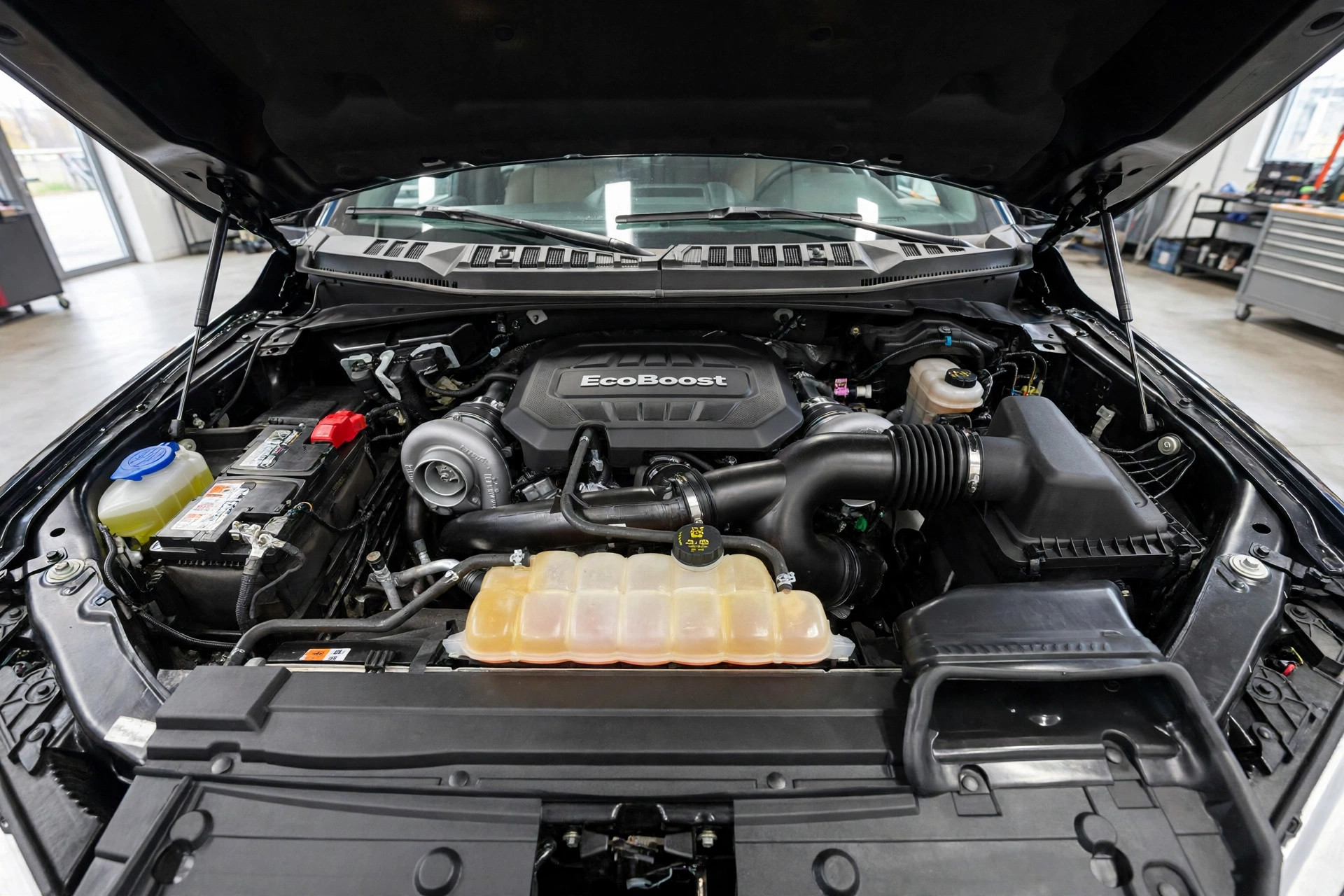
Ford added port fuel injection alongside the existing direct injection. The twin turbochargers gained electrically actuated wastegates, and the oil pump became an electronically controlled variable-displacement unit. The block uses compacted graphite iron, the same material Ford uses in its diesel blocks.
Port and Direct Injection
The dual injection setup sprays fuel through port injectors at low load and direct injectors under boost. Port injection washes the intake valves, which direct-only engines leave dry. This change answers the carbon buildup worry that followed the first generation engine.
The 10 Speed Automatic
The 10-speed SelectShift automatic (10R80) replaced the 6-speed automatic on the 2.7L for 2018. Ten ratios keep the engine near its 2,750 rpm torque peak more often, both when towing and when cruising. The wider spread also helps the EPA numbers, which the next section covers.
Compacted Graphite Iron Block


The compacted graphite iron block is stronger and stiffer than a standard cast iron block at the same weight. Ford pairs it with a forged steel crankshaft and fracture-split connecting rods. These parts let a 2.7L V6 hold 400 lb-ft without the bulk of a V8.
Our Ford 2.7L EcoBoost specs by year and generation guide tracks how the numbers changed from 2015 through today. The engine changes also moved fuel economy, so that is next.
2019 F-150 2.7 EcoBoost MPG and Fuel Tank Size
The EPA rates the 2019 F-150 2.7 EcoBoost at 20 mpg city and 26 mpg highway with 2WD, for 22 mpg combined. Four-wheel drive drops the rating to 19 mpg city and 24 mpg highway, for 21 mpg combined. These are the best EPA figures of any gas engine in the 2019 F-150 lineup.
Heavy-payload 4WD versions rate slightly lower, at 18 mpg city and 23 mpg highway. The EPA fuel economy ratings list each version separately, so match the GVWR class to your truck.
Regular Cab and SuperCab trucks carry a standard 23-gallon tank, while SuperCrew trucks carry a standard 26-gallon tank.
The Max Trailer Tow Package swaps in a 36-gallon tank, which stretches combined range toward 792 miles on the EPA figures.
The 26-gallon tank is standard on every SuperCrew. Check the build sheet if tank size matters for your towing plans.
Fuel economy is the 2.7L selling point against the bigger engines. The 3.5L EcoBoost and the 5.0L V8 both tow more, but neither matches the 2.7L at the pump.
3 Mistakes That Shrink Your Towing and Payload Numbers
Most towing disappointments come from reading the wrong number, not from a weak engine. The three errors below show up in listings and dealer pages again and again.
Towing Without the Tow Package
The first error is assuming the 9,000 lb rating applies to every 2.7L truck. It does not.
A truck without the Trailer Tow Package is capped at 5,000 lbs, and the 9,000 lb figure also needs the 3.73 axle and the Payload Package on the right cab. Ask for the build sheet and read the package codes before you pay.
Trusting the Max Number Blindly
The second error is treating the max rating as your rating. Payload drops with every option, and tongue weight counts against payload.
Passengers and bed cargo count against payload before the trailer hooks up. The door-jamb label, not the brochure, gives the number for your truck.
Mixing Gen 1 and Gen 2 Figures
The third error is mixing first and second generation figures. Some dealer pages still list 375 lb-ft of torque and 2,210 lbs of payload for the 2019 truck.
Those are 2015 to 2017 numbers. The 2019 engine makes 400 lb-ft and carries up to 2,470 lbs, and a 2019 F-150 towing capacity guide that cites the Ford towing guide confirms both figures.
With the numbers verified and the traps named, the picture is clear. The 2.7L is the efficiency pick in the 2019 lineup, with real towing ability when the truck carries the right packages.
How the 2019 2.7 EcoBoost Specs Stack Up for You
The 2019 Ford F-150 2.7 EcoBoost specs add up to a simple verdict. You get 325 hp, 400 lb-ft at 2,750 rpm, up to 9,000 lbs of towing and up to 2,470 lbs of payload, plus the best gas MPG in the lineup.
That mix suits daily driving, weekend towing and work use in one truck.
Match the truck to the job before you buy. Pick the 3.73 axle and the tow packages if you tow near the limit.
Read the door label on the exact truck. The right 2.7L setup tows a travel trailer with ease. The wrong one stops at 5,000 lbs.
5 Questions About 2019 F-150 2.7 EcoBoost Specs
How Much Can a 2019 Ford F-150 2.7 EcoBoost Tow
Up to 9,000 lbs when properly equipped with the 3.73 axle and the Payload Package on a SuperCrew 4×2 with the 6.5-ft bed. Most configurations tow 7,600 to 8,900 lbs, and trucks without a tow package stop at 5,000 lbs.
What Is the Payload of a 2019 F-150 2.7 EcoBoost
Up to 2,470 lbs with the 2.7L EcoBoost Payload Package on XL and XLT trims. Typical XL trucks without the package carry 1,710 to 1,840 lbs, and heavier trims and 4×4 models carry less.
What MPG Does the 2019 F-150 2.7 EcoBoost Get
The EPA rates it at 20 mpg city and 26 mpg highway with 2WD, for 22 mpg combined. Four-wheel drive models rate 19 mpg city and 24 mpg highway, for 21 mpg combined.
Is the 2019 2.7 EcoBoost a Good Engine
The second generation engine suits buyers who tow light to medium loads and want the best gas MPG in the lineup. It makes 400 lb-ft at 2,750 rpm, runs a 10-speed automatic and adds port injection to control intake valve deposits.
What Transmission Does the 2019 2.7 EcoBoost Use
It uses the 10-speed SelectShift automatic transmission, known as the 10R80. The 6-speed automatic belonged to the first generation 2.7L from 2015 to 2017 and to the base 3.3L V6 in 2019.