3.5 EcoBoost Problems by Year Symptoms and Fixes 2011–2026

The most important thing to know about 3.5 EcoBoost problems is that the failure pattern changes by model year. A 2012 Ford F-150 with the 3.5L EcoBoost V6 does not have the same diagnostic priorities as a 2019 or 2022 truck.
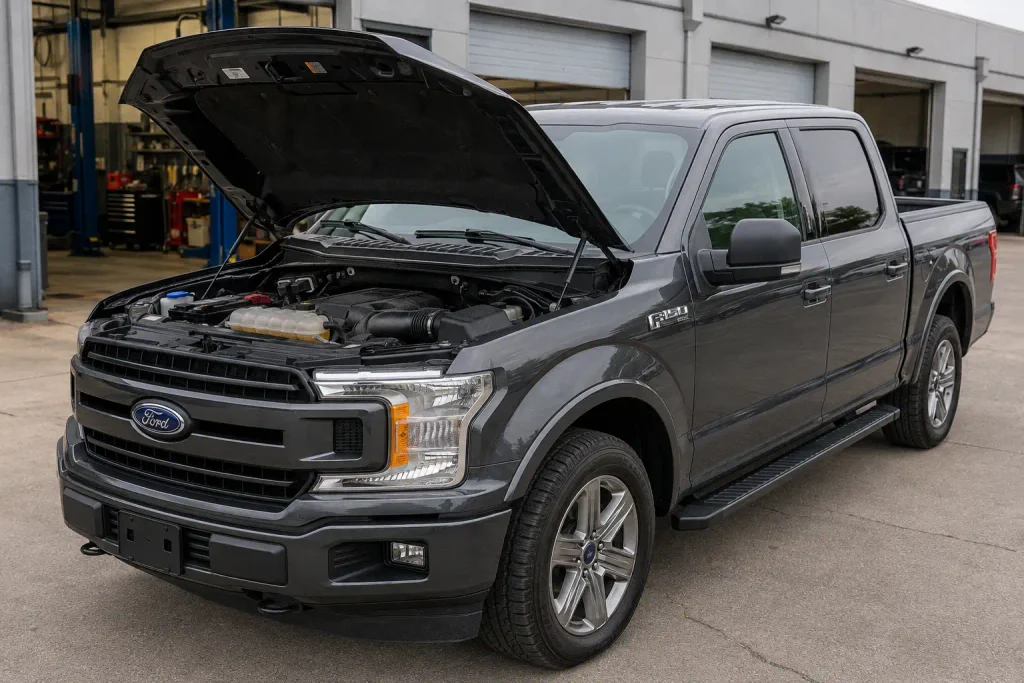
Early F-150s have documented timing-chain, charge-air cooler, boost-control, and oil-dilution concerns. Certain 2017 to 2020 trucks have documented Variable Camshaft Timing problems, while later 2021 to 2022 trucks have their own coolant-leak service bulletins.

Prime for Young Adults — 6 Months Free
Students and 18–24s get six months of Prime free, then half price.
Start 6 Months FreeThe fastest diagnosis starts with three things: model year, symptom, and diagnostic trouble code.
3.5 EcoBoost Problem Diagnostic Flow
Start with the model year, then match the symptom and diagnostic trouble code before replacing parts.
Confirm Model Year
Early and later 3.5L EcoBoost engines have different documented failure patterns.
Identify the Symptom
Cold-start rattle, misfire, low boost, coolant loss, or oil loss point to different systems.
Read Stored Codes
P0016, P0299, P0300-series, and P164C help narrow the diagnostic branch.
Test Before Replacing
Verify mechanical timing, boost control, ignition, cooling, or VCT operation before buying parts.
| Model Years | Symptom or Code | Likely Diagnostic Branch | First Check |
|---|---|---|---|
| 2011–2014 | P0016 or timing-related drivability concern | Primary timing chain and VCT system | Verify cam and crank correlation before replacing sensors |
| 2011–2012 | Misfire after humid highway driving | Charge-air cooler and combustion misfire | Check misfire data and charge-air system condition |
| 2011–2015 | P0299, low power, whistle, hiss, or boost loss | Boost-control and turbo system | Pressure-test charge piping and inspect control hardware |
| 2017–2020 | Two-to-five-second cold-start rattle | VCT cam phasers | Confirm cold-start noise from the front cover area |
| 2021–2022 | External coolant loss | Degas hose or thermostat housing | Inspect external cooling-system leak points first |
| 2024–2025 | Rapid oil loss on an affected VIN | Engine cup plug recall inspection | Check VIN recall status before further diagnosis |
What 3.5 EcoBoost Problems Change by Generation
Recommended Best Deal Products


Ford introduced the 3.5L EcoBoost V6 in the F-150 for the 2011 model year. The engine changed substantially for 2017, so treating every 2011 to 2026 engine as mechanically identical creates bad diagnoses.
First Generation 2011 to 2016
The first-generation 3.5L EcoBoost V6 uses twin turbochargers and gasoline direct injection. Several Ford Technical Service Bulletins, or TSBs, specifically cover early F-150 applications.
The strongest documented issues include primary timing-chain wear, humid-weather acceleration misfires, boost-control faults, and fuel contamination of the engine oil.

Audible — Listen Free for 30 Days
One free credit a month and thousands of titles included.
Listen Free for 30 DaysThese issues do not mean every 2011 to 2016 truck will fail. Build dates, stored codes, symptoms, previous repairs, and maintenance history matter.
Second Generation 2017 to 2020
Ford introduced the second-generation 3.5L EcoBoost in the 2017 F-150. Ford described it as a redesigned engine, and later versions use both port and direct fuel injection.
The major documented concern for this generation is Variable Camshaft Timing, or VCT, cam-phaser noise.
Ford’s Customer Satisfaction Program 21N03 covered certain 2017 to 2020 F-150s equipped with the 3.5L EcoBoost. The documented symptoms include cold-start rattle and hot-idle knock.
Later 2021 to 2026 Engines
Later 3.5L EcoBoost engines should not automatically inherit every first-generation problem.
Ford issued service information for specific 2021 to 2022 coolant leaks and misfire complaints. Ford has also issued VIN-specific safety recalls affecting limited populations of newer 3.5L-powered trucks.
The correct approach for a 2021 to 2026 F-150 is to diagnose the actual symptom and check the VIN for open recalls rather than assuming an older EcoBoost weakness applies.
7 Most Common 3.5 EcoBoost Problems by Year
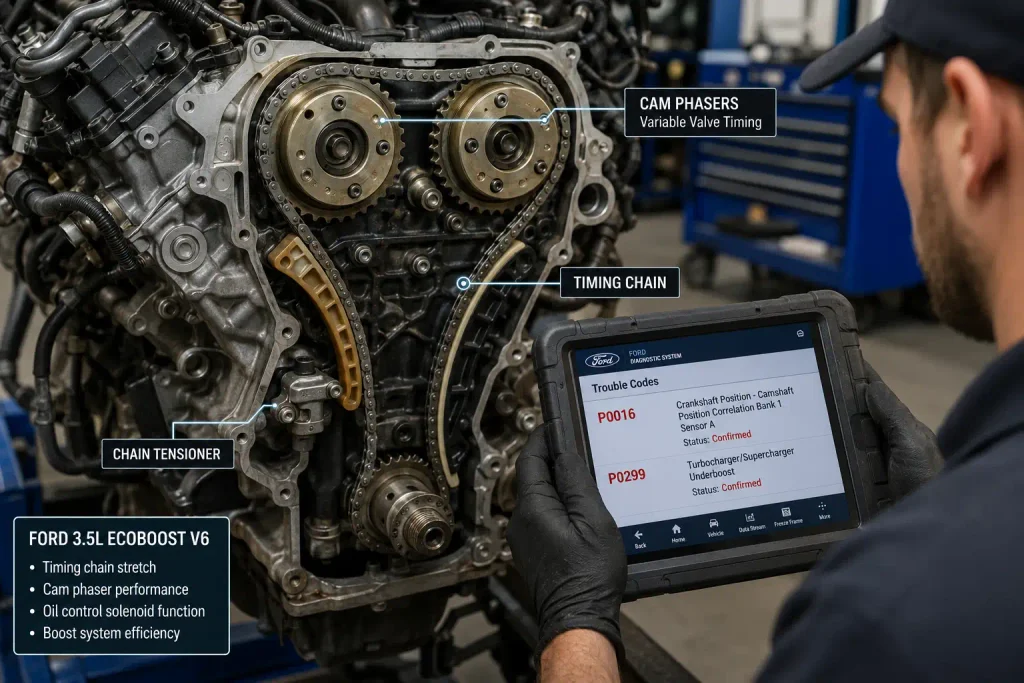
These seven issues have useful Ford service documentation behind them. The model year and build date are just as important as the symptom.
Audible Premium Plus — Annual Membership
12 audiobook credits up front, plus the full Audible catalogue.
See Annual Plans1. Timing Chain Wear
Primary timing-chain wear is one of the best-documented early 3.5 EcoBoost problems.
Ford TSB 14-0194 applies to certain 2011 to 2014 F-150s with the 3.5L Gasoline Turbocharged Direct Injection engine built on or before October 10, 2014. Ford states that P0016, other codes, and drivability concerns may result from a worn primary timing chain.
P0016 means the Powertrain Control Module detects an unexpected relationship between crankshaft and camshaft position.
It does not automatically prove the chain is bad. Ford’s procedure used VCT data to determine whether the bulletin applied before calling for chain replacement.
If you own one of these early trucks, our guide to the F-150 EcoBoost timing chain recall and service history explains the issue in more detail.
2. Cam Phaser Cold Start Rattle
Cam-phaser problems deserve the most attention on certain 2017 to 2020 trucks.
Ford TSB 23-2143 describes a ticking, tapping, or rattling noise from the top front cover area after a cold soak of six hours or more. Ford says the noise may last roughly two to five seconds and may result from worn VCT units.
The bulletin covers certain 2017 to 2020 F-150s equipped with the 3.5L EcoBoost and built on or before November 30, 2019.
A related Ford customer program instructed dealers to replace all four VCT units when the covered cam-phaser noise condition was confirmed.
If repair cost is your main concern, Truck Guider also has a breakdown of 3.5 EcoBoost cam phaser replacement cost.
3. Humid Weather Misfire Under Acceleration
Some 2011 to 2012 F-150s developed an unusual stumble or misfire after extended highway driving in humid or damp weather.
Ford TSB 13-3-3 documents the condition on 2011 to 2012 F-150s equipped with the 3.5L GTDI engine. The symptom could appear during hard acceleration following highway cruising.
Possible codes included:
- P0304
- P0305
- P0306
- P0430
Ford’s repair procedure included inspecting diagnostic data and, where applicable, replacing the charge air cooler assembly.
If an early EcoBoost runs normally around town but suddenly stumbles under hard acceleration after a long humid highway drive, this service history deserves attention.
4. P0299 and Turbo Boost Problems
P0299 means the engine is producing less boost than the Powertrain Control Module expects.
That does not automatically mean both turbochargers have failed.
Ford TSB 16-0013 covered certain 2011 to 2015 F-150s with a 3.5L GTDI engine built on or before February 28, 2015. Ford documented P0234, P0299, drivability symptoms, and noises including hissing, whooshing, whistling, grinding, growling, or scraping.
Another Ford bulletin for certain 2011 to 2013 trucks addressed boost-related codes caused by damage near the turbocharger boost sensor wiring.
If you have P0299, inspect the complete boost system before buying turbochargers. Charge-air leaks, boost-control hardware, sensor data, wastegate operation, wiring, and turbo condition all require evaluation.
5. Fuel Dilution and Overfull Engine Oil
Ford also documented fuel odor in the engine oil on certain early 3.5L EcoBoost trucks.
TSB 15-0003 applies to some 2011 to 2014 F-150s equipped with the 3.5L GTDI engine. The complaint was raw-fuel odor from the oil, an oil level reading above full, or both.
Ford’s procedure included checking the Positive Crankcase Ventilation, or PCV, valve version and replacing it where applicable. The procedure also called for an oil and filter change.
An unexplained rising oil level should therefore not be dismissed as harmless overfilling, especially on an early 3.5L EcoBoost.
6. Coolant Leaks on 2021 to 2022 Trucks
Later trucks have a different coolant-leak pattern.
Ford TSB 21-2373 covers certain 2021 F-150s with the 3.5L EcoBoost or 3.5L PowerBoost built on or before March 31, 2021. Ford identified possible external coolant loss from the degas bottle hose between the bottle and thermostat housing.
Ford later issued SSM 50835 for certain 2021 to 2022 F-150s equipped with the 3.5L EcoBoost. It describes coolant leakage at the thermostat housing caused by an incomplete weld.
Ford’s stated repair was replacement of the thermostat housing on affected trucks.
If a 2021 or 2022 truck is losing coolant, inspect those external areas before assuming an internal head-gasket failure.
7. 2024 to 2025 Engine Cup Plug Recall
A limited number of newer trucks were included in an engine cup-plug safety recall.
Ford Safety Recall 24S70 covered certain 2024 to 2025 F-150s plus certain Expedition and Navigator vehicles equipped with a 3.5L GTDI engine.
Ford reported that an improperly positioned rear engine cup plug could cause rapid oil loss. Oil contacting hot engine or exhaust components could increase fire risk, while oil loss could also cause loss of motive power.
The initial Ford notice listed 2,412 affected U.S. vehicles across the covered models.
This is not a reason to label every 2024 or 2025 3.5L EcoBoost defective. Recall eligibility depends on VIN, assembly plant, and build date.
Which 3.5 EcoBoost Problem Matches Your Symptoms
Recommended Best Deal Products


Your symptom often narrows the problem faster than mileage alone.
| Symptom | First Diagnostic Branch | Higher Priority Years |
|---|---|---|
| Cold-start rattle for a few seconds | VCT cam phasers | Certain 2017 to 2020 |
| P0016 on an early truck | Mechanical timing and VCT diagnosis | Certain 2011 to 2014 |
| Misfire after humid highway driving | Charge air cooler and misfire data | 2011 to 2012 |
| P0299 and low power | Boost leaks, controls, sensors, turbos | Especially early documented applications |
| Raw fuel smell in oil | PCV and fuel-dilution diagnosis | 2011 to 2014 |
| External coolant loss | Degas hose or thermostat housing | Certain 2021 to 2022 |
| Rapid oil leak on newer truck | VIN recall check | Certain 2024 to 2025 |
If a 2017 to 2020 F-150 rattles for several seconds after a true cold start, then the documented VCT cam-phaser path deserves priority.
If a 2011 to 2014 truck stores P0016, then mechanical timing should be checked before replacing a camshaft-position sensor simply because its name appears in the code description.
If P0299 is present, then test the boost system before condemning the turbochargers.
The point is simple: year plus symptom plus DTC is more useful than mileage alone.
What 3.5 EcoBoost Trouble Codes Point to Each Failure
A diagnostic trouble code identifies a system or operating condition. It does not always identify the failed part.
P0016 Cam and Crank Correlation
P0016 indicates that camshaft and crankshaft positions are outside the expected relationship.
On certain 2011 to 2014 F-150s, Ford specifically documented worn primary timing chains as one possible cause. Ford still required diagnostic data before applying the TSB repair.
A timing-related repair can be expensive because access involves significant engine disassembly. Truck Guider’s Ford F-150 timing chain replacement cost guide covers the cost side separately.
P0299 Turbo Underboost
P0299 means actual boost is below the expected value.
Check charge pipes, hoses, intercooler connections, boost-pressure data, turbocharger control, wastegates, wiring, and the turbochargers themselves.
Ford’s early 3.5L GTDI service history confirms that P0299 could appear alongside several drivability and turbo-system symptoms, so replacing both turbos from the code alone is not a sound diagnosis.
P0300 Through P0306 Misfires
P0300 represents random or multiple-cylinder misfire. P0301 through P0306 identify individual cylinders.
Possible causes include spark plugs, ignition coils, injectors, air-fuel problems, compression loss, or another condition affecting combustion.
Ford issued SSM 50412 for 2021 to 2022 3.5L EcoBoost F-150s instructing technicians to swap a suspected ignition coil with a known-good cylinder before replacing it. The coil should only be replaced when the misfire follows that coil.
P164C With Cold Start Noise
Ford TSB 23-2143 notes that some covered 2017 to 2020 trucks may have cold-start VCT noise with or without P164C.
A code is therefore useful evidence, but the cold-start noise pattern and applicable build date remain important parts of the diagnosis.
Which 3.5 EcoBoost Problems Need Immediate Repair
Not every EcoBoost complaint has the same urgency.
Stop and Diagnose Quickly
Rapid oil loss, major coolant loss, overheating, low oil-pressure warnings, severe mechanical knocking, or a flashing check-engine light deserve quick attention.
A flashing malfunction indicator lamp can indicate an active misfire severe enough to threaten the catalytic converter. Ford’s 2026 F-150 manual also warns that continuing to drive with certain powertrain warning lamps may cause reduced power, engine shutdown, or damage.
A truck losing oil rapidly under an applicable cup-plug recall also needs recall verification rather than continued normal driving.
Schedule Diagnosis Soon
Repeated cold-start cam-phaser rattle, persistent P0299, repeated misfire under load, or a coolant leak should be diagnosed before the condition progresses.
A truck can still seem normal during light driving while storing pending codes or failing only under boost.
Monitor Only After Diagnosis
Do not treat an unexplained rattle, oil leak, coolant loss, or misfire as harmless simply because the truck still drives.
Monitoring makes sense only after the dangerous causes have been ruled out and you know what condition you are observing.
How to Inspect a Used 3.5 EcoBoost in 8 Steps
A warm engine can hide one of the most recognizable 3.5L EcoBoost symptoms, so request a genuine cold start before buying.
- Confirm the model year and engine. Verify that the truck actually has the 3.5L EcoBoost V6 rather than the naturally aspirated 3.5L V6, 2.7L EcoBoost, or 3.5L PowerBoost.
- Start the engine completely cold. Listen closely for a two-to-five-second front-cover rattle on 2017 to 2020 trucks.
- Scan for current and pending DTCs. Do this before anyone clears the Powertrain Control Module.
- Check the oil level. Look for an unusually high oil level, strong fuel odor, or evidence of rapid loss.
- Check the cooling system. On 2021 to 2022 trucks, inspect around the degas hose and thermostat housing for external coolant evidence.
- Road-test the truck under load. Confirm that it builds power cleanly without stumbling, surging, excessive whistle, or an underboost warning.
- Request service records. Look specifically for timing-chain, VCT phaser, coolant-system, turbo-system, and recurring misfire repairs.
- Check the VIN for recalls. A recall campaign applies to specific VINs, not every truck from a model year.
This inspection will not replace a professional pre-purchase inspection, but it can identify the highest-value warning signs before money changes hands.
Which 3.5 EcoBoost Years Need the Closest Inspection
Calling an entire model year “bad” is less useful than knowing exactly what deserves inspection.
2011 to 2014 Trucks
These years deserve the strongest timing-system scrutiny.
Check for P0016 history, timing-chain repair records, hard-acceleration misfires, fuel-contaminated oil, and unresolved boost-control complaints. Ford’s service bulletins provide direct documentation for each of these early-engine categories.
A well-maintained early truck with documented repairs is a different purchase from one with unknown service history and active symptoms.
2015 to 2016 Trucks
These are still first-generation 3.5L EcoBoost applications, but do not assume that every 2011 to 2014 bulletin applies automatically.
For example, Ford’s P0299 and P0234 turbo-system bulletin includes certain 2015 applications with the applicable engine build date, while TSB 14-0194 specifically targets 2011 to 2014 F-150s.
Use the actual build date and code history.
2017 to 2020 Trucks
Cold-start cam-phaser noise is the major documented inspection target.
Perform the first startup after the truck has sat for several hours. Listen for the characteristic brief rattle from the front-cover area.
Ask whether the VCT units have previously been replaced and review the repair invoice rather than relying on a seller’s verbal claim.
2021 to 2022 Trucks
Check for external coolant loss and recurring misfires.
Ford issued documentation for thermostat-housing and degas-hose leaks on specified builds. Ford also provided a specific diagnostic approach for ignition-coil-related misfires.
These are different diagnostic priorities from the first-generation timing-chain issue.
2023 to 2026 Trucks
Do not assume a newer 3.5L EcoBoost is immune to faults, but avoid projecting every older problem onto these engines.
For 2024 to 2025 trucks, check the VIN against Ford and NHTSA recall records because a limited population was included in the 24S70 engine cup-plug campaign.
For 2026 trucks, use current Ford service information and the VIN rather than relying on problem lists written about engines built a decade earlier.
How to Diagnose 3.5 EcoBoost Problems Without Guessing
Replacing parts from a generic problem list wastes money.
Use this sequence instead:
- Confirm the exact model year, engine, and build date.
- Record the symptom before clearing any codes.
- Scan current, pending, and permanent DTCs.
- Check engine-oil and coolant levels.
- Match the year and symptom to known Ford service information.
- Test the affected system before replacing components.
- Use Ford workshop procedures for mechanical timing, VCT, fuel, and turbocharger diagnosis.
For example, P0299 should lead to boost-system testing. It should not automatically lead to a pair of new turbochargers.
Likewise, P0016 on an applicable early truck makes timing-chain wear relevant, but Ford’s own bulletin required diagnostic confirmation before chain replacement.
Is the 3.5 EcoBoost Reliable With Proper Maintenance
The 3.5L EcoBoost V6 has several well-documented weak points, but the correct reliability verdict depends heavily on generation and service history.
For used 2011 to 2014 trucks, timing history deserves close attention. On certain 2017 to 2020 trucks, listen specifically for VCT cam-phaser noise. For 2021 to 2022 trucks, inspect documented coolant-leak locations and diagnose misfires methodically.
The best way to handle 3.5 EcoBoost problems is not to fear every issue ever reported for the engine. Identify the year, document the symptoms, read the stored codes, and diagnose the system Ford actually associates with that configuration.
Frequently Asked Questions
What Is the Most Common 3.5 EcoBoost Problem?
There is no single problem that applies equally to every generation. Timing-chain wear is strongly documented on certain 2011 to 2014 F-150s, while VCT cam-phaser noise is a major documented issue on certain 2017 to 2020 trucks.
What Years Have 3.5 EcoBoost Cam Phaser Problems?
Ford service documentation specifically covers certain 2017 to 2020 F-150s with the 3.5L EcoBoost. TSB 23-2143 applies to affected trucks built on or before November 30, 2019, with the specified cold-start noise condition.
What Does a Bad 3.5 EcoBoost Cam Phaser Sound Like?
Ford describes a ticking, tapping, or rattling noise from the top front-cover area after a cold soak. In the applicable TSB, the sound may last around two to five seconds following initial startup.
Does P0016 Mean the 3.5 EcoBoost Timing Chain Is Bad?
No. P0016 identifies a crankshaft-to-camshaft correlation problem, not a specific failed component. Ford did associate P0016 with primary timing-chain wear on certain 2011 to 2014 F-150s, but its service procedure required diagnostic verification before replacement.
Can P0299 Mean Both 3.5 EcoBoost Turbos Are Bad?
P0299 does not prove that either turbocharger is mechanically failed. Boost leaks, sensors, wiring, wastegate operation, charge-air components, or turbocharger faults can all require investigation before parts are replaced.
Which 3.5 EcoBoost Years Should I Avoid?
No whole model year should be rejected from the keyword alone. Inspect 2011 to 2014 trucks carefully for early timing and related service history, and inspect certain 2017 to 2020 trucks closely for cam-phaser noise.
![2019 Ram 1500 Coolant Type: Specs & Fitment Guide [2026]](https://truckguider.com/wp-content/uploads/2026/03/2019-ram-1500-coolant-type-featured.webp)