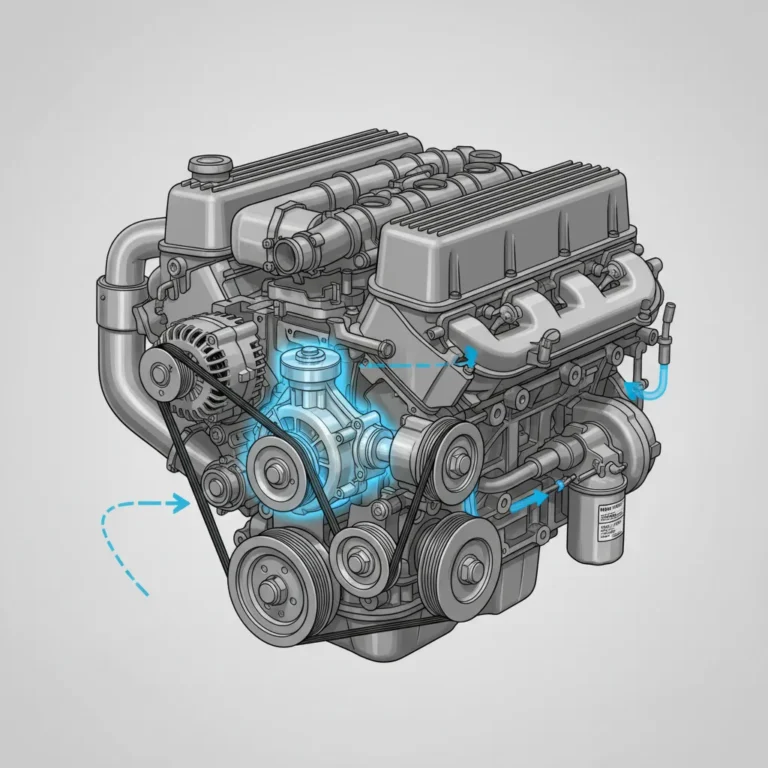
6.7 Cummins Water Separator Location And Maintenance Guide For Truck Owners

For owners of the 6.7 Cummins, the difference between a 300,000-mile engine and a catastrophic fuel system failure often comes down to a few ounces of water. Modern diesel engines utilize high-pressure common rail (HPCR) systems that are incredibly sensitive to moisture, requiring absolute purity in the fuel stream to maintain the tight tolerances of high-pressure pumps and injectors. Despite this criticality, many owners remain unsure exactly where their 6.7 Cummins water separator location is or how to perform routine maintenance. This comprehensive guide provides the exact location of the water separators on your 6.7 Cummins across different model years, detailed instructions for draining them, and professional insights into the best filtration upgrades available today to protect your investment.
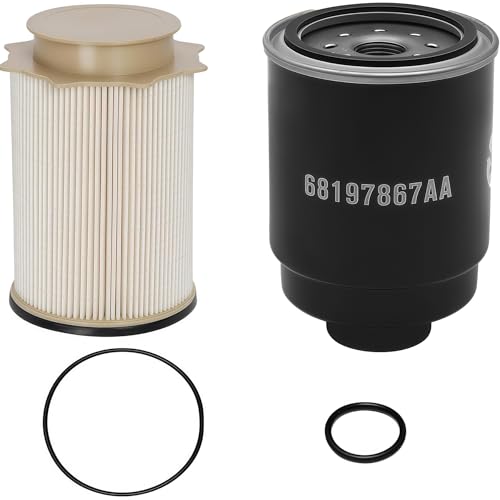


Identifying the Primary 6.7 Cummins Water Separator Location on the Frame Rail
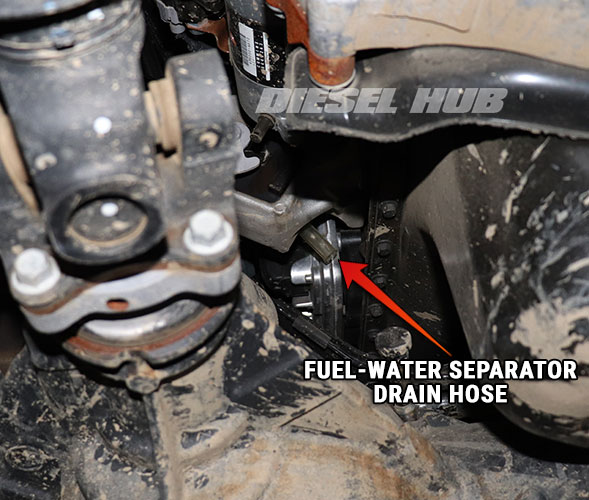
If you own a Ram 2500 or 3500 manufactured from 2013 to the current model year, your primary line of defense is located underneath the truck. The primary fuel filter/water separator housing is mounted directly to the driver-side frame rail. To find it, look between the fuel tank and the transmission area. It is typically positioned just forward of the rear fuel tank, tucked safely against the heavy steel of the frame to protect it from road debris.
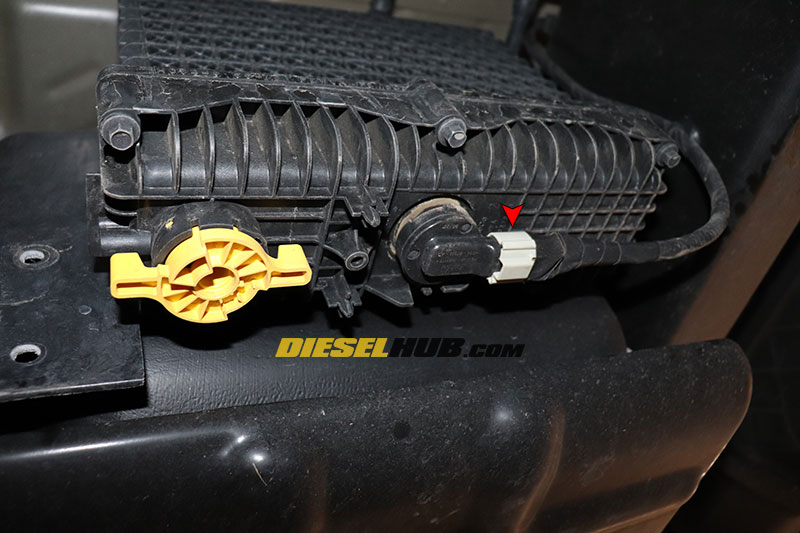
Visual cues for identification are straightforward once you are underneath the chassis. You are looking for a cylindrical canister that features either a clear or black plastic bowl at the bottom. On OEM Mopar units, you will often see a distinct yellow lever or a knurled twist knob designed for manual draining. This frame-mounted location is strategically chosen to provide the initial filtration of heavy contaminants and bulk water separation before the fuel is drawn toward the engine-mounted lift pump. For instance, a 2018 Ram 2500 owner will find this filter tucked slightly behind the transfer case area, making it accessible but requiring a bit of a reach.
It is important to note that while the general location remains consistent for the 2013+ chassis, there can be slight variations in the mounting bracketry depending on whether the truck is a Crew Cab, Mega Cab, or a Chassis Cab model. When working in this area, always prioritize safety. Ensure the vehicle is on level ground and use jack stands or a professional service pit. This filter is the “workhorse” of the system, handling the highest volume of water and debris, which is why its maintenance is non-negotiable for long-term reliability.
Always inspect the frame-rail housing for salt corrosion if you live in the “salt belt.” The aluminum housing can sometimes seize against the plastic cap, making future filter changes difficult without a specialized filter wrench.
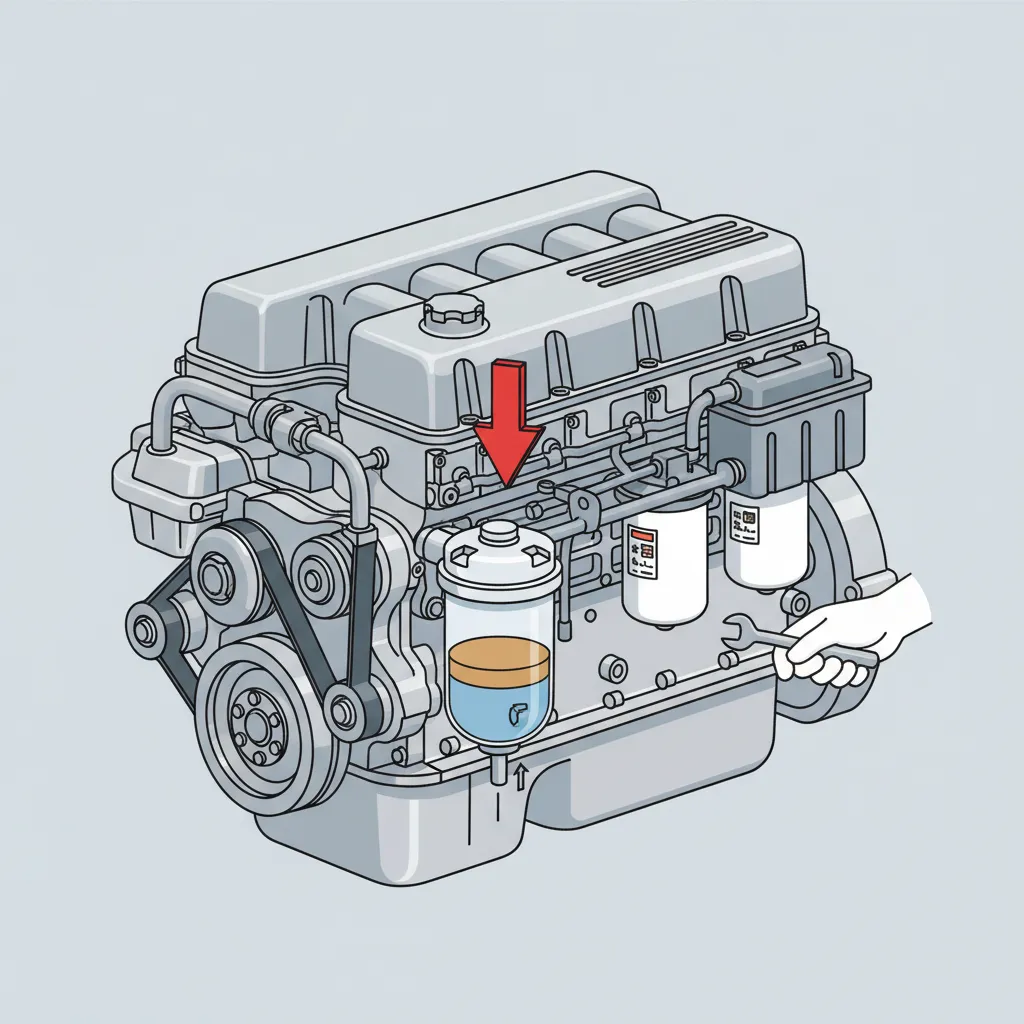
The Secondary 6.7 Cummins Water Separator Location Under the Hood
While the frame-rail filter handles the heavy lifting, the secondary fuel filter/water separator serves as the “Final Filter.” This component is located under the hood, typically mounted on the driver side of the engine block, nestled near the intake manifold and the brake master cylinder. This dual-stage approach is part of what makes the 6.7 Cummins so durable; it ensures that any microscopic particles or emulsified water that might have slipped past the primary filter are captured before reaching the high-pressure common rail (HPCR) system.
This engine-mounted housing is critical because it holds the Water-in-Fuel (WIF) sensor. This sensor is the primary trigger for the dashboard warning light. When water reaches a certain level in this secondary canister, it completes an electrical circuit, alerting the driver immediately. For 2019+ models, owners often find it convenient to access the drain valve through the driver-side wheel well or by using a long extension from the top of the engine bay, as the intake ducting can be quite crowded. Referring to the official guide from the manufacturer can provide specific torque specs for these housings.
The secondary filter is engineered with a much tighter micron rating—often 3 microns—compared to the primary filter. This extreme level of filtration is necessary because the Bosch high-pressure fuel pumps used in these engines depend on the diesel fuel itself for lubrication. Even the smallest amount of water can cause “flashing” or steam-induced erosion inside the pump, leading to metal shavings being sent through the entire fuel system. Regular visual inspection of the seal and the WIF sensor wiring is recommended to ensure no environmental corrosion is compromising the sensor’s accuracy.
Step-by-Step Guide to Draining the Water Separator
Draining your water separator is a convenient task that can be performed in your driveway with minimal tools. Routine maintenance is the hallmark of a responsible owner and can save you thousands in fuel system repairs. You should aim to drain these separators at every oil change, or more frequently if you are buying fuel from high-volume truck stops or lower-tier stations.
📋
Maintenance Workflow


Gather a 1-1/8 inch (or 28mm) socket for the filter caps and a lengths of clear 1/4″ ID hose. Place a drain pan underneath the separator locations to catch the mixture.
Attach your hose to the drain nipple. Open the drain valve. If the fluid doesn’t flow, slightly loosen the top cap of the filter housing to break the vacuum and allow gravity to evacuate the water.
After closing the valves, turn the ignition to ‘RUN’ (do not start) for 30 seconds. Repeat this 5 times to prime the pump and purge air. Failure to do this can air-lock the system.
Once the draining is complete, ensure you dispose of the contaminated diesel properly at a trusted local hazardous waste facility or a nearby community diesel specialist. Never pour diesel or water-diesel mixtures into storm drains or on the ground. If you find significant amounts of sediment during this process, it is a sign you should contact an available parts supplier for a full filter replacement rather than just a simple drain.
Attempting to start the engine without properly priming the fuel system can lead to air-locking the injection pump. Repairing an air-locked or damaged CP4 pump can cost over $2,000 in labor and parts alone.
Why Water Separation is Critical: Protecting the Fuel System
The physics of diesel fuel management are unforgiving. Diesel is hygroscopic, meaning it naturally absorbs moisture from the air. As temperatures fluctuate throughout the day and night, the air in your fuel tank expands and contracts, leading to condensation on the inner walls of the tank. This accumulated water eventually settles at the bottom of the tank and is sucked into the fuel lines. Without a functional water separator, this moisture hits the Bosch CP3 or CP4.2 high-pressure pump with devastating results.

Water lacks the lubricity of diesel. Inside the high-pressure pump, metal components slide against each other at incredibly high speeds. When water replaces diesel, that lubrication disappears, leading to metal-on-metal wear. Furthermore, water causes corrosion on injector tips, which ruins the finely tuned “spray patterns” required for efficient combustion. This often manifests as a noticeable “engine knock” or a significant drop in fuel economy. For those interested in the engineering behind these powerplants, the official guide from Cummins provides deeper insights into fuel requirements.
By The Numbers
of Injector Failures caused by Water
Secondary Filter Micron Rating
Average Full Fuel System Overhaul Cost
Consider the long-term benefits: extending the life of your fuel system beyond the 200,000-mile mark is entirely possible through diligent water management. Neglecting the “Water-in-Fuel” dashboard warning—even for a single drive—is a gamble. There are numerous accounts in the diesel community of owners who ignored the light, only to face an $8,000 repair bill after a single tank of contaminated fuel from a low-volume station.
Upgrading to Aftermarket Fuel Filtration Systems
For many 6.7 Cummins owners, especially those who tow heavy loads or operate in harsh environmental conditions, the factory 6.7 Cummins water separator location and efficiency are just the baseline. Upgrading to a dedicated aftermarket system like FASS (Fuel Air Separation System) or AirDog is one of the most popular modifications in the diesel world. These systems completely relocate your filtration to a single, easily accessible bracket on the frame rail.
99% Efficiency
Aftermarket systems can remove up to 99% of water and contaminants, significantly exceeding OEM specifications.
Air Separation
These units remove entrained air and vapor from the diesel, leading to more consistent injection timing and power.
Beyond just filtration, these systems solve the “access” problem. Instead of crawling deep under the truck or reaching over a hot engine, both filters are mounted side-by-side on the frame. A filter change on a FASS system can take as little as two minutes, compared to the 20-minute process required for the stock dual-filter setup. Furthermore, for the community serving colder northern climates, many of these aftermarket units include heater elements that prevent fuel gelling—a common failure point for the 6.7 Cummins in sub-zero temperatures.
Whether you choose to stick with the reliable OEM setup or upgrade to a high-performance aftermarket unit, the core mission remains the same: keep water out of the high-pressure common rail. By understanding your 6.7 Cummins water separator location and adhering to a strict maintenance schedule, you ensure that your truck remains available for the long haul, whether that means daily commuting or cross-country towing.
In summary, the 6.7 Cummins typically utilizes a dual-filter system with locations on the frame rail and under the hood. Regular draining of the water separator is the most cost-effective way to prevent 85% of injector-related failures, while aftermarket systems like FASS or AirDog offer superior 99% filtration and simplified maintenance access. Check your frame rail today to locate your primary separator, and ensure you have a spare filter kit available in your truck for emergency roadside changes.
Frequently Asked Questions
Where exactly is the water separator on a 2013-2024 6.7 Cummins?
On 2013 and newer Ram trucks, there are two locations. The primary water separator is located on the driver-side frame rail, just in front of the rear fuel tank. The secondary fuel filter/water separator is located under the hood, mounted to the engine block on the driver’s side near the intake manifold.
How often should I drain the water separator on my Cummins?
It is best practice to drain the water separator every time you change your oil, or roughly every 15,000 miles. However, if you frequently fuel up at high-volume truck stops or live in a humid climate, checking the separator monthly is a proactive way to prevent the ‘Water in Fuel’ light from activating.
What happens if I don’t drain the water separator?
If water bypasses the filtration system, it enters the high-pressure fuel pump and injectors. Because water does not have the lubricating properties of diesel, it causes immediate internal wear and corrosion. This leads to poor fuel atomization, engine knocking, reduced power, and eventually, a total fuel system failure requiring expensive replacements.
Can I replace the water separator myself or do I need a shop nearby?
Most owners can perform this maintenance at home with basic hand tools. You will need a drain pan and a 1-1/8 inch socket. However, if you are uncomfortable with the fuel priming process or have a stuck drain valve, a nearby diesel-specialist community garage can typically perform the service in under 30 minutes.
Is the FASS system better than the stock 6.7 Cummins water separator?
The FASS and AirDog systems are generally considered superior to the stock setup. They offer better filtration (down to 2 microns), remove air bubbles from the fuel, and consolidate the filters into one easily accessible location on the frame. These systems are highly recommended for those looking to maximize the longevity of their high-pressure fuel components.