7.3 Powerstroke Oil Type and Capacity: Complete HEUI Lubrication Guide 2026

The 7.3 Powerstroke oil type and capacity is one of the most critical specifications any owner of a 1994.5–2003 Ford F-250, F-350, E-350, or Excursion must know cold. The engine requires exactly 15.0 quarts (14.2 liters) of oil meeting Ford’s WSS-M2C171-F1 specification — and unlike a gasoline engine where oil is purely a lubricant,
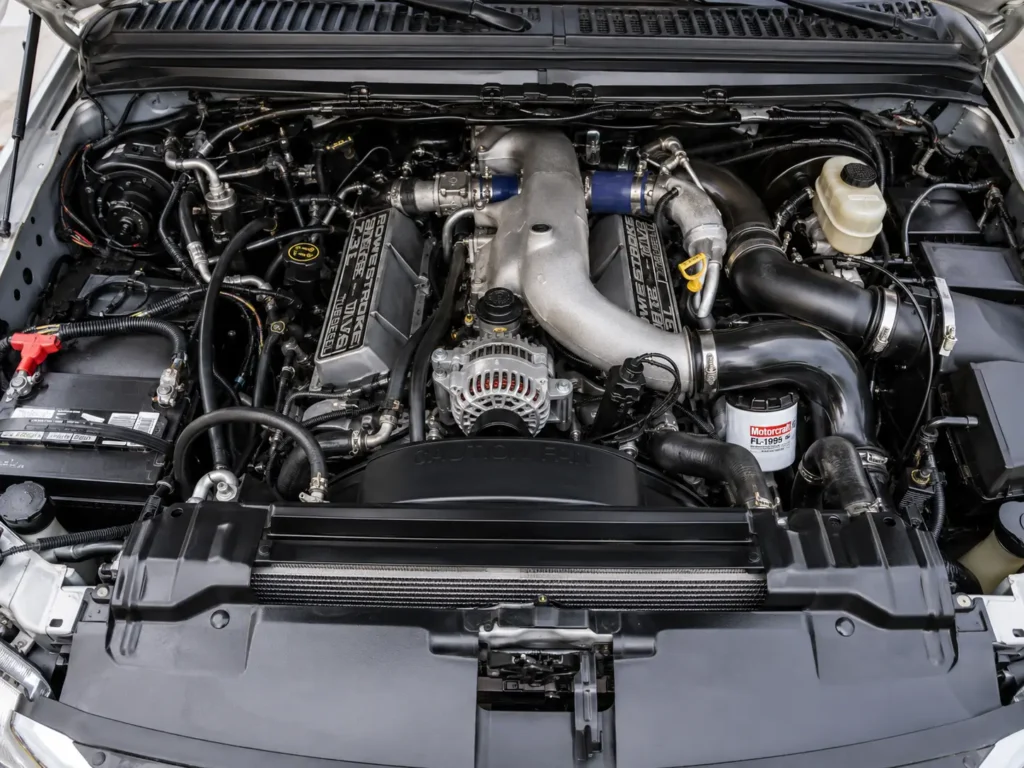
the 7.3L Powerstroke’s Hydraulically Actuated Electronically Controlled Unit Injector (HEUI) system uses engine oil as a high-pressure hydraulic fluid at up to 3,000 PSI to fire the fuel injectors. Correct viscosity, volume, and additive chemistry are absolute mechanical requirements, not guidelines.



7.3 Powerstroke Oil Capacity: The 15-Quart Mandate
The 15-quart capacity is universal across every 7.3L Powerstroke from the first “OBS” (Old Body Style) trucks through the final 2003 Super Duty. It does not change based on model year, body style (pickup, van, or SUV), or transmission type. Here is exactly where those 15 quarts reside:
| Oil Location | Volume | % of Total |
|---|---|---|
| Oil pan / crankcase | 12.0 quarts | 80% |
| Motorcraft FL-1995 filter | ~2.0 quarts | 13.3% |
| HPOP reservoir & galleys | ~1.0 quart | 6.7% |
| Total (with filter change) | 15.0 quarts | 100% |
| Total (without filter change) | ~14.0 quarts | — |
Pro tip: Always change the filter at every oil service. The FL-1995 retains roughly 2 quarts of used oil contaminated with HEUI-sheared soot and metallic particles. Skipping the filter negates much of the benefit of fresh oil.
7.3L Powerstroke oil system: volume distribution pie chart and oil particulate density comparison line chart
Oil volume distribution
7.3L Powerstroke — 15 qt total
Particulate concentration over time
Full-flow vs. bypass filtration
Total oil capacity
15 qt
Standard viscosity
15W-40
HPOP max pressure
3,000 PSI
Min crank ICP
500 PSI

7.3 Powerstroke Oil Type: WSS-M2C171-F1 Explained
The standard factory-recommended viscosity is SAE 15W-40, but Ford approved a specific matrix of viscosity grades depending on ambient temperature. More importantly, every approved oil must carry the Ford WSS-M2C171-F1 certification — a designation that guarantees a minimum of 1,000 ppm of phosphorus (ZDDP anti-wear additive) and elite shear stability. A generic API CK-4 oil without this Ford approval does NOT meet spec.
Ford viscosity selection guide by temperature
| Viscosity Grade | Ambient Temperature Range | Best Use Case |
|---|---|---|
| SAE 15W-40 | Above 10°F (-12°C) | Standard heavy-duty and towing in warm to moderate climates |
| SAE 10W-30 | -10°F to 90°F (-23°C to 32°C) | Moderate climates, lighter duty cycle |
| SAE 5W-40 Full Synthetic | All temps, especially below 30°F | Cold climates, frequent short trips, year-round use |
| SAE 0W-30 / 0W-40 | Below 0°F (-18°C) | Extreme Arctic conditions only |
Approved oils meeting WSS-M2C171-F1
| Brand / Product | Viscosity Grades | Type |
|---|---|---|
| Motorcraft Super Duty Diesel Motor Oil | 15W-40, 5W-40, 10W-30 | Ford OEM standard |
| Shell Rotella T6 Full Synthetic | 5W-40, 0W-40 | Full Synthetic — gold standard for cold climates |
| Shell Rotella T4 Triple Protection | 15W-40, 10W-30 | Conventional — top choice for heavy towing in heat |
| Schaeffer’s SynShield OTR Plus | 15W-40, 5W-40 | Exceptional HEUI shear resistance |
| Mobil Delvac 1 ESP / Ultra | 0W-40, 5W-40 | Full Synthetic — elite arctic protection |
| Valvoline Premium Blue | 15W-40, 5W-40 | No sulfur odor — alternative to Rotella |
Warning: Do not use a modern API CK-4 or FA-4 oil that lacks the WSS-M2C171-F1 approval. In March 2017, Ford formally warned that many CK-4 formulations reduced ZDDP phosphorus levels to protect diesel aftertreatment systems (DPFs/SCRs) that the 7.3L Powerstroke does not have. Running low-phosphorus oil accelerates flat-tappet camshaft wear and HPOP internal wear.
Why the 7.3 Powerstroke Needs 15 Quarts: The HEUI System
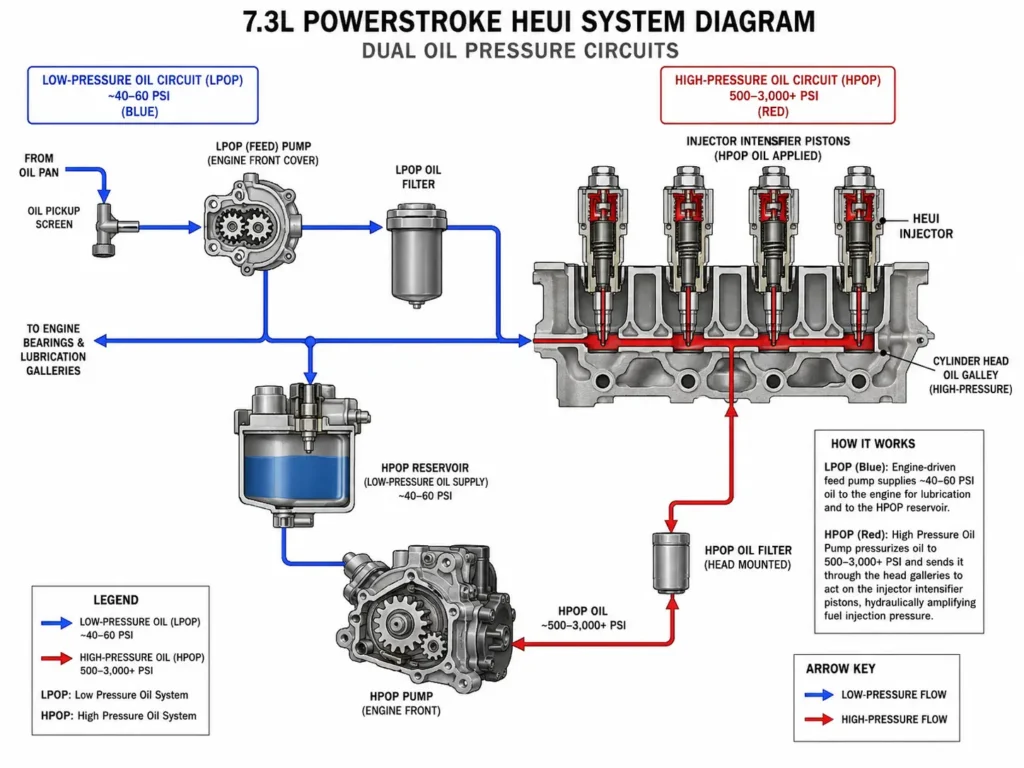
Unlike conventional diesel engines, the 7.3L Powerstroke uses engine oil for two completely separate jobs simultaneously. Understanding this is key to understanding every oil-related specification.
Low-pressure system (LPOP)
A gerotor-style Low-Pressure Oil Pump (LPOP), driven directly by the crankshaft, draws oil from the pan and routes it through the FL-1995 filter and the external oil cooler. It then supplies lubrication to the crankshaft journals, rod bearings, camshaft, and the turbocharger’s floating journal bearings. It also constantly feeds oil to the HPOP reservoir at the front of the engine valley.
High-pressure system (HPOP)
The High-Pressure Oil Pump (HPOP), a gear-driven swashplate pump, takes filtered oil from the reservoir and pressurizes it to between 500 and 3,000 PSI. This high-pressure oil flows through steel lines into the cylinder head galleys.
When the PCM commands injection, a solenoid opens on each injector, allowing the pressurized oil to push down on an intensifier piston whose surface area is approximately 7× larger than the fuel plunger beneath it. The 3,000 PSI of oil pressure is multiplied to over 21,000 PSI of fuel injection pressure — enabling efficient atomization and complete combustion.
This dual-pressure architecture is precisely why the oil volume, viscosity, and anti-foam additive package are so critical. The LPOP must maintain adequate pressure to the bearings while simultaneously feeding the HPOP reservoir at all times. The massive 15-quart volume provides essential thermal mass and de-aeration dwell time as turbulent oil returns from the injector cavities under the valve covers.
Critical: 7.3L Powerstroke Diesel vs. 7.3L “Godzilla” Gasoline Engine
A dangerous naming overlap exists in modern Ford trucks. The 2020+ naturally aspirated 7.3L V8 gasoline engine — nicknamed “Godzilla” — shares its displacement name with the Powerstroke diesel but is an entirely different engine with completely different oil requirements.
| Specification | 7.3L Powerstroke (1994.5–2003) | 7.3L “Godzilla” V8 (2020+) |
|---|---|---|
| Fuel type | Diesel | Gasoline |
| Oil capacity | 15.0 quarts (14.2L) | 8.0 quarts (7.57L) |
| Viscosity | SAE 15W-40 / 5W-40 | SAE 5W-30 |
| Ford oil spec | WSS-M2C171-F1 | WSS-M2C961-A1 |
Applying 15 quarts of 15W-40 diesel oil to the Godzilla gasoline engine will cause crankshaft windage foaming and over-pressurization. Conversely, filling a 7.3L Powerstroke with 8 quarts of 5W-30 gasoline oil will starve the HPOP of hydraulic fluid, preventing injector actuation entirely. Always verify which 7.3L you have before purchasing oil.
The Motorcraft FL-1995 Oil Filter
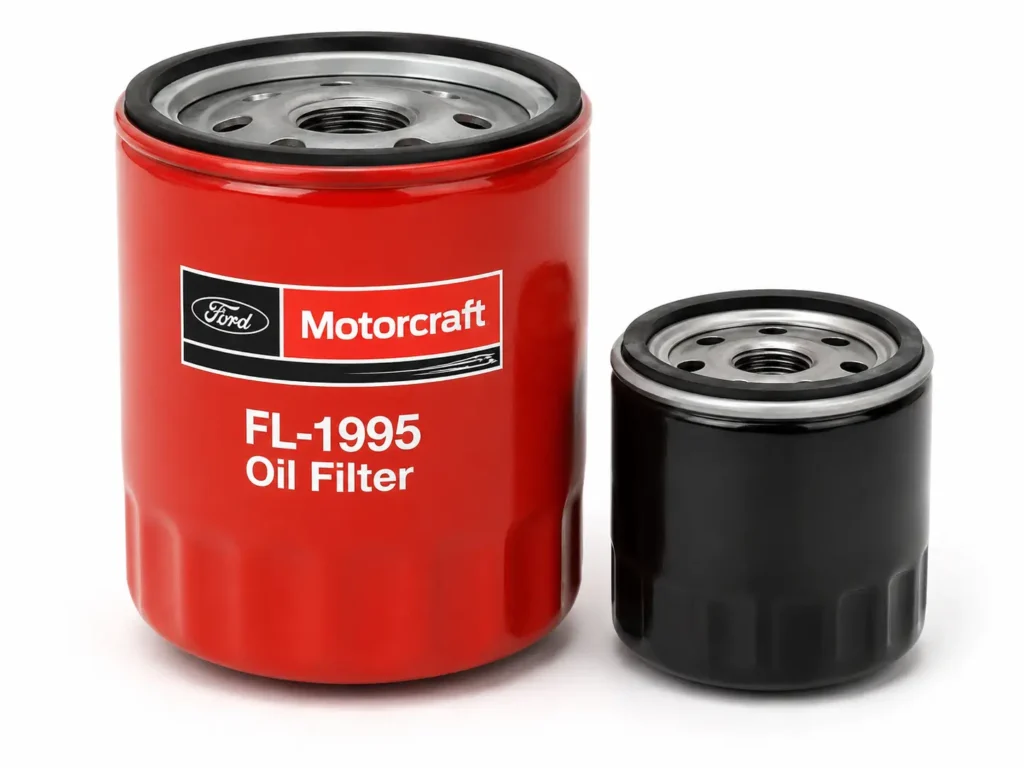
The factory oil filter for the 7.3L Powerstroke is the Motorcraft FL-1995 (Ford part number F4TZ-6731-A). Its large physical size is not cosmetic — it holds ~2 quarts of oil and is engineered specifically for the hydraulic demands of the HEUI system.
| Filter Specification | Detail |
|---|---|
| Thread pitch | 1½-16 inch |
| Filtration rating | 20 microns at 80% efficiency |
| Bypass valve opening pressure | ~12 PSI differential |
| Anti-drainback valve | Yes — premium silicone (prevents dry starts) |
| Oil capacity | ~2.0 quarts |
| Max burst pressure | 200 PSI |
The FL-1995’s bypass valve is positioned at the clean-side end of the filter so that debris trapped in the media cannot wash over the open valve into the engine during a cold-start bypass event — a critical design detail that aftermarket “oversized” filters sometimes fail to replicate. Do not deviate from the FL-1995’s physical footprint; altering filter size disrupts the LPOP’s calibrated pressure dynamics.
Mechanical Shearing: Why Oil Degrades Faster in a 7.3L Powerstroke
Multi-viscosity oils achieve temperature stability through Viscosity Index (VI) improver polymers — long-chain hydrocarbons that expand when hot and contract when cold. When motor oil is forced through the microscopic tolerances of the HPOP swashplate and injector intensifier pistons at 3,000 PSI, these polymer chains are physically sheared into smaller fragments.


Over thousands of miles, a 15W-40 oil subjected to this HEUI shearing can degrade to the viscosity equivalent of a 30-weight oil, compromising the hydrodynamic wedge protecting the main and rod bearings.
Full synthetic 5W-40 oils are inherently more shear-stable because synthetic base stocks have uniform hydrocarbon chains requiring fewer VI improver polymers. This is the primary engineering argument for running Rotella T6 5W-40 or Motorcraft 5W-40 synthetic in a high-mileage 7.3L Powerstroke — not just cold-weather starting, but long-term bearing protection.
About the “Rotella stank”
Many 7.3L Powerstroke owners report a strong sulfur/rotten-egg odor after switching to Shell Rotella T6 5W-40. This is harmless. Rotella T6’s robust anti-wear additive package off-gases sulfurous compounds when subjected to HEUI pressures.
The smell is dramatically worsened if the factory Crankcase Ventilation (CCV) system has been modified to vent atmospheric crankcase vapors under the cab rather than through the intake. The odor confirms active anti-wear chemistry — not a failing engine. Owners sensitive to the smell can use Valvoline Premium Blue as an equivalent approved alternative.
Bypass Oil Filtration: Extending Engine Life Beyond 300,000 Miles
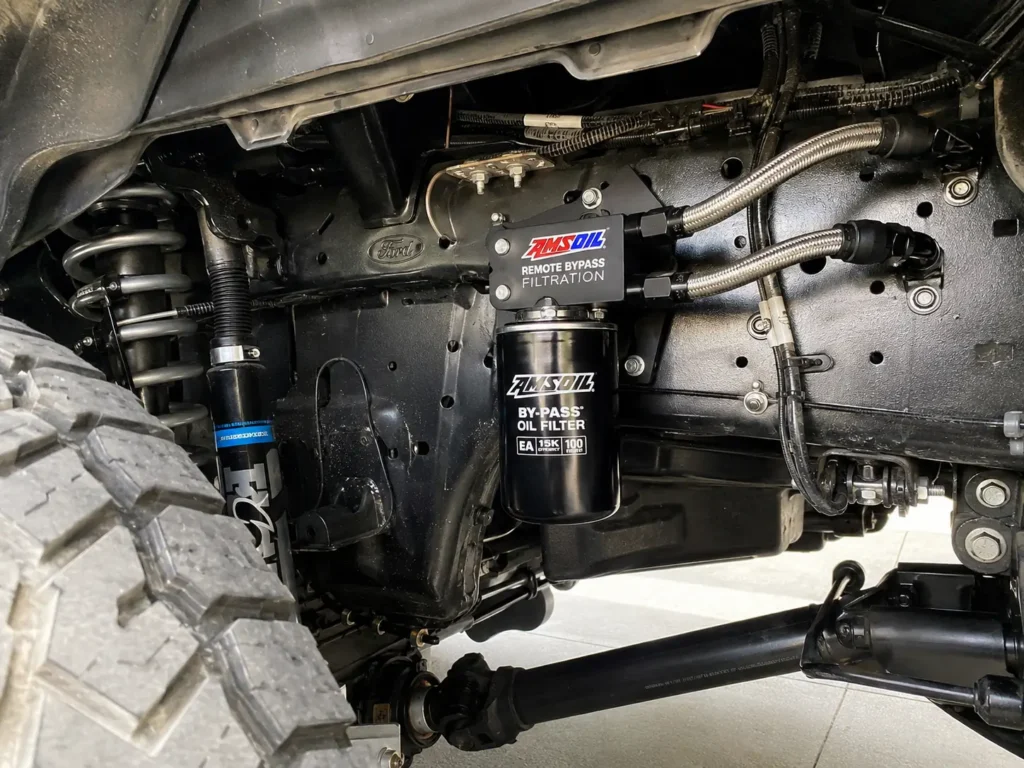
The FL-1995’s 20-micron rating allows particles between 2 and 19 microns to circulate freely. While harmless to journal bearings, these micro-abrasives act as liquid sandpaper inside the HPOP swashplate and injector intensifier pistons at 3,000 PSI — the primary cause of HEUI injector failure on high-mileage engines. A secondary bypass filtration system draws off ~10% of oil flow through a 2-micron element, capturing these abrasives before they accumulate wear damage.
| Bypass System | Filtration Rating | Capacity Added | Notable Feature |
|---|---|---|---|
| AMSOIL Dual-Remote (BMK26) | 2 microns (EaBP element) | ~1.5 quarts | Relocates both full-flow and bypass to frame rail |
| Sinister Diesel Billet Bypass | 2 microns | ~1.0 quart | CNC billet aluminum block, braided SS lines |
| Frantz Filter System | Sub-2 microns | ~1.0 quart | Captures moisture & water condensation in addition to particles |
Installing a bypass system increases total oil capacity to approximately 16–16.5 quarts. Owners running bypass filtration with top-tier synthetic oil and regular Used Oil Analysis (UOA) can safely extend drain intervals to 15,000–20,000 miles.
Oil Drain Plug Torque Specs and Pan Maintenance
The 7.3L Powerstroke oil drain plug uses an M14 x 1.5 thread pitch. There is a widely repeated but dangerously incorrect torque figure of 37 ft-lbs circulating on forums. This will strip the welded bung in the steel pan. The correct specification is:
Drain plug torque: 18–25 ft-lbs (24–34 N·m) — with master technicians recommending 14–18 ft-lbs when using a fresh copper or nylon crush washer. A Fumoto drain valve or magnetic billet steel drain plug with a replaceable O-ring eliminates thread wear entirely.
Essential 7.3L Powerstroke torque specifications
| Component | Torque Specification |
|---|---|
| Oil drain plug (M14 x 1.5) | 18–25 ft-lbs (24–34 N·m) |
| Main bearing cap bolts — stage 1 | 76 ft-lbs |
| Main bearing cap bolts — stage 2 | 96 ft-lbs |
| Connecting rod cap nuts — stage 1 | 53 ft-lbs |
| Connecting rod cap nuts — stage 2 | 80 ft-lbs |
| Flywheel / flexplate bolts | 85–89 ft-lbs |
| HPOP mounting bolts | 18 ft-lbs |
| HPOP drive gear bolt | 95 ft-lbs |
| Oil cooler retaining bolts | 18 ft-lbs (do not over-torque aluminum) |
| High-pressure oil line connector at head | 19 ft-lbs |
Diagnosing HEUI Failures with Oil System Data
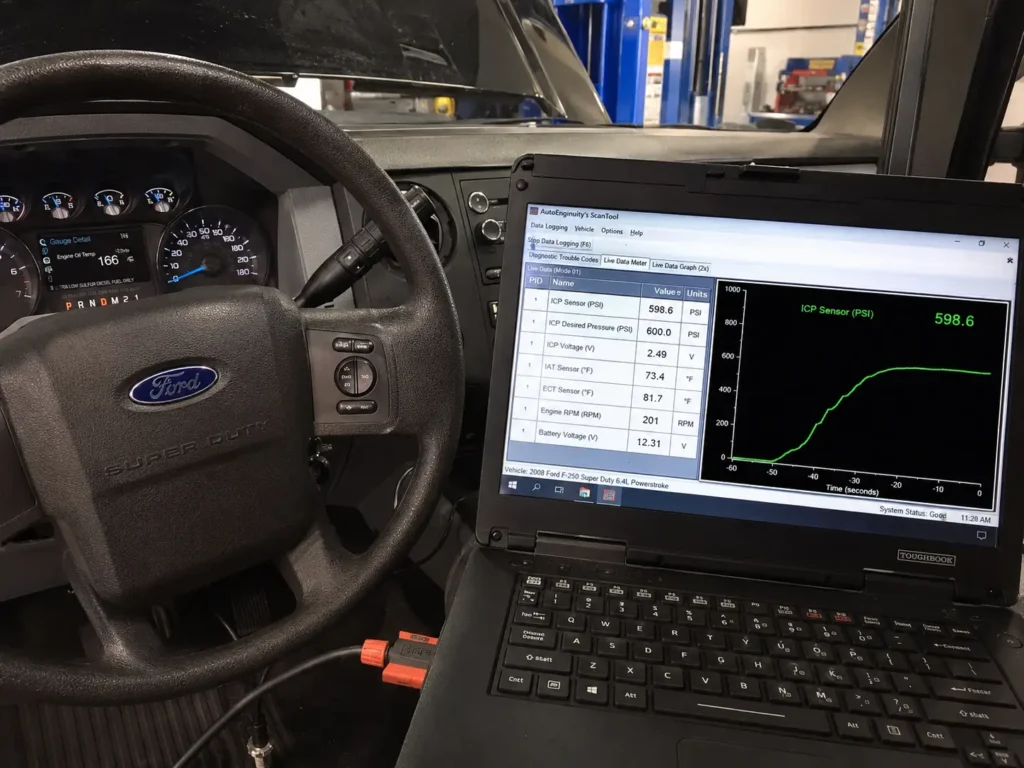
Check the HPOP reservoir first
When a 7.3L Powerstroke exhibits an extended crank, a hot hard-start, or a complete no-start, the first diagnostic step is verifying the HPOP reservoir oil level. Using a 3/16-inch Allen wrench, remove the inspection plug on the HPOP reservoir cover in the front engine valley.
Oil should be visible within 1 inch of the top threads. If empty, the engine is experiencing bleed-down — typically caused by a failed LPOP check valve allowing gravity drain-back overnight. Manually topping the reservoir and cranking the engine confirms this diagnosis if the engine fires. See our guide on the 7.3 Powerstroke ICP sensor location for further diagnostic access points, and the 7.3L Powerstroke IPR valve location for pressure regulator testing.
Scan tool parameters to monitor
| Parameter | Minimum Acceptable | Failure Indication |
|---|---|---|
| Injection Control Pressure (ICP) — cranking | 500 PSI within 15 seconds | Weak HPOP, failing IPR valve, or injector O-ring leaks |
| System voltage — cranking | 9.0–10.0 V minimum | Voltage drop causes weak IDM solenoid firing → no-start |
For full diagnostic specs on the 2003 model year, see our 2003 7.3 Powerstroke specs guide. For the 2001 model year, check our 2001 7.3L Powerstroke specs page.
Complete Fluid Maintenance Schedule: Normal vs. Severe Duty
| Fluid | Spec / Product | Normal Interval | Severe Duty Interval |
|---|---|---|---|
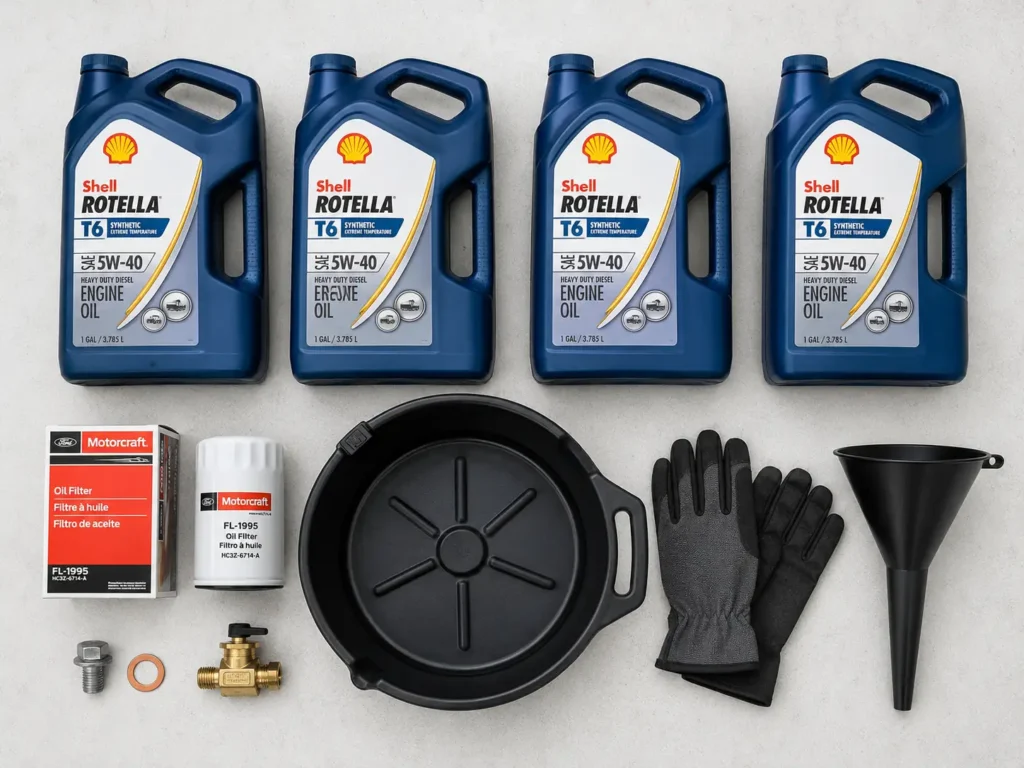
| Engine oil & FL-1995 filter | 15W-40 / 5W-40 (WSS-M2C171-F1) | 5,000 miles | 3,000 miles |
| Fuel filter (1999–2003) | Motorcraft FD4596 | 15,000 miles | 15,000 miles |
| Engine air filter | Motorcraft FA1750 (2002–03) | 30,000 miles | Inspect every 3,000 miles |
| Cooling system | 50/50 Motorcraft VC-5 Gold (32.75 qts) | 50,000 miles | 50,000 miles |
| Automatic trans (4R100) | Mercon V ATF (~17.1 qts) | 30,000 miles | 21,000 miles |
| Manual trans (ZF-6) | Mercon V ATF (~5.8 qts) | 60,000 miles | 60,000 miles |
| Front differential (Dana 60) | 80W-90 gear oil (~2.9 qts) | 99,000 miles | 30,000 miles |
| Rear differential (Sterling 10.5) | 75W-140 synthetic (~3.45 qts) | 99,000 miles | 30,000 miles |
Ford classifies severe duty as: extended idling over 10 minutes per hour, frequent short trips, routine heavy towing or payload hauling, dusty or off-road operation, or biodiesel blends above B20. The aggressive mechanical shearing from the HEUI system means most working trucks should follow severe duty intervals for the engine oil specifically.
Oil Cooler Rebuild: Preventing Coolant Contamination
The external oil cooler on the driver-side of the 7.3L Powerstroke block is a common high-mileage failure point. The cooler seals the heat-exchange tube to its front and rear cast-aluminum headers using thick rubber O-rings. After decades of thermal cycling these O-rings harden and rupture, allowing high-pressure oil to cross-contaminate the cooling system — producing the characteristic milkshake-like sludge in the coolant degas bottle, or causing large external oil leaks.


When rebuilding: torque the front header bolts (10mm) and rear header bolts (10mm) to exactly 18 ft-lbs. The aluminum headers crack easily at higher torque — a replacement part typically exceeds $400. For more on engine oil cooler service, see our engine oil cooler replacement guide.
Frequently Asked Questions
How many quarts of oil does a 7.3 Powerstroke take?
A 7.3L Powerstroke takes 15.0 quarts (14.2 liters) for a complete oil and filter change. Without changing the filter, the engine accepts approximately 14.0 quarts. The massive Motorcraft FL-1995 filter alone holds ~2 quarts.
What oil does a 7.3 Powerstroke take?
The 7.3L Powerstroke requires oil meeting Ford’s WSS-M2C171-F1 specification. The primary viscosity is SAE 15W-40 for temperatures above 10°F (-12°C). For cold climates or year-round use, SAE 5W-40 full synthetic (such as Shell Rotella T6 or Motorcraft 5W-40) is the preferred choice. A generic API CK-4 oil without the WSS-M2C171-F1 Ford approval is not sufficient.
Can you use 5W-40 instead of 15W-40 in a 7.3 Powerstroke?
Yes — and in many cases 5W-40 full synthetic is preferred. The 5W cold rating allows the HPOP to achieve the 500 PSI cranking pressure threshold much faster in cold weather, eliminating the “romp-romp” cold-start surging characteristic of thick 15W-40 in sub-freezing temperatures. Both viscosities are Ford-approved as long as they carry the WSS-M2C171-F1 certification.
What happens if you overfill the 7.3 Powerstroke?
Overfilling beyond 15 quarts raises the crankcase oil level into the path of the spinning crankshaft counterweights, which whip the excess oil into foam at engine speed. Aerated, compressible foam drawn into the HPOP cannot build the 500–3,000 PSI required to fire the injectors, causing misfires, loss of power, and potential bearing damage. Always fill to 14 quarts, let the oil settle, then use the dipstick to reach the final level.
Why does my 7.3 Powerstroke smell like sulfur after an oil change?
If you used Shell Rotella T6, the sulfur smell is a normal reaction from Rotella’s high-concentration anti-wear additive package off-gassing under HEUI pressure. It is not a sign of blown head gaskets or engine damage. The odor is amplified if your CCV system vents to atmosphere under the cab. Switch to Valvoline Premium Blue if the smell is intolerable — it provides equivalent WSS-M2C171-F1 protection without the sulfurous scent.
Why is CK-4 oil bad for the 7.3 Powerstroke?
Standard API CK-4 oils were reformulated in 2016 to reduce sulfated ash, phosphorus, and sulfur (SAPS) to protect modern diesel aftertreatment systems (DPFs, SCRs). The 7.3L Powerstroke has no DPF or SCR — but the reduction in ZDDP phosphorus below 1,000 ppm leaves the flat-tappet camshaft and HPOP internals underprotected. Ford’s empirical testing confirmed unacceptable wear rates, leading to the WSS-M2C171-F1 mandate. Use only oils explicitly approved to that spec.
Conclusion
The 7.3 Powerstroke oil type and capacity specifications are non-negotiable: 15.0 quarts of Ford WSS-M2C171-F1 certified oil — 15W-40 conventional for warm climates and heavy towing, or 5W-40 full synthetic for cold climates and year-round protection. The HEUI system’s dual role of lubrication and high-pressure hydraulic actuation means that incorrect volume, wrong viscosity, or inadequate ZDDP chemistry will manifest as injector failure, HPOP wear, or catastrophic bearing damage. Run a quality FL-1995 filter at every service, stick to the 15-quart fill procedure, and consider a 2-micron bypass filtration system if you’re pushing toward 300,000+ miles.