Can You Switch to 4WD While Driving? Complete 4H vs. 4L Guide in 2026

The question of whether an operator can transition into four-wheel drive (4WD) while a vehicle is in motion requires a nuanced understanding of modern drivetrain engineering. Historically, engaging a 4WD system demanded that the vehicle come to a complete halt, requiring the driver to manually lock the front wheel hubs before engaging a heavy mechanical lever located on the cabin floor.
Today, automotive engineering has advanced significantly with the integration of Electronic Shift-on-the-Fly (ESOF) technology, which has fundamentally transformed the operational parameters of light-duty trucks, heavy-duty work vehicles, and sport utility vehicles.


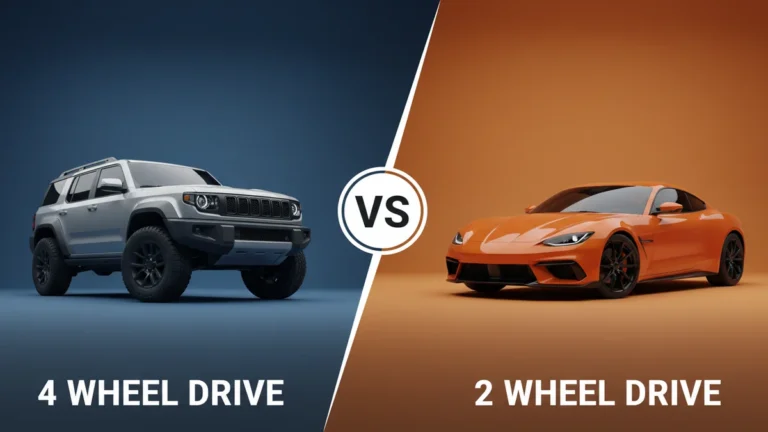
To definitively answer the query—can you switch to 4WD while driving—one must differentiate between the specific driving modes being selected. For transitioning from standard Two-Wheel Drive High (2H) to Four-Wheel Drive High (4H), modern vehicles are explicitly designed to execute this maneuver at highway speeds, typically up to 55 or 62 mph, depending on the manufacturer’s specific engineering tolerances.
However, shifting into Four-Wheel Drive Low (4L) involves profound mechanical alterations within the transfer case, specifically the engagement of planetary gear reduction sets. This shift strictly dictates that the vehicle must be either entirely stationary or rolling at a highly restricted speed of 1 to 3 mph while the transmission is shifted into neutral.
Can You Switch to 4WD While Driving?
The short answer is yes—if you have a modern truck with a “Shift-on-the-Fly” system. However, shifting into the wrong mode at the wrong speed can destroy your drivetrain. Explore the data and protocols below to protect your vehicle.
Max Speed for 4-High
Most modern electronic shift-on-the-fly systems allow transitioning from 2WD to 4-High at highway speeds, typically capping at 50-55 MPH. Lifting off the accelerator briefly during the shift ensures smoother gear meshing.
Max Speed for 4-Low
You must virtually stop to engage 4-Low. Your vehicle must be rolling at less than 3 MPH, and the transmission MUST be in Neutral. Shifting into 4-Low at speed will cause catastrophic mechanical failure.
Engagement Speed Limits by System Type
Not all 4WD systems are created equal. While modern electronic dials make it easy, older trucks with manual hubs or distinct 4-Low transfer cases have entirely different physical limitations. This chart compares the maximum safe speeds to initiate the four-wheel-drive engagement process.
The Shifting Process: 2WD to 4-High
Even with shift-on-the-fly, a specific sequence reduces wear on your transfer case synchronizers. Follow this sequence when driving on slick roads.
1. Verify Speed
Ensure you are traveling below 55 MPH (or manufacturer spec).
2. Lift Throttle
Briefly take your foot off the gas pedal to remove torque load from the drivetrain.
3. Switch Mode
Turn the dial or pull the lever from 2H to 4H.
4. Wait & Resume
Wait for the dashboard 4WD light to stop flashing and go solid before accelerating.
Traction Usage Distribution
Switching to 4WD should only happen when traction conditions dictate it. Driving in 4-High on dry pavement causes drivetrain binding, leading to expensive repairs. Here is the recommended usage distribution based on surface conditions.
-
■2WD (Dry Pavement): Everyday driving, highway cruising, dry dirt roads. Maximizes fuel economy and prevents axle binding.
-
■4-High (Low Traction): Snowy roads, heavy rain/standing water, moderate mud, sand, and loose gravel at normal speeds.
-
■4-Low (Max Torque): Deep mud, rock crawling, pulling heavy loads on inclines, deep snow. Restricted to very low speeds.
The Mechanical Architecture of the Transfer Case
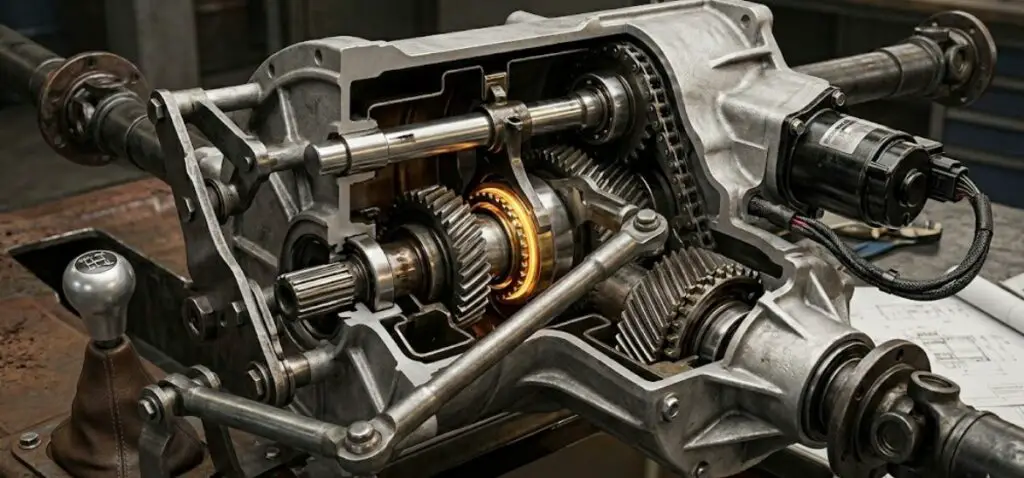
The defining component of any authentic four-wheel-drive vehicle is the transfer case. Positioned adjacent to the rear of the primary transmission, the transfer case functions as a secondary gearbox responsible for dividing the rotational power generated by the engine and transmission, distributing it concurrently to the front and rear axles.
Electronic Shift-on-the-Fly and Synchronizer Rings
The capability to seamlessly shift into 4H while a vehicle is traveling at 55 mph relies entirely on the precise functionality of synchronizer rings within the transfer case. When an operator initiates a shift via a cabin button or dial, a Transfer Case Control Module (TCCM) evaluates the vehicle’s current state and sends an electrical signal to an encoder motor mounted on the transfer case housing. This actuator physically moves internal shift forks, which attempt to connect the front driveshaft to the active driveline.
Because the vehicle is actively moving, the front driveshaft and axle components are typically not rotating at the exact same velocity as the transmission’s output shaft. The synchronizer ring, frequently constructed from specialized high-friction materials such as brass or carbon-based composites, acts as a mechanical buffer.
As the shift fork pushes the components together, the synchronizer ring applies friction to the speed gear. When the rotational speeds of the input and output shafts equalize, the external teeth of the synchronizer ring align perfectly with the sliding sleeve, permitting the gears to mesh silently and securely without catastrophic grinding.
Prolonged usage or improper shifting can cause these synchronizer rings to experience wear. If the friction material degrades, the synchronization timing fails, resulting in gear clashing, harsh physical shuddering through the chassis, and the eventual mechanical failure of the shift-on-the-fly mechanism.
Furthermore, manufacturers explicitly caution that for this shift to execute flawlessly, the vehicle must be traveling in a straight line with no active wheel slip. Applying heavy throttle acceleration, navigating a sharp turn, or operating with dissimilar tire sizes can prevent the synchronizers from matching speeds, causing the TCCM to abort the shift.


Electronic Actuation vs. Manual Mechanical Linkages
While ESOF systems provide unparalleled convenience by automating the engagement process, they introduce a layer of electronic vulnerability. These systems depend on a complex network of speed sensors, electronic actuators, and vacuum lines that are susceptible to environmental degradation.
Conversely, manual shift transfer cases, which are still actively integrated into base-model commercial work trucks and dedicated off-road vehicles, utilize a direct, physical steel linkage that connects a floor-mounted lever directly to the internal shift forks.
This mechanical simplicity translates to absolute reliability for hardcore off-roaders and commercial operators. Through the manual lever, the operator receives tactile feedback, feeling the physical meshing of the gears. Manual systems eliminate the risk of an electronic actuator burning out or a vacuum line freezing while the vehicle is submerged in deep mud or snow, ensuring the operator retains total authority over the vehicle’s tractive capabilities.
Drive Modes Decoded: 2H, 4A, 4H, and 4L
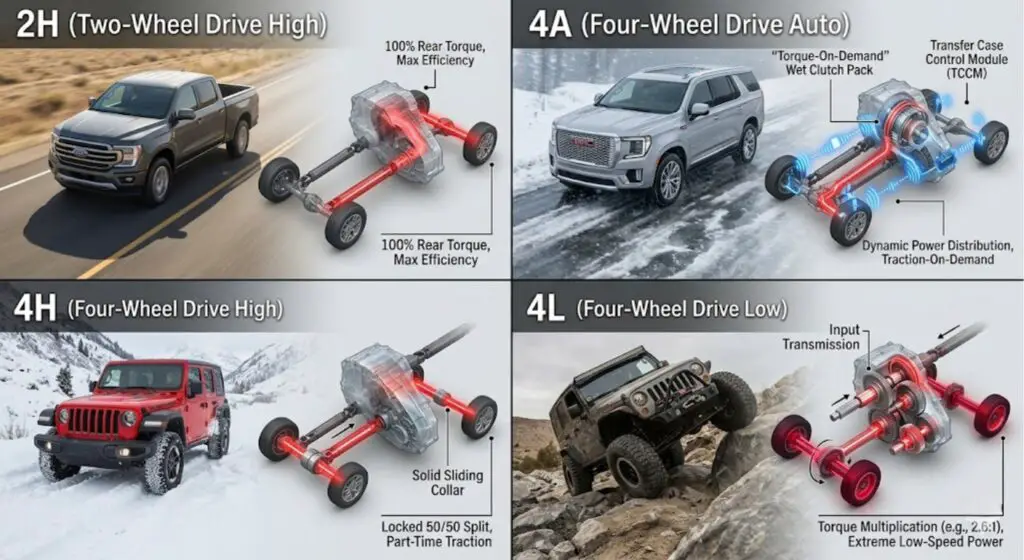
Operating a 4WD vehicle without inflicting critical damage requires a strict understanding of the distinct drive modes engineered into modern transfer cases.
Two-Wheel Drive High (2H)
Two-Wheel Drive High is the default operational state intended for dry, paved surfaces. In this configuration, the transfer case directs 100% of the engine’s available torque exclusively to the rear wheels. By leaving the front driveshaft disengaged, the vehicle minimizes parasitic mechanical drag on the drivetrain, which significantly reduces unnecessary wear on the front differential gears and maximizes the vehicle’s overall fuel economy.
Four-Wheel Drive Auto (4A / 4WD Auto)
Increasingly integrated into premium light-duty trucks and SUVs (such as the Ford F-150 Lariat, RAM 1500, and GMC Sierra Denali), the 4A mode operates similarly to an All-Wheel Drive (AWD) system. A transfer case equipped with 4A utilizes a Torque-On-Demand active system outfitted with sophisticated wet clutches. Under normal conditions, the vehicle behaves as a rear-wheel-drive machine. However, the system’s microprocessors continuously monitor data from wheel speed sensors, steering angle sensors, and throttle inputs.
If traction loss is detected, the AdvanceTrac system or equivalent TCCM commands the transfer case clutch to instantly route power to the front axle to stabilize the vehicle. The distinct advantage of 4A is its interactive nature; it is perfectly safe for daily use on dry pavement and is exceptionally valuable in mixed winter conditions where road surfaces transition unpredictably between dry asphalt, packed snow, and black ice.
Four-Wheel Drive High (4H)
Engaging Four-Wheel Drive High mechanically locks the front and rear driveshafts together through the transfer case, compelling them to rotate at the exact same speed and delivering a true 50/50 torque split. The transfer case gear ratio remains at a 1:1 drive configuration, allowing the vehicle to travel at standard highway speeds. 4H is specifically calibrated for active precipitation scenarios, including driving through deep snow, heavy rain, shallow mud, and loose sand or gravel.
A critical engineering limitation of part-time 4H systems is the absence of a center differential. When any vehicle executes a turn, the front wheels are forced to travel a wider physical arc than the rear wheels, which requires them to rotate at a faster speed. Because 4H rigidly locks the front and rear axles together, this natural speed variance is mechanically blocked. On a slippery surface like snow or mud, the tires are able to momentarily break traction and slip against the earth, relieving this tension. However, if 4H is improperly engaged on high-traction dry pavement, the tires cannot slip.
This scenario causes severe “drivetrain binding” or “wind-up,” representing an immense accumulation of kinetic stress localized in the transfer case chain, driveshaft U-joints, and differential gears. Operators will experience a violent shuddering, stiff steering response, and loud clunking noises during low-speed turns. Prolonged operation in 4H on dry pavement leads directly to catastrophic mechanical failure.
Four-Wheel Drive Low (4L)
Four-Wheel Drive Low is an extreme-duty setting. It retains the mechanically locked 50/50 torque split of 4H but utilizes a secondary planetary gearset within the transfer case to drastically multiply engine torque at the strict expense of wheel speed.
The low-range ratio dictates the extent of this torque multiplication. For instance, a standard Toyota transfer case typically utilizes a low-range ratio of 2.6:1. This means that for every 2.6 rotations of the transmission output shaft, the transfer case outputs exactly 1 rotation to the axles, effectively more than doubling the torque delivered to the wheels. This immense rotational force is essential for rock crawling, extracting stuck vehicles from ditches, navigating deep sand, and maintaining slow, highly controlled momentum on steep off-road inclines.
Because engine RPMs are vastly inflated relative to wheel speed in this mode, driving fast in 4L causes extreme friction and heat buildup. As a result, maximum speeds in 4L are heavily restricted by manufacturers to prevent transmission and transfer case destruction.
Manufacturer Specifications: Speed Limits and Shift Protocols
While the fundamental physics of 4WD remain universal, individual automotive manufacturers program their Transfer Case Control Modules with highly specific operational thresholds. The following table synthesizes the maximum allowable speeds for shifting on the fly, alongside maximum recommended operating speeds.
| Vehicle Manufacturer & Model | Max Shift Speed (2H to 4H) | Recommended Max Operating Speed in 4H | 4L Shift Protocol | 4WD System Type |
| Ford F-150 / Bronco | Up to 55 mph | 50 – 55 mph | Stop or roll 1-3 mph in Neutral | Part-Time / ESOF |
| Chevy Silverado / GMC Sierra | Up to 55 mph | 50 – 55 mph | Stop or roll 1-2 mph in Neutral | Part-Time / Auto |
| RAM 1500 | Up to 55 mph | 50 – 55 mph | Roll 2-3 mph in Neutral | Part-Time / Auto |
| Toyota Tacoma / Tundra | Under 55 mph | Under 55 mph | Completely stationary in Neutral | Part-Time |
| Nissan Frontier / Titan | Up to 62 mph | 62 mph | Completely stationary in Neutral, brake depressed | Part-Time |
| Jeep Wrangler (Command-Trac) | Up to 55 mph | 55 mph | Roll 2-3 mph in Neutral | Part-Time |
| Atlas Transfer Case (Aftermarket) | Must be moving 5-20 mph | N/A | Stop or roll slowly in Neutral | Synchronized Manual |
The “Safety Lockout” Mechanism
Modern computer-controlled vehicles feature integrated electronic safeguards to protect the drivetrain from operator error. For example, if a driver attempts to shift into 4L while traveling at 60 mph, the vehicle simply will not execute the shift. The TCCM constantly reads telemetry from transmission speed sensors; upon receiving an unsafe input,
the module rejects the command. The 4WD indicator lights on the dashboard will flash for approximately 30 seconds before extinguishing, signaling that an impossible shift was aborted, and the vehicle will remain safely in its current drive mode.
Hub Locking Dynamics: Automatic vs. Manual
Transferring power effectively from the transfer case to the front wheels requires physical engagement at the wheel hubs. These hubs are the final link connecting the front axle shafts to the wheels.



The overwhelming majority of modern consumer vehicles utilize automatic locking hubs. When 4H is selected, a vacuum-operated solenoid or electronic actuator automatically locks the internal splines of the hub to the axle shaft. When the driver returns to 2H, the hub disengages, allowing the wheel to freewheel independently of the axle. This critical design reduces rotating mechanical mass, which decreases component friction, minimizes cabin vibration, and notably improves fuel efficiency.
However, specialized heavy-duty commercial vehicles, such as the Ford Super Duty series and the Toyota Landcruiser 70 Series utilized in mining operations, frequently retain fully manual locking hubs. A manual hub forces the operator to exit the vehicle and physically rotate a dial on the wheel center from “FREE” to “LOCK”.
The engineering rationale for manual hubs is pure reliability. Automatic vacuum hubs require the wheel to rotate physically (often at least three-quarters of a turn) to engage properly. If a commercial plow truck is immobilized in a snowbank and cannot move an inch, an automatic hub cannot build the required rotational lock.
Furthermore, vacuum lines are highly susceptible to damage from trail debris. By utilizing a manual override lock, the operator guarantees physical mechanical engagement regardless of the vehicle’s electronic or pneumatic status.
Electronic Locking Differentials (E-Lockers)
While the transfer case splits power horizontally between the front and rear axles, the differential splits power laterally between the left and right wheels on a single axle. Standard “open” differentials allow wheels on the same axle to spin at varying speeds, a necessity for cornering. However, in off-road environments, an open differential will route all engine power to the wheel with the least resistance. If one tire is suspended in the air, it will spin violently while the tire with solid ground contact receives zero torque, stranding the vehicle.
To rectify this, high-capability off-road vehicles feature Electronic Locking Differentials, commonly referred to as e-lockers. When activated via a dashboard switch, an electromagnetic coil physically locks the internal spider gears within the differential carrier, binding the left and right axle shafts together into a solid unit. This forces both wheels to rotate at the exact same velocity, guaranteeing that 50% of the axle’s available torque is delivered to the tire with traction. For a comprehensive breakdown of the physics behind these systems, Chevrolet’s technical guide on locking differentials outlines how virtual and mechanical lockers enhance off-road geometry.
Dynamic Speed Governance of E-Lockers
Because locking the rear wheels together severely degrades steering responsiveness and causes extreme tire scrub on high-traction surfaces, automotive engineers implement strict speed governance on e-locker activation.
The logic programmed into the Ford F-150 serves as a prime example of this dynamic governance:
| Drive Mode Selection | Max Engagement Speed | Auto Disengagement Speed | Auto Re-Engagement Speed |
| Normal / Eco / Sport / Slippery (2H, 4A, 4H) | 20 mph (30 km/h) | 25 mph (41 km/h) | 20 mph (30 km/h) |
| Tow / Haul Mode | 20 mph (30 km/h) | 25 mph (41 km/h) | 20 mph (30 km/h) |
| Deep Snow/Sand / Mud/Ruts / Rock Crawl (4H, 4L) | No Speed Limit | No Speed Limit | No Speed Limit |
Drivetrain Diagnostics: Deciphering the Flashing 4WD Light
When operating an ESOF system, the 4WD indicator lights act as the primary diagnostic interface between the vehicle’s computer and the driver. A solid illumination of the 4H or 4L light confirms that the transfer case has successfully executed the shift. A flashing 4WD light, however, communicates a variety of mechanical or electronic statuses that demand attention.
Diagnosing Flashing Light Triggers
- Shift in Progress (Normal): During a standard shift from 2H to 4H, the indicator will flash temporarily. This signifies that the electric encoder motor is currently shifting the forks and the synchronizers are matching shaft speeds. Once a position switch inside the front differential confirms absolute physical engagement, the light stabilizes to solid.
- Safety Interlock Engaged: If an operator attempts a mechanically impossible shift (such as selecting 4L while driving 45 mph), all mode lights will flash simultaneously for approximately 30 seconds. The TCCM rejects the shift to prevent gear destruction, and no mechanical changes occur.
- Sensor or Actuator Failure: If the 4WD light flashes continuously while driving, or if a “Service 4WD” text prompt appears on the instrument cluster, the system has detected a hardware or software fault. The TCCM relies heavily on data from the throttle position sensor, transmission speed sensor, and individual wheel speed sensors. If wiring is severed, or if the external transfer case actuator fails due to water intrusion, the shift cannot be executed.
- Thermal Overload: In crossover SUVs equipped with light-duty AWD systems rather than robust transfer cases, aggressive driving in deep snow or mud can rapidly overheat the internal wet clutches. Thermal sensors will trigger a flashing light to warn the driver that the system is entering a self-preservation mode and requires cooling time.
If a persistent flashing light fault occurs, automotive technicians recommend performing a “hard reset” of the TCCM. This protocol requires the operator to park the vehicle, turn off the ignition, and physically disconnect the negative battery terminal for 10 minutes to clear the module’s electronic cache. If the warning light returns upon vehicle restart, a Diagnostic Trouble Code (DTC) is permanently stored in the module and requires extraction via an OBD-II scan tool.
Long-Term Maintenance: The “10-Mile Rule” and Lot Rot
Four-wheel-drive systems are highly susceptible to a unique form of mechanical degradation known within the industry as “lot rot” or mechanical atrophy. Because the front differential, front driveshaft, and specific internal transfer case chains remain completely stationary when a vehicle is operated exclusively in 2H, the lubricating gear oils within these housings naturally succumb to gravity, pooling at the bottom of their respective casings.
Over prolonged periods, the exposed rubber gaskets and oil seals located at the top of the axle tubes and transfer case dry out, becoming brittle and prone to cracking. This inevitably leads to catastrophic gear oil leaks and allows moisture and dirt to infiltrate the system. Furthermore, the electronic shift actuators can seize from prolonged inactivity.
To counter this, automotive manufacturers explicitly mandate strict preventative maintenance routines in their owner’s manuals. Toyota, for example, strictly advises Tacoma and Tundra owners to engage the 4WD system and drive for a minimum of 10 miles every single month.
Because driving a part-time 4WD system on dry pavement causes drivetrain binding, operators must strategically locate a suitable low-traction environment—such as a gravel road, a wet grassy field, or a rain-slicked straightaway—to perform this monthly lubrication cycle. If an operator is forced to execute this maintenance on dry pavement,
it must be done in a perfectly straight line at low speeds (to eliminate wheel speed variances) and returned to 2H immediately before attempting any steering inputs. This brief engagement effectively splashes dense gear oil over the internal bearings and ensures the shift actuators remain unfrozen.
Jeep’s Transfer Case Hierarchy: Command-Trac vs. Rock-Trac
To fully comprehend the diversity of modern 4WD engineering, examining the specific transfer cases developed by Jeep provides vital industry context. Jeep offers distinct 4WD systems engineered for vastly different torque applications and environmental severity.
| Transfer Case System | 4WD Type | Low Range Ratio | Engineering Intent |
| Command-Trac (NV241) | Part-Time 4WD | 2.72:1 | Everyday driving combined with moderate trail use and deep snow. Offers excellent wheel speed for mud. |
| Selec-Trac | Full-Time 4WD | 2.72:1 | Mixed weather utility. Utilizes a “4H Auto” setting to dynamically shift torque, ideal for patchy ice and wet roads. |
| Rock-Trac (NV241OR) | Part-Time / Full-Time | 4.0:1 | Extreme duty. Generates a massive crawl ratio designed specifically for technical rock crawling and steep ledge ascents. |
The defining feature of the Rubicon-exclusive Rock-Trac system is its aggressive 4.0:1 low-range reduction ratio. This engineering choice produces an incredibly slow mechanical crawl speed, allowing an operator to navigate hazardous boulder fields with surgical precision without relying on the braking system.
When paired with specific axle gearing and a manual transmission, the Rock-Trac system achieves a staggering 100:1 final crawl ratio, prioritizing absolute torque multiplication over forward velocity.


Fuel Economy and the Drivetrain Penalty
The operational state of a 4WD transfer case has a direct and measurable impact on a vehicle’s overall fuel consumption.
- The 2WD Efficiency Baseline: Operating in 2H is universally the most fuel-efficient configuration. Only the rear driveshaft is actively powered. If the vehicle is equipped with automatic unlocking hubs, the front wheels roll freely along the pavement without turning the heavy front axle shafts or differential gears, eliminating significant friction.
- The AWD / 4A Parasitic Penalty: Vehicles operating in 4WD Auto mode, or permanent AWD systems, generally exact a 1 to 3 MPG penalty on fuel economy. Even though power is only routed to the front wheels during a slip event, the front hubs typically remain locked, and the entire front driveline is continually rotating as the vehicle moves. This “parasitic loss” of mechanical energy forces the engine to consume more fuel simply to maintain highway speeds.
- The 4H / 4L High-Consumption State: Operating in mechanically locked 4H or 4L results in a severe reduction in fuel efficiency. The engine is tasked with pushing torque through multiple engaged gear sets, and in the case of 4L, the engine is forced to operate at vastly higher RPMs to achieve low vehicle speeds. However, because 4H and 4L are exclusively utilized in hazardous, high-resistance conditions (such as deep snow, dense mud, or heavy towing), fuel consumption is rendered a secondary concern relative to necessary traction and safety.
People Also Ask
Can you switch to 4WD while driving?
Yes, transitioning from 2H to 4H can be executed on the fly while driving at highway speeds, generally up to 55 mph or 62 mph depending on the vehicle. Synchronizer rings inside the transfer case smoothly match the rotational speeds of the driveline to allow silent engagement. However, switching into 4L requires the vehicle to be stopped or rolling at no more than 3 mph in neutral due to the massive gear reduction required.
Can I drive in 4H on the highway in the rain?
The mechanical safety of this action depends heavily on the intensity of the precipitation. If the road is merely damp, utilizing a part-time 4H system is strongly discouraged due to the immediate risk of drivetrain binding. Modern tires maintain too much traction on wet asphalt to allow the necessary tire slip required during cornering.
However, during torrential downpours with significant standing water and a severe risk of hydroplaning, 4H can provide essential directional stability. Ideally, in mixed wet conditions, a vehicle equipped with a 4A (Auto) mode should utilize that setting, as it dynamically adjusts to traction needs without binding.
Does shifting into 4WD Low give me more traction if I am stuck?
No. Shifting into 4L does not increase the physical grip or friction between the tire rubber and the earth. 4L strictly increases torque—the rotational twisting force applied to the wheels. If a truck is buried in deep mud or ice and the wheels are freely spinning in 4H, shifting into 4L will only cause the wheels to spin with greater violence, likely digging the vehicle deeper into the substrate.
To escape a completely stuck scenario, the operator requires physical traction aids (such as recovery boards, airing down tire pressure, or engaging an electronic locking differential). 4L is strictly intended for crawling or pulling heavy loads before the vehicle loses all forward momentum.
What happens if I accidentally leave my truck in 4H on dry pavement?
If an operator forgets to disengage 4H after exiting a snowy trail and drives onto a dry highway, the immediate mechanical danger manifests when the road curves. The transfer case will relentlessly force the front and rear axles to spin at identical speeds. The operator will instantly notice the steering wheel feels incredibly heavy, stiff, and resistant to input.
A loud popping or clunking noise will likely emanate from the chassis, which is the sound of the U-joints and gears binding under extreme kinetic stress. While newer, robust transfer cases can occasionally survive brief periods of this abuse, prolonged exposure will inevitably shatter the differential gears, snap an axle, or violently stretch the transfer case chain. The system must be returned to 2H immediately.
Why is it difficult to shift out of 4L?
Due to the immense torque loads applied to the planetary gears while operating in 4L, the gears can frequently become mechanically bound, making it highly difficult for the transfer case actuator to pull the shift fork back into the high-range position. If the dashboard light flashes but the transfer case refuses to exit 4L,
the operator should shift the transmission into drive, allow the vehicle to roll forward a few inches, and then immediately shift back into neutral. Relieving the kinetic tension stored in the driveline typically allows the synchronizer rings and shift collars to slide freely, successfully completing the shift back to 2H or 4H.