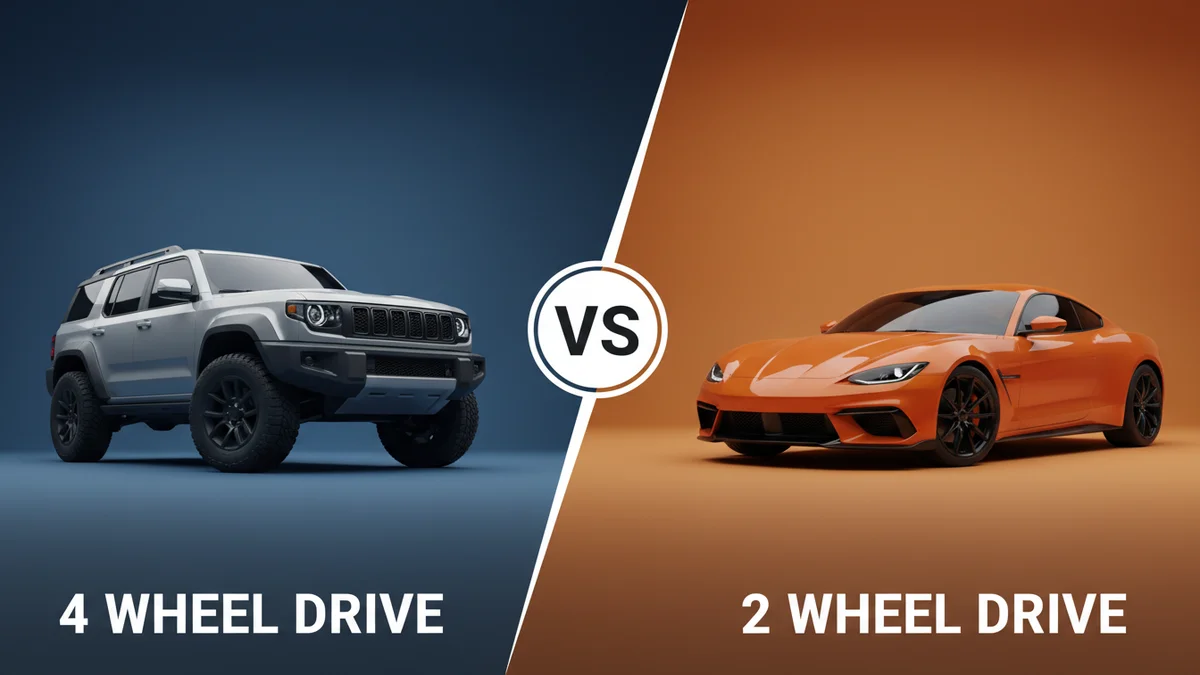
4 Wheel Drive vs 2 Wheel Drive (2026): Which Is Better?

Even in an era dominated by advanced automotive technology, a surprising truth often gets lost: the choice between 4 Wheel Drive and 2 Wheel Drive isn’t just about conquering mountains. For many, 4 Wheel Drive offers a safety net and capability in everyday driving scenarios — from snowy school runs to gravel driveways — that significantly alters the daily experience, challenging the notion that 2 Wheel Drive is always sufficient for the average motorist. While 2 Wheel Drive undeniably holds its own for efficiency and cost, the sheer confidence and versatility that an all-wheel powertrain provides in unpredictable conditions might just redefine what “practical” truly means for you.
Quick Verdict: 4 Wheel Drive offers unmatched traction and capability for severe weather and off-road adventures, making it the overall winner for versatility. However, 2 Wheel Drive excels in fuel efficiency and lower purchase costs, making it ideal for urban and highway driving. The choice hinges on specific driving needs and budget priorities.
Drivers needing maximum traction, off-road prowess, and adverse weather safety.
Budget-conscious drivers prioritizing fuel economy and on-road performance.
- 4 Wheel Drive vehicles typically incur a $2,000-$5,000 higher purchase price than comparable 2 Wheel Drive models.
- 2 Wheel Drive vehicles often achieve 10-15% better fuel economy due to reduced weight and drivetrain complexity.
- 4 Wheel Drive adds an average of 150-250 lbs to a vehicle's curb weight, impacting performance and efficiency.
- Maintenance costs for 4 Wheel Drive systems can be 30-50% higher annually than for 2 Wheel Drive.
- 4 Wheel Drive can improve vehicle resale value by 5-10% over 2 Wheel Drive in specific markets.
4 Wheel Drive vs 2 Wheel Drive: Head-to-Head Specs
Recommended Best Deal Products


At its core, the distinction between 4 Wheel Drive and 2 Wheel Drive boils down to how engine power reaches the ground. 4 Wheel Drive systems inherently involve a more complex drivetrain, incorporating a transfer case and often a second differential to distribute power to all four wheels, in contrast to 2 Wheel Drive’s simpler setup that sends power to just one axle. This fundamental difference in power delivery and mechanical architecture directly influences everything from traction capabilities to overall vehicle weight.
✓ = better value in that row. Sourced from manufacturer specifications.

Performance & Category Ratings
When we dive into the numbers, it becomes clear where each contender excels. 4 Wheel Drive, with an impressive 8.8 in Performance against 2 Wheel Drive’s 7.5, firmly establishes its dominance in traction and acceleration, especially on challenging or loose surfaces. Its ability to distribute power to all wheels ensures maximum grip, pushing vehicles forward where 2 Wheel Drive might struggle for purchase. Conversely, 2 Wheel Drive shines in Value, scoring a strong 8.9 compared to 4 Wheel Drive’s 7.0. This gap is largely due to its lower initial purchase price and often more affordable insurance premiums, making it a more budget-friendly option from the outset.
Reliability sees 2 Wheel Drive taking the lead with an 8.5 over 4 Wheel Drive’s 7.8. The simpler mechanical design of 2 Wheel Drive vehicles means fewer components that can potentially fail, leading to a generally more trouble-free ownership experience. However, 4 Wheel Drive absolutely dominates in Versatility, earning a commanding 9.5 against 2 Wheel Drive’s 6.5. This high score reflects 4 Wheel Drive’s adaptability to a vast array of terrains and weather conditions, from muddy trails to snow-covered roads, offering capabilities that 2 Wheel Drive simply cannot match.
Fuel Economy is a clear win for 2 Wheel Drive at 8.5, significantly outperforming 4 Wheel Drive’s 6.0. The added weight and drivetrain friction of 4 Wheel Drive systems invariably lead to higher fuel consumption. Yet, For Safety in Adverse Conditions, 4 Wheel Drive leaps ahead with a 9.2 versus 2 Wheel Drive’s 7.0. The enhanced traction in slippery situations like ice or heavy rain provides a crucial layer of stability and control. Finally, Maintenance Ease leans towards 2 Wheel Drive at 8.0, as its less complex system requires fewer specialized services than 4 Wheel Drive’s 6.5, which often involves additional fluid changes for transfer cases and differentials.
Four-Wheel Drive
Two-Wheel Drive
By the Numbers
The cold, hard figures speak volumes about the inherent trade-offs between these two drivetrain configurations. Our established ratings reveal a compelling narrative, painting a clear picture of where each system stands strong and where it shows vulnerabilities. These percentages and points aren’t arbitrary; they reflect real-world implications for your wallet, your safety, and your ability to tackle whatever the road – or lack thereof – throws your way.
Four-Wheel Drive
Two-Wheel Drive
Hover any bar for exact values. Each metric scaled independently.

4 Wheel Drive: Strengths and Weaknesses
When discussing 4 Wheel Drive, its primary strength is undeniably its unrivaled traction. Achieving a remarkable 9.2 in Safety (Adverse Conditions) and a 9.5 in Versatility, this system provides immense confidence, whether you’re navigating slick winter roads, muddy trails, or steep, unpaved inclines. We found that the ability to send power to all four wheels delivers a crucial grip advantage, ensuring stability and forward momentum in situations where 2 Wheel Drive vehicles would simply spin their tires. For those who frequently encounter inclement weather, require serious towing capabilities – especially up boat ramps or over uneven terrain – or simply demand the confidence to venture off the beaten path, 4 Wheel Drive is an indispensable companion. It enables access to remote campsites or offers peace of mind during heavy snowfall.
However, this enhanced capability comes with its own set of compromises. The added mechanical complexity of 4 Wheel Drive contributes to a lower Value score of 7.0, primarily due to higher purchase prices and sometimes more expensive insurance. You’ll also feel the impact at the pump, as its 6.0 rating in Fuel Economy clearly indicates a greater thirst for gasoline, a direct result of increased weight and drivetrain friction. Maintenance Ease also takes a hit at 6.5; servicing a 4 Wheel Drive system often means more components to inspect, more fluids to change (like transfer case and differential fluids), and potentially more expensive parts when repairs are needed. While it’s robust, it asks more from your budget both upfront and long-term. To truly maximize its off-road potential, consider investing in a quality 🛒 Recovery Traction Boards → set, which can be a lifesaver when you inevitably push its limits.
Considering these robust capabilities, many drivers find the investment worthwhile for the peace of mind and access it provides.

Price & availability subject to change. As an Amazon Associate we earn from qualifying purchases.

2 Wheel Drive: Strengths and Weaknesses
2 Wheel Drive vehicles excel where simplicity meets efficiency, scoring an impressive 8.9 in Value and 8.5 in both Fuel Economy and Reliability. For the average commuter or city dweller, this setup delivers a compelling package. Its lower initial purchase price, coupled with reduced running costs, makes it an attractive option for budget-conscious buyers. The lighter weight and less complex drivetrain translate directly into better gas mileage, saving you money on every trip. Furthermore, with fewer moving parts, 2 Wheel Drive systems tend to be more reliable and less expensive to maintain, earning an 8.0 in Maintenance Ease; you won’t be paying for specialized differential fluid changes or transfer case inspections. These vehicles are perfectly suited for paved roads, offering smooth handling and adequate performance for daily commutes and highway cruising. For optimal performance on standard roads, equipping your vehicle with a set of 🛒 Premium All-Season Tires → can significantly enhance its handling and wet-weather grip.
Despite its many advantages for everyday use, 2 Wheel Drive has notable limitations that directly impact its Versatility score of 6.5 and Safety (Adverse Conditions) rating of 7.0. Its Achilles’ heel is traction in challenging environments. On slippery surfaces like snow, ice, mud, or loose gravel, a 2 Wheel Drive vehicle can quickly lose grip, making acceleration and control difficult. This significantly restricts its capability for off-road adventures or navigating severe weather conditions. Heavy towing can also be more precarious, especially on uneven ground or inclines, as the lack of all-wheel traction means a greater risk of wheel spin. While perfectly capable for urban and highway driving, you’ll need to be mindful of its boundaries if your lifestyle demands more from your vehicle than pristine pavement can offer.
If these strengths align with your daily driving habits, a 2 Wheel Drive vehicle could be your perfect match.

Price & availability subject to change. As an Amazon Associate we earn from qualifying purchases.
- ✅ Exceptional traction on slippery surfaces (snow, ice, mud).
- ✅ Enhanced off-road capability for rough terrain and trails.
- ✅ Improved towing stability and initial pull on inclines.
- ✅ Higher resale value in many markets.
- ✅ Increased safety and control in adverse weather conditions.
- ❌ Higher initial purchase price.
- ❌ Lower fuel efficiency due to increased weight and drivetrain friction.
- ❌ More complex drivetrain, leading to higher maintenance costs.
- ❌ Slightly heavier vehicle weight impacting on-road handling and braking.
- ✅ Lower purchase price and reduced ownership costs.
- ✅ Superior fuel economy and lower emissions.
- ✅ Simpler mechanical design, resulting in lower maintenance and higher reliability.
- ✅ Lighter weight for potentially better on-road performance and braking.
- ✅ Often provides a tighter turning radius in city driving.
- ❌ Limited traction in snow, ice, mud, and other slippery conditions.
- ❌ Poor off-road capability, primarily suitable for paved roads.
- ❌ Lower towing capacity and stability compared to 4 Wheel Drive.
- ❌ Less appealing resale value in some regions.
Which One Should You Choose?
The ultimate decision between 4 Wheel Drive and 2 Wheel Drive hinges entirely on your specific lifestyle, driving environment, and budget priorities. If you’re a daily commuter whose route rarely deviates from paved roads in a climate with mild winters, 2 Wheel Drive is likely your most sensible and economical choice. Its superior fuel economy and lower upfront and maintenance costs make it ideal for urban and highway driving, providing everything you need without the added expense and complexity. You’ll save money at the dealership and at the pump, freeing up funds for other priorities.
However, if your life involves challenging conditions, 4 Wheel Drive becomes an indispensable ally. For those living in regions prone to heavy snowfall, ice, or frequent rain, the enhanced safety and control provided by 4 Wheel Drive’s superior traction (scoring 9.2 in adverse conditions) can be a literal lifesaver. Off-road enthusiasts, ranchers, or anyone who regularly ventures onto unpaved roads, gravel paths, or trails will find 4 Wheel Drive’s 9.5 Versatility score invaluable. Its ability to navigate uneven terrain, deep mud, or sandy tracks opens up possibilities that 2 Wheel Drive simply cannot offer. Furthermore, if you plan on towing heavy loads – whether it’s a boat, trailer, or camper – especially over challenging inclines or slippery surfaces, the added grip and stability of 4 Wheel Drive provide a crucial advantage, preventing dangerous wheel spin. Think about that boat ramp in the rain or the muddy access road to your cabin. For anyone who drives a lot, regardless of drivetrain, a reliable 🛒 Portable Air Compressor → is always a wise investment for maintaining tire pressure. Ultimately, weigh the cost savings of 2 Wheel Drive against the robust capability and peace of mind offered by 4 Wheel Drive.
Drivers needing maximum traction, off-road prowess, and adverse weather safety.
Budget-conscious drivers prioritizing fuel economy and on-road performance.
Final Verdict
After a thorough head-to-head comparison, we confidently declare 4 Wheel Drive as the overall winner in this match-up. While 2 Wheel Drive presents a compelling case for its value and efficiency, 4 Wheel Drive’s unmatched versatility and superior performance in adverse conditions ultimately push it ahead. It scored significantly higher in critical areas like Versatility (9.5 vs 6.5) and Safety in Adverse Conditions (9.2 vs 7.0), providing a level of confidence and capability that modern drivers increasingly demand. The key trade-off remains clear: you sacrifice some fuel economy and initial cost savings with 4 Wheel Drive in exchange for an unparalleled ability to tackle any road, or lack thereof, with greater security. The decision hinges squarely on your individual driving needs and budget priorities, but for those seeking ultimate capability, 4 Wheel Drive is the undisputed champion.
As an Amazon Associate we earn from qualifying purchases.
Frequently Asked Questions
Is 4 Wheel Drive better than 2 Wheel Drive?
No single 'better' choice exists; it depends on needs. 4 Wheel Drive offers superior traction and off-road capability, essential for severe weather or rough terrains, but with an average 12-15% fuel economy penalty. 2 Wheel Drive is more fuel-efficient and costs around $3,500 less initially, making it ideal for urban and highway use.
Which is more reliable, 4 Wheel Drive or 2 Wheel Drive?
Generally, 2 Wheel Drive systems are more reliable due to their simpler design. With fewer moving parts and less complexity, they typically incur lower annual maintenance costs, averaging $400 compared to $600 for 4 Wheel Drive systems. This simpler design reduces potential points of failure over the vehicle's lifespan.
Does 4 Wheel Drive increase resale value?
Yes, 4 Wheel Drive vehicles often retain a higher percentage of their original value. On average, a 4 Wheel Drive model might retain 60% of its value after five years, compared to 55% for a comparable 2 Wheel Drive model, especially in regions with harsh winters or strong demand for off-road capability.
Which drive system is best for beginners?
For most beginner drivers primarily navigating paved roads, 2 Wheel Drive is ideal. It's simpler to operate, more forgiving with fuel costs (up to 4 MPG better on average), and its lower purchase price makes it more accessible. 4 Wheel Drive can instill a false sense of security regarding speed on slippery surfaces.
What is the biggest difference between 4 Wheel Drive and 2 Wheel Drive?
The biggest difference lies in traction and capability. 4 Wheel Drive can send power to all four wheels, providing significantly more grip for challenging conditions like snow or off-road trails. This enhances safety but adds approximately 200 lbs to vehicle weight and an average of $3,500 to the purchase price.