Do Front or Rear Tires Wear Faster? Drivetrain & Wear Guide [2026]

In most modern vehicles, front tires wear out significantly faster than rear tires because they handle the majority of steering, braking, and engine weight. This is especially true for front-wheel-drive (FWD) vehicles, where the front tires are also responsible for delivering power to the road.
🎯 Key Takeaways
- Front tires typically wear faster due to steering and heavy braking forces.
- FWD vehicles experience the most rapid front-tire degradation.
- RWD vehicles distribute wear more evenly but still favor front wear.
- AWD systems require uniform tread depth to avoid drivetrain damage.
- Regular rotation every 5,000–8,000 miles is essential for balanced tread life.
In most modern passenger vehicles, your front tires will wear out significantly faster than your rear tires. This is not a manufacturing flaw; it is a direct result of how your car is designed to move, turn, and stop. Because the front axle handles multiple roles simultaneously—steering, braking, and delivering power—it is common for front tires to reach their wear limit 20% to 50% sooner than those on the rear axle.
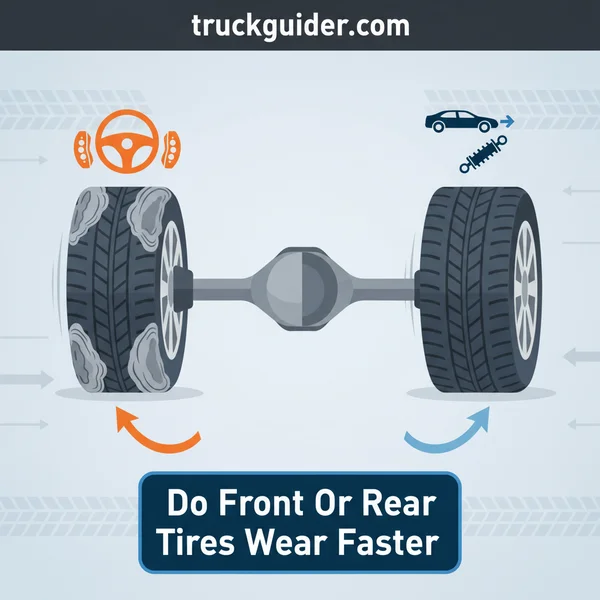
Understanding which tires take the most abuse allows you to manage your maintenance budget and keep your grip levels consistent. If you ignore these uneven wear patterns, you risk compromised handling and the unnecessary expense of replacing a full set of tires prematurely. By identifying whether your specific drivetrain is chewing through rubber, you can take control of your vehicle’s longevity and safety.
The Impact of Drivetrain on Tire Wear Patterns
Your vehicle’s drivetrain is the most significant predictor of tire life. The drivetrain determines which wheels receive torque from the engine, and that constant friction is the primary driver of tread loss. Depending on whether your car pushes, pulls, or distributes power to all four wheels, the “wear leader” shifts accordingly. Friction occurs every time the rubber meets the road to translate engine power into forward motion.

Front-Wheel Drive (FWD): The Double-Duty Dilemma
Most vehicles on the road today, from compact cars to mid-sized SUVs, use a Front-Wheel Drive setup. In an FWD vehicle, the front tires are tasked with everything. They must pull the weight of the car forward, provide the directional force for steering, and handle the vast majority of the stopping power. This “all-in-one” responsibility creates a harsh environment for tread longevity.
- Power Delivery Friction: The front tires must grip the asphalt to pull the car’s mass, causing the tread blocks to flex and wear down under torque.
- Torque Steer: During hard acceleration, the front wheels may tug or slip slightly as they struggle for traction, adding lateral stress to the rubber.
- Wear Ratio: In a typical FWD commuter car, it is common to see front tires wear at a 2:1 ratio compared to the rears.
- Maintenance Reality: If you do not rotate tires on an FWD car, you will likely need to replace the front pair twice as often as the rear pair.
RWD and AWD Wear Dynamics
Rear-Wheel Drive (RWD) vehicles distribute the workload more evenly across both axles. While the front tires still handle steering and most braking, the rear tires take the heat of acceleration. This often results in a more balanced wear pattern, though aggressive driving can cause the rear tires to wear faster. All-Wheel Drive (AWD) systems are designed for balance, but they are rarely perfectly equal. Most AWD systems are front-biased under normal driving conditions, meaning the front tires still tend to lead the wear cycle, albeit less aggressively than a dedicated FWD vehicle.
Mechanical Forces: Why Steering and Braking Target the Front Tires
Even if you took the engine out of the equation, the front tires would still face more physical stress than the rears. This is due to the fundamental physics of how a vehicle maneuvers. Gravity and friction work against the front axle more aggressively during every turn and every stop. The rear tires, by comparison, mostly follow the path set by the front of the car.
Weight Distribution and Engine Placement
The vast majority of consumer vehicles are “nose-heavy.” The engine, transmission, and cooling systems are usually located directly over or slightly in front of the front axle. This constant downward force increases the “contact patch”—the amount of rubber actually touching the road. While a larger contact patch provides grip, it also generates more heat and friction during every mile driven.
- Static Weight: Front tires often support 60% or more of the vehicle’s total weight even when the car is parked.
- Dynamic Loading: When you hit the brakes, the vehicle’s center of gravity shifts forward, piling even more weight onto the front tires exactly when they are trying to grip the road to stop.
- Heat Degradation: The combination of heavy engine weight and friction makes front tires run hotter, which softens the rubber and speeds up the wear process.
The Friction of Steering and Braking Bias
When you turn the steering wheel, you are forcing the front tires to “scrub” against the pavement to change the vehicle’s direction. This lateral friction is exclusive to the front axle. Every turn in a parking lot or curve on a highway is essentially sanding down the outer edges of your front tires. Furthermore, modern braking systems are designed with a “front bias.” Because of the forward weight shift during deceleration, the front brakes are engineered to do roughly 70% to 80% of the stopping work. This means the front tires are subjected to massive longitudinal forces that the rear tires simply never experience. In city driving with frequent stop-and-go traffic, this braking force is often the primary cause of rapid front-end tread loss.
Weight Distribution and Friction: The Role of Engine Placement
Beyond the drivetrain, the physical layout of your vehicle plays a massive role in how your rubber meets the road. In the vast majority of consumer vehicles, the engine and transmission are located at the front. This creates a front-heavy weight distribution that puts constant, disproportionate pressure on the front axle, even when the car is just sitting in your driveway.
The Impact of Weight Shift During Braking
When you hit the brakes, physics shifts the vehicle’s momentum forward. This “nose-dive” effect transfers a significant portion of the car’s total weight onto the front tires. Because the front tires are responsible for both carrying the engine’s weight and handling the majority of braking force, they experience much higher levels of friction and heat than the rear tires.
- Increased Friction: Heavy loads increase the contact patch size, leading to more heat and faster rubber degradation.
- Braking Stress: Front brakes are usually larger and do more work, which translates to more abrasive force on the front tread.
- Heat Build-up: More weight equals more friction, which generates heat—the number one enemy of tire longevity.
Lateral Friction and Steering Forces
In most cars, only the front tires are responsible for steering. Every time you turn the steering wheel, the front tires “scrub” against the pavement to redirect the vehicle’s momentum. This lateral friction is a major contributor to shoulder wear, where the edges of the tire wear down faster than the center. Rear tires, which generally just follow the front in a straight line, are spared from this specific type of mechanical stress.
Maintenance Strategies to Balance Uneven Tire Wear
Uneven tire wear isn’t just an inevitability; it’s a challenge you can manage with a few smart habits. If you ignore your tires, you’ll likely find yourself replacing the front pair twice as often as the rear, which can get expensive and lead to handling imbalances.
The Power of Regular Rotation
The most effective way to fight uneven wear is through regular tire rotations. By moving the tires from the high-stress positions (usually the front) to the lower-stress positions (the rear), you ensure that all four tires wear down at a similar rate. This “sharing of the load” allows you to replace all four tires as a complete set, which is better for your vehicle’s suspension and traction control systems.
- Standard Interval: Most experts recommend rotating tires every 5,000 to 8,000 miles.
- Cross Patterns: For FWD cars, the front tires move straight back, while the rear tires cross to the opposite front corners to change their rotation direction.
- Consistent Performance: Keeping wear even ensures that your car’s handling characteristics remain predictable during rain or snow.
Monitoring Pressure and Alignment
It’s not just about where the tire is on the car, but how it touches the road. Incorrect air pressure is a silent killer of tread life. Under-inflated tires flex too much and run hot, while over-inflated tires wear out quickly in the center. Additionally, even a slight misalignment can cause one tire to “drag” rather than roll, leading to rapid, lopsided wear that can ruin a new tire in just a few thousand miles.
Pro Tip: Check your tire pressure at least once a month, especially when the seasons change and temperatures drop.
Conclusion
So, do front or rear tires wear faster? In the majority of modern cars—especially Front-Wheel Drive and front-engine models—the front tires will almost always wear out first due to the combined stresses of steering, braking, and weight. However, high-performance Rear-Wheel Drive cars can easily flip the script by burning through rear tread during heavy acceleration.
The best way to stay ahead of the curve is to check your tread depth monthly and stick to a strict rotation schedule. Take a moment today to look at your tires; if the front edges look smoother than the back, it’s time to head to the shop. Staying proactive doesn’t just save you money—it keeps you safe on every journey.
❓ Frequently Asked Questions
Why do front-wheel-drive vehicles experience the most uneven wear?
In FWD vehicles, the front tires are ‘overworked’ because they must provide traction for acceleration, direction for steering, and the majority of stopping power. This concentrated stress, combined with the heavy engine sitting directly over them, causes them to wear much faster than the trailing rear tires.
How often should I rotate my tires to prevent uneven wear?
Most manufacturers recommend rotating your tires every 5,000 to 8,000 miles, or during every oil change. Regular rotation moves the tires from high-stress positions (like the front of an FWD car) to lower-stress positions, allowing the tread to wear down at a uniform rate across the set.
Can wheel alignment cause one set of tires to wear faster?
Absolutely. If your vehicle is out of alignment, it can cause ‘cupping’ or ‘feathering’ on specific tires regardless of their position on the car. Even if your drivetrain suggests one set should wear faster, a mechanical misalignment can override those patterns and ruin a single tire prematurely.
Why is tread depth consistency so important for AWD vehicles?
AWD systems are sensitive to the circumference of the tires; if the front tires are significantly more worn than the rear, they will spin at a different speed. This difference in rotation creates heat and mechanical strain on the center differential, which can lead to extremely expensive repairs.
Does driving style influence which tires wear out first?
Aggressive driving, such as hard cornering and late braking, puts immense lateral and longitudinal stress on the front tires. Drivers who take turns quickly will notice the outer ‘shoulders’ of their front tires wearing down much faster than those who drive more conservatively.
Should I put new tires on the front or rear if I only buy two?
Safety experts and tire manufacturers generally recommend placing new tires on the rear axle. This provides better stability and prevents hydroplaning (fishtailing) in wet conditions, even if the front tires currently show more wear.
![Cooper Tires Vs Goodyear: Full Comparison [2026]](https://truckguider.com/wp-content/uploads/2026/03/featured-d6f55b35-768x768.webp)
![Dodge Dakota 6 Lug Pattern Specifications And Wheel Fitment Guide [2026]](https://truckguider.com/wp-content/uploads/2026/03/featured-8bd2ee08-768x768.webp)

![General Grabber Atx Vs Toyo Open Country At3: In-Depth Review [2026]](https://truckguider.com/wp-content/uploads/2026/03/featured-f7dd3935-768x768.webp)