Dodge Journey Won’t Start & Brake Pedal is Hard: Fixing the Issue [2026]

If your Dodge Journey won’t start and the brake pedal feels rock hard, the most likely culprit is a faulty Brake Light Switch failing to signal the ignition system. To get moving, try applying extreme pressure to the pedal or shifting into Neutral to bypass the standard safety interlock.
🎯 Key Takeaways
- A faulty Brake Light Switch is the primary reason the car won’t recognize the brake is pressed.
- Check if your brake lights illuminate when pressing the stiff pedal to confirm switch failure.
- Pressing the brake pedal with extreme force can often engage a failing sensor temporarily.
- Shifting the vehicle into Neutral may bypass certain safety switch communication errors.
- A depleted vacuum in the brake booster naturally causes a ‘hard’ pedal feel when off.
If your Dodge Journey won’t start and the brake pedal feels like a literal brick under your foot, you are experiencing a common safety lockout. This isn’t just a random glitch; it is a failure in the communication between your foot and the car’s computer. In modern Journeys, the push-to-start system requires a “handshake” from the brake light switch before it will allow the starter to engage. If the pedal is too stiff to move, or if the switch itself has failed, that handshake never happens, leaving you stranded in the driver’s seat.


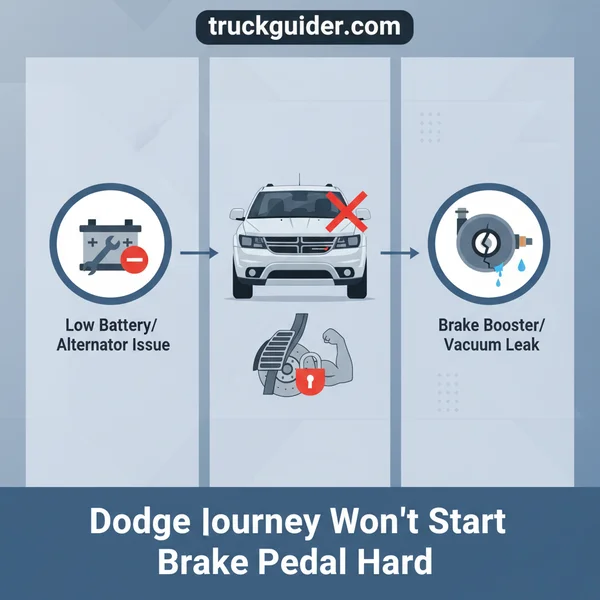
Understanding this connection is vital because it determines whether you need a simple part replacement or a physical workaround to get back on the road today. Practically speaking, this issue is usually narrowed down to two culprits: a faulty electronic sensor or a loss of vacuum pressure in the brake booster. Because the Journey relies so heavily on electronic triggers, even a tiny amount of mechanical stiffness can prevent the ignition from firing up. This guide focuses on identifying the failure point and using specific physical overrides to get your engine running immediately.
The Relationship Between the Brake Light Switch and Push-to-Start
How the Brake Switch Controls Your Ignition
The most frequent cause for a Dodge Journey refusing to start with a hard pedal is a faulty Brake Light Switch, also known as the stop lamp switch. This component is located just above the brake pedal arm under the dashboard. Its job is to detect when you have depressed the pedal and send a signal to the Powertrain Control Module (PCM). In a push-to-start vehicle, this signal is the “green light” the computer needs to engage the starter motor. If the switch fails, the car simply doesn’t know you are trying to start it, resulting in a dashboard that lights up while the engine remains silent.

Dodge Journeys are particularly sensitive to the positioning and health of this switch. If the plunger inside the switch becomes stuck, or if the electrical contacts corrode, the circuit remains open. Even if you are pushing the pedal with significant force, the electronic signal never reaches the PCM. This creates a loop where you are doing the right physical action, but the car is electronically deaf to it.
Key signs of a failed brake light switch include:
- The brake lights at the rear of the vehicle do not illuminate when the pedal is pressed.
- The “Press Brake to Start” message remains on the driver information display even while you are pushing the pedal.
- You are unable to shift the vehicle out of Park because the shift interlock solenoid isn’t receiving the “brake applied” signal.
- The key fob is recognized and accessories turn on, but the engine won’t crank.
Testing the Switch Logic
You can perform a quick diagnostic by checking your tail lights. Have someone stand behind your Journey while you attempt to start the car. If you press the brake and the lights stay dark, your switch is the primary suspect. Often, the switch just needs to be reset or replaced—a task that takes very little time but is the difference between a dead car and a running one. Without that 12v signal from the brake circuit, the Journey’s safety protocols will keep the starter locked out indefinitely.
Dodge Journey Ignition Issues Made Easy: Your Essential Action Plan
When you sit in your Dodge Journey, press the start button, and find that the engine won’t crank while the brake pedal feels as stiff as a brick, it can be an incredibly frustrating experience. This specific combination of symptoms usually points to a depletion of vacuum pressure in the brake booster or an electrical communication failure between the pedal and the Tip Start system. This guide provides a systematic, professional-grade walkthrough to diagnose and resolve this issue, ensuring you can get your vehicle back on the road without an unnecessary tow to the dealership.
Step 1: Apply Excessive Pressure to the Brake Pedal
What you need: Just your physical strength and a bit of patience.
Instructions: The most common reason for a “hard pedal” and a “no-start” condition in a Dodge Journey is the loss of vacuum assist in the brake booster. When the engine is off, and the pedal is pumped, the vacuum is depleted, making the pedal physically difficult to depress. Because modern Journeys require the brake switch to be engaged to allow the ignition to fire, a stiff pedal prevents you from pushing it down far enough to trigger that switch. To bypass this, place your foot on the brake and apply significantly more force than usual—think 70 to 100 pounds of pressure. While maintaining this heavy pressure, press the “Start” button. Often, this extra effort is all that is needed to engage the safety switch.
Pro Tip: Do not “pump” the brake pedal if the car doesn’t start on the first try. Each pump removes the remaining vacuum, making the pedal even harder to press and the vehicle more difficult to start.
Step 2: Perform a Key Fob Proximity Test
What you need: Your Dodge Journey key fob and potentially a spare.
Instructions: If the brake is hard and the car isn’t responding, the vehicle might not be “seeing” the key fob due to a weak battery or signal interference. If the dashboard displays “Key Fob Not Detected,” the brake pedal will remain stiff because the electronic brake booster check hasn’t been bypassed by a recognized key. Take the key fob and physically push the “Start/Stop” button with the nose of the fob itself rather than using your finger. This uses a Near Field Communication (NFC) chip inside the fob that doesn’t require battery power to communicate with the car’s immobilizer. If the car starts, you know the issue is a dying coin-cell battery in your remote.
Pro Tip: Avoid keeping your key fob in the same pocket as your smartphone, as the radio frequency interference can prevent the Journey’s transponder from reading the key’s security code.
Step 3: Verify the Brake Light Switch Functionality
What you need: A friend or a reflective surface (like a garage door or window).


Instructions: The Dodge Journey uses a Brake Pedal Position (BPP) sensor or a standard brake light switch to tell the engine computer (PCM) that it is safe to start. If this switch is faulty, the car won’t start regardless of how hard you press the pedal. With the ignition in the “ACC” or “ON” position, have a friend stand behind the vehicle while you press the brake pedal with maximum force. If the brake lights do not illuminate, the switch is likely broken or misaligned. If the lights do come on, the car “knows” you are braking, and the issue likely lies further down the starting circuit, such as the starter motor or the solenoid relay.
Pro Tip: Check the floor mat. A thick or bunched-up aftermarket floor mat can physically prevent the brake pedal from traveling the necessary distance to click the switch, causing a hard-pedal feel and a no-start condition.
Step 4: Execute a Shift-to-Neutral Reset
What you need: Your ignition key and the gear shifter.
Instructions: Sometimes the Transmission Range Sensor (Neutral Safety Switch) fails to recognize that the vehicle is in “Park.” If the car thinks it is in gear, it will lock out the starter for safety. To troubleshoot this, keep your foot firmly on the stiff brake pedal, move the shifter out of “Park,” cycle it through the gears down to “Low,” and then back to “Neutral.” Try starting the engine while the vehicle is in the “Neutral” position. If the engine cranks and starts in Neutral but not in Park, you have identified a failing range sensor or a shift linkage that has stretched over time and needs adjustment.
Pro Tip: If the shifter is stuck in Park, look for the small rectangular “Shift Lock Manual Override” slot near the shifter. Insert a small screwdriver to release the lock manually so you can move it to Neutral.
Step 5: Test the Battery Voltage and Terminal Integrity
What you need: A digital multimeter and a 10mm wrench.
Instructions: A weak battery can cause a “hard pedal” because the electronic vacuum pump (on certain Journey models) or the ABS module cannot initialize properly. Set your multimeter to DC volts and touch the probes to the battery terminals. A healthy battery should read between 12.4V and 12.6V. If it reads below 12.2V, it likely doesn’t have enough amperage to engage the starter solenoid. Furthermore, check for “creep” or corrosion on the terminals. If you see white or blue powdery substance, loosen the 10mm nuts, remove the cables, and clean the posts with a wire brush. Re-seat them tightly; if you can move the cable by hand, it is too loose to provide the 300+ amps needed for a cold start.
Pro Tip: In the Dodge Journey, the battery is located behind the driver’s side front wheel well. If you can’t reach it, use the remote jump-start posts located under the hood on the passenger side for testing voltage.
Step 6: Inspect and Reseat the Starter Relay
What you need: The owner’s manual and a pair of needle-nose pliers.
Instructions: Open the Totally Integrated Power Module (TIPM)—the fuse box located under the hood. Locate the starter relay (usually labeled as R1 or similar depending on your model year; check the diagram on the underside of the lid). Pull the relay straight up and inspect the metal pins for signs of burning or discoloration. If the pins look clean, try swapping it with an identical relay from a non-critical system, such as the rear defroster or horn relay. If the vehicle starts after swapping the relay, you have a simple mechanical failure within the relay’s internal coil. This is a common failure point in Chrysler vehicles that leads to an intermittent no-start condition.
Pro Tip: While the fuse box is open, check fuse M27 (20 Amp) and fuse J17 (40 Amp). These are specifically tied to the ignition and starter circuits; a blown fuse here will result in total silence when you press the start button.
Step 7: The Starter Solenoid Tap (Emergency Only)
What you need: A long wooden dowel or a heavy wrench/hammer.
Instructions: If you hear a single “click” when pressing the button but the engine won’t turn over, the starter motor’s internal brushes or the solenoid might be stuck. Locate the starter motor on the side of the engine block. While an assistant holds the brake pedal down firmly and presses the start button, use a long tool to firmly (but not violently) tap the side of the starter motor housing. This vibration can sometimes jar the internal components into contact, allowing the motor to spin one last time. If this works, it is a definitive sign that your starter motor has reached the end of its life and must be replaced immediately.
Pro Tip: Be extremely careful of moving parts and hot engine components when performing this step. Ensure the vehicle is in Park and the emergency brake is fully engaged before reaching into the engine bay.


✅ Final Checklist
- Verified the battery voltage is at least 12.4V across the terminals.
- Confirmed that brake lights illuminate when the pedal is depressed with force.
- Attempted to start the vehicle in both “Park” and “Neutral” gear positions.
- Ensured the key fob is recognized by the vehicle or used the NFC “push” method.
- Checked all relevant starter and ignition fuses in the TIPM box.
Important Notes:
- Safety Warning: Always ensure the parking brake is engaged before troubleshooting a vehicle that is struggling to start, especially when shifting gears or working under the hood.
- When to call a pro: If you hear a rapid clicking sound (low voltage) or if the dashboard lights flicker wildly, the TIPM (fuse box) may be failing, which requires professional diagnostic software.
- Estimated Time: 15 to 45 minutes depending on the complexity of the electrical check.
- Estimated Cost: $0 (for pedal/shifter tricks) to $150–$300 (if a new battery or starter motor is required).
Mechanical Causes of a Stiff Brake Pedal in the Dodge Journey
Overcoming Vacuum Loss in the Brake Booster
When you describe the brake pedal as “hard” or “stiff,” you are usually feeling a lack of vacuum assist. Your Dodge Journey uses a vacuum-operated brake booster to make the pedal easy to push. When the engine is running, it creates suction that helps you depress the pedal. When the engine is off, the booster is designed to hold enough vacuum for two or three “easy” presses. However, if the car has been sitting for a long time, or if there is a tiny leak in the check valve, that vacuum escapes. Without it, you are manually trying to move the master cylinder pistons, which requires immense physical force.
The problem is that the brake light switch requires the pedal to move a specific distance to trigger. If the pedal is too stiff to move that necessary half-inch, the switch won’t activate. To fix this immediately and get the car started, try these steps:
- Apply Extreme Force: You must press the pedal much harder than usual. Don’t be afraid to use both feet or put your full body weight into it. You aren’t trying to stop the car; you are just trying to move the pedal far enough to click the electronic switch.
- Check for Obstructions: Ensure that heavy floor mats haven’t slid forward and bunched up behind the pedal. Even a small piece of carpet can prevent that final fraction of an inch of travel needed to trigger the start sensor.
- Avoid Pumping: If the car doesn’t start on the first try, do not pump the brakes. This will only make the pedal harder by exhausting any residual vacuum left in the system.
The Neutral Bypass and Safety Overrides
A secondary mechanical trick involves the transmission. If the Journey won’t start in Park because of the brake sensor, you can sometimes bypass the safety logic by shifting into Neutral. Since the brake switch is often tied to the Park-position safety lock, shifting out of Park can occasionally reset the communication between the sensor and the ignition.
To do this, you may need to use the shift override (usually a small slot or tab near the shifter) if the brake switch is too dead to release the shifter normally. Once the car is in Neutral, firmly hold the stiff pedal and press the start button again. In many cases, this change in the gear position allows the PCM to bypass the initial “Press Brake” lockout and engage the starter. Once the engine fires up, vacuum pressure will immediately return to the booster, and your brake pedal will return to its normal, soft feel.
Electrical Failures: WIN Modules and Battery Voltage Issues
Sometimes, the reason your Dodge Journey won’t start has nothing to do with the mechanical parts of the brake system. Instead, it often boils down to the complex electrical handshake that happens the moment you push the start button. The Wireless Ignition Node (WIN) module is a frequent culprit in these scenarios. This component acts as the gatekeeper for your ignition; if it fails to recognize your key fob or suffers an internal glitch, the vehicle won’t crank, leaving you with a pedal that feels increasingly stiff as you pump it in frustration.
The WIN Module and Key Fob Communication
In many Dodge Journey models, the WIN module is essentially the ignition switch. When it starts to fail, you might notice intermittent starting issues before the car finally refuses to turn over. A common sign of a failing WIN module is a dash that lights up, but an engine that remains completely silent. Because the module isn’t sending the “start” signal to the starter motor, the vacuum in your brake booster isn’t being replenished, leading to that rock-hard pedal feel after just one or two presses.
Battery Voltage and Phantom Symptoms
The Dodge Journey is notoriously sensitive to battery health. Modern vehicles require a specific voltage range to wake up the various onboard computers. If your battery is hovering just below the necessary threshold—even if it has enough juice to turn on the radio—the Powertrain Control Module (PCM) might refuse to engage the starter.
- Voltage Drops: A weak battery can cause “ghost” codes in the brake sensor system, making the car think the pedal isn’t depressed.
- Parasitic Draw: Common in older Journey models, small electrical drains can wear down a battery overnight, leading to a “no-start” condition the next morning.
- Terminal Corrosion: Even a tiny amount of acid buildup on the battery terminals can disrupt the high-amperage flow needed to kick over the engine.
Critical Components: Vacuum Boosters vs. Sensor Faults
When the engine isn’t running, your brake system relies on stored vacuum pressure to provide “power” to the brakes. This is why the first press of the pedal might feel normal, but subsequent presses become incredibly difficult. If your Dodge Journey won’t start, a hard pedal is often just a secondary symptom of the engine not spinning, but in some cases, the brake system itself is preventing the car from starting.
The Brake Pedal Position (BPP) Sensor
Your Journey features a Brake Pedal Position (BPP) sensor that tells the car’s computer exactly when you are stepping on the brake. For safety reasons, the car will not start unless it receives a clear signal that the brake is engaged. If this sensor is faulty or misaligned, the computer assumes you aren’t pressing the pedal. You might be pushing down as hard as you can on a stiff pedal, but if the sensor doesn’t report that movement, the ignition sequence will never begin.
Vacuum Booster Check Valves and Leaks
The brake booster is a large canister that uses engine vacuum to multiply the force you apply to the pedal. A small component called the check valve is responsible for holding that vacuum in the booster after the engine is turned off. If this valve fails or if the booster has an internal leak, the vacuum escapes immediately. This results in a “hard pedal” before you even try to start the car. While a hard pedal alone won’t stop a car from starting, the extra effort required to trigger the BPP sensor can make it feel like the car is locked out.
- Internal Diaphragm Failure: If the rubber seal inside the booster tears, the pedal will feel like a brick regardless of engine state.
- Environmental Factors: Extreme cold can cause seals to shrink or check valves to stick, leading to a temporary loss of vacuum assist.
- Hose Obstructions: A cracked or collapsed vacuum line can prevent the booster from ever reaching the right pressure.
Conclusion
Dealing with a Dodge Journey that won’t start combined with a hard brake pedal is certainly frustrating, but it is usually a solvable puzzle involving your battery, sensors, or ignition modules. In most cases, the hard pedal is simply a byproduct of the engine not running, though a faulty Brake Pedal Position sensor can sometimes be the “silent” reason your car refuses to recognize your start command. Understanding the link between your electrical system and your power-assisted brakes is the first step toward a fix.
As a next step, we recommend checking your battery voltage with a multimeter or ensuring your key fob has a fresh battery. If the electronics seem fine, a closer look at the brake sensor might be necessary. Don’t let a stiff pedal stall your day—take a systematic approach and get your Journey back on the road!


❓ Frequently Asked Questions
Why does my Dodge Journey say ‘Press Brake’ when I’m already pressing it?
This indicates a failed Brake Light Switch (BLS) or a blown fuse for the stop lamps. The car’s computer isn’t receiving the electrical signal that confirms the pedal is depressed, so it blocks the starter for safety.
How much does it cost to fix a stiff brake pedal start issue?
A replacement Brake Light Switch typically costs between $20 and $50 for the part, while labor adds another $50 to $100. If the vacuum booster is the issue, repairs can range from $300 to $600.
Can a weak key fob battery cause a hard brake pedal start issue?
The key fob battery won’t change the physical feel of the pedal, but it can prevent the car from recognizing the start command. If the pedal is hard and the fob is weak, try pressing the start button directly with the key fob.
What is the ‘Neutral trick’ for starting a Dodge Journey?
If the car won’t start in Park due to a sensor glitch, shifting the gear lever into Neutral can sometimes refresh the communication between the transmission and ignition modules. This bypasses specific ‘Park-only’ safety checks.
How does the vacuum booster affect the brake pedal feel?
The vacuum booster provides power assistance; when the engine is off, the vacuum is eventually lost, making the pedal feel rock hard. In a Dodge Journey, this can prevent the pedal from traveling far enough to trigger the ignition sensor.
Is the WIN module a common failure point for this symptom?
The Wireless Ignition Node (WIN) is a known weak spot in older Dodge Journeys and can mimic brake sensor issues. If your brake lights work but the car still won’t crank, the WIN module might be failing to recognize the key’s signal.
![Why Are Fog Lights Yellow? The Science of Better Visibility [2026]](https://truckguider.com/wp-content/uploads/2026/03/why-are-fog-lights-yellow-featured.webp)
![How to Adjust a Parking Brake: Cable and Star: Step-by-Step Guide [2026]](https://truckguider.com/wp-content/uploads/2026/03/how-to-adjust-parking-brake-featured.webp)