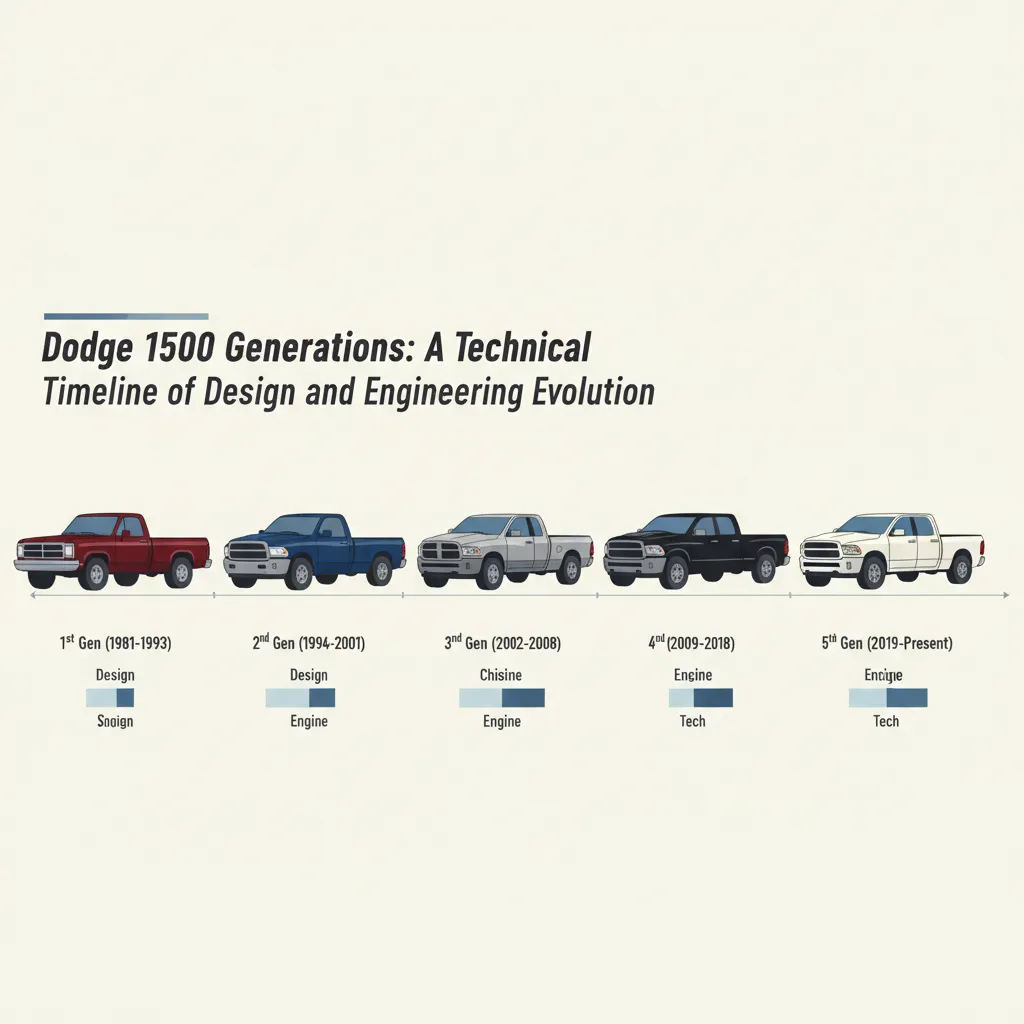
Dodge Ram 1500 Generations Chart: A Technical Timeline Of Design And Engineering Evolution

The Dodge Ram 1500 has evolved from a utilitarian ‘workhorse’ in the early 1980s into one of the most technologically advanced and luxurious vehicles on the road today. With five distinct generations and a complex brand split in 2010, many buyers find it difficult to distinguish between model years, engine options, and suspension setups. This expert-curated generations chart and guide will provide a technical timeline of the Ram 1500, helping you identify the key features, reliability milestones, and engineering shifts that define each era of this American icon.


Dodge Ram 1500 Generations Chart: The First Generation Foundation (1981–1993)
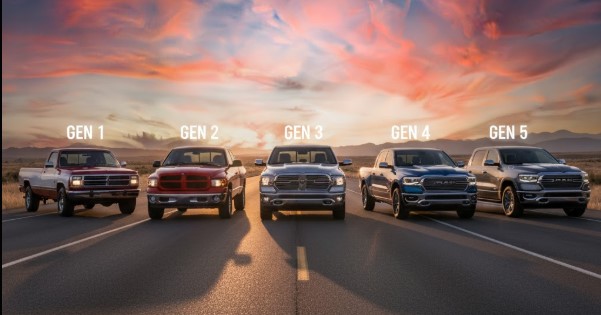
The debut of the first-generation Ram in 1981 was less of a radical departure and more of a strategic rebranding. Replacing the aging D-Series, Chrysler introduced the Ram hood ornament and nameplate to signify a new era of toughness. During this period, the trucks were officially known as the Dodge Ram, with “Power Ram” used specifically for four-wheel-drive variants. These trucks were the epitome of the “square-body” era, featuring a boxy, upright aesthetic that prioritized visibility and ease of maintenance over aerodynamics.
Technically, the first generation was a masterclass in utilitarian engineering. The interior was sparse, utilizing durable plastics and vinyl designed for commercial and agricultural duty. Under the hood, the truck initially relied on the venerable 225 cubic-inch Slant-6 and the 5.2L (318) and 5.9L (360) LA-series V8 engines. A critical turning point occurred in 1988 when the platform transitioned from traditional carburetion to electronic fuel injection (EFI) for the 3.9L V6 and 5.2L V8 engines, significantly improving cold-start reliability and fuel management.
If you are restoring a first-generation model, target the 1991–1993 versions. These received the updated ‘crosshair’ grille and improved electrical systems, making them the most refined examples of the original boxy design.
While the Ram 1500 didn’t receive the legendary Cummins Turbo Diesel (which was reserved for the 2500 and 3500 models starting in 1989), the presence of that engine in the lineup elevated the 1500’s market perception. It established the Ram as a heavy-duty contender. The introduction of the ‘Club Cab’ configuration during this era also offered a glimpse into the future of extended-cab trucks, providing much-needed interior storage space behind the front bench. This generation spanned 13 years with minimal sheet metal changes, a testament to its rugged, if unrefined, foundational design.
The Big-Rig Revolution: Second Generation Ram 1500 (1994–2001)
In 1994, the Dodge Ram 1500 fundamentally changed the trajectory of the American pickup truck. Lead designer Phillip E. Payne moved away from the industry-standard “flat-face” look, opting instead for a ‘Big-Rig’ styling approach. This featured dropped fenders, a massive freight-liner style grille, and a hood that sat higher than the surrounding bodywork. The impact was immediate and profound, turning a third-place brand into a styling leader. For a deeper look at the legacy of these designs, you can consult an official guide for historical context.
The second generation wasn’t just about aesthetics; it introduced the Magnum engine series. These were significantly updated versions of the previous V8s, featuring revised cylinder heads and multi-port fuel injection. The 5.2L Magnum and the 5.9L Magnum provided a substantial power leap, making the Ram a favorite for towing and performance enthusiasts alike. The 1994 redesign’s appearance in popular culture—most notably the red 2500 in the movie ‘Twister’—solidified its status as a rugged, expert-grade machine in the public consciousness.
By The Numbers
1994 Units Sold
Sales Growth ’93-’94
Quad Cab Intro
Innovation continued throughout the cycle, with the 1998 introduction of the Quad Cab. This featured rear-hinged doors that allowed for much easier access to the back seat, a first-to-market feature that forced competitors to rethink their cabin designs. Inside, the ergonomics shifted toward a driver-centric cockpit. The dash was angled toward the operator, and comfort features like upgraded sound systems and premium upholstery became standard options, reflecting a shift from pure utility to daily-driver capability. Research indicates that these advancements were primary drivers in Chrysler’s mid-90s profitability.


Refinement and the Return of the HEMI: Third Generation (2002–2008)
The third generation of the Ram 1500 (2002–2008) focused on structural rigidity and ride refinement. The most significant technical shift was the move to an all-new frame and the introduction of Independent Front Suspension (IFS) on 1500 4WD models. While traditionalists initially scoffed at the departure from the solid front axle, the result was a dramatic improvement in steering precision and ride quality. This generation also saw the return of a legendary nameplate: the 5.7L HEMI V8.
Launched in 2003, the 5.7L HEMI replaced the aging 5.9L Magnum. It produced 345 horsepower—a nearly 100 hp increase over its predecessor—setting a new benchmark for reliable, high-output truck performance. To maintain your vehicle’s peak performance, always refer to the specific Ram specs for fluid and maintenance intervals. The generation also birthed the ‘Mega Cab’ in 2006. By utilizing the heavy-duty frame, Dodge offered the largest interior volume in the segment, providing rear-seat passengers with limousine-like legroom.
✅ Pros
- Powerful 5.7L HEMI V8 engine
- Massive Mega Cab interior space
- Improved highway handling with IFS
- SRT-10 high-performance variant availability
❌ Cons
- Premature ball joint wear on early models
- High fuel consumption on HEMI engines
- Dashboard cracking issues in sun-exposed units
- Complex electrical modules (TIPM)
The third generation also served as the platform for the high-performance Dodge Ram SRT-10. Equipped with the 8.3L V10 from the Viper, this “Viper Truck” was a showcase of chassis versatility, capable of reaching 150 mph. Meanwhile, at the other end of the spectrum, the ‘Work Special’ and luxury ‘Laramie’ trims began a trend of trucks serving dual roles as rugged workers and premium family vehicles, a complete guide to the modern market evolution.
Brand Independence and Suspension Innovation: Fourth Generation (2009–2018)
The fourth generation marked a major corporate shift. In 2010, Ram became a standalone brand, separate from Dodge. This move allowed the brand to focus on a more professional and trusted image. The 2009 redesign was a technical marvel, most notably for the introduction of a class-exclusive multi-link coil-spring rear suspension. This replaced traditional leaf springs, providing a car-like ride without sacrificing payload capacity. It remains one of the most significant engineering distinctions in the full-size truck market.
Aerodynamics also took center stage, with the redesign improving the drag coefficient to 0.419—the best in its class at the time. This generation introduced the 8-speed TorqueFlite automatic transmission, which greatly improved fuel efficiency and power delivery. For buyers focused on economy, the 3.0L EcoDiesel V6 offered impressive torque and highway range. For those buying used, it is vital to review expert tips regarding the specific maintenance needs of the EcoDiesel and air suspension systems.
📋
Ram 1500 Selection Guide
Decide if you need the simplicity of a leaf-spring setup (3rd Gen and older) or the superior ride of the coil-spring rear (4th Gen and newer).
Remember that the “Ram 1500 Classic” is actually the 4th Generation platform sold alongside the 5th Generation to provide a value-oriented option.


The 4th generation also birthed the Ram Rebel (2015), a factory-tuned off-road package that introduced the bold R-A-M lettered grille, signaling a departure from the traditional crosshair design. Because of its popularity and reliability, the 4th generation continued production as the “Ram 1500 Classic” long after the 5th generation launched, making it a complete favorite for fleet owners and budget-conscious private buyers.
The Modern Standard: Fifth Generation and eTorque Technology (2019–Present)
The current ‘DT’ platform represents the pinnacle of truck luxury. Through the extensive use of high-strength steel and aluminum in the tailgate and engine mounts, the 5th Generation Ram 1500 achieved a weight reduction of 225 lbs compared to its predecessor. This generation’s defining technical feature is the eTorque Mild Hybrid system. By using a belt-drive generator-motor unit, the system provides seamless start-stop capability and “torque fill” during shifts, improving overall drivability and fuel economy.
Inside, the 5th generation revolutionized the segment with a 12-inch Uconnect touchscreen and premium materials that rival European luxury sedans. It was the first full-size pickup to earn a Top Safety Pick+ rating from the IIHS, proving that a rugged truck could also be exceptionally safe. The performance crown of this era is held by the 702-horsepower Ram TRX, which utilizes a supercharged 6.2L HEMI to dominate off-road environments.
The transition to the 2025 model year brings the Hurricane Twin-Turbo I6, marking the end of the traditional V8 era for the 1500. While more powerful and efficient, buyers seeking the “classic HEMI rumble” should act quickly on remaining 2024 stock.
As we look toward the future, the 5th generation continues to push boundaries with its integration of high-speed connectivity and hybrid tech. Whether it’s the 702-horsepower TRX or the efficiency of the eTorque system, the modern Ram 1500 has firmly transitioned from a simple tool into a high-tech mobile office and luxury cruiser, setting a professional standard for the entire industry.
The Ram 1500’s journey from the 1981 debut to the 2019 ‘DT’ platform represents the pinnacle of American truck engineering. Key milestones include the 1994 ‘Big Rig’ styling, the 2009 coil-spring suspension, and the 2019 luxury interior revolution. Understanding the differences between Dodge-era and Ram-brand generations is essential for accurate parts matching and purchase decisions. Whether you are seeking the value of a 4th Gen Classic or the luxury of a 5th Gen Limited, use this chart to cross-reference your required specs before visiting a trusted dealership.
Frequently Asked Questions
What year did Dodge Ram become just Ram?
The transition occurred in late 2009 for the 2010 model year. Chrysler Group LLC reorganized its brands, establishing Ram as a standalone division to focus on specialized truck needs. While many still colloquially refer to them as ‘Dodge Rams,’ vehicles produced from 2010 onward are officially branded solely as Ram trucks.


What are the differences between the Ram 1500 Classic and the newer Ram 1500?
The Ram 1500 Classic refers to the continued production of the 4th Generation (DS) body style, offering a traditional interior and lower price point. The newer Ram 1500 (DT) features a complete redesign with a 225-lb weight reduction, a larger 12-inch infotainment screen, improved aerodynamics, and available eTorque mild-hybrid technology.
Which Ram 1500 generation is considered the most reliable?
The late 4th Generation (2013-2018) is often cited by experts as a reliability ‘sweet spot’ because the 8-speed TorqueFlite transmission and 5.7L HEMI combination were fully matured. However, the 2nd Generation remains a favorite among hobbyists for its mechanical simplicity and the longevity of its Magnum-series engines.
How can I identify which generation my Ram 1500 belongs to?
The easiest way is by model year: 1981-93 (1st), 1994-2001 (2nd), 2002-08 (3rd), 2009-18 (4th), and 2019-present (5th). Visually, look for the suspension: 4th and 5th Gen 1500s have rear coil springs, whereas 1st through 3rd Gen models utilize traditional leaf springs.
What are common problems with each Ram 1500 generation?
2nd Gen models are known for dashboard cracking and transmission wear; 3rd Gen models can experience ‘HEMI tick’ or exhaust manifold bolt issues; 4th Gen models sometimes face air suspension leaks in cold climates. Modern 5th Gen models have occasional software glitches in the Uconnect 12-inch systems but are overall highly rated for quality.
![2017 Ram 2500 Transmission Specifications, Maintenance, [2026]](https://truckguider.com/wp-content/uploads/2026/03/featured-9b105d51-768x768.webp)
![2018 Ram 3500 Transmission: Complete Specs Guide [2026]](https://truckguider.com/wp-content/uploads/2026/03/2018-ram-3500-transmission-featured.webp)
![4th Gen Ram 1500 Wide Body Kits [2026]](https://truckguider.com/wp-content/uploads/2026/03/4th-gen-ram-1500-wide-body-kit-featured.webp)