
Dodge Ram 1500 Jack Tool Kit Location And Access Guide By Model Year

Standing on the side of a busy highway with a flat tire is a high-stress experience, and that stress multiplies exponentially if you cannot locate the tools necessary to perform a roadside repair. For many Dodge Ram 1500 owners, the jack and tool kit are “out of sight, out of mind” until an emergency strikes. Because Ram has updated its interior configurations across multiple generations—from the classic DS models to the modern DT series—the exact location of these tools isn’t always obvious. This guide provides the precise locations for various cab styles, expert instructions for access, and the critical safety protocols required to get your truck back on the road safely.


Dodge Ram 1500 Jack Tool Kit Location: Variations by Cab Configuration
The storage strategy for the Ram 1500 jack assembly is dictated primarily by the cab’s footprint. Engineers must balance accessible storage with the need to minimize cabin noise and vibration. Consequently, the mounting points vary significantly between a work-ready Regular Cab and a luxury-oriented Crew Cab.
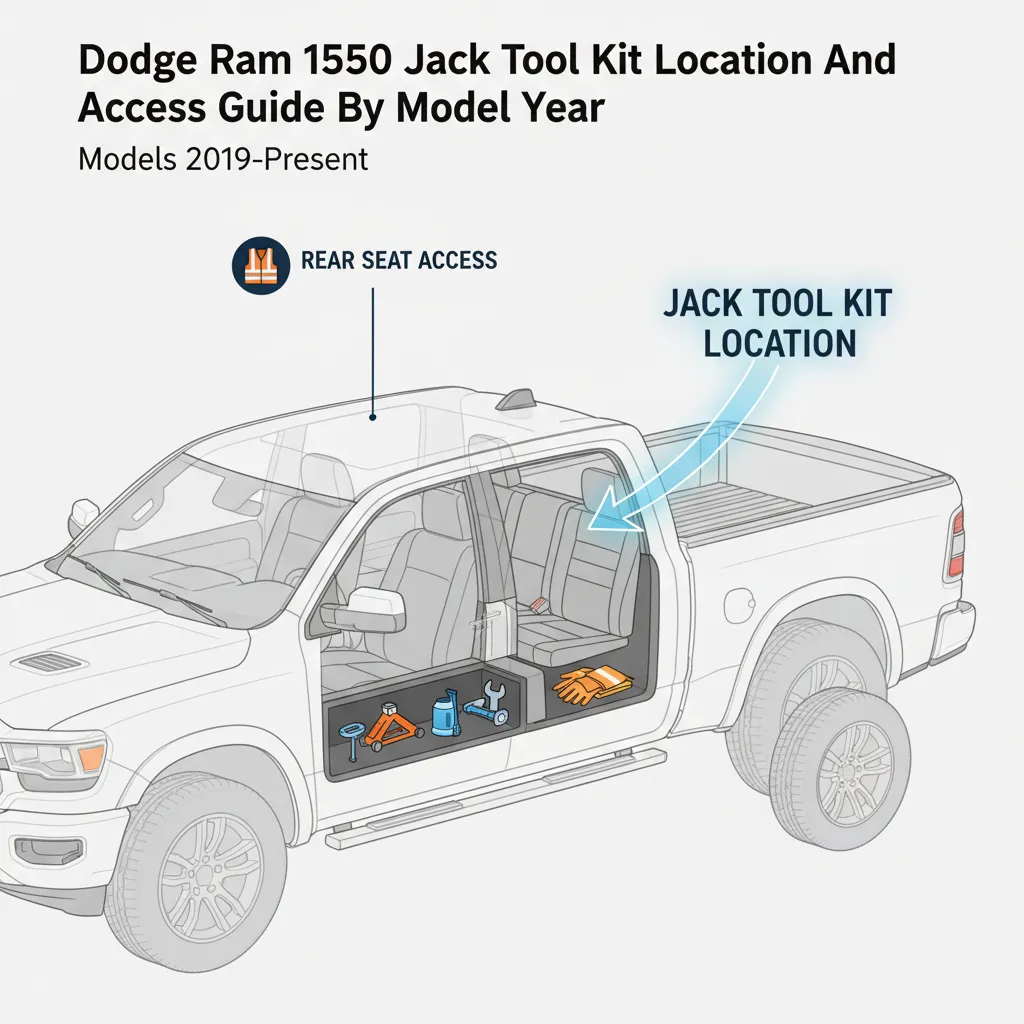
Regular Cab Models
In Regular Cab configurations, space is at a premium. The tool kit is almost universally located directly behind the front passenger seat. To access this area, you must slide the seat to its most forward position and tilt the backrest toward the dashboard. This reveals the jack assembly, which is bolted to the floor pan or secured against the back wall. This location is designed to keep the heavy steel components from becoming projectiles in the event of a sudden stop.
Quad Cab and Crew Cab Models
For owners of multi-passenger Rams, the jack and tool pouch are generally located under the rear passenger-side seat. By lifting the seat cushion, you will find a dedicated storage compartment. In older generations, this might be a simple bracket; in newer models, it is often a molded plastic bin. This area is highly convenient for quick access without disturbing the driver’s side of the vehicle.
Mega Cab Variations
The Mega Cab offers the most expansive interior storage in the Ram lineup. Instead of being under the seat, the jack and extension rods are often tucked behind the rear seat backrest. There is typically a pull-strap or latch that allows the seatback to fold forward, revealing a stowage area that keeps the heavy-duty scissor jack protected from the elements and out of the way of passengers.
Recent Model Enhancements (2019–Present)
Late-model Ram 1500s (the DT generation) have refined the storage process. Many now feature integrated plastic covers or “RamBins” in the floor, though the primary jack storage remains under the rear passenger seat. You may need to turn a plastic wing nut to release the protective cover before you can reach the tools. It is always wise to consult the official guide for your specific VIN to confirm if any mid-year production changes moved these components.
Step-by-Step Instructions for Accessing the Jack and Lug Wrench
Retrieving your tools should be done carefully to avoid damaging the truck’s interior trim or the electrical components often found under the seats of modern Rams. Whether you are serving as a roadside helper for a neighbor or changing your own tire, follow this professional sequence.
📋
Step-by-Step Retrieval Guide
Remove all floor mats and personal items from the passenger-side floor. This ensures the seat cushion can flip upward fully and stay in its locked position, preventing it from falling on your hands while you work.
Most Ram 1500 kits are secured with a large wing nut to prevent rattling. Rotate this counter-clockwise. If it is seized, use a rag for extra grip; do not use pliers unless absolutely necessary to avoid stripping the plastic.


The lug wrench and extensions are usually in a nylon pouch beside the jack. Carefully slide the jack assembly out, being mindful not to snag any wiring for heated seats or floor lighting.
Research from AAA indicates that nearly 20% of new vehicles no longer come with a spare tire, often opting for “inflator kits” instead. Fortunately, the Dodge Ram 1500 remains a model where a full tool kit and spare tire are standard equipment. However, simply having the tools isn’t enough; you must know how to assemble them. The three-piece handle requires clicking the detent buttons together to create a long enough lever to reach the spare tire winch and operate the jack safely from a standing position.
Essential Components of the Ram 1500 Jack Tool Kit
Before you find yourself stranded, you should perform an inventory of your kit. A missing rod can render the entire assembly useless, especially since the spare tire on a Ram is hoisted under the bed and requires specific tools to lower. You can often find replacement parts or available upgrades through a trusted local parts supplier if your kit is incomplete.
The Lug Wrench
Specifically sized for Ram factory lug nuts (usually 22mm). It also serves as the handle for the jack extensions.
Scissor/Bottle Jack
Designed for the truck’s specific curb weight. Newer models favor scissor jacks for stability.
The Extension Rods: These are the most commonly lost items. One rod will have a square head that fits into the spare tire winch located above the rear bumper. Without this specific rod, you cannot lower the spare tire. Some higher-trim models may also include a wheel lock key; if your truck has locking lug nuts, verify this key is in the glove box or the tool pouch.
By The Numbers
Max Curb Weight
Standard Lug Size
Service Request: Flats
Safety Precautions and Identifying Correct Jacking Points
The Ram 1500 is a heavy vehicle, weighing between 4,700 and 6,400 lbs depending on configuration. According to data from RepairPal, roadside assistance for flat tires is among the top five most common service requests, often because users feel unsafe attempting the change themselves. Safety is paramount when lifting this much mass.


Never place the jack under the body panels or the floor pan. Doing so will cause significant structural damage and risks the vehicle falling. Only use the manufacturer-specified lift points on the frame or axle.
Front and Rear Lifting Points
For front tire changes, position the jack head under the frame rail or the lower control arm, as specified by the owner’s manual for your year. For rear tire changes, the jack should be placed directly under the rear axle tube, as close to the flat tire as possible. Ensure the jack’s saddle is centered on the tube to prevent it from slipping on the rounded surface.
Before lifting, you must ensure the vehicle is on a level, hard surface. Avoid soft dirt or hot asphalt where the jack may sink. The transmission must be in ‘Park,’ and the emergency brake should be fully engaged. If you are on a slight incline or feel the situation is unsafe, utilize nearby roadside assistance or consult with the community for advice on specific roadside challenges.
Troubleshooting Missing Tools and Finding Replacements Nearby
It is surprisingly common for used Ram 1500s to be sold with missing tool kits. If you discover your kit is incomplete, don’t wait for a flat tire to address it. A survey suggests a significant portion of drivers lack confidence in changing tires; having a functional, complete kit is the first step toward building that self-reliance.
Periodically apply a small amount of white lithium grease to the jack’s screw mechanism. Factory jacks are prone to rusting if stored in humid cabins, which can cause them to seize when you need them most.
If your kit is missing the “square-head” extension, you will not be able to access the spare tire. You can source replacements at a trusted local Mopar dealership or from automotive recyclers in your area. Many owners choose to supplement their factory kit with a 12V impact wrench or a higher-capacity floor jack for home maintenance. If your jack bracket is damaged or rattling, a local technician can help secure the tools properly to prevent cabin noise or safety hazards during transit.
Conclusion
Knowing the exact location and operation of your Dodge Ram 1500 jack tool kit is a fundamental part of truck ownership. Whether your tools are behind the seat of a Regular Cab or tucked under the rear bench of a Crew Cab, ensuring they are present and functional is a non-negotiable safety step. Always prioritize safety by working on level ground, using the correct jacking points, and engaging your parking brake before attempting any repair. Check your tool kit today—don’t wait for a roadside emergency to find out you’re missing a critical extension rod. If your kit is incomplete, visit a local parts provider to secure the necessary components and ensure you are prepared for whatever the road throws your way.
Frequently Asked Questions
Where is the jack located in a Dodge Ram 1500 Crew Cab?
In the Crew Cab model, the jack and tool kit are located under the rear passenger-side seat. You must lift the seat cushion to reveal the mounting bracket. The assembly is typically secured by a plastic wing nut that must be unscrewed to release the jack and the tool pouch.


Does the Ram 1500 tool kit include a lug wrench?
Yes, the standard tool kit includes a lug wrench, often stored within a nylon pouch alongside the jack handle extensions. This wrench is designed to fit the factory-installed lug nuts. If you have aftermarket wheels, you should verify that the factory wrench still fits the new hardware.
How do I lower the spare tire on my Ram 1500?
To lower the spare, you must assemble the jack handle extensions found in your tool kit. Insert the assembled rod through the access hole located near the rear license plate. Fit the end of the rod into the winch mechanism and turn counter-clockwise to lower the tire to the ground.
What should I do if my jack tool kit is missing?
If your kit is missing, you can source a replacement through a local Mopar dealership or an automotive salvage yard. Ensure the replacement jack is rated for the weight of a half-ton truck. Many community-based auto parts stores also carry universal bottle jacks that can serve as an emergency substitute.
Are the jacking points the same for all Ram 1500 models?
While the general locations are similar, always consult your owner’s manual for specific instructions. Generally, the front jacking point is under the lower control arm, and the rear point is under the axle tube near the spring seat. Never lift by the bumper or the body panels.
![2021 Ram 1500 Classic Warlock: Full Specs & Data [2026]](https://truckguider.com/wp-content/uploads/2026/03/2021-ram-1500-classic-warlock-featured.webp)
![2017 Ram 2500 Mega Cab: Complete Specs Guide [2026]](https://truckguider.com/wp-content/uploads/2026/03/2017-ram-2500-mega-cab-featured.webp)