GMC Sierra Bed Size Chart: 1500 and HD Models by Cab 2026

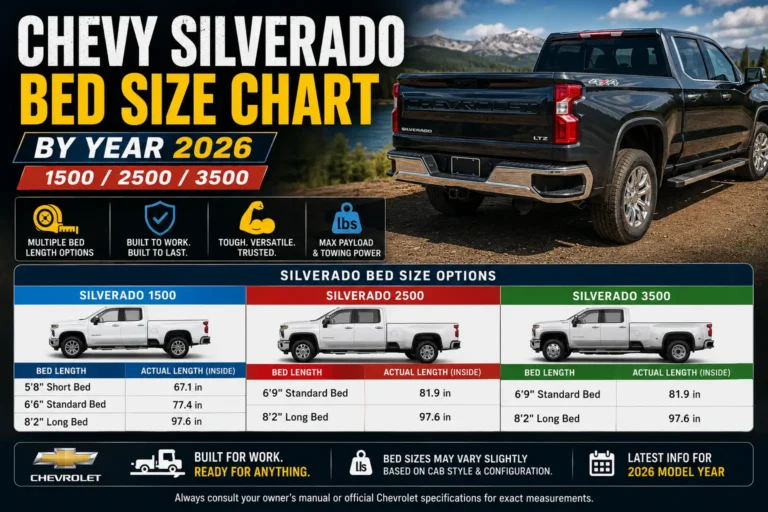
A GMC Sierra 1500 bed runs 69.9 inches in short bed form, 79.4 inches standard, and 98.2 inches long bed. Sierra 2500HD and 3500HD models step up to a 82.3-inch standard bed and a 98.3-inch long bed. Which sizes you can actually order depends on the cab you pick, since GMC pairs specific bed lengths with specific cab styles rather than mixing and matching freely.
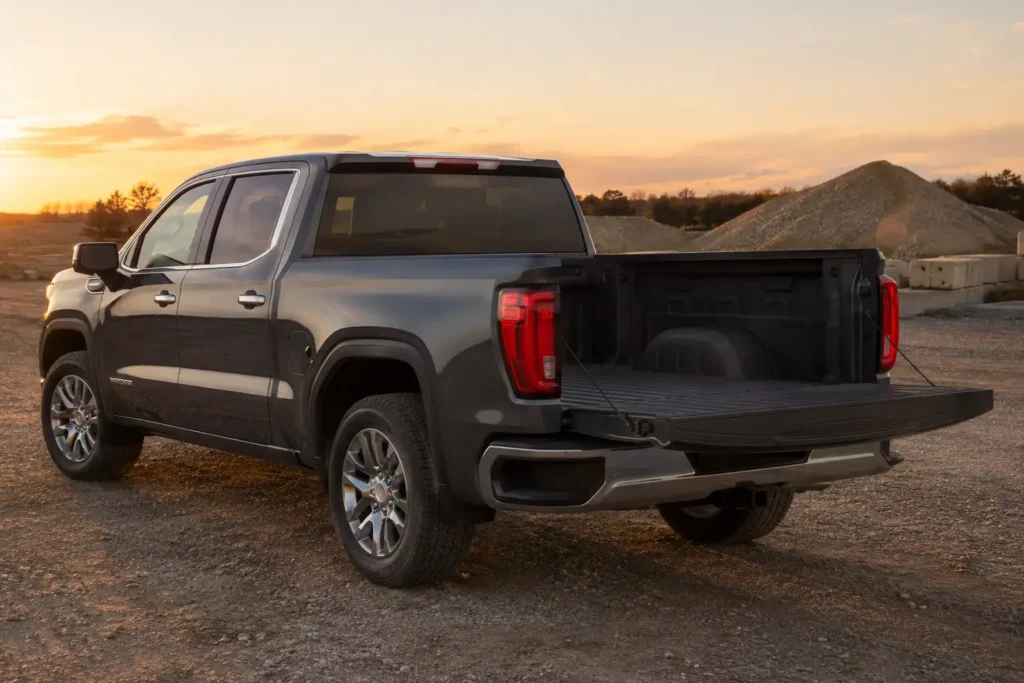
This chart covers every current Sierra 1500 and Sierra HD bed and cab combination, how those dimensions have held steady since the current-generation truck launched, and what bed length means for payload, tonneau cover fitment, and bed liner sizing.



GMC Sierra Bed Size at a Glance
Cargo box length, volume, and cab pairing across the current Sierra 1500 and Sierra HD lineup
Sierra 1500
Crew Cab only
Double Cab, Crew Cab
Regular Cab only
Sierra 2500HD & 3500HD
2500HD Double/Crew Cab, 3500HD Crew Cab


All cabs, 3500HD adds dually option
Max Payload by Model
GMC Sierra 1500 Bed Size Chart by Cab Style
The Sierra 1500 offers three bed lengths, and each one locks to a specific cab configuration. You cannot order a long bed with a Crew Cab, and you cannot get a short bed on a Regular Cab. Here is how the cab and bed pairings break down, along with the cargo box dimensions for each.
| Bed Size | Length | Width at Floor | Width Between Wheel Housings | Box Height | Cargo Volume | Cab Availability |
|---|---|---|---|---|---|---|
| Short Bed | 69.9 in (5’8″) | 71.4 in | 50.6 in | 22.4 in | 62.9 cu ft | Crew Cab only |
| Standard Bed | 79.4 in (6’6″) | 71.4 in | 50.6 in | 22.4 in | 71.7 cu ft | Double Cab, Crew Cab |
| Long Bed | 98.2 in (8’2″) | 71.4 in | 50.6 in | 22.4 in | 89.1 cu ft | Regular Cab only |
The Regular Cab is the only way to get the long bed on a Sierra 1500, and it trades passenger space for maximum cargo room, seating three across a single bench. The Double Cab splits the difference, offering rear-seat access with the standard bed as its only option. The Crew Cab is the volume seller in the lineup and gives buyers a choice between the short bed and standard bed depending on how much passenger room they want to keep.
GMC Sierra 2500HD and 3500HD Bed Size Chart
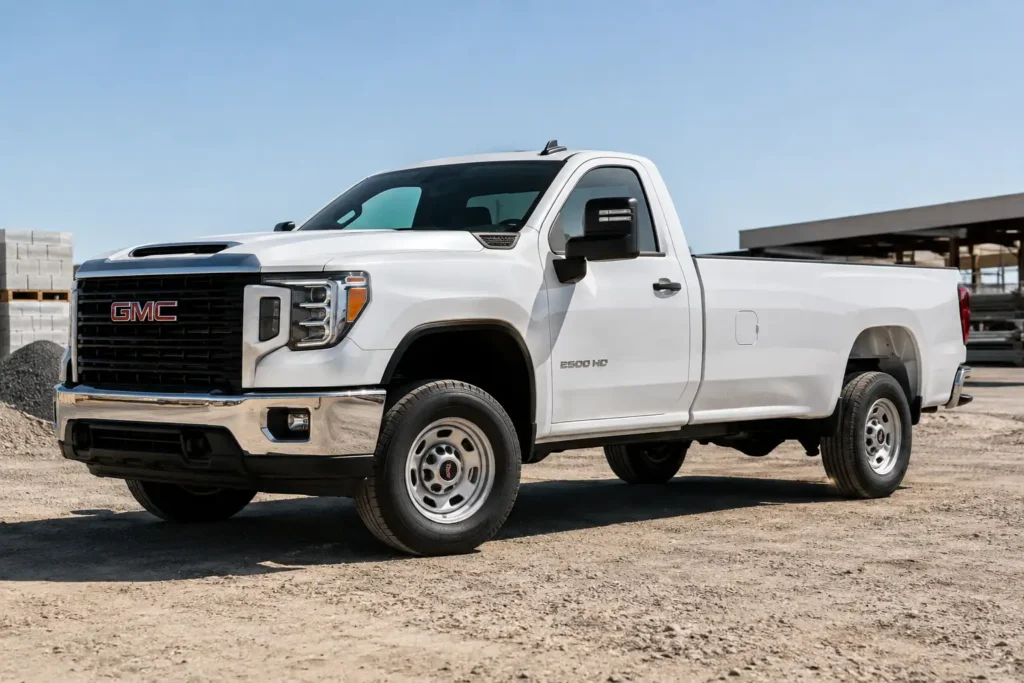
Sierra HD trucks simplify the bed lineup to two lengths instead of three, but they add more cab and drivetrain combinations than the 1500. Unlike the 1500, both HD bed sizes are available across more cab styles, and the 3500HD adds a dual rear wheel long bed option for maximum payload builds.
| Bed Size | Length | Width at Floor | Width Between Wheel Housings | Box Height | Cargo Volume | Cab Availability |
|---|---|---|---|---|---|---|
| Standard Bed | 82.3 in (6’9″) | 71.4 in | 51.9 in | 21.0 in | 69.5 cu ft | 2500HD Double Cab, 2500HD Crew Cab, 3500HD Crew Cab |
| Long Bed | 98.3 in (8’2″) | 71.4 in | 50.6 in | 21.0 in | 83.5 cu ft | 2500HD Regular Cab, Double Cab, Crew Cab; 3500HD Regular Cab, Double Cab, Crew Cab |
The 3500HD long bed is available with either single rear wheel or dual rear wheel (dually) axles, and the dually configuration is what unlocks the truck’s highest payload and gooseneck towing ratings. If you are cross-shopping the 1500 against the HD line, the standard HD bed is nearly three inches longer than the 1500’s standard bed and holds roughly two cubic feet less volume per inch of added length, since the HD box trades some height for structural reinforcement.
How Sierra Bed Sizes Have Changed Since 2014
The current-generation Sierra 1500 launched for the 2019 model year as a full redesign from the third-generation truck sold from 2014 through 2018, and it carried a 2022.5 mid-cycle refresh along with minor updates through the 2025 and 2026 model years. Across that entire run, GMC has kept the same three bed lengths and the same cargo volume figures shown in the chart above. No model year inside the current generation changed the box dimensions.
The third-generation Sierra 1500, built from 2014 to 2018, used the same three-tier bed lineup, marketed then as a 5.5-foot short bed, a 6.5-foot standard bed, and an 8-foot long bed, roughly two to four inches shorter per bed than the current truck’s short, standard, and long boxes. GMC did not publish cargo volume in cubic feet for that generation the way it does now, so a direct cu-ft comparison to the current truck is not available, but the physical box length grew modestly with the 2019 redesign even though the cab and bed pairing rules stayed the same: long bed only on Regular Cab, standard bed only on Double Cab, and a choice of short or standard bed on Crew Cab.
GMC’s next full redesign of the Sierra 1500 is expected for the 2027 model year, which means anyone shopping a 2019 through 2026 Sierra 1500 today can rely on the bed dimensions in this chart regardless of which of those model years they buy.
Which Cab and Bed Combinations Are Available
Not every bed length pairs with every cab. Here is the full combination breakdown for both the Sierra 1500 and Sierra HD lineups.


Sierra 1500:
- Regular Cab: Long bed only
- Double Cab: Standard bed only
- Crew Cab: Short bed or standard bed
Sierra 2500HD:
- Regular Cab: Long bed only
- Double Cab: Standard bed or long bed
- Crew Cab: Standard bed or long bed
Sierra 3500HD:
- Regular Cab: Long bed only, single or dual rear wheel
- Double Cab: Standard bed or long bed
- Crew Cab: Standard bed or long bed
If you are ordering a truck and want a specific box length, confirm the cab pairing before you build, since dealers cannot special-order a bed and cab combination GMC does not build. A best tool box for a GMC Sierra 1500 is also worth planning around at this stage, since crossbed and chest-style boxes are sized differently for short beds versus standard beds.
How Bed Size Affects Sierra Payload and Towing
Bed length by itself does not set your payload rating. Payload comes from a combination of engine, axle ratio, trim weight, and suspension, which is why a longer bed does not automatically mean a higher payload number and a shorter bed does not cap it either. In fact, GMC’s own published figures for the Sierra 1500 run the opposite direction from what most buyers expect.
According to GMC’s official specifications, the current Sierra 1500 tops out at 2,230 pounds of payload on the Regular Cab, in both standard bed and long bed form, since the Regular Cab carries the least curb weight of the three cab styles. The Double Cab standard bed follows at up to 2,040 pounds, the Crew Cab short bed at up to 2,020 pounds, and the Crew Cab standard bed comes in lowest at up to 1,950 pounds, since it carries the most passenger-cabin weight. Off-road focused trims like the AT4X reduce these figures further, sometimes to around 1,350 pounds, because of the added weight of off-road suspension and armor.
On the Sierra HD line, payload climbs sharply and the spread by configuration is even wider. The 2500HD ranges from roughly 2,701 pounds on a loaded Crew Cab Standard Bed AT4X AEV Edition with 4WD and the diesel engine up to roughly 3,979 pounds on a lighter Regular Cab gas configuration. The 3500HD tops the entire lineup at up to 7,290 pounds, a figure reached specifically on a Regular Cab Long Bed with dual rear wheels, 2WD, and the gas engine, while more heavily equipped Crew Cab 3500HD trims typically land in the 4,700 to 5,300 pound range instead.
The number that matters for your specific truck is on the yellow certification label inside the driver’s door jamb, not the bed length or even the general figures above, since options and packages shift the rating within each configuration. If you are shopping the full Sierra lineup for payload and towing beyond bed dimensions, the GMC Sierra accessories buying guide covers the parts and upgrades that pair with different hauling setups.
Choosing the Right Bed Size for Tonneau Covers and Bed Liners
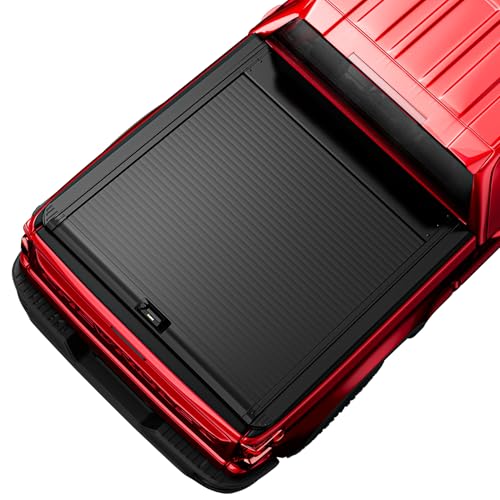
Bed length is the single most common measurement mistake truck owners make when ordering a tonneau cover or bed liner. A cover built for a 5.8-foot short bed will not fit an 8-foot long bed, and the reverse mistake happens just as often when owners assume all “Sierra 1500” covers are interchangeable across bed sizes.
Before ordering, measure your actual cargo box length at the floor, from the front bulkhead to the inside of the tailgate, rather than relying on your cab style alone. Two Sierra 1500 Crew Cabs can carry different bed lengths, so cab style alone will not tell you which cover to buy. Once you know your exact bed size, the best tonneau cover for a GMC Sierra 1500 breaks down which styles fit which lengths and how to avoid a return.



GMC Sierra Bed Size Frequently Asked Questions
What is the biggest bed size on a GMC Sierra? The longest bed across the entire lineup is the 98.3-inch long bed on the Sierra 2500HD and 3500HD, which is slightly longer than the Sierra 1500’s 98.2-inch long bed and holds up to 83.5 cubic feet of cargo.
Can a Sierra 1500 Crew Cab get a long bed? No. The Sierra 1500 Crew Cab is limited to the short bed or standard bed. The long bed is only available on the Regular Cab.
Is the Sierra 2500HD bed the same size as the 1500? No. The 2500HD standard bed measures 82.3 inches versus 79.4 inches on the 1500 standard bed, and the HD box is roughly two inches narrower between the wheel housings. If you already own a cover or liner from a Sierra 1500, it will not fit a 2500HD. For a closer look at fit-specific options built for the HD box, the best hard tonneau cover for a GMC Sierra 1500 guide explains why HD and 1500 covers are not interchangeable even when sold under the same model name.
How much cargo volume does a Sierra bed hold? Cargo volume ranges from 62.9 cubic feet on the Sierra 1500 short bed up to 89.1 cubic feet on the Sierra 1500 long bed, and from 69.5 to 83.5 cubic feet across the Sierra HD standard and long beds.
Bed dimensions and cargo volume figures reflect the current-generation GMC Sierra 1500 (2019 through 2026 model years) and current Sierra 2500HD/3500HD models, sourced from GMC’s official specifications at gmc.com and gmc.com’s Sierra 1500 spec page, with 2500HD/3500HD payload figures cross-checked against GM Authority’s model-year payload breakdowns. Payload figures vary by trim, engine, axle ratio, and model year. Always confirm your specific truck’s rating from the certification label inside the driver’s door jamb before loading cargo.