Jeep Gladiator Gear Ratio Chart: 2026 Configuration Component Breakdown

The Jeep Gladiator gear ratio chart outlines the mechanical configuration between the transmission output and axle input. Standard ratios vary from 3.73:1 for highway efficiency to 4.10:1 for Rubicon trail performance. This chart dictates tire size compatibility and engine RPM management, ensuring the driveline system operates within optimal torque bands for specific configurations.
📌 Key Takeaways
- Standard gear ratios range from 3.73 to 4.10, with 4.88 or 5.13 aftermarket swaps common for 37-inch+ tires.
- The identification tag is located on the front or rear axle housing differential cover.
- Always verify pinion preload and ring gear backlash when modifying the gear system, typically to 0.006–0.010 inches.
- Incorrect gear ratio configuration causes transmission hunting and premature clutch or torque converter wear.
- Consult a professional drivetrain specialist if you lack specialized dial indicators or micrometer tools for gear set installation.
The Jeep Gladiator, built on the JT platform, utilizes a complex drivetrain configuration that demands precision when altering tire diameters. Whether you are upgrading to 37-inch mud-terrain tires or optimizing for towing, the integration of engine torque output and transmission shift points relies heavily on the final drive ratio. A comprehensive understanding of the Jeep Gladiator gear ratio chart is critical for maintaining mechanical longevity and fuel efficiency. Without proper gear adjustment, your transmission control module (TCM) and engine will struggle to operate within the optimal power band, leading to premature component failure and degraded vehicle performance across all trim levels, from the Sport to the Rubicon.
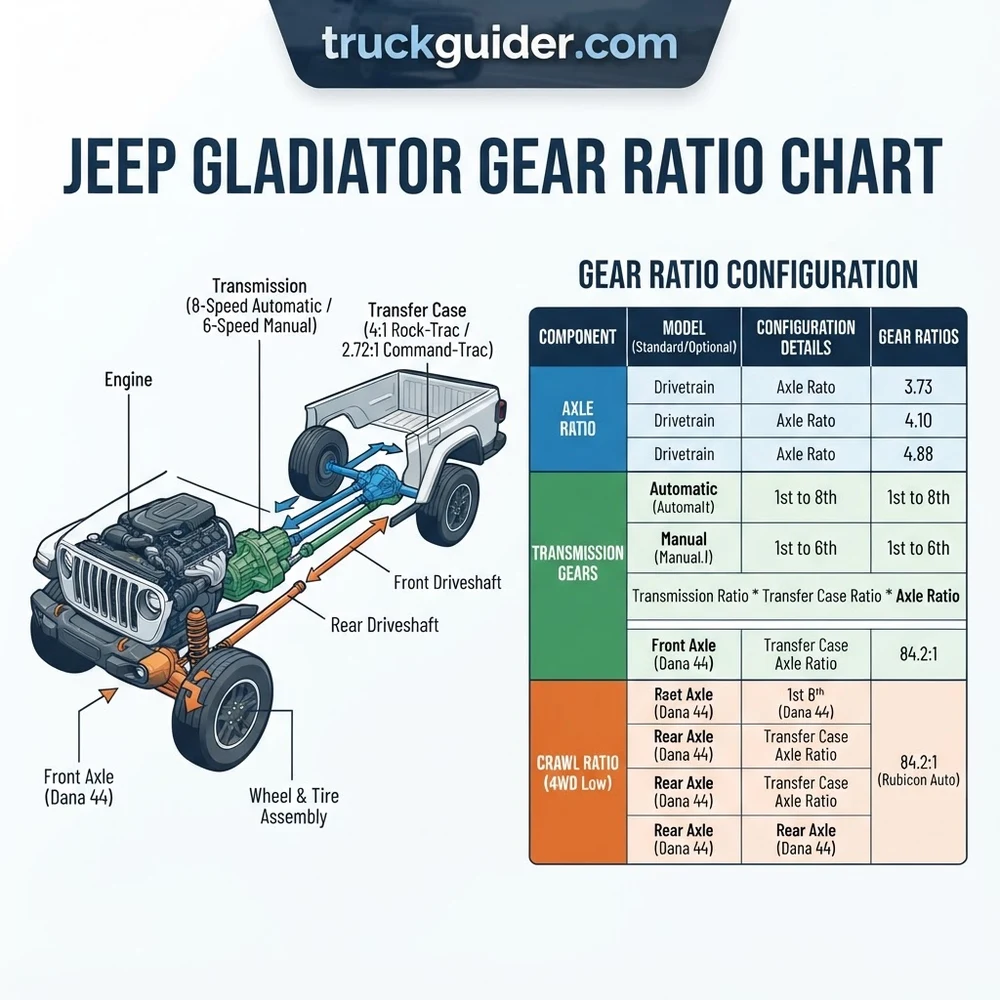
(Diagram visual: A side-profile schematic of the JT drivetrain, tracing power flow from the engine crank, through the transmission and transfer case, to the front and rear Dana 44 axles. Callouts highlight the ring gear, pinion gear, and carrier assembly.)
Understanding the Jeep Gladiator Gear Ratio Chart for Tire Size
Recommended Best Deal Products


Achieving mechanical synergy between your tire diameter and the ring and pinion set is the most critical aspect of vehicle modification. The engine produces power at specific crankshaft revolutions per minute (RPM), and the gear ratio acts as the mechanical multiplier that determines how much torque reaches the pavement. When you increase tire size, you effectively increase the leverage the road exerts against the engine, necessitating a numerically higher gear ratio to return the engine to its efficient operating range.
The foundational relationship in the Jeep Gladiator gear ratio chart is based on the final drive ratio (FDR), which is calculated as the product of the transmission gear ratio and the axle gear ratio. For a standard 3.6L Pentastar engine, peak torque occurs at approximately 4,400 RPM, while the 3.0L EcoDiesel reaches peak torque significantly lower in the band. To maintain highway fuel economy and crawl capability, the axle gears must compensate for the effective change in diameter.
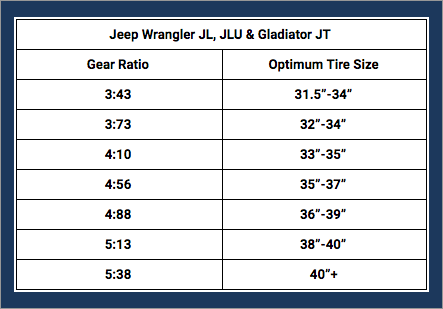
| Tire Diameter | Factory Ratio (3.73) | Recommended Ratio (Off-Road) | Highway/Tow Ratio |
|---|---|---|---|
| 32″ (Stock) | 3.73 | 3.73 | 3.73 |
| 35″ | 3.73 | 4.56 | 4.10 |
| 37″ | 4.10 | 5.13 | 4.88 |
| 40″ | N/A | 5.38 | 5.13 |
Note that these recommendations assume a stock transmission configuration. When re-gearing, always calculate your crawl ratio by multiplying first gear (e.g., 4.71 for 850RE automatic) by the transfer case low-range ratio and the axle gear ratio.
Jeep Gladiator Gear Ratio Chart: Essential Drivetrain Components
The structural integrity of the Gladiator relies on the Dana 44 front and rear axles. Unlike legacy TJ or JK setups, the JT utilizes a wider, reinforced axle housing to handle the increased tow rating and wheelbase. The system configuration is a high-pinion front and low-pinion rear design, which dictates specific ring and pinion tooth profiles.
Ring and Pinion Gear Set: The heart of the axle system. The pinion gear, driven by the driveshaft, meshes with the larger ring gear attached to the differential carrier. The gear ratio is determined by dividing the number of teeth on the ring gear by the number of teeth on the pinion.
Differential Carrier: This unit houses the spider gears and, in many Gladiator trims, the electronic locking mechanism. When selecting new gears, you must verify the carrier break. The carrier break defines the range of gear ratios that a specific carrier can accommodate based on the physical size of the ring gear mounting surface.
Transfer Case: The Command-Trac or Rock-Trac units distribute torque to the driveshafts. In the Rubicon trim, the 4:1 low-range ratio provides exceptional multiplication when combined with short axle gears, essential for technical rock crawling.
Dana 44 Axle Housing: These units are designed for specific gear sets. When re-gearing, you must use a gear set compatible with the Gladiator’s specific housing tolerances to ensure proper pattern development and lash.
Standard Dana 44 ring gear bolt torque for the Jeep Gladiator is 85 ft-lbs, using a criss-cross pattern. Ensure the use of medium-strength thread locker (Loctite 243) on all hardware.
How to Use the Jeep Gladiator Gear Ratio Chart for Re-gearing
Recommended Best Deal Products


Re-gearing a Jeep Gladiator is an advanced mechanical procedure that involves precise measurement and component clearance. Before beginning, identify your current gear ratio by lifting the vehicle, marking the pinion flange, and rotating the tire one full revolution while counting pinion rotations.
1. Verify Carrier Compatibility: Determine if your new gear set requires a new carrier. Many aftermarket performance sets for the Dana 44 accommodate a wide range of ratios, but verify if your specific “carrier break” requires a full case locker replacement.
2. Axle Disassembly: Secure the vehicle on jack stands. Drain the differential fluid and remove the differential cover. Mark the bearing caps for orientation, as these are precision-fit components.
3. Pinion Depth Adjustment: Install the new pinion gear using the appropriate shims to achieve the correct depth. This is a trial-and-error process using a bearing press and depth gauge.
4. Backlash and Pattern Check: Install the ring gear onto the carrier. Apply gear marking compound to the teeth and rotate the carrier. Analyze the footprint (drive and coast sides). A perfect pattern should be centered on the tooth face.
5. Final Assembly and Break-in: Once the pattern is set, install new crush sleeves (or solid spacers) and torque the pinion nut to specification. Perform a 500-mile break-in period where the differential is not subjected to heavy load or high heat.
Failure to properly break in new ring and pinion gears will cause premature pitting and hardening loss. Do not exceed 55 MPH or drive for extended periods during the first 50 miles of the break-in cycle.
Troubleshooting Jeep Gladiator Gear Ratio Chart Mismatches
Symptoms of an incorrect gear ratio configuration are often subtle initially, manifesting as “lazy” acceleration or the transmission “hunting” for gears on highway grades. In the 8-speed 850RE automatic transmission, the TCM relies on inputs from wheel speed sensors to determine shift points. If the axle gears are swapped without updating the tire size and gear ratio parameters via a flash programmer, the computer will detect a discrepancy between engine load and ground speed, often triggering a limp mode or the “Check Engine” light.
Common signs of a mismatch include:
RPM Deviation: If the engine is running significantly higher or lower than the expected 2,000–2,500 RPM at highway cruising speeds, your gear ratio is likely not optimized for the current tire diameter.
Transmission Overheating: Constant gear hunting generates excessive heat in the transmission fluid, which can be monitored via the vehicle’s Performance Pages if equipped.
* Driveline Vibration: Often caused by an incorrect pinion angle after axle modification, this vibration can lead to pinion seal failure. Ensure your driveline geometry remains within 1-2 degrees of the transmission output shaft angle.
If your dashboard displays a traction control fault or speedometer error, you must utilize an OBD-II interface tool (such as the Z-Automotive Tazer) to calibrate the vehicle’s computer. This step is non-negotiable when changing physical hardware; it ensures that the ABS and stability control systems remain active and responsive.
Jeep Gladiator Gear Ratio Chart Questions Answered
Can I install Rubicon gear sets in a Sport axle housing?
While both utilize Dana 44 architecture, specific internal tolerances for locker clearance may differ. It is recommended to verify the specific part number for your axle’s production date, as mid-year manufacturing changes can occur.
Does re-gearing impact my factory warranty?
According to OEM service guidelines, any alteration to the powertrain that deviates from factory specifications may void the drivetrain portion of your warranty. Always consult your local service manager regarding authorized upgrades.
What is the benefit of a solid pinion spacer over a crush sleeve?
A solid spacer provides more consistent preload settings and prevents the pinion nut from over-tightening under extreme off-road torque loads. This is highly recommended for vehicles running tires larger than 37 inches.
Why do I need to update the TCM after re-gearing?
The 8-speed automatic transmission software utilizes a calculated torque-load map. Without a recalibration, the transmission will not know how to correctly apply the shift pressure and timing based on the new final drive ratio, leading to poor fuel economy and potentially internal clutch damage.
Step-by-Step Guide to Understanding the Jeep Gladiator Gear Ratio Chart
Identify – Determine your Gladiator’s current tire diameter and factory axle ratio via the VIN or axle tag.
Locate – Find the target gear ratio on the chart that aligns with your planned tire upgrade for optimal power.
Reference – Use the chart to compare your current system configuration against desired highway cruising RPMs.
Connect/Route – Verify that all drivetrain modifications, including differential gear changes, are compatible with your existing locker system.
Verify – After installation, calibrate the Jeep’s PCM to the new gear ratio using an OBDII diagnostic tool.
Troubleshoot – Monitor for abnormal differential whine or transmission thermal spikes during the break-in period following any gear ratio swap.