Nissan Titan Years to Avoid: 2026 Best Years to Buy Used

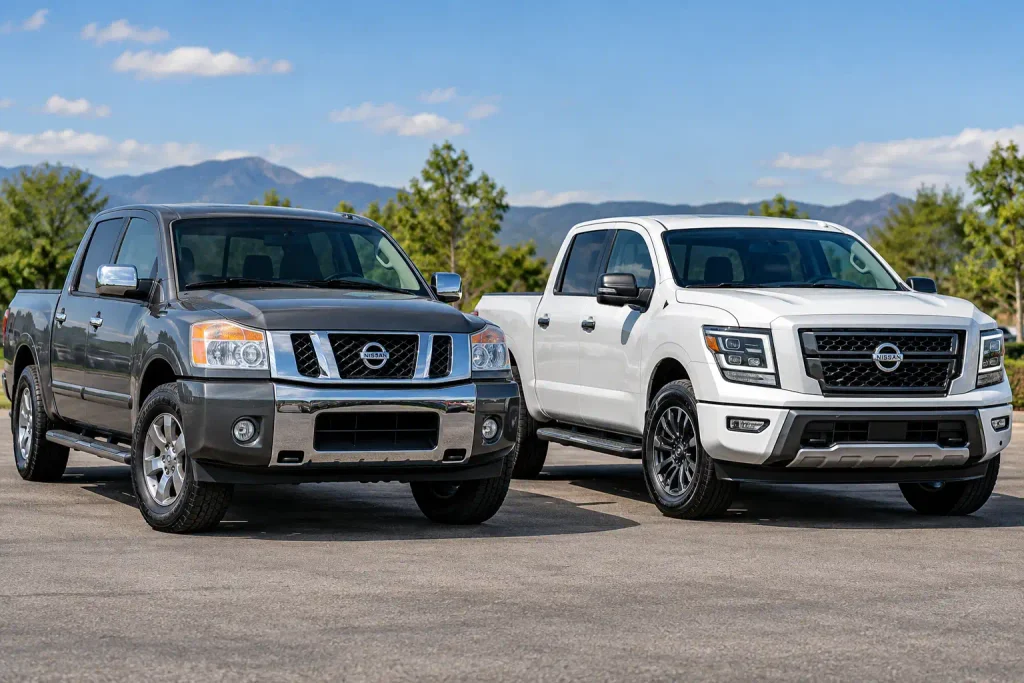
The Nissan Titan years to avoid are primarily 2004–2006 and 2008 due to historical drivetrain complaints. Buyers should also approach 2016–2019 Titan XD diesel trucks and certain 2017–2019 gasoline V8 models with extra caution because of documented engine concerns.
For buyers looking for a dependable used Titan, the 2011–2015 models are promising starting points. A well-maintained 2020 or newer gasoline Titan may also be worth considering, provided its applicable recalls have been addressed.
Not every truck from a problematic year will experience the same failures. Engine configuration, maintenance records, repair history, and a professional inspection matter more than the model year alone.
Nissan Titan Used-Buyer Risk Map
Match the model year and engine to known concerns. These are inspection priorities, not measured failure rates.
Historical rear differential and drivetrain complaints.
Check axle-seal leakage, differential condition, and age-related wear.
Useful starting years for a well-maintained used Titan search.
NHTSA investigated crankshaft and main-bearing failures.
Nissan bulletin covers engine knock and possible cylinder scuffing.
Check 2020–2023 parking-pawl recall applicability; 2024 has less long-term data.
Before You Buy, Follow These Four Checks
Confirm VIN and engine
Check recalls and TSBs
Review service invoices
Get an independent inspection
Editorial screening guide only. Model-year and engine groups can overlap. VIN-specific applicability, mechanical condition, and repair history determine the decision. Years not highlighted still need inspection.
Which Nissan Titan Years Are Riskiest to Buy?


The Nissan Titan has several model-year groups that deserve attention, but the reasons differ. Early first-generation trucks have historical rear axle and drivetrain complaints, while later models have specific gasoline or diesel engine concerns.
The following table separates the primary caution years from models that may be reasonable used purchases.
| Model Years | Risk Assessment | Main Concern | Buying Recommendation |
|---|---|---|---|
| 2004–2006 | High Caution | Differential and drivetrain complaints | Prefer alternatives unless repairs are documented |
| 2007–2008 | Extra Caution | Rear axle seals and drivetrain condition | Inspect thoroughly |
| 2009–2010 | Conditional | Age and maintenance-related wear | Buy only after inspection |
| 2011–2015 | Better Candidates | Normal aging and previous maintenance | Worth shortlisting |
| 2016–2019 Titan XD Diesel | High Caution | Cummins crankshaft and main-bearing failures | Demand detailed engine inspection |
| 2017–2019 Gas V8 | Extra Caution | Engine knocking and possible cylinder-wall scuffing | Verify VIN and engine history |
| 2020–2023 | Conditional | Transmission parking-pawl recalls on affected trucks | Confirm recall completion |
| 2024 | Limited Long-Term Data | Shorter ownership history | Assess condition and remaining coverage |
These assessments are buying recommendations, not official reliability ratings. A truck with a verified repair history may be a better purchase than a supposedly reliable model with neglected maintenance.
What Determines Reliability in a Used Nissan Titan?



Four factors should guide your decision: model year, engine, service history, and recall status. Each can change whether a particular Titan is worth purchasing.
Model Year and Generation
The first-generation Nissan Titan was introduced for 2004 and continued through 2015. These models use the 5.6L VK56DE gasoline V8.
The redesigned Titan lineup arrived with different equipment and powertrain configurations. The Titan XD debuted for 2016, while the redesigned standard Titan followed for 2017.
Understanding this distinction prevents buyers from confusing problems affecting different generations.
Gasoline Engine or Cummins Diesel
The 5.6L gasoline V8 and 5.0L Cummins V8 Turbo Diesel have different mechanical characteristics.
A concern specific to the Cummins diesel should not automatically be applied to the gasoline Titan. Similarly, the gasoline VK56VD cylinder-wall bulletin is not evidence of the same failure in the diesel engine.
Always confirm the engine before researching known defects.
Mileage and Maintenance Records
A low-mileage Titan with missed oil changes can be a worse purchase than a higher-mileage example with complete service documentation.
Look for consistent engine oil changes, cooling-system maintenance, transmission service, and differential repairs. The seller should be able to explain significant work and provide supporting invoices.
Major repairs without documentation create additional uncertainty.
VIN and Recall History
The vehicle identification number (VIN) identifies the exact truck and helps establish which safety campaigns apply.
A recall affecting a model-year range does not necessarily include every truck from that year. The VIN and production information determine applicability.
Ask for proof that applicable repairs have been completed rather than relying on the seller’s verbal assurance.
Why 2004 to 2008 Nissan Titans Need Caution


Early Nissan Titans generated substantial drivetrain complaints, particularly the 2004, 2005, and 2006 models. Rear axle and differential concerns are especially important when shopping for these older pickups.
The 2008 model also deserves scrutiny. However, an individual truck’s actual mechanical condition is more useful than labeling every vehicle from these years defective.
Rear Axle Seal Leaks
Nissan issued Technical Service Bulletin NTB10-032 for rear axle oil-seal leakage affecting 2004–2008 Titan models.
The bulletin addresses leaks at the left or right rear axle seals when the rear final-drive gears and bearings are not producing abnormal noise or vibration.
Under those conditions, Nissan specifies replacement of an updated axle-shaft assembly rather than the entire rear axle.
You can review the Nissan rear axle seal service bulletin for the original repair guidance.
When inspecting an older Titan, look for gear oil around the axle ends, backing plates, and inner wheel areas. Check whether previous repairs used the specified components.
A repaired axle seal is not automatically a reason to reject the truck.
Differential Noise and Damage
A leaking seal and a damaged differential are different problems.
Whining, grinding, clunking, or vibration from the rear axle may indicate worn bearings, gear damage, or another drivetrain fault. The actual cause requires diagnosis.
During the test drive, listen for noise while accelerating, cruising, and slowing down.
If the truck produces pronounced differential noise, do not assume replacing a seal will fix it.
Request a professional inspection and a written repair assessment before considering the purchase.
Maintenance and Rust Inspection
Age adds concerns unrelated to a Titan’s original manufacturing defects.
A 2004 truck has had more than two decades of exposure to road conditions, weather, and repairs. Rust, worn suspension joints, corroded brake lines, and neglected fluids can outweigh the original model-year reputation.
Inspect the frame, crossmembers, suspension mounting points, exhaust components, and underside of the bed.
Our recommendation: Treat 2004–2006 Titans as higher-risk used purchases. Consider 2007–2008 examples only after reviewing the rear axle condition and maintenance history.
Should You Avoid the 2016 to 2019 Titan XD?


The 2016–2019 Nissan Titan XD equipped with the 5.0L Cummins V8 Turbo Diesel deserves particular attention because of documented crankshaft failures.
This issue is different from the rear differential concerns affecting older gasoline Titans.
What Happened to the Cummins Engine?
The National Highway Traffic Safety Administration (NHTSA) opened investigation PE23020 in November 2023.
Investigators examined reports of crankshaft main-bearing failures that could result in a fractured crankshaft, loss of engine power, and an inability to restart.
The investigation covered approximately 38,763 vehicles equipped with the affected diesel engine.
NHTSA’s investigation summary identified 550 nonduplicate incident reports across the reviewed data sources. These reports should not be interpreted as 550 independently confirmed manufacturing defects.
The analysis also found:
- Some failures were preceded by knocking, vibration, a malfunction indicator lamp, or poor performance.
- Half of the reported failures with usable mileage information occurred by 60,000 miles.
- Failure frequency decreased across successive model years.
- The reviewed data showed substantially fewer failures after 80,000 miles.
NHTSA closed the investigation on June 27, 2025, without requiring further manufacturer action. The agency explicitly cautioned that closure did not establish the absence of a defect.
The details are available in the NHTSA Titan XD crankshaft investigation report.
What Diesel Buyers Should Check
Start with engine service history and confirm whether the original engine remains installed.
Ask for invoices documenting any major engine work. If the engine was replaced, establish when the replacement occurred, who performed the work, and whether the replacement came with warranty coverage.
During inspection, investigate abnormal knocking, vibration, warning lights, and inconsistent engine performance.
A truck that has exceeded 80,000 miles is not automatically safe. The investigation describes a population-level mileage pattern, not a guarantee for individual engines.
Should You Buy One?
If you need a diesel Titan XD, do not purchase it without a qualified diesel mechanic’s inspection.
A documented replacement engine, satisfactory inspection, and complete maintenance records can reduce uncertainty. However, they cannot guarantee that future engine failures will not occur.
Our recommendation: Buyers who prioritize predictable long-term repair costs should generally favor a well-maintained gasoline Titan over an unverified 2016–2019 Cummins-powered XD.
How Risky Are 2017 to 2019 Gas Titans?
Certain 2017–2019 Nissan Titan and Titan XD models equipped with the VK56VD 5.6L gasoline V8 fall within Nissan’s engine knock or tick noise service bulletin.
The issue should not be confused with the Cummins diesel crankshaft investigation.
Engine Knocking and Cylinder Scuffing
Nissan Technical Service Bulletin NTB19-057a, dated April 3, 2020, describes diagnosis of an engine knocking or ticking concern.
The bulletin applies to specified vehicles built before a listed VIN and production-date cutoff, including certain Titan and Titan XD trucks manufactured before January 10, 2019.
It directs technicians to inspect cylinder number 7 for possible cylinder-wall scuffing when the defined symptoms and preliminary diagnostic requirements are met.
Nissan distinguishes normal light cylinder markings from more severe scratches in the area where the piston skirt travels.
If qualifying scuffing is confirmed, the bulletin specifies replacement of the short engine assembly.
The complete procedure appears in Nissan Technical Service Bulletin NTB19-057a.
How to Check a Used Gasoline Titan
Ask whether the engine has developed an unusual tick or knock during ownership.
Request any dealership diagnosis relating to engine noise, cylinder-wall inspection, or short-engine replacement.
A technician should examine suspicious noises and determine whether the VIN falls within the applicable range.
Do not assume every ticking sound indicates cylinder scuffing. Exhaust leaks, accessory components, and other mechanical conditions can also produce unusual noises.
Equally, a quiet engine during one short test drive is not proof that no mechanical problem exists.
When Is the Truck Worth Buying?
A 2017–2019 gasoline Titan may be a reasonable purchase when its engine operates normally and the service history supports its condition.
Documented repairs and a clean professional inspection strengthen the case.
However, an unresolved knock, a known cylinder-scuffing diagnosis, or a seller refusing independent inspection should stop the purchase.
Our recommendation: Investigate the exact engine and build date rather than avoiding every 2017–2019 gasoline Titan indiscriminately.
Should You Buy a 2020 to 2024 Titan?
Later Nissan Titans offer a newer platform and different reliability considerations.
The most important documented safety concern involves the automatic transmission parking-pawl system on certain trucks.
Transmission Parking Pawl Recall
NHTSA recall 22V-671 covers certain 2020–2023 Nissan Titan trucks equipped with a nine-speed automatic transmission.
The reported issue involves resistance within the parking mechanism that can prevent the parking pawl from engaging properly.
If that occurs, a truck placed into Park may still roll, increasing the risk of a crash or injury.
Not every truck sold during 2020–2023 is necessarily affected. The production dates and VIN determine whether an individual vehicle belongs to the recall population.
Check all applicable recall campaigns, verify the manufacturer’s prescribed remedy, and request completion records.
Always use the parking brake when parking, regardless of recall status.
Is the 2024 Titan a Better Choice?
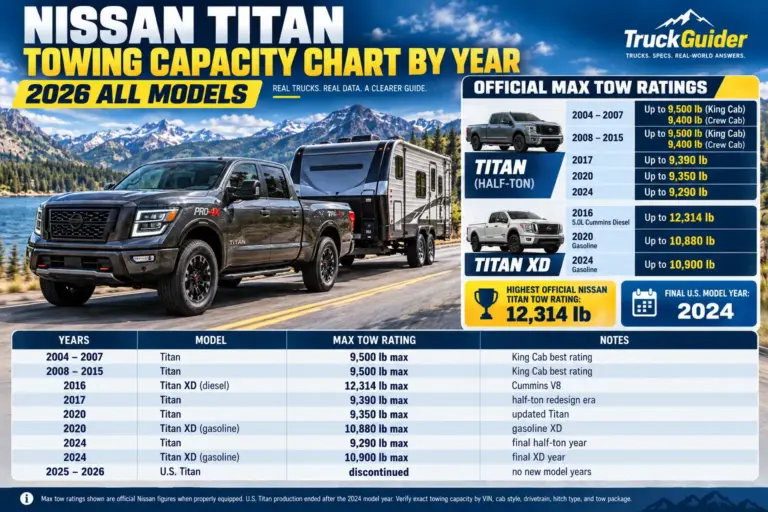
The 2024 Titan was the final model year before Nissan ended production of the standard Titan and Titan XD.
The 2024 lineup used a 5.6L gasoline V8 and nine-speed automatic transmission. Nissan no longer offered the 5.0L Cummins diesel engine.
Its relatively recent production date means buyers have less long-term ownership history to evaluate compared with older generations.
That does not make the 2024 model unreliable. It simply limits how confidently anyone can predict its durability over high mileage.
Our recommendation: A 2020–2024 gasoline Titan with documented service and completed applicable recalls deserves consideration. Inspect the transmission, engine, electronics, and drivetrain before purchase.
Which Nissan Titan Years Are Better Used Buys?
For buyers comparing reliability, purchase price, and established ownership history, 2011–2015 gasoline Titans deserve the strongest initial consideration.
These later first-generation models generally show more favorable historical complaint patterns than the early 2004–2006 trucks.
That does not mean every example will be inexpensive to maintain.
The 2011 and 2012 Nissan Titan
The 2011 and 2012 models are practical starting points for someone who wants a traditional gasoline V8 pickup without the additional complexity of the later Cummins diesel.
Historical complaint comparisons have generally been more favorable for these years than for early first-generation Titans.
Their biggest disadvantages today are age and accumulated mileage.
Look for a documented service history, normal engine operation, sound suspension, and no evidence of significant corrosion.
A well-maintained example can be worth purchasing, but an unusually cheap truck with major deferred repairs is not a bargain.
The 2013 to 2015 Nissan Titan
The 2013–2015 Titans are also worthwhile candidates.
They represent the later years of the original generation and share much of its established mechanical design.
Their lower historical complaint totals are encouraging, but complaint totals alone cannot establish an individual truck’s reliability.
Condition remains decisive.
Inspect the rear axle, transmission behavior, steering, suspension, cooling system, and frame before agreeing to a purchase.
The 2020 and Newer Gasoline Titan
A newer gasoline Titan can suit buyers who want more modern equipment and are willing to pay more than they would for an older first-generation truck.
The 2020 model is an interesting option because it avoids the earlier Cummins diesel configuration and benefits from the redesigned lineup.
However, applicable parking-pawl recalls and other model-specific service history still require verification.
Before choosing between Nissan and another full-size pickup, consider our comparison of the most reliable Ram 1500 model years.
How to Inspect a Used Nissan Titan Before Buying
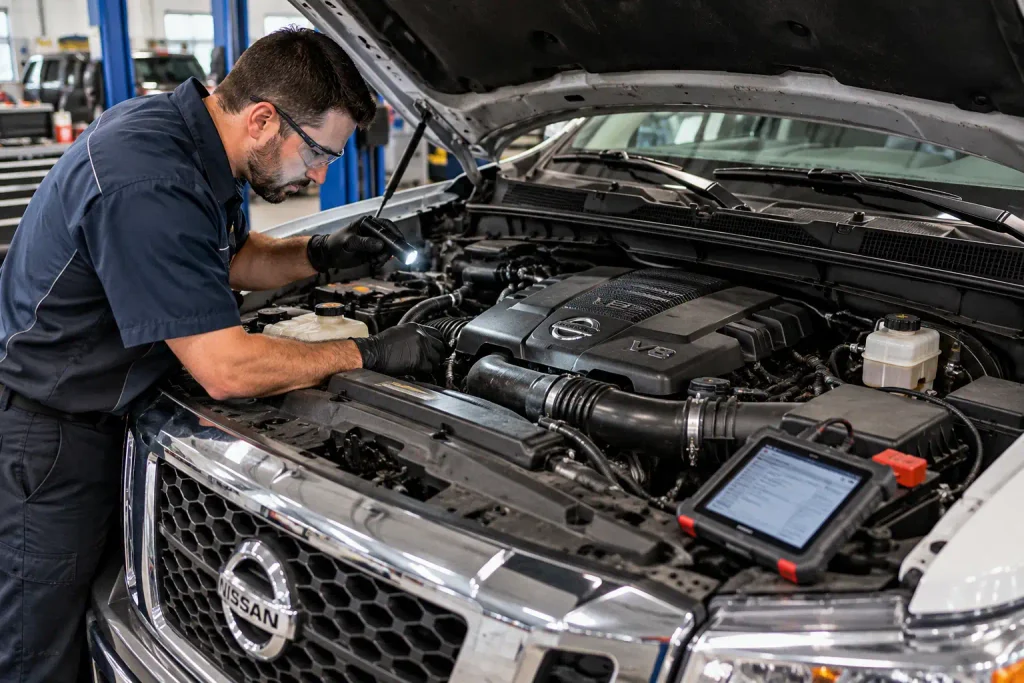
A proper pre-purchase inspection can uncover problems that a model-year reliability chart cannot identify.
Follow these five steps before committing to any used Titan.
Step 1 Verify the Exact VIN and Engine
Confirm the VIN on the truck matches its title and paperwork.
Identify the model year, engine, drivetrain, and whether the truck is a standard Titan or Titan XD.
For 2017–2019 gasoline V8 trucks, ask a Nissan service department to check applicability of the relevant engine bulletin.
For 2016–2019 Titan XD diesel trucks, include the Cummins crankshaft concerns in the inspection request.
Step 2 Check Recalls and Service Bulletins
Search the truck’s VIN using the official NHTSA recall lookup.
You can also use TruckGuider’s truck recall and TSB lookup to research model-related safety campaigns and service bulletins.
Understand the difference between these records.
A safety recall addresses a defect or noncompliance requiring a manufacturer remedy. A Technical Service Bulletin (TSB) provides repair guidance for a specified condition and does not automatically establish a safety recall.
An online recall lookup is not a complete record of every repair performed on the truck. Confirm completed remedies through service invoices or a Nissan dealership.
Step 3 Review Maintenance and Repair Records
Look for consistent engine oil changes and evidence that major maintenance was performed.
Check transmission and differential service history, coolant maintenance, and previous diagnostic work.
On an early-generation Titan, pay particular attention to axle seals and differential repairs.
On a Cummins-powered XD, ask specifically about engine replacement, internal repairs, and any history of knocking or sudden power loss.
A seller unable to provide records does not necessarily own a defective truck, but the lack of evidence increases buying uncertainty.
Step 4 Perform a Cold Start and Road Test
Ask the seller not to warm the engine before your appointment.
Listen for abnormal knocking, persistent ticking, or rough idle during startup.
During the test drive, check for delayed or harsh shifts, abnormal vibration, differential whining, and inconsistent power delivery.
Test the truck on several road surfaces at safe speeds.
Inspect the underside afterward for fluid leaks. If warning lights appear or unusual mechanical symptoms are present, arrange professional diagnosis before continuing.
Step 5 Arrange an Independent Inspection
Hire a qualified mechanic familiar with full-size pickup trucks.
For a Cummins-powered Titan XD, choose a technician experienced with the 5.0L diesel engine.
The inspection should cover the engine, transmission, cooling system, rear axle, suspension, steering, brakes, frame, and electronic diagnostic codes.
Request a written report identifying immediate faults, developing concerns, and repairs required before regular use.
Do not approve a purchase based only on the seller’s statement that the truck drives perfectly.
Which Nissan Titan Should You Buy or Avoid?
The following decision guide turns model-year concerns into specific purchase recommendations.
| Used Titan Scenario | What to Verify | Our Recommendation |
|---|---|---|
| 2004–2006 truck with rear axle noise | Differential damage and repair estimate | Walk away if unresolved |
| 2007–2008 truck with axle-seal leakage | Proper diagnosis and repair history | Inspect before negotiating |
| 2011–2015 gas Titan with full records | Mechanical condition and frame integrity | Strong candidate |
| 2016–2019 Titan XD diesel | Engine condition and major repair history | High caution |
| 2017–2019 gas Titan with engine knock | Applicability of Nissan TSB and diagnosis | Walk away if unresolved |
| 2020–2023 Titan with open recall | Applicable recall remedy | Resolve before purchase |
| 2024 gas Titan with clean inspection | Maintenance, warranty and VIN history | Worth considering |
The decision is straightforward when an expensive unresolved failure is present: avoid purchasing the truck until the problem has been diagnosed, repaired, and documented.
If the truck passes inspection and its service history is consistent, its original model-year reputation should carry less weight.
For buyers comparing other half-ton pickups, TruckGuider also covers the Ram 1500 years to avoid and their major reliability concerns.
Which Nissan Titan Model Years Make Sense?
The Nissan Titan years to avoid most strongly are the early 2004–2006 models when rear axle and drivetrain condition cannot be verified. The 2008 model also warrants caution, particularly when maintenance or repair history is incomplete.
Buyers considering a 2016–2019 Titan XD diesel should investigate its Cummins engine carefully. Certain 2017–2019 gasoline Titans require additional attention to engine knocking and cylinder-wall scuffing.
For a practical used-truck shortlist, start with 2011–2015 gasoline models and consider well-maintained later gasoline Titans after checking applicable recalls.
A model-year guide can identify which questions to ask, but it cannot replace a professional inspection.
Choose the Nissan Titan with the strongest documented maintenance and inspection history, not simply the newest model year.
5 Common Questions About Nissan Titan Reliability
Which Nissan Titan Year Has the Most Problems?
The 2004 Nissan Titan is frequently identified among the most complained-about model years in historical NHTSA-based datasets. Early drivetrain and differential complaints contribute to its unfavorable reputation. Complaint totals are not the same as verified failure rates, so a professional inspection remains necessary.
Are 2017 and 2018 Nissan Titans Reliable?
Some 2017 and 2018 gasoline Titans may be dependable, but certain vehicles fall within Nissan’s engine knock and cylinder-scuffing service bulletin. Inspect the engine carefully and check its service history. Unresolved knocking or a confirmed internal engine defect should be treated as a serious purchase concern.
Is the 5.0L Cummins Titan XD Worth Buying?
A Cummins-powered Titan XD may be worth considering only when its engine condition and repair history have been carefully verified. NHTSA documented crankshaft-related failures in the 2016–2019 models. Buyers prioritizing lower mechanical uncertainty may prefer the gasoline Titan.
What Are the Best Nissan Titan Years to Buy Used?
The 2011–2015 gasoline Titans are reasonable first choices based on historical complaint patterns and established ownership history. Later gasoline models can also be appealing when service records and recall completion are verified. Condition, mileage, corrosion, and maintenance should determine the final selection.
Did Nissan Stop Making the Titan After 2024?
Yes. Nissan ended Titan and Titan XD production after the 2024 model year. Buyers can still find these pickups on the used market, but there is no 2025 or 2026 production-model Titan. Parts availability and maintenance support should be considered when planning long-term ownership.