P06Dd Dodge Caravan: Fix & Reset Guide [2026]

When your Dodge Caravan’s dashboard displays a Check Engine Light and the vehicle suddenly loses its highway passing power, the culprit is frequently the P06DD diagnostic trouble code. This specific fault code points to an issue with the engine’s dual-stage oil pump system, a critical component that manages lubrication for the 3.6L Pentastar engine but is prone to mechanical and electronic failures. In this expert guide, you will learn the precise meaning of P06DD, the most reliable diagnostic steps to identify the root cause, and the professional repair strategies required to restore your engine’s performance and longevity.
Decoding the P06DD Fault in the Dodge Caravan 3.6L Pentastar Engine
📤 Share Image
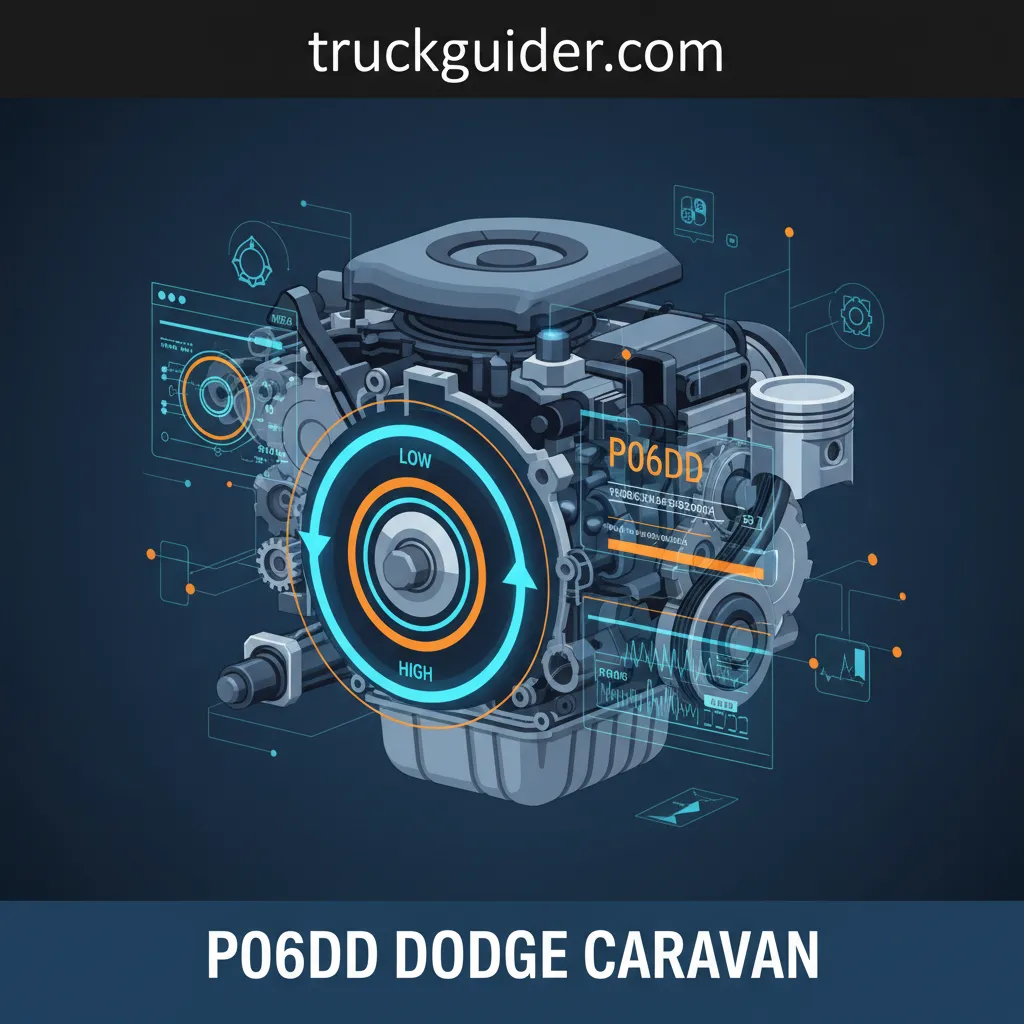
The 3.6L Pentastar V6 engine, a staple of the Dodge Caravan lineup, utilizes a sophisticated dual-stage oil pump designed to balance engine protection with fuel efficiency. The P06DD code is defined as “Dual Stage Oil Pump Stuck Low.” This means the Powertrain Control Module (PCM) has commanded the oil pump to switch into its high-pressure mode, but the oil pressure sensor did not detect the expected increase in PSI. This discrepancy triggers the fault, as the engine is operating at a high load or RPM without the necessary lubrication pressure to support it.
To understand why this happens, one must look at the pump’s technical operation. The oil pump contains an internal solenoid that regulates a bypass circuit. At idle and low speeds, the pump operates in a low-pressure mode (approximately 29 psi) to reduce parasitic drag on the crankshaft, thereby improving fuel economy. However, once the engine reaches roughly 3,500 RPM or the oil temperature exceeds 230 degrees Fahrenheit, the PCM energizes the solenoid to move the pump into high-pressure mode, where readings should exceed 60 psi.
The PCM is expert at monitoring these thresholds. It uses a logic map based on oil temperature and engine speed to determine what the pressure should be. When the actual pressure lags behind the target, P06DD is stored. It is vital to distinguish this from P06DE, which indicates the pump is “Stuck High.” While P06DE can hurt fuel economy, P06DD is significantly more critical for engine longevity because it implies a lack of adequate oiling during high-demand cycles. In a typical failure scenario, a driver might be merging onto a highway; as the engine revs past 3,500 RPM, the PCM realizes the pressure hasn’t jumped to the required 60+ PSI and immediately enters a fail-safe mode, limiting the engine to 3,500 RPM to prevent the bearings from spinning or the cam phasers from seizing.
Identifying Primary Symptoms and the Impact of the P06DD Code
Recognizing the symptoms of a P06DD fault early can save a Dodge Caravan owner thousands in engine replacement costs. The most immediate sign is the activation of the Malfunction Indicator Lamp (MIL). However, unlike a simple emissions code, P06DD usually brings a noticeable change in vehicle behavior known as “Limp Mode.” This professional protective measure restricts acceleration, ensuring you cannot push the engine into a range where low oil pressure would cause permanent damage.
By The Numbers: Oil Pressure Thresholds
Typical Low-Stage Pressure
High-Stage Target Range
P06DD Trigger Point (High Load)
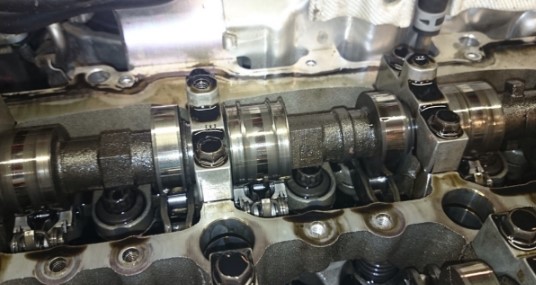
Beyond the dashboard lights, the Electronic Vehicle Information Center (EVIC) is a trusted tool for diagnosis. Drivers should navigate to the vehicle info screen to monitor live oil pressure. If you accelerate and the engine RPM rises while the oil pressure remains stagnant around 30 PSI, the system is failing. You may also notice audible indicators, such as a sharp “lifter tick” or a rhythmic tapping from the top end of the engine. This occurs because the hydraulic lash adjusters and the Variable Valve Timing (VVT) solenoids are not receiving the volume of oil required to function silently and efficiently at higher speeds.
Fuel economy will also suffer. When the PCM detects the P06DD fault, it retards spark timing and limits throttle plate opening. This is a complete strategy to lower internal combustion temperatures and pressures, but it results in a sluggish, unresponsive driving experience. Imagine trying to merge onto a freeway on-ramp; you floor the gas, the engine hits 3,500 RPM, the Check Engine Light flashes, and suddenly the power drops off as if you’ve hit a governor. This is the classic P06DD manifestation in the Caravan platform.

Leading Causes of P06DD Faults in Reliable Dodge Service History
Determining the “why” behind P06DD requires an expert eye for both mechanical and maintenance-related factors. While the oil pump itself is a common failure point, several other components can mimic a pump failure. In reliable service history, the leading causes are often divided between part failure and maintenance neglect.
Maintenance Integrity
Incorrect oil viscosity (using 10W-30 instead of 5W-20) or low-quality filters that collapse can trigger P06DD.
Mechanical Failure
Cracked internal pump housings or a failed solenoid are responsible for over 60% of cases in high-mileage Caravans.
One of the most frequent mechanical weak points is the oil filter housing assembly, particularly in 2011–2016 models. These housings feature an internal bypass valve held by a plastic clip. If this clip breaks, the valve can no longer maintain backpressure, causing the oil to bleed back into the pan and preventing the system from reaching the high-pressure stage. Similarly, the use of an aftermarket “bargain” oil filter can be disastrous. These filters often lack the structural quality of a Mopar original; they can collapse internally under the pressure of the high-stage cycle, physically obstructing the oil flow and triggering the code.
Lastly, internal engine sludge or debris in the oil pickup tube screen cannot be ignored. If a Caravan has been subjected to extended oil drain intervals, carbon deposits can accumulate. When the pump attempts to pull the high volume of oil required for the 60+ PSI stage, the restricted pickup screen causes cavitation, resulting in a pressure drop. While an expert technician will check the oil pressure sensor and wiring harness, P06DD is fundamentally a performance code—meaning the sensor is usually working correctly and is accurately reporting a genuine low-pressure condition.
📋
Professional Diagnostic Steps
Always start by replacing the oil and filter with a trusted Mopar filter and the correct 5W-20 or 5W-30 synthetic oil. This eliminates the most common “cheap” variables.
Use a professional scan tool (like an Autel or Snap-On) to perform a manual Solenoid State test. Command the pump into high-pressure mode while watching the live pressure graph.
If the scan tool shows low pressure, verify it with a manual mechanical gauge at the oil pressure port. This ensures the sensor isn’t simply lying to the PCM.
Professional Diagnostic Procedures for Accurate P06DD Resolution
A comprehensive diagnostic approach is the only way to avoid the “parts cannon” approach. After the initial oil and filter check, a technician should inspect the oil filter housing carefully. Remove the filter and look down into the center post of the housing. If the spring-loaded bypass valve is missing or crooked, you’ve found your problem. This is a common failure point that mimics a bad pump but is much easier to replace.
If the housing is intact, the next step involves the PCM software. Dodge released TSB 18-034-14 specifically for the Pentastar engine. This bulletin addresses oil pressure sensor logic and PCM calibration. In some cases, the thresholds for the “Stuck Low” code are too sensitive in the original software. A flash update might resolve the issue if the mechanical pressure is borderline but still healthy. However, if the mechanical pressure test reveals that the pump is only producing 30 PSI when the solenoid is commanded “ON” at 3,500 RPM, the pump has failed internally.
Before condemning the pump, shine a high-intensity light into the oil fill cap. If you see heavy varnishing or sludge, there’s a high probability the oil pickup screen is clogged, which will require dropping the pan anyway.
Repair Solutions and Component Replacement Best Practices
Replacing the oil pump in a Dodge Caravan is a complete and labor-intensive task due to its transverse engine mounting. Accessing the pump requires the removal of both the upper and lower oil pans. An expert tip for this repair is to ensure the vehicle is properly supported on a lift or heavy-duty jack stands, as you will need to remove the front engine mount and slightly shift the engine to reach the bolts hidden by the frame member and bellhousing.
✅ Pros of Proper Repair
- Restores full VVT functionality
- Eliminates Limp Mode restrictions
- Extends engine life significantly
- Prevents “lifter tick” damage
❌ Cons of Delaying
- Permanent camshaft scarring
- Total engine seizure risk
- Decreased fuel economy
- Increased diagnostic costs
When the pump is replaced, it is professional best practice to replace the entire assembly, which includes the new solenoid. Attempting to swap just the solenoid is often a futile effort, as the internal mechanical seals or the bypass spring in the pump housing are often the primary failure points. Furthermore, once the oil pan is removed, the pickup screen must be meticulously cleaned. Even a small amount of residual RTV sealant or sludge can cause a secondary failure of the brand-new pump.
The average labor time for this job is between 4.5 and 6.0 hours. During reassembly, the application of RTV sealant must be precise. Excessive sealant can squeeze out into the pan and find its way back into the new pump’s intake. Once the repair is finished, clear the P06DD code and perform a drive cycle. This guide recommends a wide-open throttle (WOT) run once the engine is at operating temperature. This forces the PCM to command the high-pressure stage; if the pressure jumps cleanly to 60-80 PSI on your EVIC or scan tool, the repair is a success.
Do not continue to drive a Caravan in “Limp Mode” for extended periods. While the PCM is trying to protect the engine, the low-pressure state at highway speeds is still insufficient for long-term health, leading to premature wear of the main bearings.
In summary, P06DD is a performance-based code indicating the dual-stage oil pump is unable to reach the required high-pressure state. Diagnostic priority should be given to oil quality, filter integrity, and sensor accuracy before proceeding to a more expensive pump replacement. Replacing the pump with quality Mopar components and adhering to strict maintenance schedules is the only way to ensure long-term engine health. If your Caravan is experiencing these symptoms, consult with a trusted professional technician today to perform a mechanical pressure test and prevent potential engine damage.
Frequently Asked Questions
Can I drive my Dodge Caravan with a P06DD code?
While the vehicle may remain drivable, it will likely enter ‘limp mode,’ limiting your RPMs to 3,500. It is not recommended to drive long distances or under heavy loads, as insufficient oil pressure during high-demand situations can lead to premature wear of engine bearings and the valvetrain.
How much does it cost to fix a P06DD code on a Caravan?
The cost varies significantly based on the cause. A simple oil and filter change may cost $70-$100, while a professional oil pump replacement typically ranges from $600 to $1,200, including parts and 5-6 hours of labor at a certified repair facility.
Will an oil change fix the P06DD code?
In some cases, yes. If the oil is extremely dirty, of the wrong viscosity, or if a low-quality oil filter has collapsed, a fresh oil change with a Mopar filter can resolve the pressure differential. However, if the internal solenoid or pump housing is damaged, an oil change will only be a temporary fix.
Is there a recall for the Dodge Caravan oil pump?
While there have been various Technical Service Bulletins (TSBs) and extended warranties on specific components like the oil filter housing for certain years, there is currently no universal recall for the P06DD pump issue. Owners should check their VIN with a local dealer for specific coverage.
What is the difference between P06DD and P06DE?
P06DD means the oil pump is ‘Stuck Low’ and cannot provide enough pressure when needed. P06DE means the pump is ‘Stuck High’ and is providing maximum pressure constantly. P06DD is generally considered more dangerous for the engine due to the risk of oil starvation at high speeds.
![P0171 Dodge Ram 1500: Fix & Reset Guide [2026]](https://truckguider.com/wp-content/uploads/2026/03/p0171-dodge-ram-1500-featured.webp)
![Engine Block Heater Installation [2026]](https://truckguider.com/wp-content/uploads/2026/03/featured-9331f5b2.webp)
![U1424 Code Ram 1500: Causes, Symptoms, and AGS Solutions [2026]](https://truckguider.com/wp-content/uploads/2026/03/u1424-code-ram-1500-featured-768x403.webp)
![Dodge 3.7 Firing Order: Cylinder Layout & Diagram Guide [2026]](https://truckguider.com/wp-content/uploads/2026/03/dodge-3-7-firing-order-featured-768x403.webp)