P1128 Code Dodge: Causes, Symptoms & How to Fix It in 2026

The P1128 diagnostic trouble code represents a manufacturer-specific powertrain fault that predominantly affects Dodge, Chrysler, and Jeep vehicles.
Technically defined as “Closed Loop Fueling Not Achieved Bank 1,” this code serves as a critical indicator that the vehicle’s engine management system is failing to transition from its initial, less efficient warmup sequence into its optimal operating state.
Resolving the P1128 code requires a highly nuanced understanding of fuel trim logic, engine thermodynamics, and model-specific mechanical flaws—most notably those inherent to the widely utilized Dodge 5.7L HEMI V8 and the 3.6L Pentastar V6 engines.
The Thermodynamics of Closed-Loop Fueling
To accurately diagnose a P1128 code, technicians must first understand the fundamental operating logic of a modern Powertrain Control Module (PCM). When a Dodge engine undergoes a cold start, the PCM operates exclusively in “open-loop” mode. During this initial phase, the PCM deliberately ignores feedback from the vehicle’s oxygen (O2) sensors.
Because traditional zirconium dioxide O2 sensors must reach an internal operating temperature of approximately 600°F (315°C) to generate accurate voltage signals, their early data is fundamentally unreliable. Instead of relying on these sensors, the PCM utilizes pre-programmed, static fuel maps that intentionally command a rich air-fuel mixture to prevent engine stalling and rapidly accelerate the catalyst warmup process.
As the combustion process heats the exhaust and the engine coolant temperature rises, the upstream O2 sensors reach their conductivity threshold. At this precise moment, the PCM transitions into “closed-loop” mode.
In a closed-loop state, the PCM actively monitors the real-time voltage oscillations from the upstream sensors (specifically Bank 1 Sensor 1 and Bank 2 Sensor 1), utilizing this feedback to dynamically adjust the fuel injector pulse widths. This continuous micro-adjustment allows the engine to achieve and maintain the perfect 14.7:1 stoichiometric air-to-fuel ratio, ensuring maximum fuel economy and minimal tailpipe emissions.
The P1128 diagnostic trouble code is triggered when the PCM detects that the fuel management system has remained trapped in its open-loop operation for a duration that exceeds the manufacturer’s maximum acceptable time or temperature threshold for Bank 1. The designation “Bank 1” specifically identifies the physical side of the engine block that houses the number one cylinder.
Flowchart: Open-Loop vs. Closed-Loop Fuel Transition Logic
- Start Node: Engine Cold Start Initiated -> Current State: Open-Loop (PCM utilizes preset rich fuel maps; O2 sensors inactive).
- Decision Node: Have the Engine Coolant Temperature (ECT) and Upstream O2 Sensor Temperature thresholds been successfully met?
- Path A (Yes): Transition to Closed-Loop Operation (PCM utilizes live O2 sensor cross-count feedback for dynamic fuel efficiency).
- Path B (No / Timeout Exceeded): System Remains in Open-Loop -> PCM triggers DTC P1128 and illuminates the Malfunction Indicator Lamp.
Symptomatology and Drivability Impacts
Because the Dodge PCM automatically defaults to pre-stored, rich fuel injection values when sensor feedback is invalid, a vehicle triggering a P1128 code remains temporarily drivable. However, long-term operation in a permanent open-loop state carries severe consequences for the vehicle’s mechanical longevity and efficiency.
The primary and most immediate symptom is the illumination of the Check Engine Light. Beyond this dashboard warning, the persistent open-loop state manifests in a cascade of drivability and performance degradations. Fuel economy plummets significantly, as the PCM is unable to optimize fuel delivery for current engine load conditions.
This constant over-fueling leads to a rough engine idle, often perceived by the driver as fluctuating engine revolutions or increased mechanical vibration when the vehicle is parked or stopped at a traffic light.
Furthermore, the excess unburned hydrocarbons exiting the exhaust valves can quickly foul the spark plugs, leading to noticeable hesitation under acceleration and random or cylinder-specific misfires.
If left unaddressed, the continuous stream of raw fuel will overwhelm the emissions control system, guaranteeing a failed emissions test and eventually causing irreversible thermal damage to the catalytic converter matrix.
Mechanical and Electrical Root Causes
Diagnosing the P1128 code requires an investigator to look beyond the oxygen sensors themselves. While a dead sensor is a frequent culprit, the code routinely points to secondary systems preventing the closed-loop transition, requiring a targeted diagnostic approach based on the specific Dodge engine architecture.
The 5.7L HEMI Exhaust Manifold Flaw
On Dodge Ram 1500s, Chargers, and Durangos equipped with the 5.7L HEMI V8, the P1128 code is frequently the downstream symptom of a well-documented mechanical design flaw rather than a primary electronic failure. The HEMI architecture utilizes a cast-iron exhaust manifold bolted directly to an aluminum cylinder head.
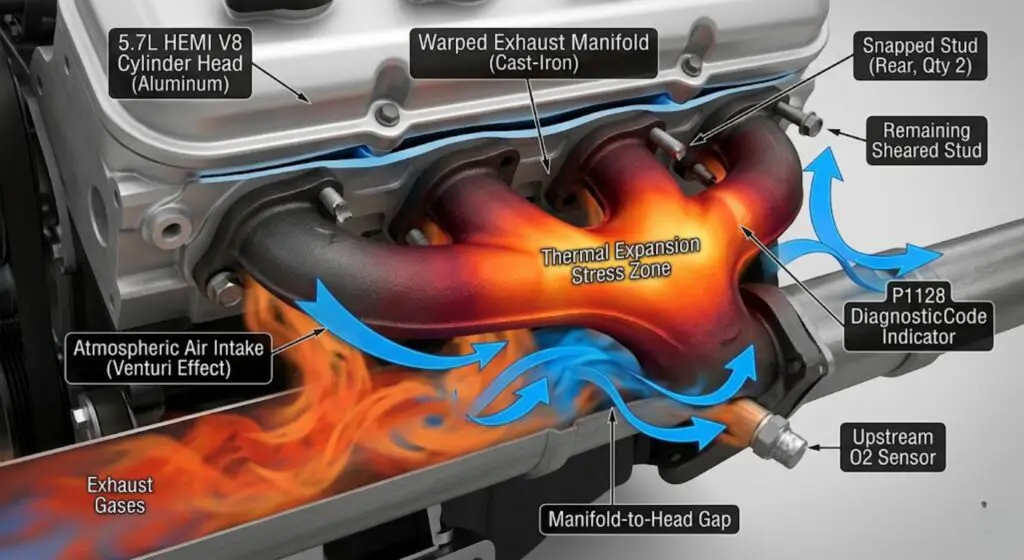
Due to the vastly different thermal expansion rates of ductile iron and aluminum, extreme heat cycling causes the cast-iron manifold to warp over time. This immense physical stress ultimately shears the rear manifold bolts, snapping the heads off the studs.
When the warped manifold separates from the cylinder head, outside atmospheric oxygen is sucked directly into the exhaust stream via the Venturi effect. The upstream O2 sensor reads this newly introduced oxygen and falsely reports a dangerously lean air-fuel condition to the PCM. In a desperate attempt to correct a lean condition that does not actually exist inside the combustion chamber,
the PCM commands maximum fuel enrichment, ultimately failing to achieve closed-loop stability and throwing the P1128 code. A key diagnostic indicator of this specific failure is a loud, metallic ticking noise that is highly prominent on cold starts but fades as the exhaust manifold heats up, expands, and temporarily seals the gap.
The 3.6L Pentastar Thermostat Failure
Thermal management failures represent another primary cause of the P1128 code, particularly concerning the mechanical thermostat. This is a notorious issue on the 3.6L Pentastar V6 engine utilized heavily in the Dodge Grand Caravan, Journey, and Challenger.
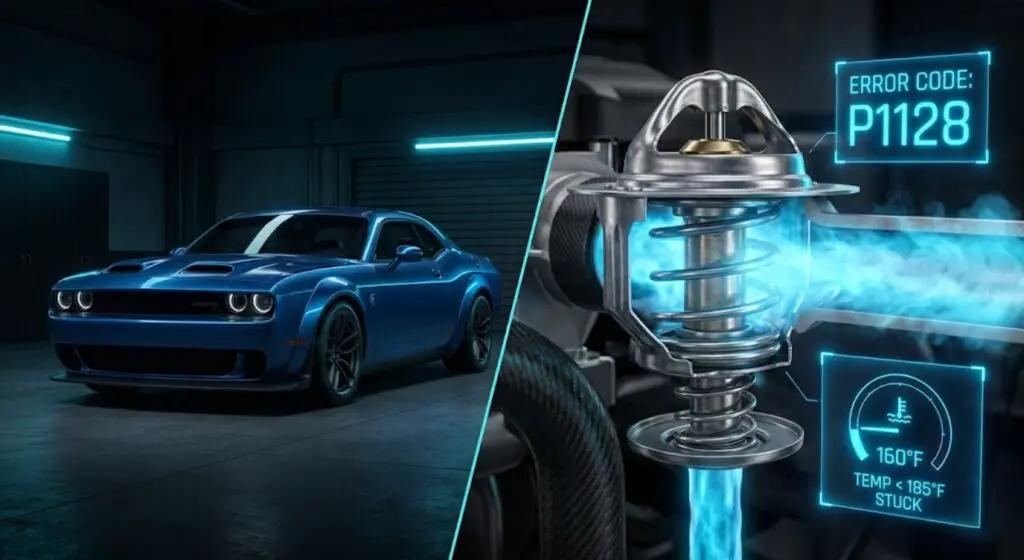
The PCM relies implicitly on the Engine Coolant Temperature (ECT) sensor to determine when the engine is sufficiently warm to execute the closed-loop transition. According to diagnostic data from automotive intelligence providers like(https://www.alldata.com/us/en/DTC-P1128-Dodge-Caravan-Intermittent-Stumble), a sticking thermostat is a leading cause of this fault.
In a documented case study involving a 2010 Dodge Grand Caravan presenting an intermittent P1128 code, exhaustive electrical testing revealed that the O2 sensors, MAP sensor, and associated wiring were in perfect condition.
The actual fault was a mechanically fatigued thermostat that was sticking open, preventing the engine coolant from swiftly reaching the required 185°F (85°C) operational threshold. Because the engine was running artificially cold, the PCM infinitely delayed the closed-loop transition, incorrectly assuming the warmup cycle was incomplete.
Oxygen Sensor Degradation and Wiring Faults
If mechanical integrity is confirmed, the fault often lies within the upstream heated oxygen sensor (Bank 1, Sensor 1) or its corresponding electrical circuit. If the sensor’s internal heating element burns out, it will fail to reach the necessary 600°F operating temperature to become conductive.
Without a rapidly fluctuating voltage signal, the PCM refuses to enter closed-loop operation. Furthermore, physical damage to the sensors, contamination of the sensor element from excessive oil consumption or coolant leaks, and melted wiring harnesses shorting against the hot exhaust pipes will instantly interrupt this vital data stream.
Intake Air and Fuel Delivery Deficiencies
Unmetered air entering the engine intake manifold through cracked vacuum lines or a failing Manifold Absolute Pressure (MAP) sensor severely skews the air-fuel ratio calculation. The MAP sensor calculates engine load by measuring intake vacuum; if it fails, it feeds incorrect air density data to the PCM, creating a lean or rich condition so severe that the upstream O2 sensors cannot mathematically correct it.
Similarly, fundamental fuel delivery issues, such as a clogged internal fuel pump strainer, failing fuel injectors, or abnormally low fuel pressure, physically restrict the system from supplying the commanded fuel volume, leaving the engine stranded in open-loop correction.
| Primary Component Failure | Diagnostic Mechanism Triggering P1128 | Most Affected Dodge Engine Platforms |
| Exhaust Manifold Hardware | Warped manifold shears bolts; Venturi effect pulls atmospheric oxygen over the sensor, creating a false lean reading. | 5.7L HEMI V8 (Ram 1500, Charger, Durango) |
| Engine Thermostat | Mechanical valve sticks open; engine coolant continuously circulates and fails to reach the ~185°F closed-loop threshold. | 3.6L Pentastar V6 (Grand Caravan, Journey) |
| Upstream O2 Sensor | Internal heater circuit failure or tip contamination prevents required voltage oscillation, stalling the PCM logic. | Applicable to All Dodge Models |
| MAP Sensor / Vacuum | Unmetered intake air creates a volumetric efficiency mismatch beyond the PCM’s maximum fuel trim correction limits. | Applicable to All Dodge Models |
Advanced Diagnostic Workflow and Live Data Analysis
Accurately diagnosing the P1128 code requires moving past basic code-reading and utilizing the live data stream capabilities of a professional OBD-II scan tool. Parts cannons are ineffective here; empirical data observation is mandatory.
The first diagnostic step involves verifying the Engine Coolant Temperature thresholds. By connecting a scan tool to a cold engine, a technician can monitor the live ECT data as the vehicle idles. The temperature should climb steadily and stabilize between 190°F and 215°F. If the data shows the temperature struggling to reach 185°F, fluctuating wildly at highway speeds, or taking an excessive amount of time to warm up, a faulty thermostat is confirmed.
If the thermal dynamics are correct, the technician must monitor the upstream O2 sensor voltage. Navigating to the live data feed for Bank 1 Sensor 1 (often labeled O2S11), the technician should observe the voltage output. On a cold start, the voltage will remain relatively flat and unresponsive.
However, as the exhaust heats up, a healthy zirconium O2 sensor will begin to rapidly oscillate, drawing sharp, continuous sine waves alternating between 0.1 volts (indicating a lean mixture) and 0.9 volts (indicating a rich mixture).
If the live data reveals a voltage line that flatlines steadily at 0.45V or 0V after the engine has reached operating temperature, the sensor element is dead or the wiring harness is compromised. Conversely, if the voltage stays pegged low near 0.1V despite the PCM adding maximum fuel trim, this strongly suggests an exhaust manifold leak introducing outside air before the sensor, or a massive intake vacuum leak.
Live Data Charting: Healthy vs. Failing Upstream O2 Sensor Voltage
- Y-Axis: Sensor Voltage Output (0.0V to 1.0V)
- X-Axis: Engine Run Time (Seconds at Operating Temperature)
- Data Series 1 (Healthy Sensor): Rapid, continuous sine wave oscillations peaking at 0.85V and dipping to 0.15V multiple times per second (high cross-counts).
- Data Series 2 (Failing Sensor – P1128 Condition): A flat, non-oscillating line hovering steadily at a default 0.45V, indicating zero closed-loop feedback activity to the PCM.
Technical Service Bulletins and PCM Flash Updates
In highly specific instances, the P1128 code is the result of overly sensitive factory software parameters rather than actual mechanical component failure. Automotive manufacturers frequently issue Technical Service Bulletins (TSBs) to address these logic flaws.
According to documentation housed by the National Highway Traffic Safety Administration (NHTSA), various PCM flash updates exist across the Dodge vehicle lineup to rectify false diagnostic triggers. While bulletins such as TSB 18-102-23 often focus on broader drivability concerns like shift quality and cylinder misfires,
Dodge technicians are frequently required to perform a PCM reflash to update the closed-loop fueling time thresholds and correct sensor tolerance logic. If exhaustive mechanical and electrical diagnostics pass without identifying a physical fault, verifying that the Powertrain Control Module possesses the latest factory software revision using a specialized wiTECH diagnostic tool is a mandatory final step.
Economic Analysis of Repair Costs
The financial impact of resolving a P1128 code varies significantly based on the root cause and the labor intensity required for the specific Dodge engine architecture. Utilizing aggregated automotive service data from industry standards like(https://repairpal.com/estimator) and(https://www.kbb.com/obd-ii/p1128/), the following provides a realistic baseline for expected parts and labor costs.
Replacing an upstream oxygen sensor is generally the most straightforward repair. The average cost to replace an O2 sensor on a Dodge Ram 1500 ranges from $323 to $631. The hardware itself dictates the bulk of the cost ($270 to $554 for OEM-grade sensors), while labor is generally billed at 0.5 to 1 hour ($52 to $77).
However, labor costs can escalate rapidly if the sensor threads have seized inside the exhaust bung due to severe rust, requiring the technician to utilize induction heating or re-tap the exhaust threads.
If the diagnostic points to a thermal failure, such as replacing the thermostat on a Dodge Grand Caravan 3.6L Pentastar, the total repair averages between $367 and $417. This comprehensive service includes $108 to $159 in labor, plus the cost of the original equipment thermostat assembly, new housing gaskets, and the necessary fluid exchange to bleed and refill the engine coolant.
The most financially burdensome repair associated with the P1128 code involves the 5.7L HEMI exhaust manifold failure. Extracting broken, hardened steel studs from an aluminum cylinder head inside the incredibly tight confines of a Ram 1500 engine bay is a high-risk operation. Technicians frequently have to weld extraction nuts directly to the broken studs or utilize specialized heavy-duty drilling jigs.
Replacing the warped manifold, upgrading the hardware to aftermarket locking studs, and installing new premium gaskets routinely exceeds $1,000 to $1,500 at a professional repair facility due to the extensive labor hours required.
| Repair Procedure | Estimated Parts Cost | Estimated Labor Cost | Total Average Estimate |
| Upstream O2 Sensor Replacement | $270 – $554 | $52 – $131 | $323 – $631 |
| Engine Thermostat & Coolant Service | $200 – $258 | $108 – $159 | $367 – $417 |
| MAP Sensor Replacement | $124 – $150 | $54 – $79 | $178 – $229 |
| Exhaust Manifold Replacement & Stud Extraction | $300 – $600 | $700 – $1,200 | $1,000 – $1,800+ |
People Also Ask
How do I physically locate Bank 1 on a Dodge engine?
In automotive diagnostics, “Bank 1” universally refers to the side of the engine block that houses cylinder number one. Because Dodge utilizes both longitudinal and transverse engine mounting configurations, the physical location shifts depending on the vehicle platform. On the 5.7L HEMI V8—mounted longitudinally in rear-wheel-drive platforms like the Ram 1500,
Charger, and Durango—Bank 1 is located on the driver’s side of the engine bay. Conversely, on the 3.6L Pentastar V6 mounted transversely in front-wheel-drive platforms like the Dodge Grand Caravan and Journey, Bank 1 is the rear cylinder bank, situated closest to the passenger cabin firewall.
What is the technical difference between Code P1128 and P1129?
Both the P1128 and P1129 diagnostic trouble codes share the identical technical definition of “Closed Loop Fueling Not Achieved.” The sole distinction between the two codes lies entirely in the geographical location of the fault. P1128 indicates a failure specific to Bank 1, whereas P1129 alerts the technician to a failure on Bank 2 (which is the passenger side on a longitudinal HEMI, or the front radiator-facing side on a transverse Pentastar V6). Because they utilize identical PCM logic parameters, the diagnostic workflow, voltage testing, and mechanical repair procedures for both codes remain exactly the same.
Can a failing MAP sensor directly trigger a P1128 code?
Yes, a degraded Manifold Absolute Pressure (MAP) sensor is a documented root cause of the P1128 fault. The MAP sensor is responsible for calculating the physical load on the engine by measuring the intake manifold vacuum. If the MAP sensor internally fails, or if its vacuum port becomes obstructed with carbon buildup,
it will transmit highly inaccurate air density metrics to the PCM. Acting on this false data, the PCM injects an incorrect volume of fuel, creating an extreme lean or rich condition. If this volumetric efficiency mismatch is so severe that the upstream O2 sensors cannot mathematically correct it via fuel trims, the PCM will suspend closed-loop operation to protect the engine, thereby triggering the code.