P2002 6.7 Powerstroke Code Causes, Diagnosis and Fixes by Year 2026

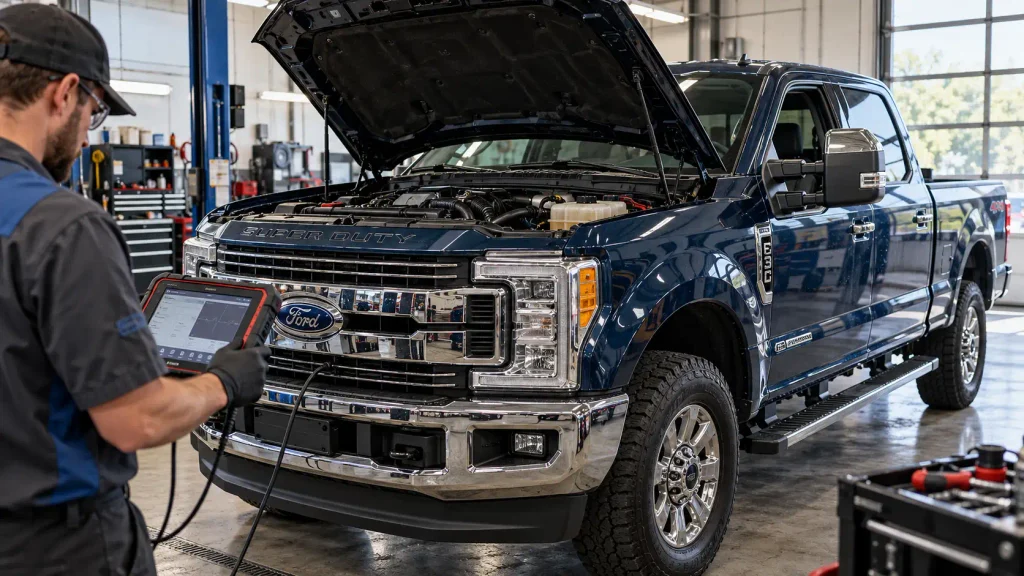
The P2002 6.7 Powerstroke trouble code means the diesel particulate filter (DPF) is not meeting its monitored filtration-efficiency threshold. It does not automatically mean the filter is clogged.
On certain Ford Super Duty trucks, the problem can involve a damaged DPF substrate, and Ford has issued service bulletins addressing that condition.
Before paying for a filter, sensor, or regeneration service, identify your truck’s model year, production date, other stored codes, and applicable Ford service programs.
Ford 6.7L Power Stroke V8 · DTC P2002
P2002 Diagnostic Decision Map
Diesel particulate filter efficiency below threshold, Bank 1. A P2002 code does not automatically prove a clogged filter, cracked DPF, or failed sensor.
Model year, VIN, Super Duty model, and door-jamb build date.
P2002, other stored or pending DTCs, and freeze-frame details.
PCM updates, previous DPF work, and emissions recall completion.
Check TSB 17-2250 for a P2002-only condition; 20M06 may affect eligible DPF coverage.
Check TSB 17-0055 when P2002 is the only PCM DTC.
Check TSB 21-2332 for the documented potential cracked DPF condition.
Check programs 22N05-S3 or 25N14, each with separate recall prerequisites.
Other years or unmatched conditions: use the appropriate Ford Workshop Manual diagnosis. A TSB is not automatic proof of failure or free repair.
Check build date, engine, other DTCs, and bulletin applicability.
A matching bulletin may direct assembly replacement and PCM programming. Confirm every requirement.
Use VIN-specific Ford service tests; inspect other DTCs and relevant exhaust or sensor evidence.
2015–2016: verify 20M06 limits. Certain 2022 trucks: verify the required recall and deadlines for 22N05-S3 or 25N14. Eligibility is vehicle-specific.
Regeneration can remove soot but cannot repair a cracked DPF substrate. Complete Ford-directed post-repair checks.
What Does P2002 Mean on the 6.7 Powerstroke


P2002 is an OBD-II diagnostic trouble code (DTC) for Particulate Filter Efficiency Below Threshold, Bank 1. The 6.7L Power Stroke V8 uses a DPF in its exhaust aftertreatment system to trap particulate matter before exhaust leaves the tailpipe.
The powertrain control module (PCM) monitors whether the filter is doing its job. Ford uses model-year-specific sensing and monitoring strategies.
Efficiency is not the same as restriction. A filter can restrict exhaust because it contains too much soot, while a cracked filter can allow particles to pass through. P2002 points to inadequate filtration performance; it does not tell you which part to replace without further evidence.
Which Four Conditions Change a Ford P2002 Diagnosis


Four details determine which troubleshooting path makes sense. Record them before clearing the fault.
Model Year and Build Date
Ford’s published P2002 bulletins have specific vehicle populations. The 2017 production-date split is especially important: a truck built on May 12, 2017, falls under different guidance than one built on May 13, 2017, if all other bulletin conditions are met.
P2002 Alone or Multiple Codes
Record every stored and pending DTC. Ford TSB 17-0055 applies only when P2002 is the sole PCM code on qualifying 2017 trucks.
Filter Condition and Sensor Evidence
DPF damage, suspect sensor data, or other emissions faults require different investigations.
Previous Repairs and Recall History
Check PCM updates, DPF replacements, and emissions recalls. Some 2022 coverage requires a completed recall.
How to Diagnose P2002 Before Replacing Ford Parts


A methodical diagnosis starts with evidence, not a parts order. Follow this sequence, using the Ford Workshop Manual for your exact truck when testing beyond basic inspection.
- Save the complete scan report. Record P2002, all companion codes, freeze-frame information, warning messages, and whether the malfunction indicator lamp is illuminated. Avoid clearing codes first; that can erase useful context.
- Identify the truck precisely. Confirm F-250, F-350, or other Super Duty configuration, model year, VIN, engine, and door-jamb production date. Model year alone is not enough for every TSB.
- Check the matching bulletin. Verify that the stated vehicle, build date, engine, and code conditions all match. If they do, the Ford procedure takes priority over generic internet troubleshooting.
- Review related emissions faults. Additional pressure-sensor, exhaust-temperature, regeneration, or other aftertreatment codes may require their own pinpoint tests. A scan tool that can read Ford-specific modules and live data is preferable to a basic code reader.
- Inspect only what is safely accessible. With the exhaust cool, look for obvious damage or disconnected components. Do not touch a hot exhaust assembly or loosen aftertreatment components while they are hot.
- Confirm the repair and verify afterward. A qualified technician should complete the applicable repair, PCM programming if required, and Ford-specified post-repair checks. Clearing the light without correcting the cause is not a confirmed fix.
For component identification, use TruckGuider’s 6.7 Powerstroke sensor location diagram.
When Does P2002 Indicate a Cracked DPF


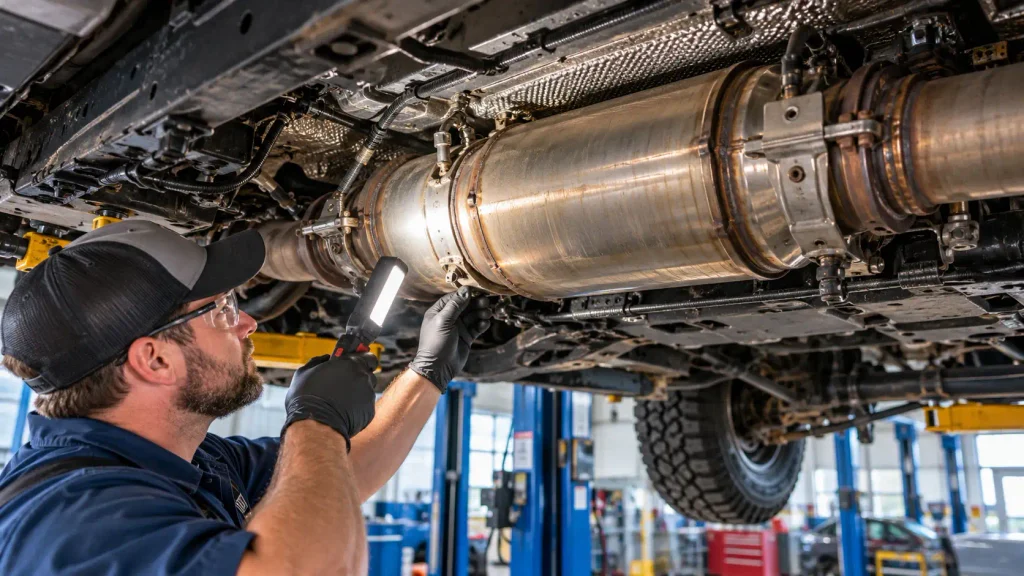
A DPF contains a porous substrate designed to capture soot. If the substrate cracks, exhaust particles may bypass the intended filtration path. Regeneration burns accumulated soot; it cannot restore a broken filter structure.
This distinction matters for 2017–2020 Super Duty trucks equipped with the 6.7L Power Stroke and built on or after May 13, 2017. Ford TSB 21-2332 identifies P2002 on the applicable vehicles as a condition that may involve a cracked DPF substrate. The bulletin’s repair procedure calls for replacing the relevant catalyst-and-particulate-filter assembly and reprogramming the PCM.
A TSB does not prove a crack or guarantee free repair.
How to Distinguish P2002 From DPF Sensor Problems
The DPF differential pressure sensor measures pressure differences across the filter, but P2002 does not prove that sensor has failed.
For example, a separate sensor circuit or performance code should be diagnosed on its own terms. A technician may need to test live readings, wiring, and pressure connections.
TruckGuider’s DPF pressure sensor location guide explains what differential pressure sensors do and how their pressure connections are commonly arranged. Confirm Ford-specific test procedures separately.
Which Ford P2002 TSB Applies by Model Year
Ford has issued different technical guidance for the 6.7L Power Stroke. A technical service bulletin (TSB) documents a known condition and service procedure; it is not automatically a recall or a warranty promise.
| Ford Model Year or Build Range | Relevant Document | What the Document Addresses |
|---|---|---|
| 2015, built on or before March 26 | Historical TSB 15-0152 | PCM calibration for P2002, P246C and/or P2463; later superseded |
| 2015–2016 pickups | TSB 17-2250 | P2002-only condition; catalyst/DPF assembly replacement and PCM programming |
| 2017, built on or before May 12 | TSB 17-0055 | P2002 as the only PCM DTC; filter assembly replacement and PCM programming |
| 2017–2020, built on or after May 13, 2017 | TSB 21-2332 | Possible cracked DPF substrate; replace applicable assembly and reprogram PCM |
| Certain 2022 Super Duty trucks | Program 22N05-S3 | Conditional one-time DPF replacement after recall 22E02 or 22E05 |
| Certain 2022 F-250–F-600 trucks | Program 25N14 | Separate conditional DPF replacement after recall 25E09 |
Why the 2015 Bulletin Needs Context
TSB 15-0152 originally addressed certain early-build 2015 trucks with a PCM update. Ford later published superseding P2002 guidance for 2015–2016 pickups, including TSB 17-2250. A 2015 owner should not assume that a software update is the complete current repair simply because an older bulletin appears in search results.
Why the 2017 Build Cutoff Matters
For qualifying early-build 2017 trucks, TSB 17-0055 instructs technicians to check whether P2002 is the only PCM code. If it is, the published procedure specifies replacement of the catalyst and particulate filter assembly, followed by PCM reprogramming. Other stored codes put the truck outside that bulletin’s stated diagnostic branch.
For eligible trucks built from May 13, 2017, through the 2020 model year, TSB 21-2332 provides a separate service route.
What About 2011 to 2014 and 2021 to 2026
The specific bulletins above do not establish a universal repair procedure for every 6.7L Power Stroke model year. If your truck does not match a listed document, follow the Ford Powertrain Control/Emissions Diagnosis procedures for its VIN and calibration. A dealership can also check whether a newer or separate service message applies.
Can DPF Regeneration Fix a P2002 Code
Not if the cause is a cracked DPF substrate. Regeneration is intended to reduce soot accumulated in the filter. It cannot repair damaged filtration material, cracked internal passages, or a broken catalyst-and-filter assembly.
A truck may also have a soot-loading or regeneration problem, sometimes accompanied by other DTCs. That is a different diagnostic situation from a Ford bulletin addressing P2002 caused by reduced filter efficiency. P2002 alone is not an instruction to perform a forced regeneration.
Avoid repeated forced regens, chemical cleaning, or code clearing as experiments. First confirm the trouble codes and the correct service procedure. If a qualified technician identifies actual soot restriction rather than substrate damage, follow the model-specific Ford regeneration or repair instructions for that condition.
When Will Ford Cover P2002 DPF Replacement
Some owners may qualify for Ford-paid repairs, but coverage is VIN-specific. The model year, warranty start date, mileage, completed recalls, diagnostic conditions, and program deadline all matter. Ask an authorized Ford dealer to check the vehicle in Ford’s OASIS service system before approving customer-paid replacement.
Program 20M06 for Certain 2015 and 2016 Trucks
Ford’s Customer Satisfaction Program 20M06 extends DPF coverage on certain 2015–2016 Super Duty trucks when qualifying P2002 conditions are present. It addresses DPF damage associated with extended idle operation, not every clogged or failed filter.
Published Super Duty coverage limits are:
- GVWR up to and including 14,000 lb: 11 years or 120,000 miles from the warranty start date, whichever comes first.
- GVWR over 14,000 lb: 10 years or 110,000 miles from the warranty start date, whichever comes first.
These are program limits, not a guarantee that an individual truck still qualifies in 2026. Coverage for a particular vehicle may already have ended because of age or mileage. The program excludes DPF plugging caused by failure to regenerate and unrelated faults.
Program 22N05-S3 for Certain 2022 Trucks
Ford updated Program 22N05-S3 in June 2026 for certain 2022 F-250–F-600 vehicles with the 6.7L engine. It provides a no-cost, one-time DPF repair under specified conditions after completion of emissions recall 22E02 or 22E05.
The relevant recall must have been completed and claimed, the malfunction indicator lamp must be on, and the program requires P2002 as the only set DTC under the published service-action conditions. The dealer must confirm the VIN is eligible.
The deadline differs by completed recall:Completed Emissions Recall One-Time Repair Coverage Ends 22E02 One year after recall repair, or December 31, 2026, whichever comes first 22E05 One year after recall repair, or December 31, 2029, whichever comes first
The 2029 date is not an automatic extension for every 2022 truck. If the qualifying recall was completed more than one year ago, the program window may already be closed. The dealer must verify the actual completion date and status.
Program 25N14 for a Different Group of 2022 Trucks
Ford’s separate Program 25N14 applies to a specific population of 2022 F-250–F-600 trucks built at Kentucky Truck from May 13 through August 5, 2022. Ford’s program population was 1,649 vehicles in the United States.
This path requires emissions recall 25E09 to be completed and claimed for the VIN, the malfunction indicator lamp to be illuminated, and P2002 to be present. Its one-time repair window ends one year after the 25E09 repair or December 31, 2029, whichever comes first. Do not confuse this program with 22N05-S3.
Which P2002 Repair Path Fits Your Ford Truck
The quickest way to avoid paying for the wrong repair is to match the truck’s documented condition to the correct next step.Your Situation Recommended Next Step Early-build 2015 with P2002 and related restriction codes Check latest Ford guidance; do not rely solely on superseded TSB 15-0152 2015–2016 with P2002 only Check TSB 17-2250 and 20M06 eligibility 2017 built by May 12, with P2002 only Check TSB 17-0055 conditions 2017–2020 built from May 13, 2017, with P2002 Check TSB 21-2332 conditions 2022 with qualifying recall history Have dealer check 22N05-S3 or 25N14 by VIN Additional sensor, temperature, or aftertreatment faults Diagnose those codes using Ford’s service procedures No matching bulletin or campaign Perform normal VIN-specific emissions diagnosis
The presence of a bulletin does not prove your truck qualifies for free repair. It helps identify what a technician should verify and how Ford directs the service process.
When Should You Visit a Ford Diesel Technician
Arrange professional diagnosis if P2002 returns after clearing, the truck enters reduced-power operation, additional exhaust-system faults appear, or inspection suggests filter damage. Follow any dashboard instruction to stop driving.
Ask the shop to give you the full DTC report, the applicable Ford bulletin number, confirmation of the VIN’s program eligibility, and a written estimate. For confusing pressure-related faults, TruckGuider’s exhaust pressure sensor location guide can help distinguish exhaust backpressure sensing from DPF differential pressure sensing.
A cracked DPF repair may require removal of exhaust aftertreatment components and PCM programming. Those jobs are better handled with the appropriate Ford diagnostic equipment and service documentation.
What to Do Next With P2002 on Your Powerstroke
The correct P2002 6.7 Powerstroke fix starts by verifying the code, not assuming the DPF is clogged. Check the truck’s VIN, production date, other fault codes, and Ford’s current service guidance. That is especially important for 2015–2016, 2017–2020, and certain 2022 trucks covered by the documents discussed above.
If a Ford bulletin identifies DPF replacement and PCM programming for your specific condition, follow that procedure. Have a dealer check potential 20M06, 22N05-S3, or 25N14 coverage before approving repairs.
Common Questions About the P2002 Powerstroke Code
What Does P2002 Mean on a 6.7 Powerstroke
P2002 means the DPF is performing below its monitored filtration-efficiency threshold on Bank 1. It does not by itself identify a clogged filter, cracked substrate, or failed sensor. The Ford diagnostic procedure and related fault codes determine what to inspect next.
Can I Drive My Ford Truck With a P2002 Code
A P2002 code alone does not establish a universal safe driving distance. Follow any dashboard instructions and have the fault diagnosed promptly, especially if the truck has reduced power, unusual exhaust symptoms, or additional warnings. Do not assume the absence of a drivability problem means the emissions system is healthy.
Will a Forced Regeneration Clear P2002
A regeneration can burn trapped soot, but it cannot repair cracked DPF material. Do not order a forced regeneration without a confirmed diagnosis.
Does P2002 Always Mean the DPF Is Cracked
No. Ford has documented cracked DPF conditions for certain vehicles, but a code by itself does not establish the cause. A technician needs to match the truck to the correct bulletin and assess other relevant faults before selecting a repair.
Can a Faulty DPF Pressure Sensor Cause P2002
Faulty sensor information can complicate aftertreatment diagnosis, but P2002 is not a direct sensor-replacement instruction. The monitoring strategy differs by model year. Check companion codes and Ford-specific pinpoint tests before buying any pressure sensor.
Is Ford P2002 DPF Replacement Covered Under Warranty
Sometimes. Program 20M06 has specific time, mileage, and failure requirements, while 22N05-S3 and 25N14 have separate recall prerequisites and deadlines for qualifying 2022 trucks. Only a VIN-specific Ford dealer check can establish whether your vehicle currently qualifies.