P20EE 6.7 Powerstroke Code Causes, Diagnosis and Fixes 2026

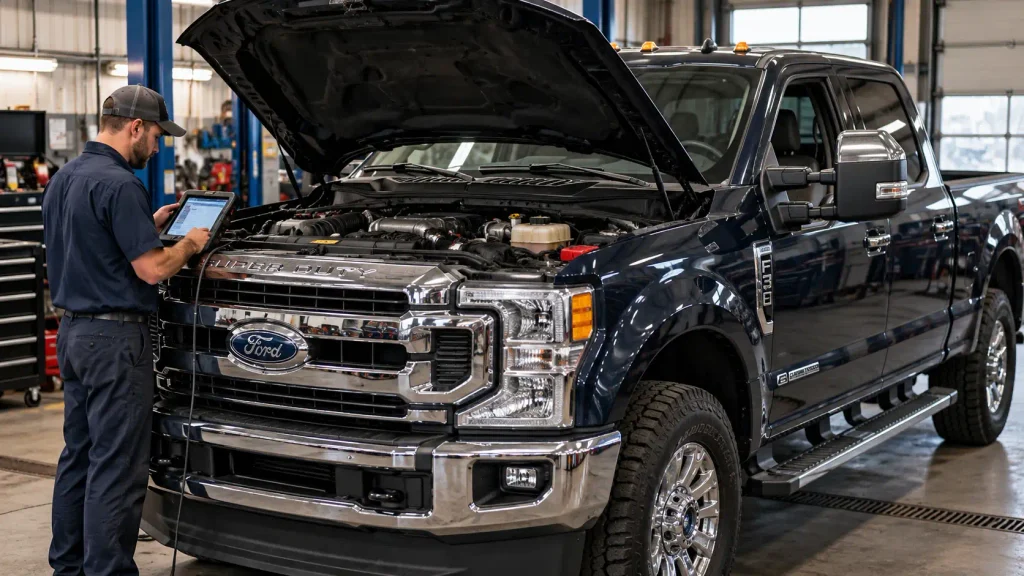
P20EE on a 6.7 Powerstroke means SCR NOx Catalyst Efficiency Below Threshold (Bank 1). The Ford Powertrain Control Module (PCM) has detected that the selective catalytic reduction system is not reducing nitrogen oxides as effectively as expected. It does not prove that the catalytic converter has failed.
Bad diesel exhaust fluid (DEF), incorrect dosing, NOx sensor readings, leaks, or software can affect the result. The correct fix depends on the model year, companion codes, and verified tests.
SCR NOx catalyst efficiency below threshold. Follow the evidence before replacing DEF, NOx, or catalyst components.
Record model year, VIN, build date, warning messages, and relevant repair history.
Read stored and pending codes, related module data, and freeze-frame information before clearing anything.
Match service guidance to the VIN, model year, build date, and code combination; complete the prescribed pinpoint test.
If DEF quality or dosing tests fail, correct the confirmed fluid, injector, pump, or control issue. P207F may guide testing.
If circuit or live-data tests fail, inspect the identified sensor and harness. Do not replace a sensor based on P20EE alone.
If P2002, P2459, or P2463 is present, follow the model-specific DPF tests and applicable Ford guidance.
If prescribed tests still confirm poor SCR performance, evaluate the catalyst before authorizing replacement.
Complete any required Ford service functions, run the prescribed monitor or drive cycle, and recheck for returning codes.
What P20EE Means on the 6.7 Powerstroke


The 6.7L Power Stroke V8 Turbo Diesel uses selective catalytic reduction (SCR) to reduce nitrogen oxides (NOx) in exhaust gas. Diesel exhaust fluid enters the exhaust stream ahead of the SCR catalyst, where the system helps convert NOx into nitrogen and water.
The PCM evaluates NOx sensors, exhaust temperatures, operating conditions, and DEF dosing. P20EE can set when calculated conversion efficiency fails its calibrated limit.
Ford’s 2023–2024 diesel OBD system operation summary lists a 55% cumulative SCR efficiency threshold for that documented monitor. This is a model-year-specific technical reference, not a universal threshold to apply to every 2011–2026 truck.
P20EE concerns SCR NOx conversion; P2002 concerns diesel particulate filter (DPF) efficiency. Both may appear together, but the diagnoses differ.
Which Ford P20EE Symptoms Require Urgent Service


A check engine light may be the only obvious sign of P20EE. Some trucks may also display an exhaust-fluid-system warning, reduced-performance message, or a warning about an approaching speed restriction. Messages vary by model year and other faults.
If the truck runs normally and shows only a check engine light, arrange a diagnostic appointment promptly, record the codes, and avoid unnecessary towing or long trips until the warnings are understood. The light alone does not prove imminent engine failure.
If a speed-limit countdown, severe power loss, overheating, or unsafe drivability appears, stop in a safe place and follow the owner’s manual or arrange professional assistance. Do not rely on a promised number of miles before a restriction starts.
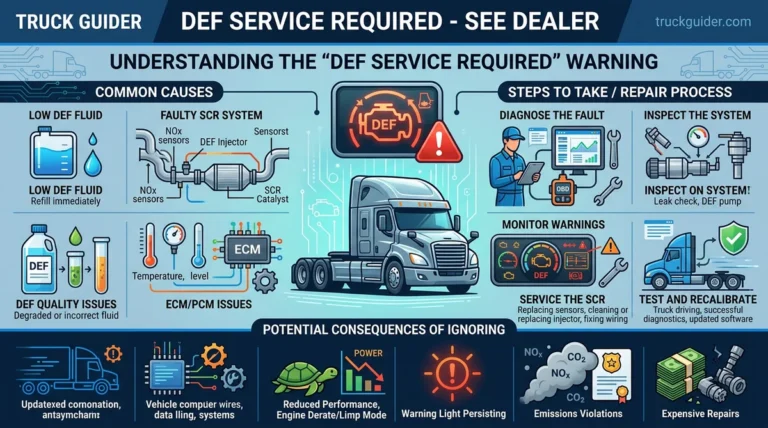
For related dashboard-message context, see TruckGuider’s DEF service required warning guide. Use the Ford display and owner’s manual for your truck.
How to Start a Ford P20EE Diagnosis


The best first repair is often no replacement at all. Collect evidence before authorizing sensors, a DEF pump, or a catalyst assembly.
- Identify the exact truck. Record the model year, F-250 or F-350 designation, VIN, build date, mileage, and whether emissions components or PCM software were previously changed. A bulletin may cover only certain build dates.
- Scan every relevant module. Capture confirmed, pending, and stored diagnostic trouble codes (DTCs). Save the freeze-frame conditions before clearing anything. Basic readers may omit Ford-specific information.
- Check the warning and DEF history. Note the dashboard wording, fluid level, last refill date, unusual fluid contamination, and whether the problem started after other exhaust repairs.
- Inspect safely. With the exhaust cold, look for obvious leaks, damaged harnesses, disconnected plugs, and visible DEF residue around accessible components. Do not disconnect hot aftertreatment parts or handle contaminated DEF without proper precautions.
- Match the Ford procedure. Use the applicable Ford Powertrain Controls and Emissions Diagnosis (PC/ED) pinpoint test and any current VIN-specific technical service bulletin (TSB). A Ford-capable diagnostic tool may be necessary to test dosing, sensors, and service functions.
If your scanner cannot display the required data, ask a diesel shop to document which test failed.
Which Ford P20EE Bulletins Apply by Model Year


Ford has issued different P20EE guidance over time. A bulletin number does not prove its repair applies to your truck. Confirm the build date, code conditions, and later revisions.
| Model Year | Ford Service Reference | What to Check First |
|---|---|---|
| 2011–2012 early builds | TSB 13-11-6 | Historical NOx sensor and calibration guidance for qualifying early-build trucks; verify later updates. |
| 2013–2016 | Customer Satisfaction Program 21N06 | A historical SCR coverage program tied to recall 21E01. It is expired. |
| 2015 | TSB 18-2109 | PCM calibration guidance for specified DTCs, including P20EE. Confirm current calibration. |
| 2017 | TSB 18-2005 and TSB 21-2368 | Specific build-date or code-set conditions; 21-2368 superseded 19-2082. |
| 2018 | TSB 19-2083 | Historical software and DPF-related diagnostic guidance; check for newer instructions. |
| 2017–2020 | SSM 49202 | Updated P20EE pinpoint test RD15 with technician-performed DPF regeneration and SCR parameter reset. |
| 2021–2026 | Current VIN-specific Ford PC/ED | Use the actual model-year procedures; do not transplant an older TSB onto a newer truck. |
For example, Ford’s 2015 TSB 18-2109 describes a PCM reprogramming procedure for trucks with P012F, P207F, P2002, and/or P20EE under its specified conditions. Ford’s 2017 TSB 21-2368 addresses a different set of qualifying codes and supersedes 19-2082. An older forum answer may omit the revision.
Ford’s SSM 49202 for 2017–2020 Super Duty trucks describes an updated RD15 test that calls for two DPF manual regenerations and an SCR parameter reset with an appropriate Ford diagnostic scan tool. This is a professional procedure, not advice to force regeneration whenever P20EE appears.
Once your year-specific procedure is confirmed, choose the next branch based on actual test results.
If Ford DEF Quality or Dosing Tests Fail
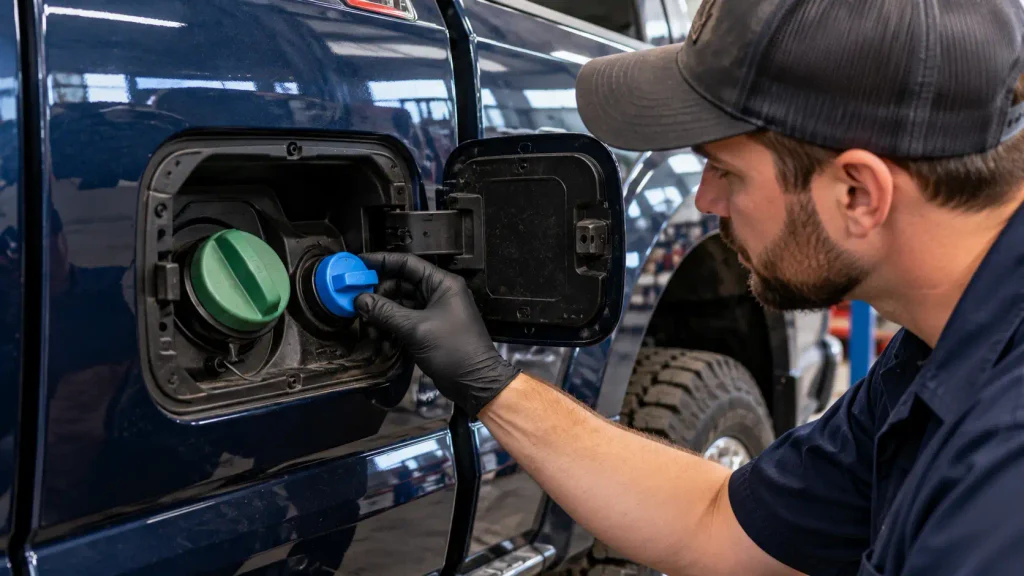
If the prescribed tests show contaminated, incorrect, or improperly delivered DEF, correct that finding before evaluating the SCR catalyst as defective. DEF problems can make an otherwise functional catalyst appear inefficient.
A technician should check DEF quality using the approved method for that truck and then verify delivery-system operation. Testing may identify a fluid problem, injector restriction, pump pressure fault, electrical issue, or dosing-control problem. The failed test determines what needs repair.
P207F is particularly relevant because it is associated with reductant-quality performance. It is a reason to follow the matching Ford diagnostic path, not proof that a fresh tank of DEF will fix P20EE.
Do not add homemade chemicals, repeatedly top off questionable fluid, or bypass emissions equipment. After correcting a confirmed issue, the shop should complete the required service functions and recheck SCR operation.
If Ford NOx Sensor Tests Show Faults
If a sensor circuit fault or implausible NOx reading is confirmed, investigate that sensor and its wiring before authorizing SCR catalyst replacement. P20EE by itself does not identify which sensor, if any, is faulty.
P2201, communication faults, connector damage, or inconsistent readings may change the diagnosis. A technician should check the prescribed live-data parameters.
Sensor number, mounting position, and service part can differ by generation. Use the 6.7 Powerstroke sensor location diagram as a location reference, then confirm the exact sensor through Ford’s VIN-based parts information.
Replace a NOx sensor only after its failure is supported by the proper diagnostic test. Inspecting a sensor does not establish that its electrical or measuring function is defective.
If Ford P20EE Appears With Other Trouble Codes
Related DTCs can point toward tests that need attention before the SCR efficiency result is interpreted. The table below gives diagnostic directions, not automatic component replacements.
| Companion Code | What It Indicates | Appropriate Next Check |
|---|---|---|
| P207F | Reductant quality performance | Follow Ford’s reductant quality and delivery diagnosis. |
| P2201 | NOx sensor circuit range or performance | Follow the model-specific NOx sensor pinpoint test. |
| P2002 | DPF efficiency below threshold | Investigate the DPF-related fault separately. |
| P2459 | DPF regeneration frequency | Check whether the applicable Ford bulletin changes the service sequence. |
| P2463 | DPF soot accumulation | Follow prescribed DPF and regeneration diagnostics before clearing codes. |
For P2002, TruckGuider already provides a focused 6.7 Powerstroke P2002 diagnostic guide. Keep the DPF diagnosis separate rather than applying a P20EE catalyst repair to both codes.
A code’s presence does not establish that its related component is defective. Use the current Ford procedure to identify active faults and test order.
If Ford SCR Catalyst Efficiency Remains Low
If DEF quality, reductant dosing, NOx sensor operation, exhaust integrity, and applicable software checks all pass, the SCR catalyst becomes a stronger suspect. It still requires the prescribed efficiency evaluation before replacement is justified.
The shop should document the SCR test result, relevant temperature and NOx measurements, any leaks or contamination, and the calibration status. Some years require resets or a prescribed drive-cycle evaluation.
For certain 2013–2016 Super Duty trucks, Ford’s historical program documentation identifies the SCR as part of a catalyst and particulate filter assembly. That is one reason the replacement bill can be substantially larger than the price of a single sensor.
Do not buy a catalyst from the code description alone. Require a VIN-matched part and documented failure.
How Much Ford P20EE Repairs May Cost
There is no fixed P20EE repair price. A calibration update, DEF-system repair, sensor replacement, and catalyst assembly replacement are different jobs. Model year, chassis configuration, shop labor rate, and verified parts fitment all change the estimate.
Here are two concrete reference points that should not be confused with universal quotes:
- PCM update labor reference: Ford TSB 18-2109 lists 0.4 labor hour for its specific 2015 F-Super Duty diagnostic and PCM reprogramming operation. This is a historical bulletin labor allowance, not a 2026 retail price or a time guarantee for other trucks.
- SCR assembly parts-price example: At the time of research, a 2015 F-250 6.7L catalog listing showed Ford part FC3Z-5H270-C at $4,633.13 online, against a listed $5,478.67 MSRP. That is a specific advertised parts price, excluding diagnostic labor, installation, tax, shipping, and other charges. Verify VIN fitment and the current listing before ordering.
For further context, Ford’s 2021 program 21N06 listed 1.6 labor hours for a particular Super Duty catalyst/particulate-filter assembly replacement operation, including its specified code inspection. That historical program allowance is not an estimate for every chassis or a full contemporary dealer quote.
Request an estimate listing the failed test, VIN-matched part, labor, software work, and verification.
Does Ford Program 21N06 Still Cover Repairs
No. The special 21N06 extension expired on December 31, 2024, or 12 months after qualifying recall 21E01 completion, whichever came first. It applied to specific 2013–2016 Super Duty trucks under defined conditions, not all P20EE repairs.
Ford’s 21N06 dealer program letter explains those conditions and the expiration date. Other original or extended warranty rights must be assessed separately using the VIN and service history; do not assume a free repair remains available in 2026.
How to Confirm the Ford P20EE Repair
Clearing the check engine light is not proof that the SCR system now meets its monitored performance requirement. Verification should match the procedure used to diagnose the fault.
- Record the actual repair, replaced part numbers, software calibration, and original failure evidence.
- Complete any Ford-required parameter reset, calibration, or prescribed regeneration procedure using appropriate service equipment.
- Run the applicable monitor or drive-cycle verification safely under the specified conditions.
- Recheck confirmed, pending, and returning DTCs. Confirm that the warning messages have cleared through proper system operation.
A returning P20EE needs renewed diagnosis. Repeated clearing erases useful evidence.
Which Ford P20EE Repair Path Fits Your Truck
Use the results you already collected to select the next test. Do not treat the following branches as a shortcut around Ford PC/ED diagnostics.
| If the Evidence Shows | Your Next Action | When to Escalate |
|---|---|---|
| Qualifying Ford software or service bulletin condition | Check and apply the current VIN-specific Ford procedure. | Programming or controlled regeneration requires a qualified shop. |
| Failed DEF quality or dosing test | Correct the confirmed fluid or delivery fault. | Advanced dosing and pump tests require service equipment. |
| Confirmed NOx sensor or wiring failure | Repair the identified sensor circuit or sensor. | Readings remain abnormal after repair. |
| Separate DPF-related fault | Follow the matching DPF pinpoint test. | Regeneration or pressure testing is required. |
| SCR efficiency remains below specification after other checks pass | Complete Ford’s prescribed SCR evaluation. | Replace the assembly only if that test supports replacement. |
The decision rule is simple: a matching bulletin controls the service path when its conditions apply; otherwise, the confirmed test failure determines the repair. Without a confirmed failed test, keep diagnosing.
What to Do Next With Ford P20EE
P20EE on a 6.7 Powerstroke indicates that the truck’s SCR monitoring system has detected insufficient NOx conversion efficiency. It does not name a failed sensor, pump, or catalyst.
Start with the model year, VIN, freeze-frame record, and complete code list. Check the current Ford bulletin and pinpoint test for that configuration. If a DEF, sensor, DPF, or calibration issue is confirmed, correct it and verify the repair before considering the SCR assembly.
That approach protects against unnecessary parts replacement and produces a diagnosis a repair shop can explain. If your truck shows a speed-restriction warning or needs controlled service functions, arrange qualified diesel service promptly.
5 Common Ford P20EE Questions Answered
Can I Drive With Ford P20EE
Sometimes, but driving decisions depend on the dashboard warnings and how the truck behaves. If it runs normally with only a check engine light, arrange prompt diagnosis. Stop safely and seek assistance if severe power loss, overheating, or a speed-limit countdown develops.
Can Bad DEF Cause P20EE
Yes. Contaminated or incorrect DEF, or a dosing fault, can reduce measured SCR effectiveness. Confirm DEF quality and system operation using the correct Ford procedure before draining the system or replacing expensive emissions parts.
Does P20EE Mean Catalyst Failure
No. P20EE reports monitored SCR efficiency below its threshold; it does not identify the cause by itself. A catalyst replacement becomes reasonable only after the prescribed tests have ruled out relevant DEF, sensor, exhaust, and calibration problems and confirmed catalyst failure.
Can a NOx Sensor Cause P20EE
Yes. Inaccurate NOx readings can affect the SCR efficiency calculation, and sensor-related companion codes may provide diagnostic clues. Check the relevant live-data and circuit tests for your model year before deciding that any particular NOx sensor needs replacement.
Will P20EE Clear After Repair
The warning may clear after the system completes the appropriate monitoring checks, but some repair paths require Ford-specific service functions or resets. Do not assume a cleared code means the problem is solved. Confirm the prescribed monitor completes and the fault does not return.