Power Stroke Specs Chart by Year: 1994-2026

The Power Stroke specs chart by year starts with the 7.3L Power Stroke V8 in the 1994 model year and reaches the 6.7L High Output Power Stroke V8 used in the 2026 Ford Super Duty.
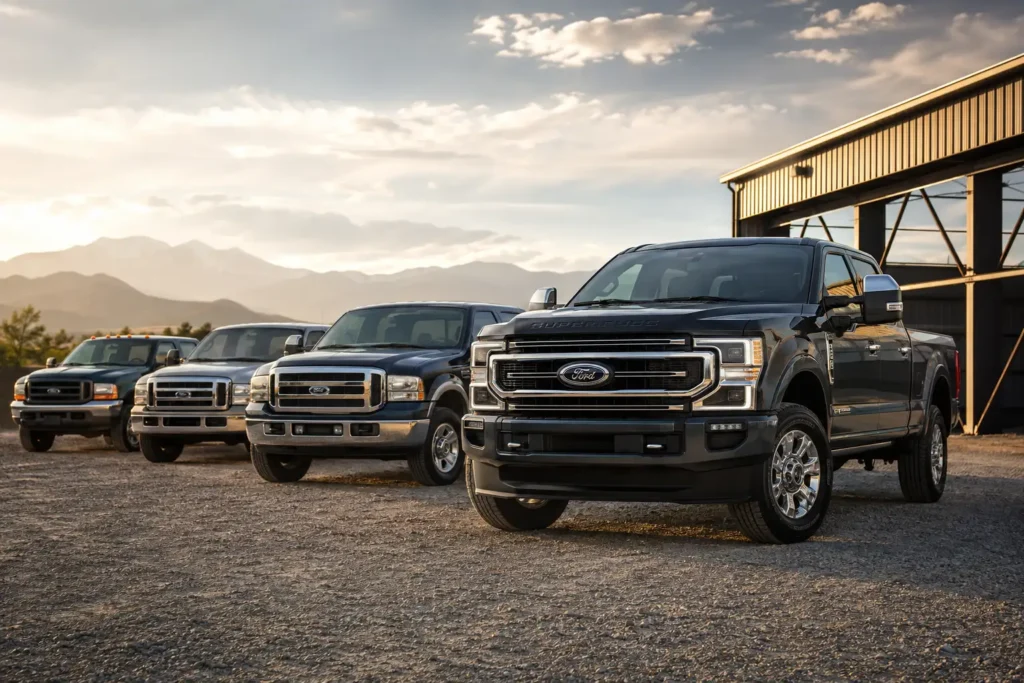
Ford’s diesel output rose from about 210 horsepower and 425 lb-ft in the early 7.3L era to 500 horsepower and 1,200 lb-ft with today’s High Output 6.7L. The numbers did not increase every year, and transition years such as 2003 and 2011 need extra context.
This guide focuses on F-Series and Super Duty pickup ratings. E-Series vans, F-650/F-750 medium-duty trucks, and chassis-cab models can use different calibrations.
Power Stroke Specs by Year 1994 to 2026
Four major Power Stroke generations took Ford Super Duty diesel output from roughly 210 horsepower and 425 lb-ft to 500 horsepower and 1,200 lb-ft.
Power Stroke Generation Timeline
Power Stroke Specs Chart by Year 1994 to 2026
Recommended Best Deal Products


The table below gives the quickest view of Ford Power Stroke horsepower and torque changes by model year.
| Model Year | Power Stroke Engine | Horsepower | Torque | Key Change |
|---|---|---|---|---|
| 1994.5-1995 | 7.3L Power Stroke V8 | 210 hp | 425 lb-ft | First Power Stroke F-Series application |
| 1996 | 7.3L Power Stroke V8 | 215 hp | 450 lb-ft | Revised calibration |
| 1997 | 7.3L Power Stroke V8 | 225 hp | 450 lb-ft | Final OBS F-250/F-350 model year |
| 1998 | 7.3L Power Stroke V8 | N/A* | N/A* | No conventional 1998 F-250/F-350 model year in this sequence |
| 1999-2000 | 7.3L Power Stroke V8 | 235 hp | 500 lb-ft | Super Duty generation begins |
| 2001 early automatic | 7.3L Power Stroke V8 | 250 hp | 505 lb-ft | Higher automatic output |
| 2001 early manual | 7.3L Power Stroke V8 | 235 hp | 500 lb-ft | Early manual calibration |
| 2001 late manual | 7.3L Power Stroke V8 | 275 hp | 520 lb-ft | Revised manual calibration |
| 2002 automatic | 7.3L Power Stroke V8 | 250 hp | 505 lb-ft | F-Series automatic |
| 2002 manual | 7.3L Power Stroke V8 | 275 hp | 520 lb-ft | F-Series manual |
| 2003 automatic | 7.3L Power Stroke V8 | 250 hp | 525 lb-ft | Final 7.3L model year |
| 2003 manual | 7.3L Power Stroke V8 | 275 hp | 520 lb-ft | Final manual 7.3L configuration |
| 2003-2004 | 6.0L Power Stroke V8 | 325 hp | 560 lb-ft | 6.0L introduced during 2003 |
| 2005-2007 | 6.0L Power Stroke V8 | 325 hp | 570 lb-ft | Torque increased by 10 lb-ft |
| 2008-2010 | 6.4L Power Stroke V8 | 350 hp | 650 lb-ft | Common-rail injection and twin sequential turbos |
| 2011 initial | 6.7L Power Stroke V8 | 390 hp | 735 lb-ft | First Ford-designed Power Stroke |
| 2011 updated-2014 | 6.7L Power Stroke V8 | 400 hp | 800 lb-ft | Ford PCM calibration update |
| 2015-2016 | 6.7L Power Stroke V8 | 440 hp | 860 lb-ft | Second-generation 6.7L upgrades |
| 2017 | 6.7L Power Stroke V8 | 440 hp | 925 lb-ft | Major torque increase |
| 2018-2019 | 6.7L Power Stroke V8 | 450 hp | 935 lb-ft | Revised fuel and boost calibration |
| 2020-2022 | 6.7L Power Stroke V8 | 475 hp | 1,050 lb-ft | 10-speed transmission era |
| 2023 | 6.7L Power Stroke V8 | 475 hp | 1,050 lb-ft | Standard-output engine continues |
| 2023 | 6.7L High Output Power Stroke V8 | 500 hp | 1,200 lb-ft | High Output version introduced |
| 2024-2025 | 6.7L Power Stroke V8 | 475 hp | 1,050 lb-ft | Standard-output rating |
| 2024-2025 | 6.7L High Output Power Stroke V8 | 500 hp | 1,200 lb-ft | High Output rating |
| 2026 | 6.7L Power Stroke V8 | 475 hp | 1,050 lb-ft | Standard 6.7L |
| 2026 | 6.7L High Output Power Stroke V8 | 500 hp | 1,200 lb-ft | Highest factory Power Stroke output |
*The 1998 transition requires care because Ford’s heavy-duty F-Series model-year sequence does not line up like the surrounding years. Historical published ratings also contain some discrepancies for 1996-1997, so the engine identification label remains the best source for a specific truck.
Ford currently rates the 2026 standard 6.7L Power Stroke V8 at 475 hp and 1,050 lb-ft, while the High Output version makes 500 hp and 1,200 lb-ft.
How Power Stroke Generations Changed Across 32 Years
Four main Power Stroke engine families account for the F-Series and Super Duty pickup timeline covered here.
| Engine | Pickup Years | Displacement | Injection System | Turbo Design |
|---|---|---|---|---|
| 7.3L Power Stroke V8 | 1994.5-2003 | 7.3L / 444 cu in | HEUI | Single fixed-geometry turbo |
| 6.0L Power Stroke V8 | 2003-2007 | 6.0L / 365 cu in | HEUI | Single variable-geometry turbo |
| 6.4L Power Stroke V8 | 2008-2010 | 6.4L / 390 cu in | High-pressure common rail | Twin sequential turbos |
| 6.7L Power Stroke V8 | 2011-2026 | 6.7L / 406 cu in | High-pressure common rail | Single turbo, design varies by generation |
HEUI means Hydraulic Electronic Unit Injection. The system uses high-pressure engine oil to operate the fuel injectors, rather than relying only on a conventional high-pressure fuel pump.
Ford moved away from HEUI with the 6.4L and continued using high-pressure common-rail injection when it developed the 6.7L in-house.
7.3L Power Stroke Specs From 1994 to 2003
Recommended Best Deal Products

The 7.3L Power Stroke V8 did not carry one horsepower rating throughout its production life. Ford changed calibrations, emissions configurations, and transmission-specific output several times.
1994 to 2000 Factory Ratings
The first 7.3L Power Stroke arrived during the 1994 model year with roughly 210 hp and 425 lb-ft. Output increased through the late 1990s, and the Super Duty version reached 235 hp and 500 lb-ft by 1999.
The 1996 and 1997 numbers deserve some caution because historical Ford-advertised ratings and surviving reference material do not always agree. Published figures commonly place these engines between 215 and 225 hp with roughly 425 to 450 lb-ft.
The 1999 Super Duty brought an intercooler, revised intake system, electric fuel supply, and other changes that separate it from the earlier OBS trucks.
2001 to 2003 Transmission Differences
Transmission choice became especially important after 2001. Early 2001 manual trucks remained around 235 hp, while later manual calibrations reached 275 hp and 520 lb-ft.
Automatic trucks generally stayed at 250 hp. For a deeper year-specific breakdown, see our 2001 7.3L Power Stroke specs.
The 2003 model year is another exception. Ford offered both the outgoing 7.3L and incoming 6.0L during the transition, so the model year alone does not identify the diesel under the hood.
Our dedicated 2003 7.3 Power Stroke specs guide covers that final 7.3L application in more detail.
7.3L Core Engine Specifications
| Specification | 7.3L Power Stroke |
|---|---|
| Configuration | 90-degree V8 |
| Displacement | 7.3L / 444 cu in |
| Bore | 4.11 inches |
| Stroke | 4.18 inches |
| Compression Ratio | 17.5:1 |
| Block Material | Cast iron |
| Head Material | Cast iron |
| Injection | Direct-injection HEUI |
| Valvetrain | OHV, 2 valves per cylinder |
| Turbo | Single fixed-geometry turbo |
| Intercooler | Added on later Super Duty applications |
Historical engine data lists a 4.11-inch bore, 4.18-inch stroke, 17.5:1 compression ratio, cast-iron block and heads, and HEUI direct injection.
6.0L Power Stroke Specs From 2003 to 2007
The 6.0L Power Stroke V8 raised Super Duty output to 325 hp when Ford introduced it during 2003.
Torque was rated at 560 lb-ft for 2003-2004 Super Duty applications and increased to 570 lb-ft for 2005-2007.
2003 Power Stroke Crossover
A 2003 Ford Super Duty can have either a 7.3L or 6.0L Power Stroke. Ford phased the 6.0L into production while remaining 7.3L inventory was still being installed.
That makes 2003 one of the most important years to verify through the VIN, underhood label, engine layout, or build information rather than assuming the engine from the registration year.
6.0L Core Engine Specifications
| Specification | 6.0L Power Stroke |
|---|---|
| Configuration | 90-degree V8 |
| Displacement | 6.0L / 365 cu in |
| Bore | 3.74 inches |
| Stroke | 4.134 inches |
| Compression Ratio | 18.0:1 |
| Block Material | Cast iron |
| Head Material | Cast iron |
| Injection | Second-generation HEUI |
| Valvetrain | OHV, 4 valves per cylinder |
| Turbo | Garrett variable-geometry turbo |
| Intercooler | Air-to-air |
The 6.0L retained hydraulically operated electronic injectors but added a variable-geometry turbocharger, which helped it build boost quickly across a wider engine-speed range.
6.4L Power Stroke Specs From 2008 to 2010
Ford used the 6.4L Power Stroke V8 for only three Super Duty model years, and its headline output stayed at 350 hp and 650 lb-ft throughout the run.
The engine represented a major technology change. It replaced HEUI with high-pressure common-rail fuel injection and used two sequential turbochargers instead of a single turbo.
6.4L Core Engine Specifications
| Specification | 6.4L Power Stroke |
|---|---|
| Configuration | 90-degree V8 |
| Displacement | 6.4L / 390 cu in |
| Bore | 3.87 inches |
| Stroke | 4.134 inches |
| Compression Ratio | 17.5:1 |
| Block Material | Cast iron |
| Head Material | Cast iron |
| Injection | High-pressure common rail |
| Valvetrain | OHV, 4 valves per cylinder |
| Turbo | Twin sequential turbochargers |
| Factory Output | 350 hp / 650 lb-ft |
The turbo arrangement combines a variable-geometry high-pressure turbo with a fixed-geometry low-pressure unit. The 6.4L was also the first Power Stroke pickup engine in this timeline equipped with a diesel particulate filter.
6.7L Power Stroke Specs From 2011 to 2026
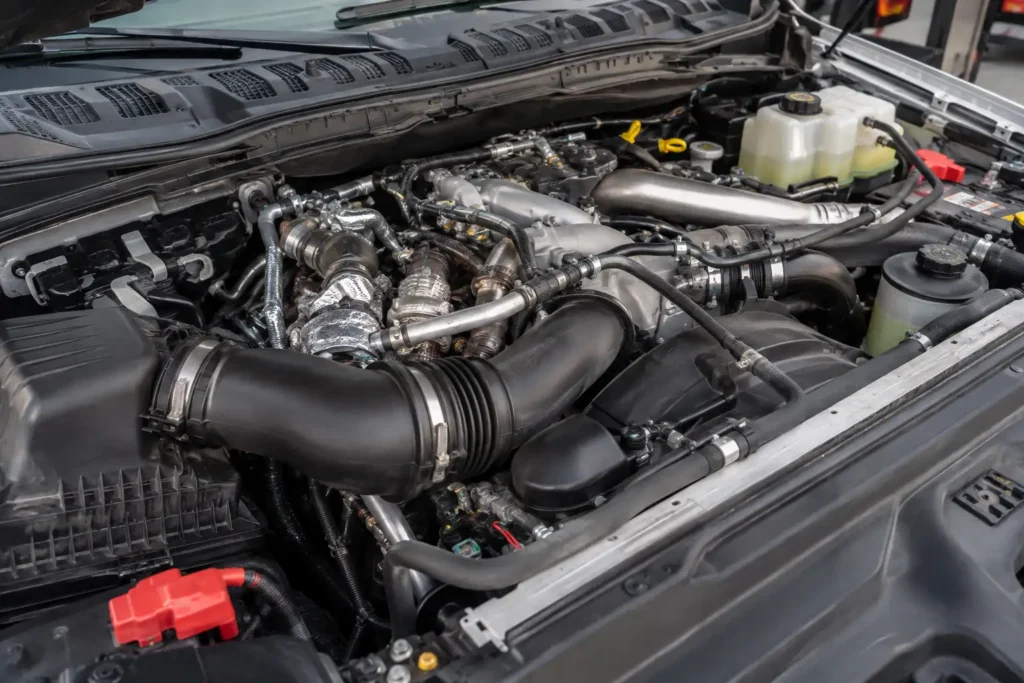
The 6.7L Power Stroke V8 has been in production much longer than the 6.0L or 6.4L, but its factory output changed repeatedly.
It was also the first Power Stroke pickup diesel designed and manufactured by Ford rather than supplied by International Navistar.
2011 to 2014 First Generation Output
Ford initially launched the 2011 engine at 390 hp and 735 lb-ft. Later in the same model year, an updated PCM calibration raised output to 400 hp and 800 lb-ft.
Ford made the new calibration available to qualifying early trucks through a dealer update. The 400 hp and 800 lb-ft rating then carried through 2014.
2015 to 2019 Power Increases
The 2015 update brought one of the first major jumps for the 6.7L, raising output to 440 hp and 860 lb-ft. Ford’s official 2015 Super Duty specifications confirm those figures.
Torque rose again to 925 lb-ft for 2017. Ford then upgraded the 2018 model to 450 hp and 935 lb-ft, an increase of 10 hp and 10 lb-ft over 2017.
2020 to 2022 Third Generation Output
For 2020, Ford raised the 6.7L Power Stroke to 475 hp and 1,050 lb-ft.
The updated engine also received major internal and fuel-system revisions, including higher injection pressure, stronger block and cylinder-head castings, steel pistons, and a lower compression ratio than the 2011-2019 version.
A 10-speed TorqShift automatic became part of the redesigned Super Duty powertrain package.
2023 to 2026 Standard and High Output
Ford introduced a second diesel choice for 2023.
The standard 6.7L remained at 475 hp and 1,050 lb-ft, while the new 6.7L High Output Power Stroke V8 produced 500 hp and 1,200 lb-ft. Ford’s 2023 launch material confirms both ratings.
For 2026, Ford still lists those same ratings. The standard engine produces 475 hp at 2,600 rpm and 1,050 lb-ft at 1,600 rpm. The High Output version makes 500 hp at 2,600 rpm and 1,200 lb-ft at 1,600 rpm.
6.7L Core Engine Specifications
| Specification | 6.7L Power Stroke |
|---|---|
| Configuration | 90-degree V8 |
| Displacement | 6.7L / 406 cu in |
| Bore | About 3.90 inches |
| Stroke | About 4.25 inches |
| Block Material | Compacted graphite iron |
| Head Material | Aluminum |
| Injection | High-pressure common rail |
| Valvetrain | OHV, 4 valves per cylinder |
| Charge Cooling | Water-cooled charge-air cooler |
| 2011-2019 Compression | 16.2:1 |
| 2020-2022 Compression | 15.8:1 |
| Current 2026 Compression | 15.2:1 |
Ford’s 2026 technical specifications list a 3.90-inch bore, 4.25-inch stroke, compacted graphite iron block, aluminum heads, four valves per cylinder, and a 15.2:1 compression ratio.
Which Power Stroke Years Made the Biggest Power Jumps
The raw numbers become more useful when you look at the years where Ford made meaningful changes.
- 1999 Super Duty: The 7.3L reached about 235 hp and 500 lb-ft as Ford introduced the heavier-duty Super Duty platform.
- Late 2001: Manual-transmission 7.3L trucks could reach 275 hp, making transmission choice important when comparing factory ratings.
- 2003: The new 6.0L jumped to 325 hp and 560 lb-ft while the 7.3L was being phased out.
- 2008: The 6.4L raised output to 350 hp and 650 lb-ft while introducing common-rail injection and sequential turbos.
- 2011: Ford’s first 6.7L launched at 390 hp and 735 lb-ft, then quickly moved to 400 hp and 800 lb-ft through an updated calibration.
- 2015: The second-generation 6.7L climbed to 440 hp and 860 lb-ft.
- 2017: Peak torque rose to 925 lb-ft without an increase in the 440 hp rating.
- 2020: Ford crossed the 1,000 lb-ft mark with 475 hp and 1,050 lb-ft.
- 2023: The High Output 6.7L reached 500 hp and 1,200 lb-ft.
Those gains explain why comparing two trucks that both say “6.7L Power Stroke” can still mean a difference of hundreds of pound-feet.
How to Identify Your Power Stroke by Model Year
Model year narrows the engine quickly, but transition years still need physical verification.
| Model Year | Most Likely Pickup Power Stroke |
|---|---|
| 1994.5-1997 | 7.3L Power Stroke V8 |
| 1999-2002 | 7.3L Power Stroke V8 |
| 2003 | 7.3L or 6.0L Power Stroke V8 |
| 2004-2007 | 6.0L Power Stroke V8 |
| 2008-2010 | 6.4L Power Stroke V8 |
| 2011-2022 | 6.7L Power Stroke V8 |
| 2023-2026 | Standard or High Output 6.7L Power Stroke V8 |
For a transition-year truck, check the VIN, engine information label, emissions label, and physical engine layout before ordering parts.
This matters most for 2003 and for 2023-and-newer trucks where standard and High Output 6.7L versions share the same displacement.
Power Stroke Specs That Matter Beyond Horsepower
Horsepower and torque are useful comparison numbers, but they do not describe the entire engine.
Displacement
The Power Stroke family moved from 7.3 liters to 6.0, 6.4, and finally 6.7 liters. Smaller displacement did not mean lower output because injection, airflow, turbocharging, and engine controls improved substantially.
Fuel Injection
The 7.3L and 6.0L use HEUI systems driven by high-pressure engine oil.
The 6.4L switched to high-pressure common-rail injection, and Ford continued that design philosophy with the 6.7L.
Turbocharger Design
The 7.3L uses a conventional fixed-geometry turbo. The 6.0L introduced a variable-geometry turbo, while the 6.4L used two sequential turbochargers.
The 6.7L returned to a single turbocharger arrangement, although the actual turbo design changed across its generations.
Compression Ratio
Compression ratios also changed. The 7.3L and 6.4L are listed at 17.5:1, while the 6.0L uses 18.0:1.
The 6.7L dropped from 16.2:1 in early trucks as Ford revised the engine for greater cylinder pressure, emissions control, and output.
Transmission Pairing
Late 7.3L trucks show why transmission pairing matters because manual and automatic versions could carry different factory engine ratings.
Modern Super Duty trucks use automatic transmissions, including the 10-speed TorqShift paired with current 6.7L diesels.
Factory engine torque is also not the same thing as a truck’s towing rating. Cab configuration, axle ratio, GVWR, GCWR, hitch type, drivetrain, and truck model all affect the trailer limit. Use our Ford towing capacity chart when you need towing numbers rather than engine output.
What the Power Stroke Specs Chart Shows
The Power Stroke specs chart by year shows how far Ford’s heavy-duty diesel lineup has progressed since the 1990s.
Early 7.3L trucks produced roughly 210 hp and 425 lb-ft. The 2026 High Output 6.7L Power Stroke produces 500 hp and 1,200 lb-ft, more than double the horsepower and nearly triple the torque.
The model year alone is usually enough to identify the engine family, but 2003, early 2011, and 2023-and-newer trucks deserve extra attention. Check the engine label and exact configuration before ordering parts or comparing specifications.
If you are deciding between old-school simplicity and modern output, our 7.3L vs 6.7L Power Stroke comparison explains where each generation makes more sense.
5 Common Questions About Power Stroke Specs
What Year Did Ford Start Using the Power Stroke
Ford introduced the 7.3L Power Stroke V8 during the 1994 model year, commonly referred to as 1994.5. It replaced the earlier 7.3L IDI diesel and brought direct injection with electronically controlled HEUI injectors.
What Year Did the 7.3L Power Stroke End
The 7.3L Power Stroke ended during the 2003 model year. Ford phased in the 6.0L Power Stroke during the same year, which means a 2003 Super Duty can have either engine.
Which Power Stroke Has the Most Factory Horsepower
The 6.7L High Output Power Stroke V8 has the highest factory horsepower in the pickup timeline covered here. Ford rates the 2026 version at 500 hp at 2,600 rpm.
Which Power Stroke Has the Most Factory Torque
The 6.7L High Output Power Stroke V8 also has the highest factory torque rating. Ford lists 1,200 lb-ft at 1,600 rpm for the 2026 Super Duty High Output diesel.
Did Every 2003 Ford Super Duty Use the 6.0L Power Stroke
No. Ford sold both the 7.3L and 6.0L Power Stroke during the 2003 transition. Check the VIN, engine label, or engine layout before using year-specific parts or service specifications.