Ram 1500 Third Brake Light Bulb Size: The Complete Guide 2026

The Center High-Mounted Stop Lamp (CHMSL), universally known as the third brake light, serves as a critical safety mechanism for light trucks. For owners and technicians servicing the Ram 1500 platform, understanding the precise ram 1500 third brake light bulb size requires navigating decades of generational shifts, the transition from halogen to light-emitting diode (LED) technology, and complex Central Body Controller (CBC) electrical architectures. Furthermore, this specific lighting assembly is the focal point of a well-documented engineering defect involving cab water intrusion.
This comprehensive research report details the exact CHMSL and cargo light bulb specifications across all Ram 1500 generations. The analysis explores technical retrofit parameters for high-output LEDs, permanent repair protocols for the infamous third brake light water leak, and in-depth diagnostic solutions for electrical faults.
Ram 1500 Third Brake Light
Bulb Size & Analytics
A comprehensive visual breakdown of the Center High Mount Stop Lamp (CHMSL) specifications, performance upgrade metrics, and critical failure points for Dodge Ram trucks.
The Core Metric: Quick Answer
For Dodge Ram 1500 models spanning from 1994 through 2018 (including Classic models up to 2023), the definitive bulb size for the entire CHMSL assembly remains unified.
⚡ Technical Specifications
🔍 Cross-Reference Data
If the 921 size is unavailable, the following wedge bulbs share the exact same base and fitment, varying only slightly in native halogen wattage:
Housing Anatomy & Composition
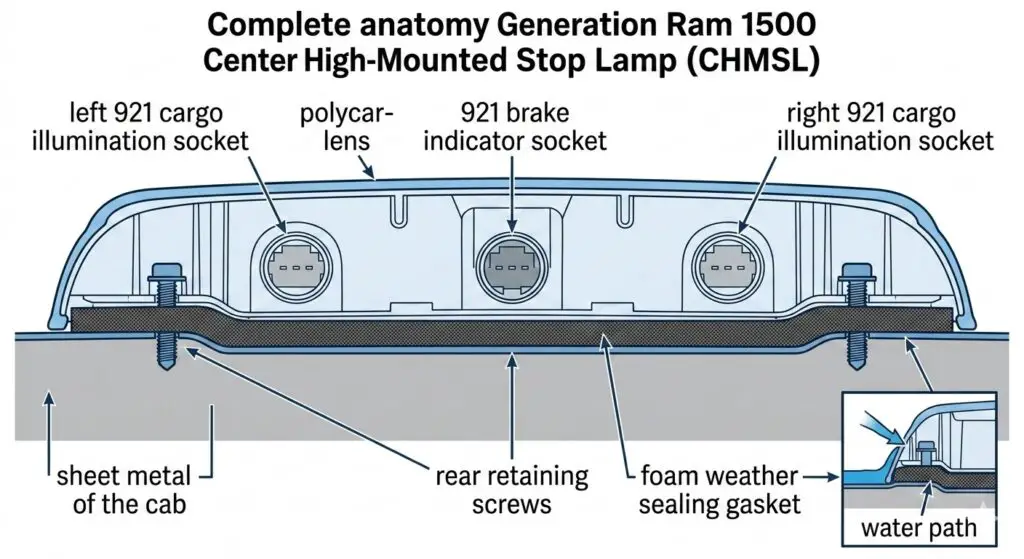
The standard Ram CHMSL utilizes a straightforward three-bulb architecture. A common misconception is that the center brake light requires a different bulb than the surrounding cargo lights. Data shows that Dodge standardized the 921 clear bulb across all three nodes.
The red coloration of the braking signal is achieved entirely through the polycarbonate lens optical filtering, not a colored filament.
Note for 5th Gen Owners: Starting in 2019, higher trim levels abandoned replaceable 921 bulbs in favor of a sealed, non-serviceable surface-mounted LED printed circuit board (PCB).
Structural Layout
Aftermarket Performance Analytics
Transitioning from OEM incandescent bulbs to solid-state LED replacements is the most statistically significant lighting upgrade for the Ram 1500. The following datasets illustrate the quantitative advantages across luminosity, longevity, and electrical efficiency.
☀ Luminous Flux Comparison
Measuring raw light output (Lumens) between factory and premium aftermarket solutions. Higher output drastically improves bed visibility.
Analysis: Premium LED configurations yield an average 222% increase in raw luminous flux compared to aging OEM halogens.
⏱️ Operational Lifespan
Expected hours of continuous operation before failure. Solid-state technology eliminates fragile filament breakage.
Analysis: LEDs possess a structural advantage against the harsh chassis vibrations of a pickup truck, extending functional life by a factor of 30x.
📊 Multi-Variable Efficiency Matrix
This radar visualization maps four critical performance vectors. While LEDs dominate in brightness, lifespan, and low power draw, their defining safety feature is Response Time.
-
✓
Instant Illumination: Incandescent bulbs require ~200 milliseconds to heat the filament. LEDs illuminate instantly.
-
✓
Stopping Distance: At 60 MPH, a 0.2-second faster brake light gives trailing drivers an extra 17.6 feet of reaction space.
-
!
CAN-Bus Dependency: Modern Rams require “Error-Free” LEDs with built-in resistors to prevent hyper-flashing due to the vastly reduced power draw.
The Infamous Cab Leak
If accessing the CHMSL to change a bulb, evaluating the factory housing gasket is mandatory. 3rd and 4th Generation Ram 1500s suffer from an exceptionally high failure rate of the OEM foam weather seal.
Ultraviolet degradation and cab torsion cause the thin foam to compress and fail. Water intrudes behind the housing, routing down the interior C-pillars, ultimately pooling beneath the rear seats or staining the headliner.
🔧 The Permanent Solution
Discard the OEM foam. Upgrade to an aftermarket Marine-Grade dense closed-cell silicone gasket. Never use liquid RTV silicone, as it fuses the housing to the cab, severely damaging paint during future bulb replacements.
Cross-Section Diagram (Simplified)
Standard Replacement Procedure
Hardware Removal
Locate the two exterior Phillips-head screws flanking the CHMSL lens. Use a #2 Phillips screwdriver. Maintain positive pressure to prevent cam-out and stripping the heads.
Housing Extraction
Gently pull the housing straight back. The old gasket may act as an adhesive. Do not use metal pry tools against the painted cab. Wiggle vertically to break the seal.
Polarity Testing (LEDs Only)
Twist the bulb sockets counter-clockwise to remove. Pull the old 921 straight out. Insert the new LED. Crucial: LEDs have polarity. Turn on the lights before reassembling. If a bulb fails to illuminate, unplug it, rotate it 180 degrees, and re-insert.
Surface Prep & Sealing
Thoroughly clean the cab sheet metal with isopropyl alcohol. Apply the new upgraded silicone gasket to the housing. Re-seat and tighten screws sequentially to ensure an even, watertight crush on the new seal.
Generational Bulb Size Matrix for Ram 1500
Automotive lighting is strictly dictated by the platform and trim level. Over five generations, the Ram 1500 has evolved from utilizing standard dual-filament incandescent bulbs to highly sophisticated, sealed LED arrays managed by the vehicle’s onboard computers. The following matrix details the exact OEM replacement bulb sizes for the primary CHMSL and the flanking cargo lights.
| Generation | Model Years | 3rd Brake Light Bulb Size | Cargo Light Bulb Size | OEM Lighting Technology | Assembly Serviceability |
| 5th Gen (Premium/Camera) | 2019–2026 | Integrated LED | Integrated LED | LED | Sealed Assembly (No Replaceable Bulbs) |
| 5th Gen (Base Trims) | 2019–2026 | 921 (912, T15) | 921 (912, T15) | Halogen | Replaceable Wedge Bulbs |
| 4th Gen | 2009–2018 | 921 (912, T15) | 921 (912, T15) | Halogen | Replaceable Wedge Bulbs |
| 3rd Gen | 2002–2008 | 921 (912, T15) | 921 (912, T15) | Halogen | Replaceable Wedge Bulbs |
| 2nd Gen | 1994–2001 | 921 (912, T15) | 921 (912, T15) | Halogen | Replaceable Wedge Bulbs |
| 1st Gen | 1981–1993 | 1157 | 1156 | Incandescent | Replaceable Bayonet Bulbs |
The 921 Wedge Era (1994–2018)
Spanning the second, third, and fourth generations of the Ram 1500, automotive engineers standardized the use of the 921 halogen bulb for all high-mounted rear lighting. Within these assemblies, the 921 bulb serves a dual purpose. The central socket houses the primary red-filtered brake indicator, while the two outer sockets house clear versions of the exact same 921 bulb to function as cargo bed illumination. Standard 921 bulbs push into a 10mm wedge base, making replacements straightforward across these model years.
Fifth Generation Dichotomy (2019–Present)
The current DT platform Ram 1500 introduces a strict structural divide based on vehicle trim. Base models, including the Tradesman and Big Horn, continue to utilize the traditional 921 halogen bulb setup for the CHMSL and cargo lights.
However, premium trims (Laramie, Limited, TRX) and models optioned with the digital rearview mirror or the integrated cargo bed camera feature a completely sealed, solid-state LED assembly. The diodes within these premium assemblies cannot be serviced individually. In the event of a diode failure or physical damage to the lens, the entire assembly unit—carrying Mopar part numbers such as 68298380AJ—must be replaced entirely.
Technical Specifications: Halogen vs. LED Upgrades
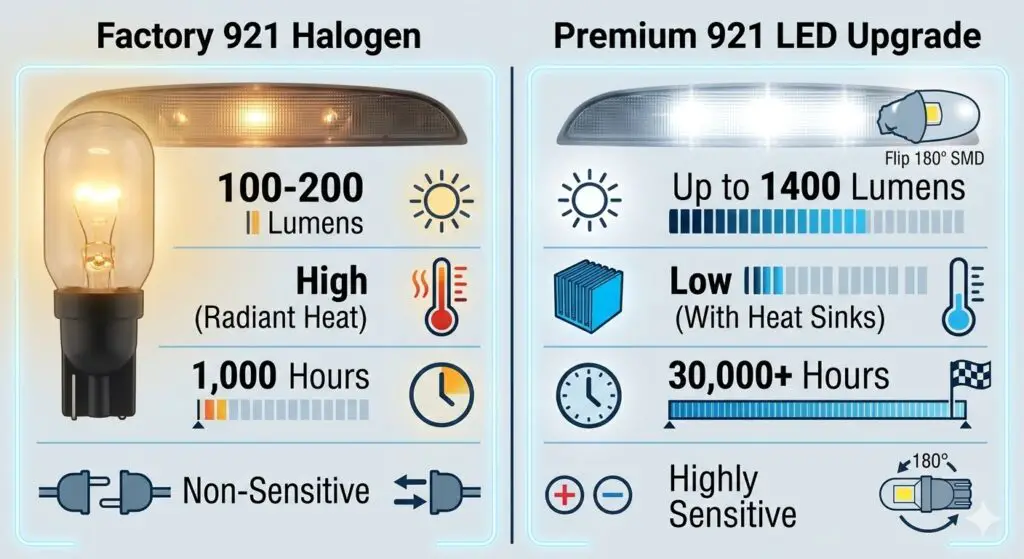
The continued reliance on halogen technology for base models presents notable bottlenecks regarding visibility, thermal management, and electrical efficiency. Factory 921 halogen bulbs operate via electrical resistance, generating significant heat while emitting a relatively dim 100 to 200 lumens of light. Because of these limitations, upgrading to modern LED equivalents is heavily advised for enhanced safety and cargo utility
| Specification Metric | Factory 921 Halogen | Premium 921 LED Upgrade | Operational Implication |
| Lumen Output | ~100 – 200 Lumens | Up to 1400 Lumens | LEDs provide drastically improved cargo bed visibility and brake warning distance. |
| Lifespan | ~1,000 Hours | ~30,000+ Hours | LEDs significantly outlast the vehicle’s functional lifespan. |
| Thermal Output | High (Radiant Heat) | Low (With Heat Sinks) | Halogens can eventually make housing plastic brittle; LEDs require aluminum heat sinks for internal diode protection. |
| Polarity Sensitivity | Non-Sensitive | Highly Sensitive | LEDs are diodes; if inserted backward, they will not illuminate and must be flipped 180 degrees. |
| Electrical Draw | High Amperage | Low Amperage | LEDs drastically reduce the load on the vehicle’s Central Body Controller. |
CANBUS Integration and the Central Body Controller
Modern Ram 1500s—particularly models manufactured from 2015 onward—feature highly sophisticated multiplexed electrical networks. Unlike older vehicles, the exterior lighting circuits do not utilize traditional localized fuses. Instead, power is directly supplied and monitored by the Central Body Controller (CBC).
The CBC continuously monitors the amperage load of the lighting circuits. If the load falls outside a predefined factory range, the computer assumes a fault. Because LEDs draw significantly less power than halogens, the CBC frequently interprets an LED upgrade as a “burnt-out” bulb, subsequently terminating power to the circuit and logging a Diagnostic Trouble Code (DTC). To bypass this issue, aftermarket LED replacements, such as those provided, must feature built-in CANBUS decoders or constant-current inductive circuitry to simulate the electrical resistance of a factory halogen bulb without requiring external wire-tap resistors.
The Ram Cab Water Intrusion Phenomenon
Beyond illumination specifications, the Ram 1500 CHMSL is universally notorious for a severe structural defect regarding weatherproofing. Across the third, fourth, and fifth generations, the third brake light assembly is highly susceptible to allowing catastrophic water intrusion directly into the truck’s cabin.
The intrusion typically manifests during heavy rainfall or high-pressure car washes. Water stains or general dampness appear on the rear headliner directly above the rear window glass. In severe cases, a “waterfall” effect occurs down the interior rear glass, leading to standing water pooling beneath the rear passenger seats, soaking the carpets, and causing premature corrosion of the 921 bulb sockets.
Engineering Root Cause Analysis
The factory OEM gasket supplied by the manufacturer is fabricated from a standard polyvinyl chloride (PVC) foam. Through the physics of automotive thermal cycling, the truck cab expands as it heats in the sun and contracts as it cools at night. Over multiple seasons, the PVC foam material “takes a set,” meaning it permanently compresses, loses its elastic memory, and shrinks away from the mating surfaces. Furthermore, Ram cab structures are manufactured with a slight stamped gap at the top edge of the CHMSL housing cutout, making the integrity of this specific gasket absolutely critical.
Permanent EPDM Seal Repair Solutions
Replacing the entire light assembly with a brand-new OEM unit only provides a temporary delay, as the newly supplied PVC gasket will inevitably suffer the exact same thermal degradation. Applying RTV silicone sealant around the housing is also highly discouraged by automotive technicians. Silicone creates a permanent bond that makes future bulb replacements practically impossible without shattering the polycarbonate housing.
The definitive engineering solution requires discarding the factory PVC seal and applying a custom-cut,.187-inch thick EPDM (Ethylene Propylene Diene Monomer) foam rubber gasket. EPDM is vastly superior to PVC in. It is worth noting that due to the sheer volume of failures, Fiat Chrysler Automobiles (now Stellantis) eventually issued an extended warranty bulletin covering the third brake light leak for specific 2019 to 2021 Ram models, though older models rely entirely on the aftermarket EPDM solution.
Procedural Protocol: Assembly Removal and Repair
Servicing the CHMSL—whether upgrading to LEDs, replacing a burnt halogen, or installing an upgraded EPDM weather gasket—requires minimal specialized equipment but demands adherence to specific torque and cleaning protocols to prevent damage to the polycarbonate housing.
| Repair Phase | Technical Protocol and Required Actions | Required Tooling |
| 1. Hardware Extraction | Locate the retaining fasteners on the exterior of the CHMSL housing. Depending on the generation, this involves either two or four external screws. Remove the screws carefully, maintaining downward pressure to prevent stripping the heads. | Phillips Head Screwdriver |
| 2. Assembly Separation | Pull the housing away from the exterior cab sheet metal. If the factory PVC gasket has degraded and adhered to the paint, gentle, evenly distributed leverage may be required to break the seal without snapping the plastic tabs. | Plastic Non-Marring Pry Tool |
| 3. Socket and Bulb Servicing | Twist the individual wiring harness bulb sockets counter-clockwise to unlock them from the plastic housing. Pull the spent halogen bulbs straight forward out of the wedge sockets. Insert the new 921 replacement bulbs. | None |
| 4. Circuit Polarity Testing | Before proceeding to reassembly, engage the vehicle’s accessory power and apply the brakes (or activate the interior cargo light switch). Verify all diodes illuminate. If an LED bulb remains dark, extract it, rotate the bulb 180 degrees to reverse the polarity, and reinsert. | Vehicle Ignition / Brake Pedal |
| 5. Surface Decontamination | If installing a new EPDM weather gasket, meticulously scrape all remnants of the old adhesive from the truck cab and the light housing. A perfectly clean, residue-free mating surface is mandatory to prevent future leaks. | Isopropyl Alcohol, Adhesive Remover (Goo Gone), Microfiber Towel |
| 6. Gasket Application and Reassembly | Apply the new single-sided adhesive gasket to the housing, starting from the bottom center and tracing the perimeter. Reinsert the bulb sockets and twist clockwise to lock. Seat the housing against the cab and thread the screws. Critical Warning: Fasteners must be tightened to light hand-torque only. Overtightening will instantly crack the plastic housing. | Phillips Head Screwdriver |
FAQs
To provide complete semantic authority on the subject of Ram 1500 high-mounted lighting, the following section addresses the most complex secondary inquiries and technical hurdles encountered during maintenance.
What is the precise difference between 921, 912, and 194 bulbs?
All three of these bulb classifications utilize the exact same 10mm miniature wedge base (industry designation W2.1×9.5d). Consequently, they will physically plug into the exact same wiring socket. The critical differences lie in the physical dimensions of the glass envelope and the electrical wattage draw. A 194 bulb features a tiny glass globe and draws minimal wattage, producing low lumen output suitable only for interior map lights or exterior license plate illumination. Conversely, the 921 bulb possesses a much larger glass globe and draws significantly higher wattage, producing the intense lumen output required for effective braking indication and cargo bed illumination. Installing a 194 bulb in a CHMSL socket will result in a dangerously inadequate light projection.
Are the cargo lights and the third brake light the exact same bulb?
Yes. In all Ram 1500 models equipped with replaceable halogen assemblies, the central brake indicator socket and the left and right cargo bed illuminator sockets utilize the identical 921 (also cross-referenced as 912 or T15) wedge-style bulb.
Where is the fuse for the Ram 1500 third brake light located?
Diagnostic procedures depend entirely on the vehicle’s generation. For fourth-generation models (specifically 2009 through 2014) and older iterations, traditional blade fuses are utilized. These are located in the Totally Integrated Power Module (TIPM) or the primary Power Distribution Center located within the engine bay. A blown fuse in this module will immediately disable the brake lights.
However, for late-model fourth-generation trucks (2015+) and all fifth-generation models, traditional fuses are eliminated for the exterior lighting. Power is regulated via solid-state drivers within the Central Body Controller. If a short is detected, the CBC disables the circuit digitally. Restoring functionality often requires rectifying the short and utilizing an OBD-II diagnostic scanner to clear the specific Central Body Controller fault codes.
Can a leaking third brake light short out the vehicle’s electrical system?
Yes, the consequences of a failed CHMSL gasket extend far beyond stained upholstery. Water intrusion from the roofline drips directly onto the rear headliner and travels downward through the structural C-pillars. This moisture routinely corrodes the wiring harnesses for the power sliding rear window, causes oxidation within the CHMSL bulb sockets, and can create localized electrical shorts. These shorts trigger the Central Body Controller’s self-preservation protocols, resulting in the computer entirely shutting down the rear lighting circuits until the moisture is removed and the module is reset.
![Ram 1500 Steering Wheel Cover Size: Specs & Fitment Guide [2026]](https://truckguider.com/wp-content/uploads/2026/03/ram-1500-steering-wheel-cover-size-featured-1.webp)

![2013 Ram 1500 Lug Pattern: Specs & Fitment Guide [2026]](https://truckguider.com/wp-content/uploads/2026/03/featured-f235e879-768x1024.webp)