2004 GMC Sierra Brake Line Diagram: Proper Routing 2026

The 2004 GMC Sierra brake line diagram details twin hydraulic circuits from the master cylinder down to the ABS module on the inner driver-side frame rail. Master cylinder feeds use 1/4-inch lines, splitting via five 3/16-inch lines: two front wheel calipers and a single rear feed splitting at the differential junction block.
📌 Key Takeaways
- Master cylinder to ABS module lines are 1/4-inch; lines running to wheels are 3/16-inch with metric flare nuts.
- The ABS/EBCM valve assembly is located along the inside of the driver-side frame rail under the cab.
- Standard tube nut torque spec is 14 to 18 lb-ft (19 to 25 Nm) to prevent thread stripping or hydraulic leakage.
- Severe corrosion along the driver-side mid-frame rail section is the most common catastrophic failure point.
- Automated ABS bleeding requires an OBD-II scan tool; major hydraulic line replacement demands advanced DIY or professional skills.
The hydraulic braking system on the 2004 GMC Sierra (GMT800 platform) utilizes a split, diagonal-biased or front/rear split configuration regulated through an electro-hydraulic control unit. Whether you are servicing a Sierra 1500, 2500HD, or Denali trim, tracing routing routes from the master cylinder down to the wheel calipers requires an exact understanding of component locations, fitting threads, and hydraulic pressure routing. This guide provides a complete mechanical breakdown of the factory brake line layout, fitting thread standards, diagnostic procedures for hydraulic failures, and installation specifications required to restore factory braking performance to OEM standards.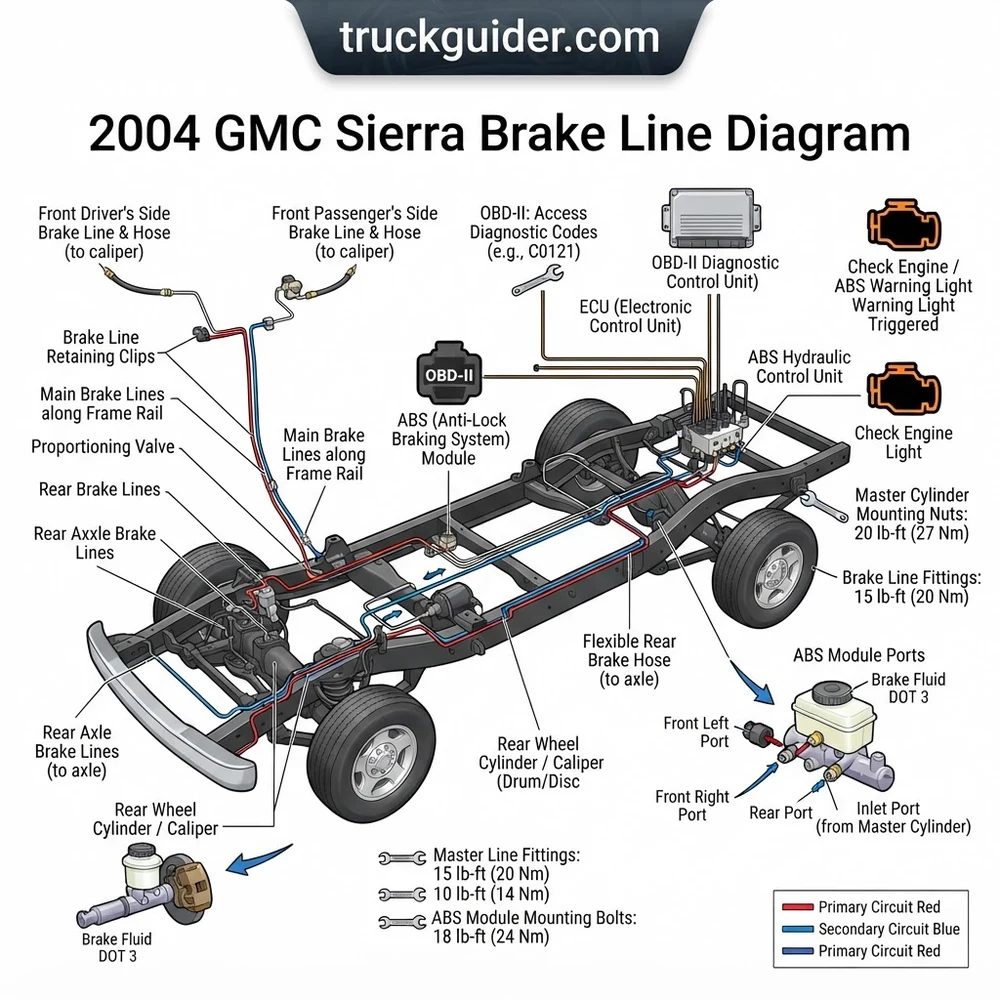
2004 GMC Sierra Brake Line Diagram and Circuit Layout


The primary hydraulic circuit on the 2004 GMC Sierra originates at the dual-reservoir brake master cylinder mounted to the vacuum brake booster or hydraulic Hydro-Boost unit (standard on 2500HD/3500 models and select 1500 packages). The master cylinder uses two outlet ports positioned on the engine-facing side of the casting: the forward port feeds the primary circuit (front brakes), while the rearward port supplies the secondary circuit (rear brakes). Both primary supply lines drop vertically down the inner driver-side engine bay, hugging the firewall and inner fender sheet metal before terminating at the Brake Pressure Modulator Valve (BPMV).


The BPMV is integrated with the Electronic Brake Control Module (EBCM) assembly, situated on the inside channel of the driver-side frame rail directly below the driver’s floor pan. As shown in the diagram above, this hydraulic distribution block serves as the central junction for the entire truck. The modulator contains internal solenoid valves that pulse hydraulic line pressure during an ABS event. Five separate hard lines connect to this block on four-wheel disc systems (or four-channel configurations): two inputs from the master cylinder and three distinct output circuits.
Master Cylinder to ABS Hydraulic Modulator (BPMV) Plumbing


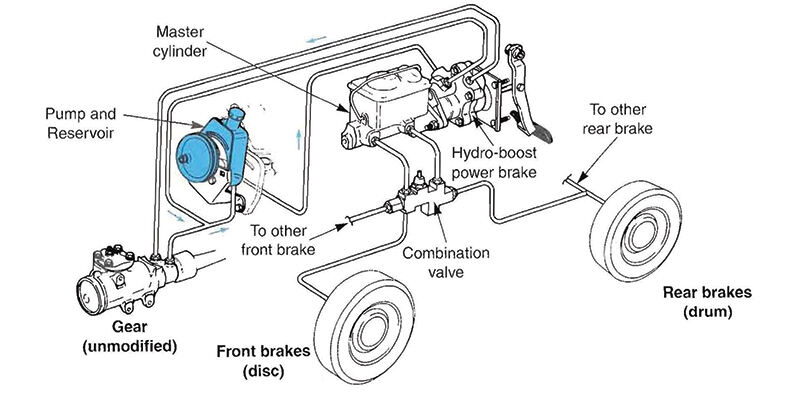
The two lines routed from the master cylinder to the ABS hydraulic modulator assembly handle full system operating pressures, frequently exceeding 1,500 PSI under panic-stop conditions. The primary feed line runs 1/4-inch outer diameter (OD) tubing, while the secondary circuit utilizes 1/4-inch tubing adapting down to vehicle-specific metric fittings. These lines route beneath the steering shaft and clear the exhaust manifold heat shields before threading into the top ports of the BPMV block. Maintaining original bend geometry here is critical to prevent contact with the steering intermediate shaft or engine components, where vibrational friction can chafe through the line walls.
Front Left and Right Hard Line Routing
The front left brake hard line is the shortest circuit on the chassis. It exits the front-facing port of the ABS BPMV, routes forward along the inside web of the driver-side frame rail, and terminates at a frame-mounted bracket. From this junction, a high-pressure rubber flex hose links the hard line to the front left single- or dual-piston brake caliper. Conversely, the front right brake hard line requires an extensive routing path. It exits the BPMV, travels forward along the driver-side frame rail, transitions into a crossmember cradle beneath the engine oil pan (passing adjacent to low-mounted accessories and steering linkages), and emerges on the passenger-side frame rail. From there, it follows the boxed frame section forward to the passenger-side wheelhouse bracket, adapting into the front right flexible caliper hose.
Intermediate Rear Brake Hard Line to Axle Junction
The intermediate rear brake line consists of a continuous 1/4-inch line originating from the dedicated rear outlet port on the ABS BPMV. It travels aft along the interior channel of the left frame rail, running directly between the chassis steel and the exterior wall of the primary fuel tank. This single supply line spans roughly 10 to 12 feet (depending on cab and bed configuration) before reaching the rear axle crossmember. At the frame-to-axle junction above the differential housing, the hard line threads into a frame-mounted tee-fitting block integrated into a flexible center axle drop hose. From the distribution block on the axle housing, two separate 3/16-inch hard lines branch outward along the axle tubes to feed the left and right rear wheel calipers.


On GMT800 platforms equipped with Traction Control (NW7) or StabiliTrak, the BPMV includes additional active-braking proportional valves. Verify the stamping code on the aluminum modulator block (typically stamped “KH” for Kelsey-Hayes or “Delphi”) before fabricating lines, as port indexing varies slightly between base ABS and dynamic stability configurations.
GMT800 Line Sizing, Fitting Flares, and Torque Specs


Fabricating or replacing lines on the 2004 GMC Sierra requires precision matching of tubing diameters, flare profiles, and thread pitches. General Motors mixed SAE and ISO standards across the GMT800 platform. Tubing connected to the master cylinder and ABS BPMV typically incorporates ISO metric bubble flares with metric thread tube nuts, whereas connections at the rear junction block and wheel cylinder/caliper flex line brackets transition between metric bubble and SAE inverted double flares.
Never intermix flare profiles. Installing an SAE 45-degree inverted double flare into an ISO metric bubble port prevents proper seating of the metal-to-metal sealing taper, creating an instant hydraulic leak path under system pressurization. The intermediate rear brake hard line running along the frame rail measures 1/4-inch OD to maintain adequate fluid volume transfer over long chassis spans, whereas the caliper branch lines step down to 3/16-inch OD to improve fluid line velocity and pedal responsiveness.
| Line Circuit Section | Tubing Outer Diameter | Fitting Thread Size & Type | Flare Style | Torque Spec |
|---|---|---|---|---|
| Master Cylinder to BPMV (Primary) | 1/4 in. (6.35 mm) | M12 x 1.0 Metric | ISO Bubble Flare | 15 lb-ft (20 Nm) |
| Master Cylinder to BPMV (Secondary) | 1/4 in. (6.35 mm) | M11 x 1.5 Metric | ISO Bubble Flare | 15 lb-ft (20 Nm) |
| BPMV to Front Left Caliper Hose | 3/16 in. (4.75 mm) | M10 x 1.0 Metric | ISO Bubble Flare | 13 lb-ft (17 Nm) |
| BPMV to Front Right Caliper Hose | 3/16 in. (4.75 mm) | M10 x 1.0 Metric | ISO Bubble Flare | 13 lb-ft (17 Nm) |
| BPMV to Intermediate Rear Line | 1/4 in. (6.35 mm) | M12 x 1.0 Metric | ISO Bubble Flare | 15 lb-ft (20 Nm) |
| Intermediate Line to Rear Drop Hose | 1/4 in. (6.35 mm) | 7/16-24 Threaded SAE | SAE Inverted Double | 14 lb-ft (19 Nm) |
| Rear Axle Hard Lines (Tee to Calipers) | 3/16 in. (4.75 mm) | 3/8-24 Threaded SAE | SAE Inverted Double | 13 lb-ft (17 Nm) |
| Caliper Banjo Bolts (Front & Rear) | N/A (Bolt M10x1.5) | M10 Copper Washers | Flat Face Seal | 30 lb-ft (40 Nm) |
When securing brake fittings into the aluminum housing of the ABS BPMV, observe the exact torque spec limits detailed above. Over-torquing steel tube nuts into cast aluminum strips the internal port threads, requiring complete replacement of the expensive hydraulic modulator unit.


Total length of the intermediate rear line on regular-cab short-bed configurations measures approximately 124 inches, while extended-cab and crew-cab long-bed variants can require up to 158 inches of continuous 1/4-inch hard line. Always verify overall chassis wheelbase before uncoiling replacement lines.
Common 2004 GMC Sierra Brake Line Diagram Failure Points


The 2004 GMC Sierra and its GMT800 platform counterparts are prone to localized corrosion failures within the factory hydraulic lines. General Motors fitted these trucks with copper-brazed, low-carbon steel tubing treated with an external terne-alloy or basic plastic coating. Over years of road exposure, this sacrificial outer layer flakes away, exposing the raw structural steel to road salts, road brine, and trapped debris.
The single most catastrophic failure zone on the 2004 Sierra is the intermediate line section running along the driver-side frame rail directly inboard of the fuel tank. Road debris, moisture, and road deicers accumulate on top of the fuel tank flanges and against the inner frame channel. Because this section cannot be visually inspected or washed without dropping the fuel tank, pinhole corrosion forms undetected. A sudden hard brake application creates sufficient hydraulic pressure (1,200 to 1,800 PSI) to rupture the compromised wall, resulting in complete failure of the secondary circuit and rapid pedal drop to the floor.
If the brake pedal sinks completely to the floorboard during travel, do not rely on pumping the brakes. Shift into neutral, apply steady pressure to the manual mechanical parking brake, and guide the vehicle safely onto the shoulder. Loss of hydraulic fluid in one half of the split circuit dramatically increases stopping distances.
A second severe failure point lies immediately forward of the ABS BPMV block. The lines make sharp radius 90-degree bends to route up to the master cylinder and forward to the front brakes. Road spray thrown off the front left tire directly blasts this exposed lower frame zone. Road grime packs tightly around the plastic mounting isolator clips, retaining road brine against the steel tubing. Over time, galvanic corrosion accelerates at the interface between the plastic clip retainers and the steel line surface.
Internal line degradation is equally problematic. Glycol-based DOT 3 and DOT 4 brake fluids are hygroscopic, absorbing ambient atmospheric moisture through rubber hoses and the master cylinder reservoir seal. If the brake fluid is not flushed every two years, water settles to the lowest points in the system: the ABS BPMV valve bores and the rear drop flex-hose junctions. This induces internal pitting corrosion that eats through the line from the inside out, masking wall thinning until catastrophic pressure rupture occurs.



Diagnosing Line Leaks and Reading OBD-II ABS Diagnostic Codes



Diagnosing hydraulic pressure loss or electrical faults in the braking network requires a two-phase workflow: locating physical line compromises and extracting electronic trouble codes stored within the electronic brake control module via the vehicle’s standard diagnostic link connector.
- Visual Hydraulic Fluid Trace and Isolation: Check the master cylinder plastic reservoir fluid level. If the forward chamber is dry while the rear remains full, the leak exists within the front caliper circuits or forward crossover line. If the rear chamber is empty, focus your inspection strictly on the intermediate rear line, the center axle drop hose, or the rear axle tubing branches. Look for wetness around the inside driver frame channel, wet road grime on the inner sidewalls of the tires, or dripping fluid under the fuel tank skid plates.
- Pressure Decay Testing: With the engine turned off, pump the brake pedal five times to deplete residual vacuum assist in the booster (or depressurize the Hydro-Boost accumulator). Apply heavy, sustained downward foot pressure (approx. 70 lbs) onto the pedal for 60 seconds. If the pedal steadily creeps downward toward the floor mats, a hydraulic leak is confirmed. If no external fluid drips are found around the hard lines or calipers, internal bypass leakage has developed across the primary and secondary piston seals inside the brake master cylinder casting.
- Interrogate the ABS ECU Module: Plug an OBD-II professional scan tool capable of bi-directional ABS communication into the 16-pin DLC port beneath the driver-side dashboard. While a standard powertrain diagnostic code reader only queries the main engine control module (ECM/PCM) for emissions issues, an ABS-capable scanner communicates directly with the ABS ECU over the Class 2 Serial Data bus. Extract all chassis (“C-series”) diagnostic trouble codes.
- Correlate Stored Diagnostic Codes with Mechanical Symptoms: Common trouble codes like C0265 or C0267 indicate an EBCM motor relay circuit failure or internal ground plane solder crack—a frequent GMT800 electronic issue. Codes spanning C0035 through C0050 identify wheel speed sensor circuit dropouts, which can cause uncommanded ABS activation at low speeds. If mechanical line failure caused hydraulic starvation during an ABS cycle, low-pressure or pump motor stall fault codes may store, triggering an instrument cluster brake warning light. Clear codes only after repairing the hydraulic line and completing an automated system bleed.
Replacement Line Options: NiCopp vs Pre-Bent Stainless Kits
Replacing rusted factory coated steel lines on a 2004 GMC Sierra demands durable materials that withstand harsh road environments. Two dominant aftermarket solutions exist: bulk Copper-Nickel alloy tubing (often sold as NiCopp or Cunifer) and pre-bent CNC-formed 304 Stainless Steel line kits.
| Line Material Category | Corrosion Resistance | Ease of Bending / Routing | Flaring Characteristics | Installation Labor Factor |
|---|---|---|---|---|
| OEM Coated Steel | Poor (4-8 year life in salt belt zones) | Moderate stiffness; requires mechanical tube benders | Requires heavy-duty hydraulic or leverage flaring tool | High; prone to premature rust reoccurrence |
| Copper-Nickel (NiCopp) | Exceptional (virtually immune to road salt rust) | High; easily hand-bent without kinking tight radii | Soft metal forms leak-free flares effortlessly | Lowest; can be snaked past the fuel tank without dropping it |
| Pre-Bent 304 Stainless | Maximum (permanent corrosion proofing) | Zero malleability; factory pre-formed paths | Pre-flared; extremely difficult to re-flare if cut | High; requiring cab lifting or dropping fuel tank & exhaust |
NiCopp (90% copper, 10% nickel alloy) is the preferred choice for mobile repair technicians and DIYers working on jack stands. Its metallurgical flexibility allows you to snake the long intermediate rear line over the frame rail brackets and past the fuel tank without removing the truck bed or dropping the tank assembly. It forms precise ISO bubble and SAE inverted flares with standard hand flaring tools without splitting the flare lip.
Conversely, pre-bent 304 stainless steel line kits replicate exact OEM line routing geometries with rigid, pre-flared ends and factory tube nuts. However, because stainless tubing is completely unyielding, installing the intermediate rear line or front crossover line requires significant vehicle disassembly—often including unbolting the truck bed, dropping the fuel tank, or lifting the cab off the frame mounts to slide the pre-formed lines into position.
2004 GMC Sierra Brake Line Diagram Diagnostic FAQ
Can an ABS hydraulic leak trigger a check engine light or OBD-II code?


A hydraulic line rupture does not illuminate the standard emissions-related check engine light on the instrument cluster, nor will it post generic P-codes (powertrain codes) readable by basic engine scanners. Instead, hydraulic pressure loss trips the dedicated red “BRAKE” warning indicator light via the fluid level sensor in the master cylinder reservoir. Additionally, if the ABS pump cycles and cannot build fluid pressure, the electronic brake control module (EBCM) illuminates the amber “ABS” dashboard lamp and logs a chassis diagnostic code (such as C0267 for pump motor open or C0281 for brake switch circuit) accessible only with an ABS-compatible scan tool.
Why does engine oil pressure or coolant flow troubleshooting coincide with brake line work?
On GMT800 platform trucks, severe under-chassis corrosion that destroys the brake hard lines frequently degrades adjacent fluid systems simultaneously. The transmission cooler lines, low-pressure power steering return lines, and auxiliary engine oil cooler lines route parallel to the front brake lines along the engine crossmember. Similarly, heater core metal delivery tubes carrying pressurized coolant flow rust through in identical salt-trap zones. When hoisting the chassis to inspect the brake line diagram, mechanics routinely discover weeping engine oil cooler connections and corroded structural hardware, making comprehensive fluid line assessment imperative during service.
What is the factory torque spec for GMT800 brake tube nuts?
Factory service manual torque specifications dictate tightening M10x1.0 and 3/8-24 tube nuts into calipers and wheel cylinders to 13 lb-ft (17 Nm). The larger M11x1.5 and M12x1.0 metric tube nuts securing into the aluminum housing of the ABS BPMV and the master cylinder body require 15 lb-ft (20 Nm). Caliper banjo bolts on both front and rear disc brake calipers require 30 lb-ft (40 Nm) with new copper crush washers installed on both sides of the flex hose fitting. Never apply anti-seize compound to flare line threads, as thread lubrication falsely skews applied torque values and risks hydraulic fluid contamination.
How does bleeding the 2004 Sierra ABS BPMV differ from standard bleeding?
Standard manual pedal pumping or basic vacuum bleeding cannot evacuate air trapped within the secondary accumulator bores and internal solenoid chambers of the ABS BPMV if the system ran completely dry from a ruptured line. Purging air out of these internal valve pathways requires connecting an advanced OBD-II scan tool capable of performing a “Brake Bleed / Automated Bleed” function. During this software routine, the scanner commands the ABS ECU to cycle each proportional valve and spin the return pump motor for several seconds per wheel corner. This action forces trapped micro-air bubbles into the main hard lines, allowing them to be pushed out through the caliper bleeder screws.
Is it safe to splice new line segments into original factory coated steel lines?


Compression fittings sold in hardware stores must never be used on automotive hydraulic brake lines under any circumstances. Compression sleeves cannot safely hold the 1,500+ PSI generated during emergency braking stops and will blow apart under load. The only approved method for splicing brake line tubing is using an SAE/ISO rated threaded hydraulic brass or steel union coupled with properly flared line ends (either dual SAE 45-degree inverted flares or matching ISO bubble flares). However, if an original 2004 Sierra steel line has rusted thin enough to develop a pinhole in one location, the remainder of the line along the frame rail is equally compromised, making complete end-to-end line replacement the only safe, professional repair practice.
Step-by-Step Guide to Understanding the 2004 Gmc Sierra Brake Line Diagram
Identify – Match each hard line on the vehicle against the diagram, differentiating 1/4-inch master cylinder feeds from 3/16-inch delivery circuits.
Locate – Find the ABS hydraulic control unit on the driver-side inner frame rail, labeling ports LF, RF, and Rear prior to disassembly.
Reference – Trace routing passages along the inner chassis rails using the diagram to determine line standoff clip and heat shield positioning.
Connect/Route – Route pre-formed or hand-bent lines through frame channels, threading flare nuts by hand before torquing to the 14-18 lb-ft spec.
Verify – Connect an OBD-II scan tool to run the automated ABS bleed routine, clearing any diagnostic code or check engine light related to pressure faults.
Troubleshoot – Inspect every union and flare under continuous pedal pressure to detect seeping fluid, re-torquing fittings or re-flaring damaged lines if pressure drops.