2016 Ram 1500 Towing Capacity Chart: Engine, Cab, And Axle Ratio Specifications

Determining the exact towing capacity of a 2016 Ram 1500 is not as simple as looking at a single number, as it involves a complex interplay of engine torque, axle ratios, and frame configurations. Many owners risk mechanical failure or safety hazards by assuming a universal towing limit, unaware that two seemingly identical trucks can have capacities differing by over 6,000 lbs. Whether you are hauling a weekend camper or heavy equipment, understanding the specific DNA of your vehicle is the difference between a smooth journey and a costly transmission rebuild. This comprehensive guide provides a professional breakdown of the 2016 Ram 1500 towing capacity chart, helping you identify your specific truck’s limits through engine data, cab configurations, and axle specifications.


Section 1: Essential Towing Terminology for 2016 Ram 1500 Owners
To interpret a complete guide on towing, one must first master the language of weight ratings. In my 15 years of industry experience, the most frequent mistake I see is owners focusing solely on the “Towing Capacity” while ignoring the Gross Combined Weight Rating (GCWR). The GCWR is the absolute ceiling: the maximum permissible weight of the truck, the trailer, all passengers, fuel, and cargo combined. For the 2016 Ram 1500, the GCWR can reach up to 15,950 lbs, but this is highly dependent on the powertrain.
Another critical distinction is between towing capacity and payload capacity. Payload is the weight your truck carries in the cab and bed, including the “tongue weight” of the trailer. Many drivers assume that if their truck can tow 9,000 lbs, they can also fill the bed with 1,500 lbs of gravel and seat four large adults. In reality, the tongue weight (typically 10-15% of the trailer weight) counts directly against your payload. If your trailer weighs 8,000 lbs, its 800-lb tongue weight may already consume 60% of your available payload, leaving very little room for passengers or gear.
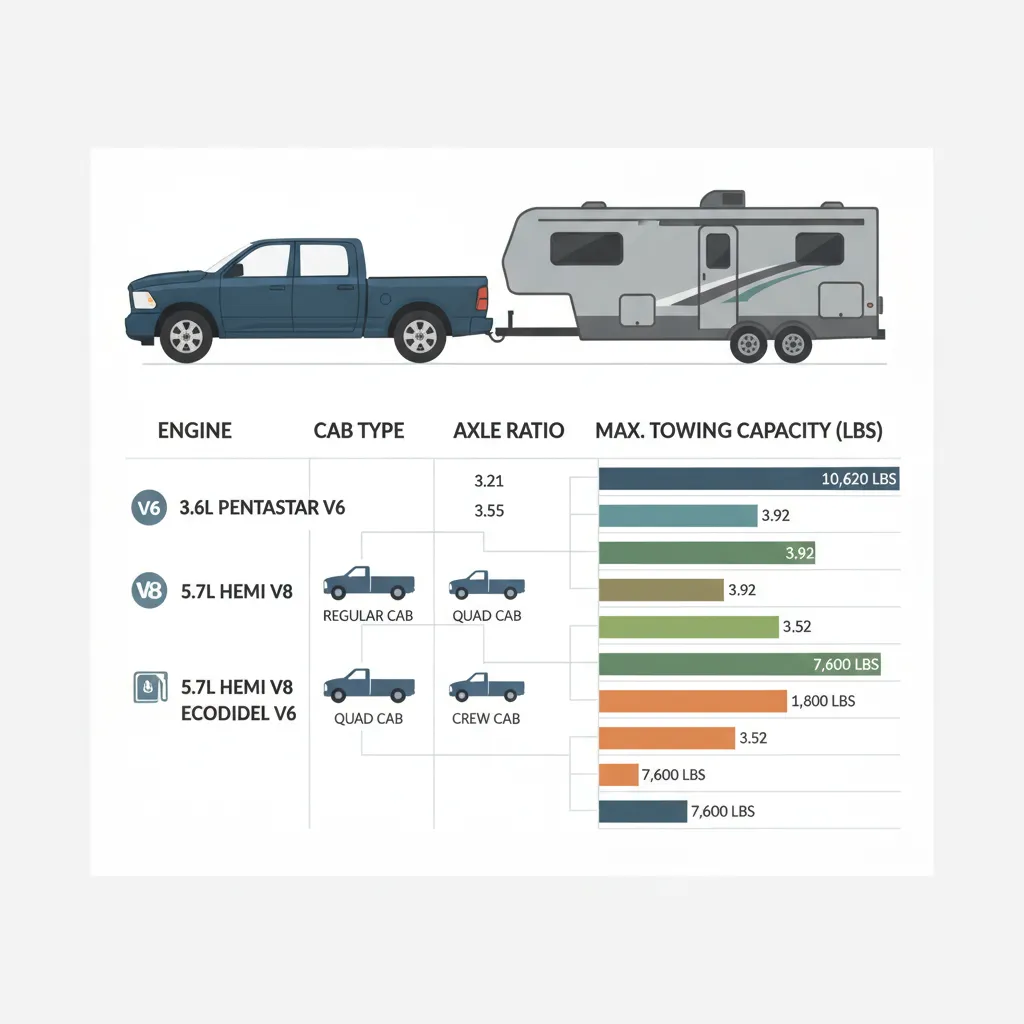
The axle ratio (3.21, 3.55, or 3.92) is essentially a torque multiplier. A 3.92 ratio allows the engine to spin more times for every revolution of the tires, providing the mechanical leverage needed to move heavy loads from a standstill. Choosing the 3.21 ratio might improve highway fuel economy, but it significantly penalizes your maximum towing capacity.
Section 2: 2016 Ram 1500 Towing Capacity Chart by Engine and Configuration
The 2016 Ram 1500 offers three distinct engine platforms, each serving a different profile of truck owner. Research indicates that engine choice is the single largest factor in determining your towing ceiling. According to the official guide, the range is vast, making it trusted and necessary to verify your specific VIN.
3.6L Pentastar V6: The Efficiency Specialist
While the Pentastar V6 is a marvel of efficiency, it represents the entry-level of the towing spectrum. Typically, these models have the lowest towing capacity, ranging from 4,230 lbs to 7,610 lbs. These trucks are ideal for small utility trailers, jet skis, or light pop-up campers. They almost exclusively utilize the 3.21 or 3.55 axle ratios.
5.7L HEMI V8: The Towing Workhorse
For those requiring reliable, high-capacity performance, the 5.7L HEMI V8 is the industry standard. When properly equipped with the 3.92 axle ratio, this engine reaches the 2016 Ram 1500’s maximum towing capacity of 10,650 lbs. It is important to note that opting for the 3.21 ratio with this V8 can drop the max capacity down to approximately 8,000 lbs, highlighting how hardware choices matter as much as engine displacement.
3.0L EcoDiesel V6: The Torque King
The EcoDiesel is a unique proposition, offering massive low-end torque (420 lb-ft) for effortless pulling. Statistics from Edmunds review data show the EcoDiesel typically offers a towing range between 7,000 and 9,200 lbs. It provides a professional balance of towing prowess and long-range fuel economy.




Section 3: Analyzing the Impact of Cab Size and Bed Length on Towing
The physical architecture of the 2016 Ram 1500 dictates its towing potential. While a Crew Cab offers the luxury of space, it comes at a “weight cost.” Adding a Crew Cab and 4WD system can increase the truck’s curb weight by over 500 lbs compared to a base Regular Cab 2WD model. Since the GCWR remains constant for a specific engine/axle combo, every pound added to the truck’s frame is a pound subtracted from its maximum trailer weight.
However, quality towing is about more than just raw numbers; it is about stability. A longer wheelbase—found in Crew Cab configurations with the 6’4″ bed—provides superior straight-line stability. In crosswinds or when being passed by large semi-trucks, the 149-inch wheelbase models exhibit significantly less “yaw” or wagging compared to the shorter 120-inch wheelbase Regular Cab models. This is a nuanced trade-off: you might lose 300 lbs of raw capacity but gain a much more relaxed driving experience on the highway.
By The Numbers
Max Towing (lbs)
Max GCWR (lbs)
EcoDiesel Max (lbs)
Section 4: Selecting the Right Hitch and Weight Distribution System
To safely access the high-end limits of the 2016 Ram 1500, you must utilize professional-grade hardware. For any trailer exceeding 5,000 lbs, Ram explicitly recommends the use of a Weight Distribution Hitch (WDH). Without a WDH, heavy tongue weight can compress the rear suspension of the Ram, causing the front tires to lose contact pressure. This leads to vague steering, poor braking performance, and dangerous headlight aim.
Managing tongue weight is an expert skill. You should aim for 10% to 15% of the total trailer weight to be focused on the hitch ball. For a 10,000-lb trailer, that is 1,000 to 1,500 lbs of downward force. If your tongue weight is too low, the trailer will sway; if it is too high, you will exceed your truck’s payload capacity and rear axle weight rating. Always ensure your 2016 Ram is equipped with a Class IV receiver hitch, which is standard on most higher trims but may be an upgrade on base models.
📋
Pre-Towing Hardware Checklist
Check for any cracks in the welds or excessive rust. Ensure the hitch pin and hair-pin clip are made of high-grade steel.
Use the integrated trailer brake controller in the Ram cab to set the ‘Gain’ according to the trailer’s weight, ensuring the trailer brakes engage smoothly with the truck.


Section 5: Safety Protocols and Maintenance for High-Capacity Towing
Operating a truck at its mechanical limit requires a higher standard of maintenance. The 5.7L HEMI, paired with the TorqueFlite 8-speed transmission, uses an active thermal management system to keep fluid temperatures in the optimal range. However, frequent heavy towing can accelerate fluid degradation. For expert tips on long-term truck health, visit Ram specs discussions among veteran owners.
When descending a steep grade, never rely solely on your wheel brakes. Use the “Tow/Haul” mode, which recalibrates the transmission to downshift sooner and hold gears longer, providing essential engine braking. This prevents “brake fade,” a condition where overheated brake pads lose their friction capabilities. Furthermore, always check your Tire Pressure Monitoring System (TPMS). When towing a heavy trailer, you should often inflate the rear tires to the “Cold Max” pressure indicated on the door jamb sticker (not the pressure listed on the tire sidewall) to support the increased vertical load.
Air Suspension Advantage
Models with the optional four-corner air suspension can automatically level the truck, maintaining a consistent ride height even when fully loaded.
Cooling Upgrades
Towing packages often include heavy-duty cooling for both the engine and transmission, vital for hot-weather hauling.
General charts are helpful, but the sticker on your specific driver’s side doorjamb contains the exact weights for your truck as it left the factory. Never exceed the GVWR or GAWR (Gross Axle Weight Rating) listed on that sticker.
In summary, the 2016 Ram 1500 is a highly versatile platform with towing capacities ranging from 4,230 to 10,650 lbs. Achieving the maximum rating requires the 5.7L HEMI V8 and the 3.92 axle ratio, but safe towing also demands careful consideration of cab size, bed length, and payload. Always utilize a weight-distributing hitch for loads over 5,000 lbs and maintain strict adherence to your vehicle’s GCWR. Before hitching your trailer, verify your truck’s specific equipment by checking the door jamb sticker or using a VIN decoder to ensure you are operating within safe mechanical limits.
Frequently Asked Questions
What is the max towing capacity of a 2016 Ram 1500 with a 5.7 HEMI?
The 2016 Ram 1500 equipped with the 5.7L HEMI V8 engine can tow a maximum of 10,650 lbs. This peak capacity is achieved in the Regular Cab 2WD configuration with a 6’4″ bed and a 3.92 axle ratio. Other HEMI configurations, especially those with a 3.21 axle ratio or heavier Crew Cab bodies, will have lower maximum ratings, typically ranging between 8,000 and 9,000 lbs.


How do I find the axle ratio of my 2016 Ram 1500?
You can find your axle ratio by inspecting the original window sticker (Monroney label) or by looking for a small metal tag attached to the differential housing on the rear axle. Alternatively, you can use a professional VIN decoder or the Mopar Owner’s Site; by entering your VIN, you can generate a ‘Build Sheet’ which lists the specific axle ratio installed at the factory.
Can a 2016 Ram 1500 with a V6 engine tow a travel trailer?
Yes, but with limitations. The 3.6L Pentastar V6 has a towing capacity ranging from 4,230 to 7,610 lbs. While this is sufficient for smaller, lightweight travel trailers or pop-up campers, it may struggle with large, multi-slide trailers. Always check the ‘Dry Weight’ and ‘GVWR’ of your trailer to ensure it falls well within the truck’s specific capacity, keeping in mind that cargo and water add significant weight.
What is the difference between towing capacity and payload on a Ram 1500?
Towing capacity is the maximum weight the truck can pull behind it, while payload is the maximum weight the truck can carry in its cabin and bed. Crucially, the ‘tongue weight’ of your trailer (usually 10-15% of the trailer weight) counts as part of your payload. If your trailer has a 800 lb tongue weight, you must subtract that from your total payload capacity to see how much weight remains for passengers and gear.
Is the EcoDiesel better for towing than the HEMI?
The ‘better’ engine depends on your priorities. The 3.0L EcoDiesel offers superior fuel efficiency and high low-end torque (420 lb-ft), making it excellent for steady, long-distance towing of loads up to 9,200 lbs. However, the 5.7L HEMI V8 offers a higher absolute maximum towing capacity (10,650 lbs) and more horsepower for merging and passing, though it consumes more fuel under load.