
2019 Ram 1500 Oil Capacity Guide: Classic vs. New Body 2026

The 2019 model year represents a highly complex transition period for the Ram 1500 platform. During this production cycle, the manufacturer introduced the completely redesigned fifth-generation (DT) body style while simultaneously manufacturing the outgoing fourth-generation chassis, marketed as the “Ram 1500 Classic” (DS).
This generational overlap created a highly fragmented maintenance landscape, particularly regarding fluid specifications and engine lubrication architecture. Determining the correct 2019 Ram 1500 oil capacity, viscosity grade, and filter application requires first identifying the exact chassis generation and the specific engine configuration equipped.


A failure to distinguish between the legacy powertrains of the Classic (DS) and the upgraded internal architectures of the New Body Style (DT) frequently results in improper lubrication, leading to overfilled crankcases, oil starvation, and destructive valvetrain wear. This exhaustive report synthesizes official manufacturer service data, technical service bulletins (TSBs), and mechanical diagnostics to provide an authoritative breakdown of oil capacities, OEM filter part numbers, torque specifications, and critical maintenance nuances for every 2019 Ram 1500 variant.
Don’t Kill Your Engine.
Know Your Model.
2019 was a unique year for Ram. They sold two distinct trucks side-by-side: the New Body Style (DT) and the Classic (DS). While the V8 engines share specs, the V6 engines have different oil capacities. Getting this wrong can lead to overfilling or oil starvation.
CRITICAL CHECK:
Does your truck have a 6-lug wheel pattern (New Body) or 5-lug (Classic)? Always confirm before pouring.
Standard Capacity (5.7L HEMI)
Engine Oil Capacity by Model Type
The chart below illustrates the exact oil capacity (with filter change) for the primary engine options. Note the crucial difference in the 3.6L V6 engine between the New Body and Classic models.
5.7L HEMI V8
7.0 qt
Consistent across New & Classic models.
3.6L V6 (New Body)
5.0 qt
Significantly less than the Classic.
3.6L V6 (Classic)
6.0 qt
Older oil pan design requires more oil.
Oil Viscosity Recommendations
Using the correct weight is essential for the Multi-Displacement System (MDS) in V8s and the eTorque system in newer V6s.
5W-20: Recommended for all 5.7L HEMI V8s and 3.6L V6 (Classic).


0W-20: Recommended for 3.6L V6 (New Body / eTorque).
Maintenance & Filter Specs
Ram uses an intelligent Oil Life Monitor, but strict intervals apply to ensure warranty compliance.
Never exceed 10k miles or 12 months.
Towing, off-road, or extensive idling.
Oil Filter Part Numbers (MOPAR)
Resetting the System
Performed your own change? You must reset the Oil Life Monitor to keep tracking accurate.
Turn ignition to RUN (do not start engine).
Fully depress gas pedal 3 times within 10 seconds.
Turn ignition OFF, then start engine to verify.
Master Engine Oil Capacity and Viscosity Matrix
The following data table outlines the foundational oil capacity and viscosity requirements across all 2019 Ram 1500 engine configurations, factoring in both the Classic (DS) and New Body Style (DT) architectures.
| Engine Configuration | Chassis / Body Style | Total Capacity (w/ Filter) | Recommended Viscosity | OEM Oil Specification |
| 3.6L Pentastar V6 | Classic (DS) | 5.9 Quarts (5.6 Liters) | SAE 5W-20 or 0W-20 | Chrysler MS-6395 |
| 3.6L Pentastar V6 (Upgrade) | New Body Style (DT) | 5.0 Quarts (4.7 Liters) | SAE 0W-20 | Chrysler MS-6395 |
| 5.7L HEMI V8 (incl. eTorque) | Both (DS & DT) | 7.0 Quarts (6.6 Liters) | SAE 5W-20 | Chrysler MS-6395 |
| 3.0L EcoDiesel V6 (Gen 2) | Classic (DS) | 10.5 Quarts (9.9 Liters) | SAE 5W-40 Synthetic | Chrysler MS-10902 |
The 3.6L Pentastar V6 Generational Divide
The most pervasive maintenance error surrounding the 2019 Ram 1500 involves the 3.6L Pentastar V6 engine. Because two entirely different truck architectures were sold in 2019 under the 1500 badge, the V6 engine’s internal oil capacity varies drastically depending on the specific model. For every model year from 2002 to 2026, see our Ram 1500 oil capacity chart by year.
The 2019 Ram 1500 Classic (DS) utilizes the legacy 3.6L Pentastar engine block. This older architecture requires approximately 5.9 to 6.0 quarts of oil during a standard service that includes a filter replacement. Conversely, the 2019 Ram 1500 New Body Style (DT) is equipped with the “Pentastar Upgrade” engine. To accommodate new packaging constraints within the redesigned engine bay and to optimize thermal efficiency, engineers redesigned the lower crankcase and equipped the upgraded engine with a significantly smaller oil pan. Consequently, the upgraded 3.6L Pentastar in the DT chassis dictates a precise 5.0-quart oil capacity.
Furthermore, the mechanical design of the upgraded DT Pentastar introduces a secondary variable that routinely confounds both amateur and professional technicians. The updated engine features Variable Valve Lift (VVL) solenoids integrated into the front of each valve cover, along with an added Exhaust Gas Recirculation (EGR) cooler mounted directly to the cylinder head. These complex internal modifications result in a substantially slower oil drain-back rate compared to the legacy Pentastar engine.
According to an official(https://static.nhtsa.gov/odi/tsbs/2019/MC-10166589-9999.pdf), checking the oil dipstick immediately after filling the upgraded 5.0-quart system will often yield a false low reading because the high-viscosity fluid has not yet migrated back down through the cylinder heads and into the oil pan. Unaware operators frequently misinterpret this reading and add an extra quart of oil to reach the “full” line, thereby dangerously overfilling the crankcase. Overfilling causes the rotating crankshaft to whip the excess oil into a foam, a process known as aeration. The mechanical oil pump cannot effectively circulate aerated oil, ultimately leading to catastrophic oil starvation and pressure loss. The manufacturer strictly advises allowing the vehicle to sit so the oil can settle before verifying the dipstick level, and emphasizes never exceeding the 5.0-quart maximum.
The 5.7L HEMI V8 and eTorque System Dynamics
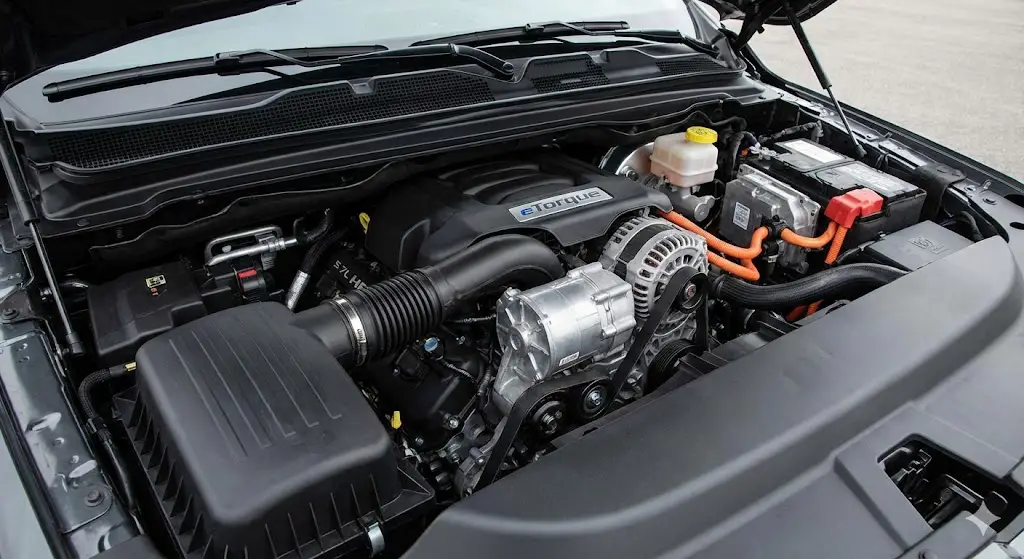
The 5.7L HEMI V8 engine features a simpler capacity standard, requiring exactly 7.0 quarts of SAE 5W-20 full synthetic or synthetic blend motor oil, irrespective of whether the truck is a Classic (DS) or the New Body Style (DT). The oil utilized must strictly meet the FCA Chrysler MS-6395 quality specification to ensure proper hydrodynamic lubrication across the engine’s internal clearances and variable valve timing components.
The introduction of the eTorque mild-hybrid system on the 2019 DT models brought significant questions regarding fluid capacities from the consumer market. The eTorque system utilizes a robust 48-volt motor-generator unit mounted to the top of the engine in place of a traditional alternator, providing supplemental low-end torque and smoothing transmission shifts. While this system dramatically alters the powertrain’s accessory drive and electrical architecture, it does not alter the internal crankcase volume or the engine oil routing. Therefore, the engine oil capacity for a 5.7L HEMI equipped with eTorque remains firmly at 7.0 quarts of 5W-20.


However, the presence of the eTorque system dictates highly specific lubrication requirements elsewhere in the drivetrain. To maximize fuel efficiency and handle the unique load characteristics of the hybrid torque application, Ram engineering mandates that the front axle and rear differentials on eTorque-equipped models be lubricated with SAE 5W-20 motor oil, rather than traditional, heavy-weight gear oil such as 75W-90 or 75W-140. This highly unconventional differential fluid requirement is critical; using heavy gear oil in an eTorque differential will severely impact operating temperatures, increase parasitic drag, and reduce overall powertrain efficiency.
It should also be noted that while the 2019 5.7L HEMI strictly utilizes SAE 5W-20, later iterations of the eTorque HEMI starting in the 2022 model year were transitioned by the manufacturer to an ultra-low viscosity SAE 0W-20 oil to comply with increasingly stringent corporate average fuel economy (CAFE) standards and emissions regulations. Owners of 2019 models must resist the temptation to back-date this fluid change; the 2019 bearing clearances and VVT solenoids were calibrated specifically for the kinematic viscosity of 5W-20, and utilizing thinner oil may compromise high-temperature shear stability.
The 3.0L EcoDiesel V6 Specifications
The 2019 Ram 1500 3.0L EcoDiesel represents another critical fork in the maintenance road. The 2019 Ram 1500 Classic is equipped with the Generation 2 EcoDiesel V6, which requires 10.5 quarts of heavy-duty SAE 5W-40 full synthetic diesel engine oil, bringing the total capacity to 10.6 quarts if the engine is completely dry. The oil utilized must meet the FCA Material Standard MS-10902, along with the API CJ-4 or ACEA A3/B4 certifications, to effectively manage the heavy soot loading inherent to diesel combustion and to protect the delicate variable geometry turbocharger bearings.
Technicians must be acutely aware of the transition to the Generation 3 EcoDiesel, which was subsequently introduced for the 2020 model year in the DT chassis but frequently causes parts-catalog confusion for late-build 2019 models. The newer Gen 3 engine requires a smaller 8.5-quart oil capacity and utilizes an entirely different API SN or SN+ oil formulation meeting the MS-12991 standard. Furthermore, the cartridge-style oil filters for the Gen 2 and Gen 3 engines appear visually identical but contain internal structural differences. Installing a newer Gen 3 oil filter into a 2019 Gen 2 EcoDiesel will cause immediate oil bypass issues, leading to unfiltered oil circulating through the engine and eventual internal bearing failure.
Because modern diesel emissions systems rely heavily on Diesel Exhaust Fluid (DEF) to chemically reduce nitrogen oxides (NOx) in the exhaust stream, standard service intervals for the EcoDiesel should always pair an engine oil and filter replacement with a thorough top-off of MOPAR DEF fluid to maintain emissions compliance.
OEM Mopar Oil Filter Part Numbers and Revisions
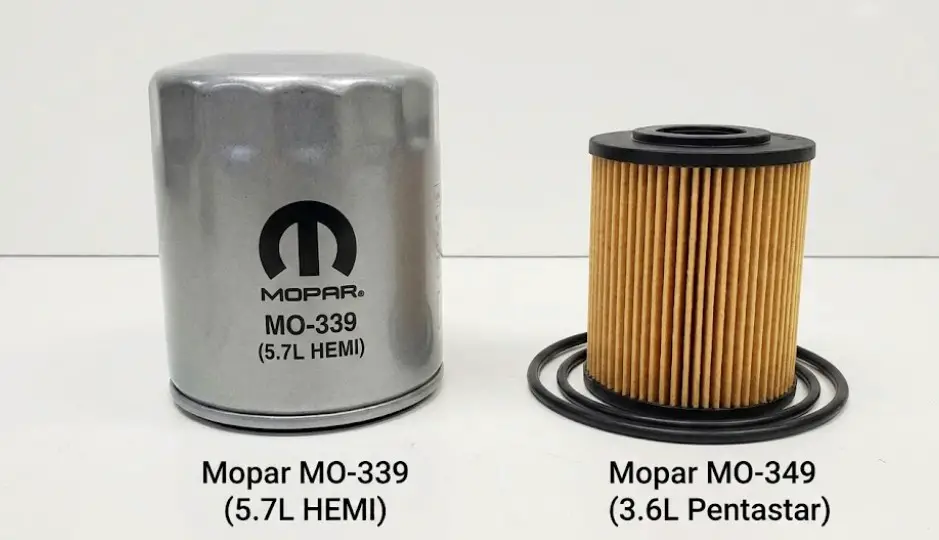
Maintaining the integrity of the engine’s oil pressure requires utilizing high-quality filtration media. The manufacturer strictly advises the use of Official Mopar Filters, as aftermarket equivalents often feature inferior anti-drain back valves. A faulty anti-drain back valve allows oil to siphon out of the upper engine galleries after the vehicle is shut off, leading to highly destructive “dry starts” where the valvetrain operates without lubrication for several seconds upon ignition.
When sourcing replacement oil filters, consumers often encounter conflicting alphanumeric part numbers. In the automotive supply chain, the core numeric string denotes the specific part geometry, while the alphabetical suffix represents sequential engineering revisions. As the manufacturer updates the internal filtration media, adjusts the spring tension of the bypass valve, or changes the polymer composite of the filter housing, the suffix advances from “AA” to “AB” or “AC”. Purchasing the highest suffix available ensures the vehicle receives the latest iterative design improvements, though prior iterations generally remain fully backward-compatible.
The following table details the exact OEM Mopar part numbers required for each 2019 Ram 1500 engine application.
| Engine Configuration | Primary OEM Part Number | Alternate OEM Designations | Filter Architecture |
| 3.6L Pentastar V6 | MO-349 | 68191349AA, 68191349AB, 68191349AC | Drop-in Paper Cartridge |
| 5.7L HEMI V8 | MO-339 | 4892339AA, 4892339AB, 4892339BH | Metal Spin-On Canister |
| 3.0L EcoDiesel (Gen 2) | 68229402AA | 68109834AA, 68492616AA | Drop-in Paper Cartridge |
Drain Plug Torque Specifications and Gaskets
Ensuring the system remains sealed without stripping the delicate aluminum oil pan threads requires strict adherence to factory torque specifications. Over-tightening the drain plug compromises the integrity of the integrated rubber gasket or crush washer, inevitably resulting in slow seepage and the potential need for an expensive oil pan replacement. It is highly recommended to replace the drain plug gasket (Mopar part number 68443840AA or 68087456AA) during every service interval to guarantee a secure mechanical seal.
| Application Area | 3.6L Pentastar | 5.7L HEMI V8 | 3.0L EcoDiesel |
| Oil Pan Drain Plug Torque | 20 ft-lbs (27 Nm) | 25 ft-lbs (34 Nm) | 33 ft-lbs (45 Nm) |
| Oil Filter Cap / Housing | 18 ft-lbs (25 Nm) | Hand-tight + 3/4 turn | 18 ft-lbs (25 Nm) |
Preventive Maintenance Combating the 5.7L HEMI Tick
A pervasive mechanical phenomenon associated with the 5.7L V8 is the “HEMI tick.” This audible, rhythmic metallic tapping sound emanating from the upper valvetrain is primarily caused by the premature failure of the lifter rollers and subsequent scoring of the camshaft lobes. The root etiology of this failure is directly tied to the engine’s fundamental lubrication architecture.
The 5.7L HEMI features a camshaft that is positioned relatively high within the engine block. At low engine speeds, such as during prolonged idling, the mechanical oil pump generates less fluid volume and pressure. Consequently, the lifter rollers, which rely heavily on splash lubrication and pressurized oil galleries to maintain a microscopic fluid film between metal surfaces, become starved of adequate lubrication. This friction is exacerbated by the engine’s Multi-Displacement System (MDS), which actively deactivates four cylinders during light-load driving by collapsing specific lifters. If the complex internal oil passages feeding the MDS solenoids and lifters become restricted by sludge, carbon buildup, or degraded oil, the lifters fail to rotate properly against the camshaft, resulting in catastrophic metal-on-metal wear.
Mitigating the HEMI tick requires a hyper-vigilant approach to oil maintenance. While the vehicle’s onboard computer may allow for oil change intervals extending up to 10,000 miles under ideal highway conditions , automotive experts and teardown specialists strongly advise against pushing the fluid to this extreme. To preserve the valvetrain and prevent the accumulation of abrasive particulates in the lifter galleries, the 5.7L HEMI should be serviced with premium full synthetic oil every 5,000 miles, or every 6 months, particularly if the vehicle is subjected to stop-and-go driving, heavy towing, or extended idling. Utilizing a high-quality synthetic oil engineered with robust concentrations of friction modifiers can provide a sacrificial barrier on the cam lobes during these low-pressure idle states.
Overcoming the 5.7L HEMI Oil Filter Splash Hazard
Changing the oil on the 5.7L HEMI engine presents a notorious logistical challenge due to the specific placement of the oil filter. Engineers mounted the spin-on filter directly above the electric power steering rack and the front differential housing. When the filter’s seal is broken during removal, the residual warm oil trapped within the filter housing cascades downward, coating the sensitive steering components, differential cooling fins, and the structural subframe. This not only creates an extensive mess but also leads to persistent burning oil odors and false leak diagnoses in the days following a service.
To circumvent this design flaw, professional technicians and seasoned owners employ several specialized fluid diversion tactics. The most common, low-cost intervention involves maneuvering a one-gallon heavy-duty Ziploc bag entirely over the filter prior to unscrewing it. As the filter separates from the mounting boss, the bag captures both the filter and the escaping oil, allowing for a completely dry extraction.


Alternatively, mechanics frequently utilize formable aluminum splash shields or specialized aftermarket barriers, such as the silicone-based to create a temporary funnel. This barrier drapes safely over the steering rack and differential, smoothly routing the descending oil directly into the catch pan below, entirely eliminating the need for post-service degreasing.
Oil Life Monitor Calibration Procedure
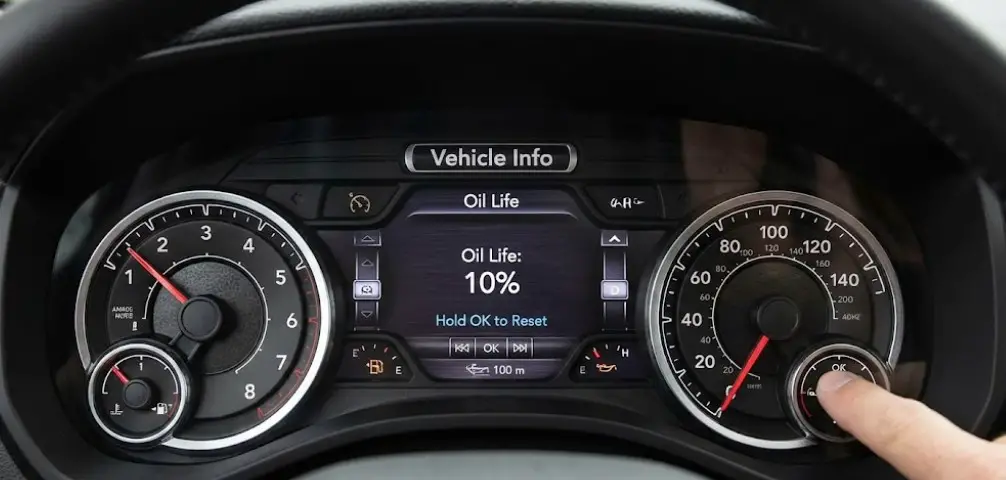
The 2019 Ram 1500 utilizes a sophisticated, algorithm-driven Oil Change Indicator system. Unlike rudimentary mileage counters, the Ram’s onboard computer continuously analyzes a complex matrix of operational variables, including engine revolutions, ambient operating temperatures, ethanol fuel percentages, and idle times, to dynamically calculate the degradation of the motor oil. Severe driving conditions, such as off-roading, towing, or operating in extreme heat, will prompt the system to trigger the “Oil Change Required” dashboard notification much sooner than a vehicle driven exclusively on the highway.
Once the physical oil replacement is complete, the digital monitor must be manually recalibrated to establish a baseline for the new fluid. Failure to reset the system will cause the warning light to persist and corrupt the algorithm’s tracking for the subsequent service interval. The reset procedure is entirely digital and requires no specialized OBD-II scanning equipment.
To execute the reset protocol, the operator must first cycle the ignition to the “ON/RUN” position without actually starting the engine. This is achieved by pressing the push-to-start ignition button twice while ensuring the foot is completely removed from the brake pedal. Once the vehicle’s electrical systems are initialized, the operator utilizes the directional keypad located on the left side of the steering wheel to navigate the central digital instrument cluster.
The driver must scroll up or down through the main menu until the “Vehicle Info” interface is highlighted. Upon entering the Vehicle Info section, the operator scrolls left or right to locate the “Oil Life” display gauge. With the current, degraded oil life percentage visible on the screen, the operator must press and hold the “OK” button (or the right arrow, depending on the specific trim level’s steering wheel layout) for approximately three to five seconds. The digital gauge will flash and then reset to 100%. After verifying the new 100% status, the operator simply cycles the ignition off to complete and save the calibration.
In-Depth People Also Ask
Does the eTorque system alter the engine oil capacity or viscosity?
The inclusion of the eTorque mild-hybrid system does not alter the internal combustion engine’s oil capacity. A 5.7L HEMI equipped with eTorque requires the exact same 7.0 quarts of SAE 5W-20 engine oil as a non-eTorque variant. The eTorque motor-generator unit sits externally and operates independently of the engine’s internal lubrication circuit. However, it does drastically change the required lubrication for the front and rear differentials, mandating SAE 5W-20 motor oil in those specific drivetrain components instead of traditional gear oil to maximize system efficiency.
Can 0W-20 be safely used in a 2019 5.7L HEMI instead of 5W-20?
While Ram transitioned the 5.7L HEMI eTorque engines to SAE 0W-20 beginning in the 2022 model year for the purpose of meeting stricter CAFE fuel economy standards, owners of 2019 models are strongly advised to adhere strictly to the 5W-20 specification outlined in their owner’s manual. The 2019 bearing clearances and Variable Valve Timing (VVT) solenoids were mathematically calibrated for the kinematic viscosity and flow characteristics of 5W-20. Utilizing an ultra-low viscosity 0W-20 oil in an engine not expressly tuned for it may compromise high-temperature shear stability and lead to pressure drops at idle, potentially exacerbating issues like the HEMI tick.
Why does the 3.6L Pentastar dipstick read overfilled after a precise five-quart change?
This is a documented engineering quirk specific to the “Pentastar Upgrade” engines found in the New Body Style (DT) Ram 1500. The redesigned cylinder heads, which incorporate Variable Valve Lift (VVL) solenoids and an integrated EGR cooler, create complex internal geometries that drastically slow the rate at which oil drains back into the primary oil pan. When a technician pours the specified 5.0 quarts into the engine and immediately checks the dipstick, the oil is still suspended in the upper valvetrain, resulting in a false low reading. If more oil is added to compensate, the engine will become dangerously overfilled once the fluid finally settles. The manufacturer mandates allowing the engine to sit for several minutes before verifying the level to ensure accurate readings.
What are the precise consequences of ignoring the Chrysler MS-6395 standard?
The FCA Chrysler MS-6395 specification is a proprietary chemical and performance benchmark that off-the-shelf motor oils must pass through rigorous, multi-year fleet testing. The MS-6395 standard specifically measures an oil’s capacity to resist sludge formation during severe thermal duty cycles, its chemical compatibility with Ram’s specific elastomeric engine seals, and its ability to maintain stable viscosity under the immense shearing forces generated by the HEMI V8. Utilizing generic bulk oil that lacks the MS-6395 certification can lead to accelerated seal degradation, microscopic bearing wear, and the immediate denial of powertrain warranty claims should an internal mechanical failure occur.
![2008 Dodge Ram 1500 Towing Capacity: Complete Specs Guide [2026]](https://truckguider.com/wp-content/uploads/2026/03/featured-4b2248df-768x768.webp)
![P062A Ram 1500: Diagnosing Fuel Pump Control Module Issues [2026]](https://truckguider.com/wp-content/uploads/2026/03/p062a-ram-1500-featured.webp)