Can You Mix 87 and 89 Gas? The Definitive Engineering Guide 2026

For truck owners and automotive enthusiasts, standing at the fuel pump often brings up questions regarding fuel grades, performance optimization, and mechanical safety. A frequent point of confusion is whether it is safe to mix different octane ratings in the same fuel tank.
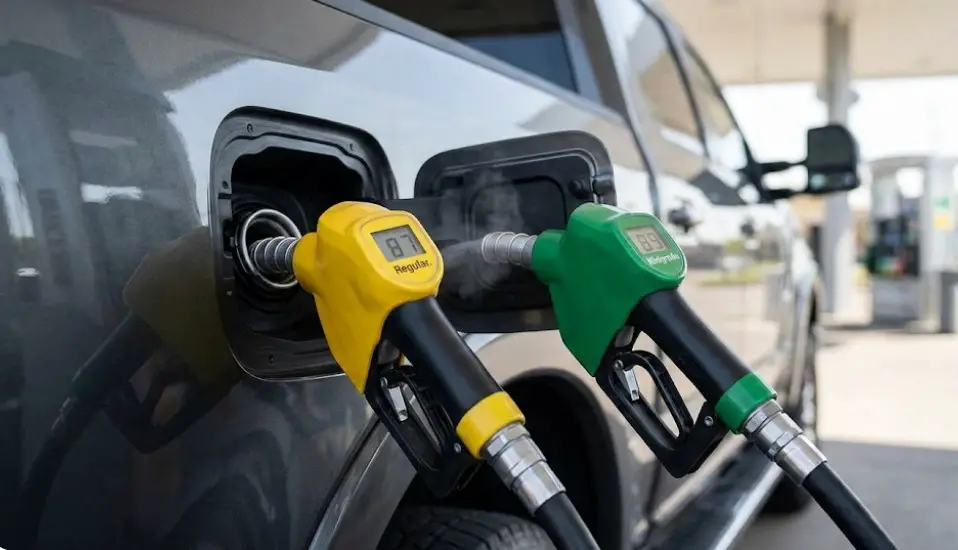
The direct answer is yes. You can safely mix 87 and 89 octane gasoline. Mixing unleaded fuel grades will not trigger chemical degradation, harm the fuel delivery system, or cause catastrophic engine failure. However, the resulting hybrid fuel mixture does have specific, measurable impacts on engine timing, combustion dynamics, and overall vehicle performance.
This comprehensive report breaks down the mechanical realities of octane blending, the physics of engine knock, and how modern truck platforms—from high-compression naturally aspirated V8s to turbocharged direct-injected V6s—adapt to varying fuel grades.
Can You Mix 87 and 89 Gas?
The Definitive Guide to Octane Blending, Engine Safety, and Performance.
The Math of Mixing Octane
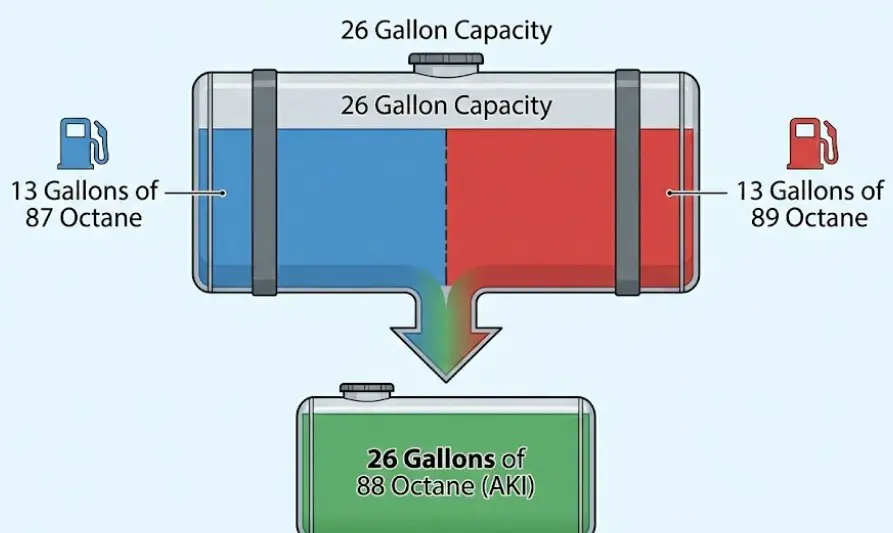
When you mix gasoline of different octane ratings, the result is a proportional blend. Octane isn’t a magical chemical; it’s a rating known as the Anti-Knock Index (AKI). If you accidentally start pumping 87 Regular and switch halfway to 89 Mid-Grade, your tank simply averages the two.
The 50/50 Rule
Mixing exactly half a tank of 87 octane with half a tank of 89 octane yields a full tank of exactly 88 octane fuel. Gas stations actually use this exact blending method inside their pumps to create mid-grade fuel from standard and premium underground tanks.
Visualizing a 50/50 blend of standard pump fuels.
The Science: What is Octane Anyway?
Octane does not equal more power or more energy. It simply represents a fuel’s resistance to detonating too early under high pressure and heat. Lower octane fuels ignite easier, which is fine for standard engines but dangerous for high-compression engines.
The ECU: Your Engine’s Built-in Defense
What happens if your car requires 89, but you mix in 87 and end up with 88? Modern vehicles are equipped with an Engine Control Unit (ECU) and knock sensors that adapt to sub-optimal fuel blends in milliseconds to prevent damage.
1. Fuel Injected
Lower-than-required octane fuel enters the combustion chamber.
2. Micro-Knock Occurs
Fuel ignites slightly too early due to cylinder pressure.
3. Sensor Detects
Piezoelectric knock sensors hear the abnormal frequency.
4. ECU Adjusts
Timing is retarded. Engine is safe, but loses minor power/MPG.
Vehicle Compatibility Matrix
Match your owner’s manual requirements against the fuel you put in the tank.
| Engine Requirement | Using Only 87 | Mixing 87 & 89 (Yields ~88) | Using Only 89+ |
|---|---|---|---|
| Requires 87 (Most Cars) | ✓ Optimal Performance | Safe, but wastes money. No benefit. | Safe, but wastes money. No benefit. |
| Recommends 89+ | ⚠ Safe, minor power loss | ✓ Good middle ground | ✓ Optimal Performance |
| Requires 91/93 (Premium) | ✗ Risk of engine knock | ✗ Not recommended, risk | ⚠ Acceptable if 91+ unavailable |
The Financial Impact
Is mixing 87 and 89 a valid strategy to save money if your car recommends 89? While you do lower the cost per gallon, the financial reality is minimal over the course of a year.
-
✓
If your car requires 87, buying 89 or mixing is literally burning cash. There are zero cleaning or performance benefits.
-
✓
If your car recommends 89, mixing with 87 will save you roughly $40-$60 a year, but you may lose slightly more than that in reduced fuel economy.
The Chemistry and Mechanics of Octane Blending
To understand why mixing 87 and 89 octane is fundamentally harmless, one must first understand how retail gasoline is manufactured and distributed. Octane is not a measure of a fuel’s energy content or its level of refinement; it is strictly a measurement of the fuel’s stability and its resistance to premature auto-ignition (detonation) under high heat and cylinder pressure.
In North America, the number displayed on the pump—known as the Anti-Knock Index (AKI)—is the simple average of the fuel’s Research Octane Number (RON) and Motor Octane Number (MON).
The “Splash Blending” Process
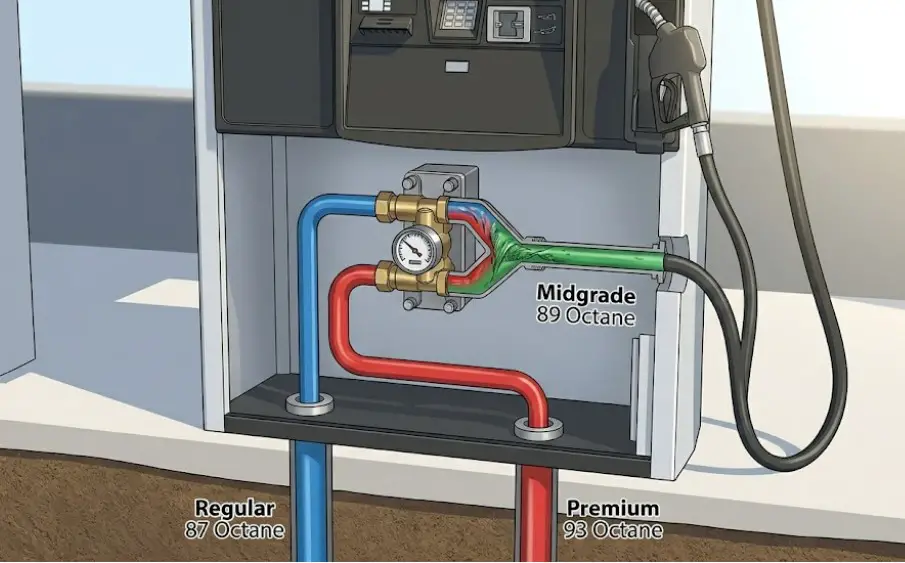
The reality of retail gasoline infrastructure is that most gas stations do not have dedicated underground storage tanks for midgrade 89 octane fuel. Instead, stations generally maintain just two primary tanks: one containing regular 87 octane and another containing premium 91 or 93 octane.
When a driver selects the 89 octane button, the fuel dispenser utilizes a mechanical blending valve to draw from both the regular and premium tanks simultaneously. It mixes them directly in the hose—a process the industry refers to as “splash blending”. Therefore, if a driver manually mixes 87 and 89 octane in their vehicle’s fuel tank, they are merely replicating the exact fluid dynamics that occur inside the retail dispenser.
The Linear Blending Formula
Because hydrocarbon fuels are entirely miscible, octane blends perfectly on a linear scale based on volumetric proportions. Automotive engineers and fuel chemists use a weighted average formula to calculate the final Anti-Knock Index of any blended fuel:
$$Octane_{Final} = \left( \frac{Volume_{A}}{Volume_{Total}} \times Octane_{A} \right) + \left( \frac{Volume_{B}}{Volume_{Total}} \times Octane_{B} \right)$$
Gas Tank Volumetric Chart
| Component A (Gallons) | Octane A | Component B (Gallons) | Octane B | Final Tank Volume | Final Octane Rating |
| 13.0 | 87 | 13.0 | 89 | 26.0 Gallons | 88.0 AKI |
| 20.0 | 87 | 6.0 | 89 | 26.0 Gallons | 87.4 AKI |
| 6.0 | 87 | 20.0 | 89 | 26.0 Gallons | 88.5 AKI |
| 13.0 | 87 | 13.0 | 93 | 26.0 Gallons | 90.0 AKI |
Mechanical Impacts: Engine Control Units and Knock Sensors
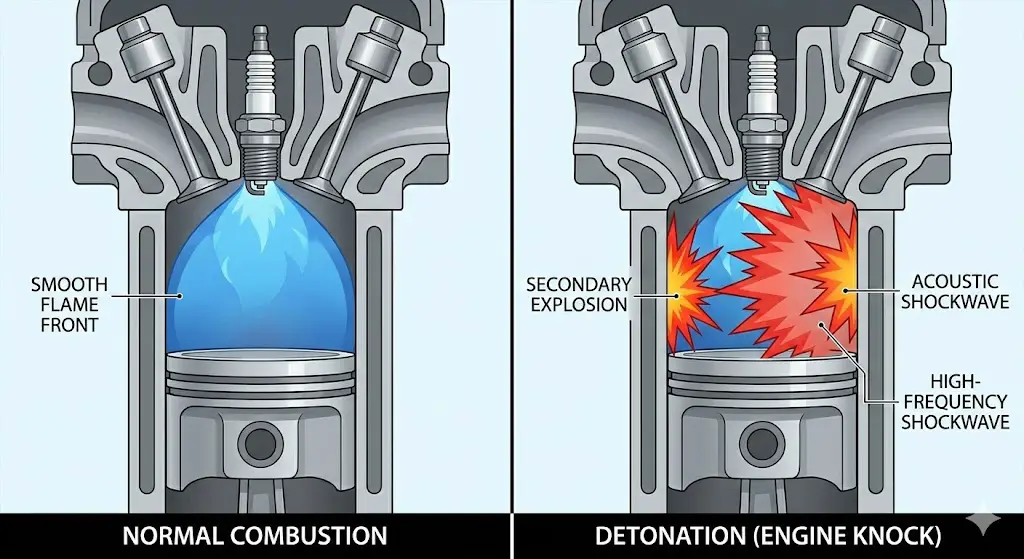
While the chemical blending of 87 and 89 octane is harmless, the resulting hybrid octane rating dictates how the Engine Control Unit (ECU) manages combustion.
In a perfectly operating internal combustion engine, the spark plug ignites the air-fuel mixture, creating a smooth, controlled flame front that expands across the cylinder, pushing the piston down. However, if the fuel’s octane rating is too low to withstand the heat and pressure generated during the compression stroke, pockets of unburned fuel can spontaneously combust.
When the primary flame front collides with this secondary auto-ignition explosion, it generates a massive acoustic shockwave. This is known as “detonation” or “engine knock,” and the resulting pressure spike can shatter pistons, crack ringlands, and destroy connecting rods.
The Spark Retard Defense Mechanism
To prevent catastrophic failure when lower-octane fuels are introduced, modern engines utilize piezoelectric knock sensors bolted directly to the engine block. These sensors function as hyper-sensitive microphones, specifically tuned to listen for the high-frequency vibrations (typically between 6 kHz and 8 kHz) indicative of detonation.
When a driver mixes 87 into a vehicle that requires a higher octane, the engine will likely experience trace amounts of detonation. The ECU immediately responds through a protective closed-loop protocol:
- Detection: The knock sensor registers the abnormal acoustic frequency.
- Timing Retardation: The ECU aggressively delays (retards) the ignition spark timing. Firing the spark plug later in the compression stroke reduces peak cylinder pressures, effectively eliminating the knock.
- Power Deficit: Because the spark is no longer occurring at Maximum Brake Torque (MBT) timing, the engine’s thermal efficiency drops. The driver experiences this as a tangible loss of horsepower, torque, and fuel economy.
Performance Reality: Mixing Gas in Modern Trucks
The actual performance penalty of mixing 87 and 89 octane depends entirely on engine architecture. High-compression naturally aspirated V8s and forced-induction (turbocharged) V6s react very differently to fractional octane changes.
Ram 1500 (5.7L HEMI V8)
The 5.7-liter HEMI V8 utilizes a high compression ratio of 10.5:1. Fiat Chrysler Automobiles (FCA) officially recommends using 89 octane for optimum performance and fuel economy, though the owner’s manual states that 87 octane is acceptable.
When owners run strictly 87 octane, the HEMI’s ECU frequently detects low-level knock under heavy throttle and pulls timing to compensate. If an owner blends 87 and 89 octane to achieve an 88-octane average, the ECU will incrementally advance the timing closer to optimal MBT. Fleet data and owner reports indicate that moving away from pure 87 toward an 88 or 89 blend in the 5.7L HEMI often restores 1 to 2 miles per gallon under load and smooths out the powerband.
Ford F-150 (3.5L EcoBoost V6)
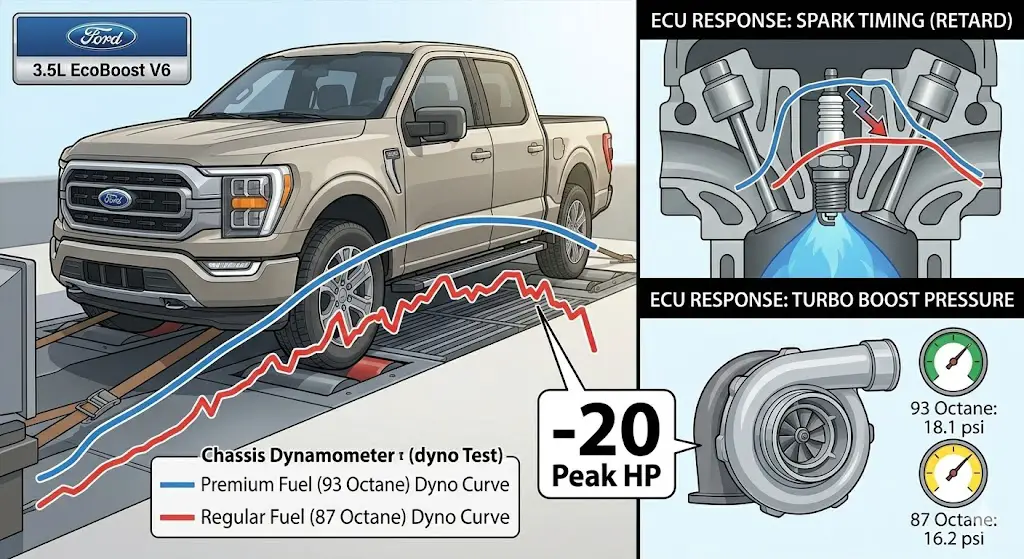
Ford’s EcoBoost engines rely on twin turbochargers to artificially compress the intake air, generating massive low-end torque. This extreme cylinder pressure makes the EcoBoost highly sensitive to fuel stability. While Ford states that 87 octane is the minimum requirement, the manual explicitly notes that 91 octane or higher is recommended for severe duty, hot weather, and trailer towing.
| Performance Metric | Premium Fuel (93 Octane) | Regular Fuel (87 Octane) | Total Deficit |
| Peak Wheel Horsepower | 380 HP | 360 HP | -20 HP |
| 0-60 MPH Acceleration | 5.3 Seconds | 5.9 Seconds | +0.6 Seconds |
| Quarter-Mile Time | 14.0 Seconds | 14.5 Seconds | +0.5 Seconds |
| Peak Turbo Boost Pressure | 18.1 psi | 16.2 psi | -1.9 psi |
| Highway Fuel Economy | 17.6 MPG | 17.0 MPG | -0.6 MPG |
When the EcoBoost knock sensors detect 87 octane, the ECU not only retards ignition timing but also commands the turbocharger wastegates to bleed off nearly 2.0 psi of boost pressure to prevent engine damage. Mixing 87 and 89 to create an 88-octane blend will only marginally reduce this extreme ECU intervention.
The Threat of Low-Speed Pre-Ignition (LSPI)
Trucks utilizing Turbocharged Direct Injection (TGDI), such as the EcoBoost, are also susceptible to a unique phenomenon known as Low-Speed Pre-Ignition (LSPI). LSPI occurs randomly at low engine RPMs under high torque loads—exactly the conditions encountered when pulling a heavy trailer from a dead stop.
Unlike standard knock, LSPI is initiated by carbon flakes or microscopic oil droplets igniting the fuel charge long before the spark plug fires. Because it happens prior to the spark event, the ECU’s spark retard mechanism is entirely useless in preventing it. While bumping a mixed 87/89 blend up to pure 91 or 93 octane offers minor resistance to LSPI, preventing it requires specific API SN Plus or SP motor oils formulated with reduced calcium detergents.
Chemical Compatibility: Detergents and Gas Station Brands
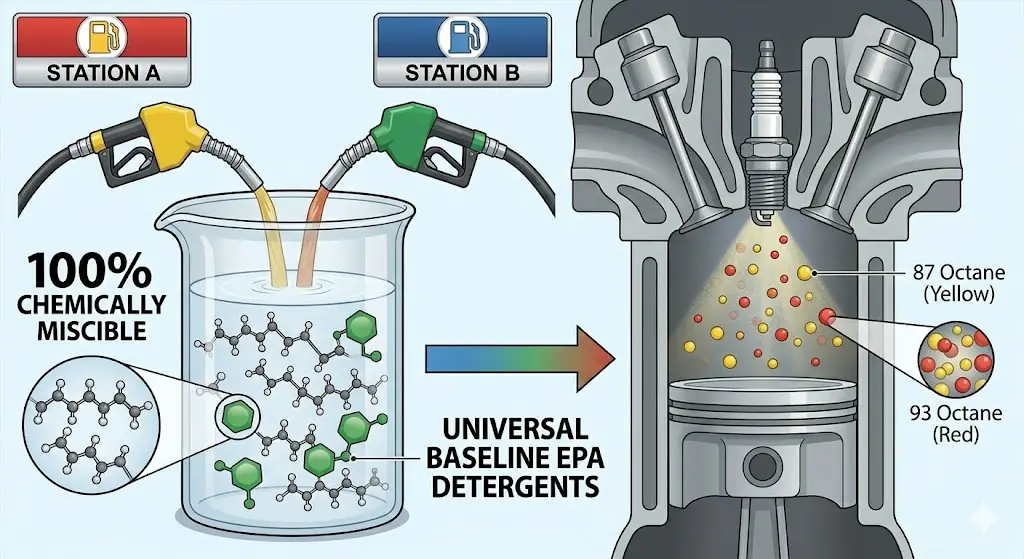
A persistent concern regarding fuel mixing is chemical compatibility. Consumers often worry that mixing 87 octane from a Shell station with 89 octane from a Chevron station will cause a detrimental reaction. From a chemical engineering standpoint, this is a myth.
All retail gasolines refine down to the same foundational hydrocarbon chains. Furthermore, the Environmental Protection Agency (EPA) mandates a universal baseline of detergent additives in all fuels to prevent carbon buildup. Because these base fuels are standardized, mixing different brands and different octanes is 100% chemically miscible and will not coagulate, separate, or damage fuel injectors.
The Top Tier Detergent Myth
Many premium fuel retailers are certified under the program, an OEM-backed standard that requires fuel to contain high concentrations of polyether amine (PEA) detergents.
A common fallacy is that higher octane fuels possess more cleaning power. In reality, within a certified Top Tier brand, the 87, 89, and 93 octane fuels all contain the exact same concentration of detergents. Mixing 89 octane into an 87 octane tank will not “clean out” the engine, dissolve existing carbon on intake valves, or unclog fuel lines. Upgrading octane for the sole purpose of engine cleaning is a financial waste.
The Economics of Pump Blending
Understanding that midgrade 89 octane is generally synthesized inside the gas pump by mixing 87 and 93 octane leads to an interesting economic reality: DIY blending can save consumers money.
Because stations rely on midgrade fuel for higher profit margins, the retail price of 89 octane is rarely the direct mathematical average of 87 and 93. Consumers driving vehicles that specifically require 89 octane (such as the 5.7L HEMI) can often save significant money at the pump by manually dispensing a calculated ratio of 87 and 93 octane into their tank to achieve an aggregate 89 AKI, rather than paying the station’s inflated midgrade convenience premium.
FAQs
Will using 89 octane in a car designed for 87 damage the engine?
No, it will cause zero mechanical damage. Using a higher octane than the manufacturer requires is perfectly safe. However, because an engine designed strictly for 87 octane operates with a lower compression ratio and a conservative ignition timing map, it physically cannot take advantage of the slower-burning 89 octane fuel. Doing so provides no additional horsepower, no improved fuel economy, and is simply an unnecessary expenditure.
Is it safe to switch back to 87 octane after running 89 or Premium?
Yes, it is entirely safe. Modern Engine Control Units operate on a continuous, closed-loop feedback system. If a driver runs 89 octane for several months and then switches back to 87, the knock sensor will immediately detect the increased propensity for detonation within a few engine revolutions. The ECU will automatically retard the timing back to its safe base map without any manual intervention or reset required from the driver.
Does altitude change how my truck reacts to 87 and 89 octane?
Yes, altitude has a profound effect on engine knock. At high elevations (such as the Rocky Mountains), the ambient air is significantly less dense. When an engine draws in this thin air, the dynamic compression ratio inside the cylinder is reduced, which naturally lowers the heat of compression and reduces the risk of auto-ignition. This is why “regular” gasoline in mountainous regions is often sold at 85 octane rather than 87. Naturally aspirated engines can safely run lower octanes at altitude. However, turbocharged engines (like the EcoBoost) compress the thin air to maintain standard manifold pressure, meaning they still require their recommended high-octane fuel regardless of elevation.
Does mixing 87 and 89 improve fuel economy?
If your vehicle’s manual specifies 87 octane, mixing in 89 will yield zero improvement in fuel economy. If your vehicle recommends 89 or 91+ octane, mixing 87 and 89 to achieve an 88-octane blend will allow the ECU to advance timing slightly closer to its optimal parameters, resulting in slightly better efficiency than straight 87, but it will still fall short of the MPG achieved by running the fully recommended premium fuel.
Conclusion
Mixing 87 and 89 octane gasoline is a common, chemically sound, and mechanically harmless practice. Because gasoline blends on a perfectly linear volumetric scale, combining the two grades simply results in a predictable aggregate octane rating.
For the vast majority of standard commuter vehicles calibrated for 87 octane, mixing in 89 octane offers no tangible benefits in performance, cleanliness, or longevity. However, for truck owners commanding high-compression naturally aspirated V8s or forced-induction engines, octane is deeply tied to capability. While advanced ECU spark-retard protocols will save these engines from destruction if lower-octane fuel is introduced, maintaining the manufacturer’s recommended higher octane rating is the only way to guarantee optimal horsepower, maximum towing capability, and peak thermal efficiency.
![How To Install In Channel Rain Guards [2026]](https://truckguider.com/wp-content/uploads/2026/03/featured-b43761fc-768x432.webp)

![How to Tow a Car with a Truck Long Distance: Step-by-Step Guide [2026]](https://truckguider.com/wp-content/uploads/2026/03/how-to-tow-a-car-with-a-truck-long-dista-featured-1.webp)