
Exhaust Manifold Gasket Replacement Costs, Diagnostics, and Repair Guides 2026

The exhaust manifold gasket represents a critical, yet often underestimated, component within the internal combustion engine’s thermal management and emissions control systems. While the component itself is financially negligible—often costing less than $50—the labor, technical complexity, and potential for collateral damage associated with its replacement make it a significant maintenance event for light and heavy-duty truck owners.
This report provides an exhaustive analysis of the exhaust manifold gasket ecosystem, synthesizing data from repair databases, metallurgical studies, mechanic forums, and federal safety investigations to provide a definitive guide for truckguider.com.


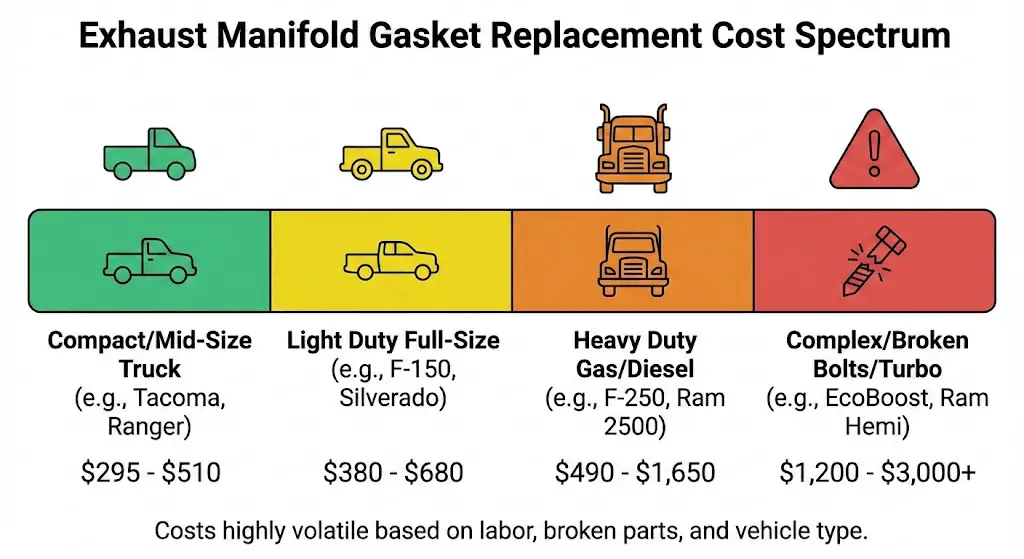
The analysis indicates that the total cost of replacement is highly volatile, ranging from $300 for a simple, single-bank replacement on a compact truck to exceeding $3,000 for complex diesel applications or scenarios involving sheared fasteners and warped castings. The variance is driven primarily by labor intensity, which is exacerbated by modern engine bay packaging, corrosion issues in specific geographic regions, and endemic engineering flaws in popular platforms such as the Ram 5.7L Hemi and Ford 3.5L EcoBoost.
Furthermore, the report identifies critical safety risks associated with deferred maintenance, including carbon monoxide cabin intrusion and catastrophic catalytic converter failure, necessitating a proactive approach to repair.
Exhaust Manifold Gasket
Replacement Cost Analysis & Guide
Why is this repair so expensive?
Replacing an exhaust manifold gasket is a classic automotive paradox: the part itself is incredibly cheap, often costing less than a standard lunch. However, the labor required to reach it—often involving rusted bolts, tight engine bays, and high heat components—drives the price up significantly.
This infographic breaks down the real costs for truck and car owners, comparing DIY savings against professional labor risks.
Avg. National Cost
$280
Low End (Standard Car)
Truck/Diesel Cost
$950+
High End (Heavy Duty)
The “Labor Trap”
85% Labor / 15% Parts
The Cost Composition
When you pay a mechanic for this job, you aren’t paying for the gasket. You are paying for time. The exhaust manifold is buried deep in the engine bay.
- Parts: Usually $20 – $50.
- Labor: Often 3 to 5 hours at $100+/hr.
Insight: If you have the tools and patience, this repair offers one of the highest “ROI” for DIY mechanics due to the massive labor savings.
Cost Variation by Vehicle Type
Not all engines are created equal. A 4-cylinder sedan is relatively accessible. A V8 truck or diesel engine often requires removing wheel wells or lifting the cab, driving costs up drastically.
Compact Cars
Simplest access. Manifolds are often right in front.


$200 – $350
V6/V8 Trucks
Tight clearance. Often requires removing other components.
$450 – $850
Diesel / Heavy Duty
Extreme heat cycles seize bolts. High labor hours.
$800 – $1,500+
DIY vs. Professional Shop
Should you tackle this yourself? The financial incentive is huge, but the risk of breaking a rusty stud is real. If a bolt snaps in the engine block, a simple $40 DIY job turns into a machine shop nightmare.
The “Broken Bolt” Nightmare Scenario
What happens to the bill when things go wrong?
Scenario A: Standard Swap
Old bolts come out clean. Gasket is swapped. New bolts torqued.
Cost: Baseline
Scenario B: 1-2 Broken Studs
Mechanic must weld nuts to studs or drill them out. Adds 1-2 hours of labor.
Cost: +$150 to +$300
Scenario C: Cylinder Head Damage
Drilling fails, head threads damaged. Cylinder head removal required.
Cost: +$1,000 to +$2,000
Signs You Need Replacement
The “Ticking” Sound
Distinct ticking on cold starts that disappears as the metal expands and seals the gap.
Exhaust Fumes
Smelling raw exhaust inside the cabin. Dangerous carbon monoxide risk.
Power Loss / MPG
Loss of backpressure affecting turbo performance and fuel efficiency.
© 2026 TruckGuider Infographics
The Engineering and Physics of Exhaust Manifold Sealing
To fully comprehend the cost structure of exhaust manifold gasket replacement, one must first understand the hostile environment in which this component operates. The gasket is not merely a static seal; it is a dynamic interface that must accommodate extreme thermal, chemical, and mechanical stresses.

Thermal Dynamics and Differential Expansion
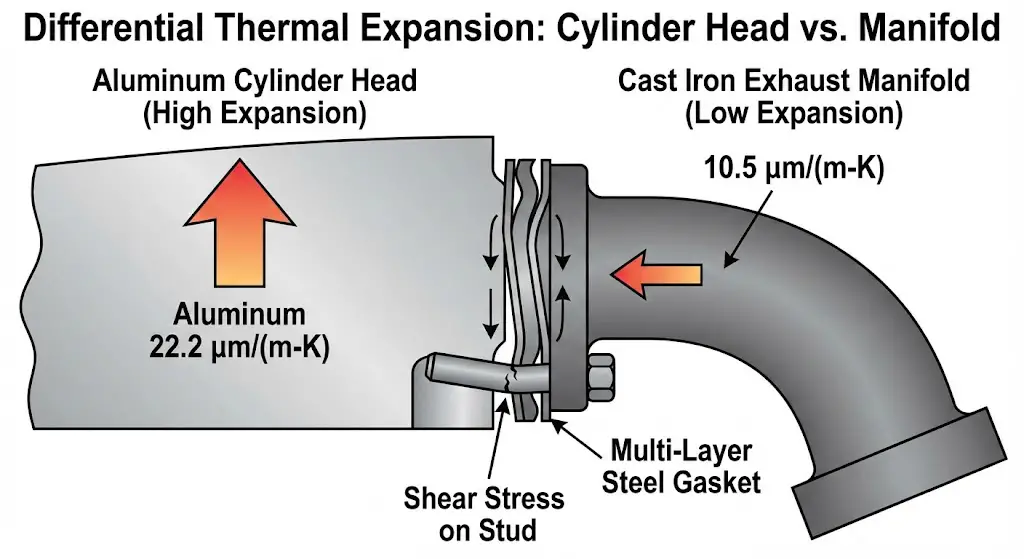
The primary driver of manifold gasket failure—and the subsequent high repair costs due to broken bolts—is differential thermal expansion. Modern truck engines typically utilize aluminum alloy cylinder heads for weight reduction and thermal efficiency, while exhaust manifolds have traditionally been constructed from cast iron or, more recently, tubular stainless steel.
Aluminum has a coefficient of thermal expansion of approximately 22.2 µm/(m·K), while cast iron expands at a rate of roughly 10.5 µm/(m·K). As the engine cycles from a cold start (ambient temperature) to operating temperature (exhaust gas temperatures reaching 1,200°F – 1,600°F under load), the cylinder head expands at nearly double the rate of the cast iron manifold.
This disparity creates a massive shearing force across the gasket face. The manifold effectively tries to slide across the cylinder head surface. The gasket must facilitate this movement while maintaining a gas-tight seal. Over thousands of thermal cycles, this “scrubbing” action fatigues the gasket material, leading to blowout. More critically, the friction generated by this movement transfers shear stress directly to the mounting studs. Eventually, the stud fatigues and snaps, usually flush with the cylinder head, turning a routine maintenance job into a complex extraction procedure.
The Operating Environment
The exhaust manifold gasket operates under conditions that are unique within the automotive ecosystem:
- Extreme Heat: Exhaust gas temperatures (EGT) in gasoline trucks can exceed 1,600°F during heavy towing. The gasket must withstand this without degrading or losing its spring tension.
- Pressure Pulses: Unlike the intake manifold which operates under vacuum, the exhaust manifold is subjected to high-pressure pulses (backpressure) synchronized with the engine’s firing order. A leak here is essentially a high-velocity jet of hot gas.
- Corrosive Chemistry: The combustion byproducts include water vapor, carbon dioxide, nitrogen oxides (NOx), and unburned hydrocarbons. When cooled, these can form acidic condensates that attack the gasket material and the fastening hardware.
Material Evolution: From Composite to MLS
The automotive industry has shifted materials to combat these stresses, which influences parts costs:
- Composite/Graphite (Legacy): Older trucks used gaskets made of perforated steel cores with graphite facing. These offered excellent conformability to rough surfaces but lacked the shear strength to survive modern bi-metal engines. They are prone to “blowout.”
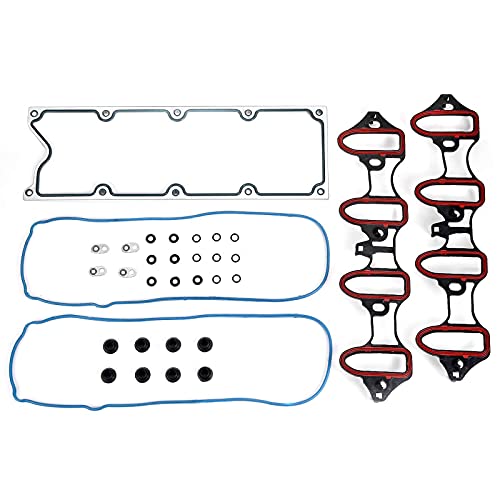
- Multi-Layer Steel (MLS) (Modern Standard): The current industry standard, utilized by OEMs and premium aftermarket brands like Fel-Pro and Mahle. An MLS gasket consists of 3 to 5 layers of embossed stainless steel. The layers are riveted together but allowed to slide slightly against one another. This internal sliding accommodates the differential thermal expansion between the head and manifold without transferring all the stress to the sealing beads. While more expensive to manufacture, they significantly reduce the incidence of failure if the mating surfaces are flat.
Comprehensive Cost Analysis
The cost of replacing an exhaust manifold gasket is rarely a fixed figure. It is a spectrum heavily influenced by vehicle class, regional labor rates, and the mechanical integrity of the system.
Baseline Replacement Costs (Parts & Labor)
The following data aggregates estimates for a standard replacement scenario where access is unobstructed and no bolts break. This represents the “best-case” scenario.
| Vehicle Segment | Vehicle Examples | Parts Cost (Low-High) | Labor Cost (Low-High) | Total Est. Range |
| Compact/Mid-Size Truck | Toyota Tacoma, Ford Ranger, Chevy Colorado | $25 – $60 | $270 – $450 | $295 – $510 |
| Light Duty Full-Size | Ford F-150, Ram 1500, Chevy Silverado 1500 | $30 – $80 | $350 – $600 | $380 – $680 |
| Heavy Duty Gas | Ford F-250 6.2L/7.3L, Ram 2500 6.4L | $40 – $100 | $450 – $800 | $490 – $900 |
| Heavy Duty Diesel | Ford Power Stroke, Ram Cummins, GM Duramax | $50 – $150 | $600 – $1,500 | $650 – $1,650 |
| Van/Cutaway Chassis | Chevy Express, Ford E-Series | $40 – $80 | $400 – $900 | $440 – $980 |
Analysis of Variance:
- Labor Dominance: In almost all cases, labor accounts for 80-90% of the bill. For example, a Chevy Express 3500 gasket costs roughly $36, but the labor is $171-$349 due to the tight “doghouse” engine access inside the cabin.
- Diesel Premium: Heavy-duty diesel trucks command significantly higher labor times. The physical size of the manifolds, the presence of turbocharger plumbing, and often crowded engine bays in trucks like the Ford F-350 (where cab removal is sometimes recommended) drive costs up.
The “Manifold Replacement” Variable
A critical insight for truck owners is that the gasket failure is often a symptom of a warped manifold. If a technician installs a new gasket on a warped manifold, the repair will fail within months. Consequently, professional recommendations often include replacing the manifold itself.
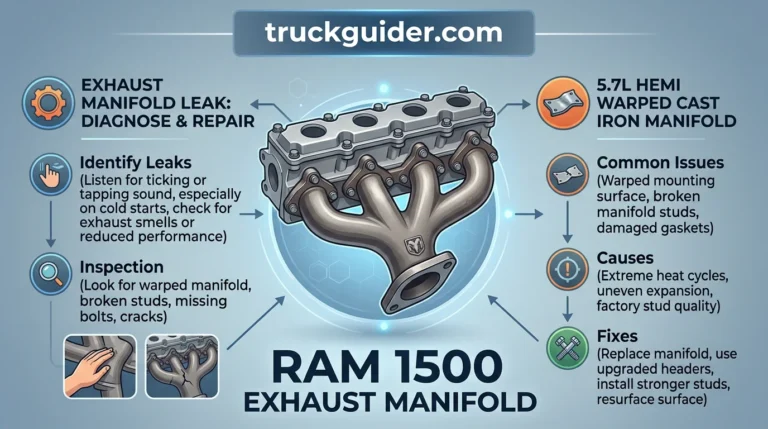
- Cast Iron Warpage: Repeated heating cycles cause cast iron to shrink and bow. On the Ram 5.7L Hemi, the manifold often bows away from the head at the rear cylinders, snapping the bolts.
- Cost Implication: Adding a manifold to the ticket increases the price significantly.
- Aftermarket (Dorman): $100 – $150 per side.
- OEM (Dealer): $250 – $450 per side.
- Total Job Impact: A gasket-only job of $400 becomes a $900 job when the manifold is added.
Regional and Shop-Type Variations
The cost of labor varies dramatically by geography and shop classification.
- The Rust Belt Factor: Trucks operated in regions using road salt (Northeast, Midwest) face severe corrosion. Exhaust bolts fuse to the manifold and cylinder head. Shops in these areas typically add a “corrosion surcharge” or quote higher baseline labor hours (e.g., 20-30% higher) to account for torching and drilling.
- Dealer vs. Independent:
- Dealerships: Higher hourly rates ($150-$220/hr) but specialized tooling for specific engines (e.g., Ford EcoBoost turbo jigs).
- Independent Shops: Lower rates ($100-$150/hr). May lack specific extraction templates for complex breaks, potentially leading to higher hours if things go wrong.
Detailed Vehicle-Specific Analysis
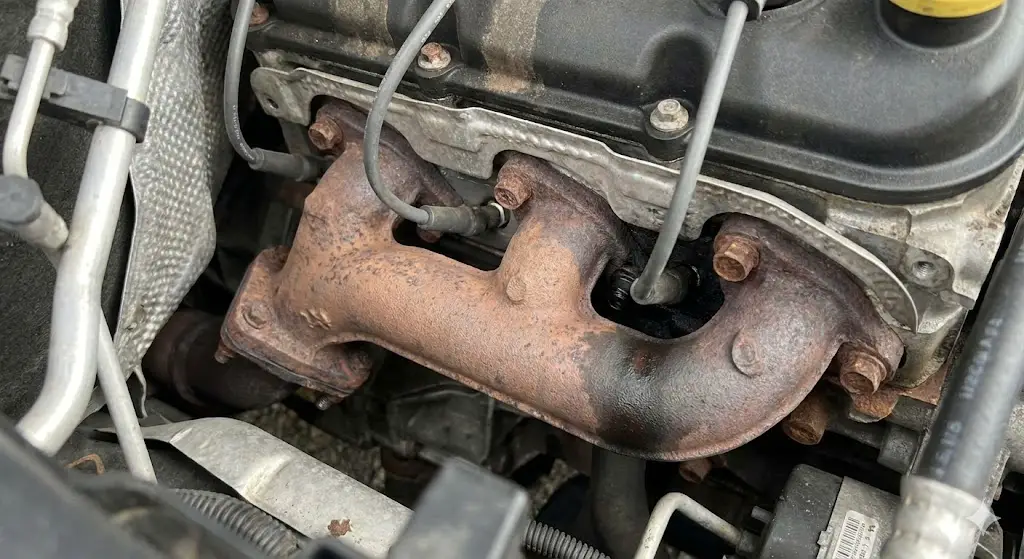
Certain truck platforms exhibit chronic exhaust manifold issues. Detailed knowledge of these specific failures is essential for accurate cost forecasting.
Ram 1500 (5.7L Hemi): The “Hemi Tick”
The Ram 1500 is arguably the most notorious vehicle for this failure, often referred to as the “Hemi Tick.”
- The Mechanism: The 5.7L engine uses a long cast iron log-style manifold. The rear cylinders (7 and 8) operate at the highest temperatures due to restricted airflow at the back of the engine bay. The manifold expands linearly, shearing the heads off the rear bolts.
- Repair Scope: It is almost never sufficient to just replace the gasket. The manifold is permanently warped.
- Parts: New Manifold ($150-$300), Gasket ($25), Bolt Kit ($40).
- Labor: 3-5 hours per side.
- Extraction: It is common to find 1-2 broken bolts per side.
- Cost Reality: While online estimators might suggest $400, real-world quotes from dealerships frequently land between $1,300 and $1,600 for a single side when broken bolts are involved. DIYers report costs around $300 for parts alone, provided they have the welding equipment to extract the bolts.
Ford F-Series (5.4L Triton & 3.5L EcoBoost)
Ford trucks present two distinct generations of problems, both expensive.
- 5.4L Triton (2004-2010):
- Issue: The passenger side manifold is buried against the frame rail and firewall. Access is notoriously difficult. The studs rust severely and snap.
- Labor: Standard times are 8-10 hours for the set, but broken studs can extend this to 14+ hours.
- Cost: Owners often report bills exceeding $1,200 for the passenger side alone.
- 3.5L EcoBoost (2011-Present):
- Issue: Turbos are bolted directly to the manifolds. The extreme heat of the turbocharging system causes the manifolds to warp.
- Complexity: Replacing the gasket requires removing the turbocharger. This necessitates draining coolant and oil, and replacing turbo oil/coolant line o-rings and gaskets.
- Cost: Estimates for the EcoBoost are among the highest for light-duty trucks, often ranging from $1,500 to $2,000 per side due to the high labor time (tubo R&R) and the cost of turbo installation kits.
Chevrolet Silverado / GMC Sierra (LS/LT Engines)
GM trucks (4.8L, 5.3L, 6.0L, 6.2L) also suffer from broken bolts, but the repair dynamics differ slightly.
- The Mechanism: Similar to Ram, the bolts snap. However, the heads often snap off leaving a “nub” of the stud protruding, or they break flush.
- Repairability: Access through the wheel well (with the liner removed) is generally better than on Ford trucks.
- Tooling: Specialized template kits (like ProMaxx) allow technicians to drill out broken bolts without removing the cylinder head, which keeps costs lower than expected for such a failure.
- Cost: Generally lower than Ford/Ram. Gasket replacement is quoted between $312 and $435 , with additional labor for extractions pushing typical bills to $600 – $800.
Import Trucks (Toyota Tundra/Tacoma/Nissan Titan)
- Toyota 5.7L (Tundra): Known for extremely expensive manifold repairs. The engine bay is tight, and the manifolds often crack rather than just blowing gaskets. The manifolds are complex and include the catalytic converter in some years/configurations (though usually separate on the 5.7L). Labor can require lifting the engine.
- Cost: Tundra manifold replacements can exceed $2,000 – $3,000 if the cam towers leak or if engine lifting is required.
- Nissan Titan: Prone to cracked manifolds where the catalytic converter is integrated. This is a massive repair, often $1,500+ per side for parts alone if the cat is integrated.
Diagnostics: Identification and Confirmation
Accurate diagnosis is crucial to avoid replacing expensive parts unnecessarily. A ticking sound can be a manifold leak, but it could also be a lifter failure or a spark plug ejection (common on Ford 5.4L).
Auditory Progression Phases
- Phase 1: The Cold Tick (Thermal Sealing)
- Symptom: A rhythmic “tick-tick-tick” is audible immediately upon cold start.
- Mechanism: The manifold and head are cold and contracted, leaving a gap where the bolt has broken or the gasket has failed.
- Disappearance: As the engine runs for 2-5 minutes, the cast iron manifold heats up and expands. This expansion closes the gap, sealing the leak, and the noise vanishes.
- Implication: This is the early warning stage. Repairing now may save the manifold from permanent warping.
- Phase 2: The Load Tick
- Symptom: The tick persists after warmup, especially when accelerating or towing.
- Mechanism: The gap is too large to be sealed by thermal expansion. Exhaust backpressure under load forces gas out of the gap.
- Implication: The hot gases are now actively eroding the aluminum cylinder head surface (flame cutting). Immediate repair is required.
- Phase 3: The Squeal (Turbo Applications)
- Symptom: On EcoBoost or Diesel engines, a leak may sound like a high-pitched squeal or chirp.
- Mechanism: High-pressure exhaust driving the turbo escapes through a small orifice, acting like a whistle.
Scientific Diagnostic Methods
Beyond listening, several methods confirm the leak source:
- Smoke Testing: A smoke machine injects mineral oil smoke into the tailpipe (with the engine off and exhaust sealed). Smoke will billow out from the failed gasket area. This is the gold standard for finding pinhole leaks.
- Fuel Trim Analysis (OBDII):
- Concept: An exhaust leak introduces fresh air (oxygen) into the exhaust stream before the O2 sensor.
- Data Signal: The upstream O2 sensor reads “Lean” (too much oxygen).
- ECU Reaction: The computer commands a Positive Fuel Trim (adding fuel) to compensate.
- Diagnosis: If Short Term Fuel Trim (STFT) is high positive at idle (+10% to +20%) but drops to normal driving, it indicates a vacuum leak. If fuel trims remain high or behave erratically under load, it supports an exhaust leak diagnosis.
The “Broken Bolt” Factor: Labor and Engineering
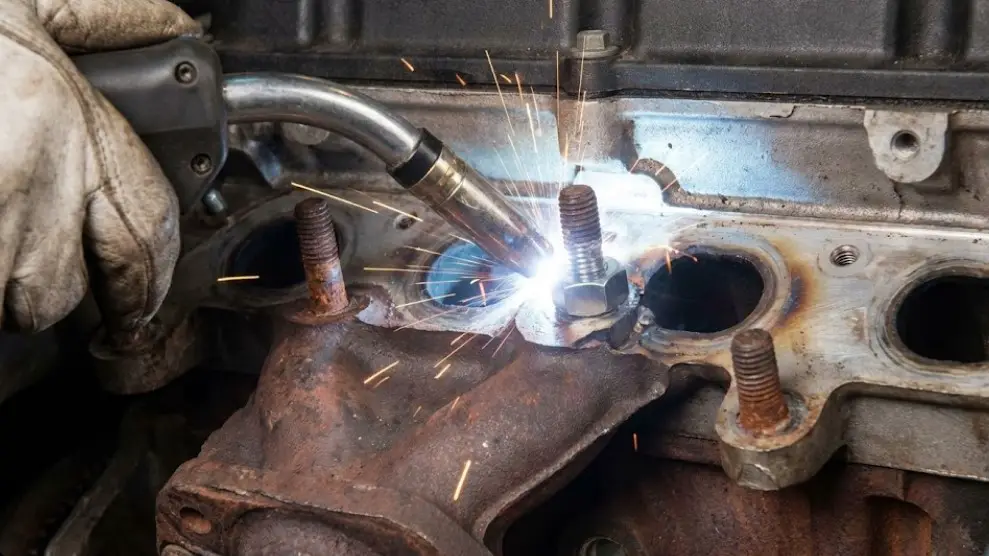
The single most significant variable in the cost equation is the integrity of the fasteners. The phrase “broken stud” strikes fear into mechanics and owners alike.
Metallurgy of Seizure
The failure of exhaust bolts is a result of galvanic corrosion and thermal fatigue.
- Galvanic Cell: The engine block is aluminum (anode), and the bolt is steel (cathode). In the presence of an electrolyte (road salt water), a battery is formed, causing the aluminum to corrode and seize the bolt threads.
- Thermal Fatigue: As the manifold expands and contracts, it bends the bolt back and forth. After millions of cycles, the steel exceeds its fatigue limit and snaps.
Extraction Techniques and Associated Costs
When a bolt breaks, the labor time shifts from “standard book time” to “actual time,” which can be open-ended.
- Weld-Nut Extraction (Preferred):
- Method: A nut is placed over the broken stud (even if flush). A MIG welder fills the nut, bonding it to the stud.
- Physics: The intense heat of welding expands the stud, breaking the rust bond. As it cools, it shrinks slightly, allowing it to be backed out.
- Cost: Most efficient. Adds 0.5 – 1.0 hours labor.
- Drilling and Tapping (High Risk):
- Method: Drilling the center of the bolt and using an extractor (easy-out).
- Risk: The steel bolt is harder than the surrounding aluminum. If the drill walks, it ruins the cylinder head water jacket, potentially totaling the engine.
- Cost: High. Requires template kits. If the head is damaged, costs skyrocket to $3,000+ for head replacement.
- Induction Heating:
- Method: Using an inductive heater (e.g., Mini-Ductor) to heat the fastener to red-hot temperatures within seconds to break rust bonds without an open flame.
Risks of Deferred Maintenance

Ignoring an exhaust leak is economically and physically dangerous. The “it’s just a noise” mentality leads to cascading failures.
Carbon Monoxide (CO) Intrusion
The most immediate threat is to human health.
- Mechanism: Truck cabin air intakes are located at the base of the windshield (the cowl). An exhaust leak in the engine bay releases CO directly into this low-pressure zone. The HVAC system then sucks this gas into the cabin.
- NHTSA Data: Investigations into vehicles like the Ford Explorer have linked exhaust leaks to driver drowsiness, nausea, and loss of consciousness.
- Symptoms: “Flu-like” symptoms without fever—headache, dizziness, weakness.
Valve Train Damage (Burnt Valves)
- Reversion: Exhaust flow is not continuous; it pulses. Between pulses, a vacuum can form (reversion). A leak allows cool ambient air to be sucked back into the exhaust port.
- Thermal Shock: This cool air hitting a red-hot exhaust valve (1,400°F) causes rapid cooling, leading to warping or cracking of the valve.
- Consequence: A burnt valve causes a loss of compression and a dead cylinder. The repair requires removing the cylinder head and a valve job, costing $2,000 – $4,000.
Catalytic Converter Meltdown (P0420)
- The Chain Reaction: Leak -> O2 Sensor reads Lean -> ECU adds Fuel -> Engine runs Rich -> Unburned fuel enters Catalytic Converter -> Fuel burns inside Converter -> Substrate melts.
- Cost: OEM converters are mandated by federal law to last 8 years/80k miles, but abuse from a rich condition is not covered. Replacement costs range from $1,000 to $2,500.
Parts Market: OEM vs. Aftermarket
Truck owners face a choice between OEM parts and aftermarket solutions.
Gaskets: Material Science
- Recommendation: Always use Multi-Layer Steel (MLS) gaskets.
- Brands: Fel-Pro and Mahle are the industry leaders. Mahle is often the OEM supplier for imports; Fel-Pro is dominant for domestics.
- Why MLS? The multiple layers of spring steel allow the manifold to slide across the head surface during expansion without tearing the gasket, unlike older graphite designs.
Manifolds: Dorman vs. OEM
- Dorman (Aftermarket): A major supplier of replacement manifolds.
- Pros: Significantly cheaper ($100 vs $300+), lifetime warranty, often reinforced in areas where OEMs failed.
- Cons: Casting quality can be rough. Flanges sometimes need to be surfaced flat before installation to ensure a seal.
- OEM: Guaranteed fit, but often the exact same design that failed originally (e.g., Ram Hemi logs).
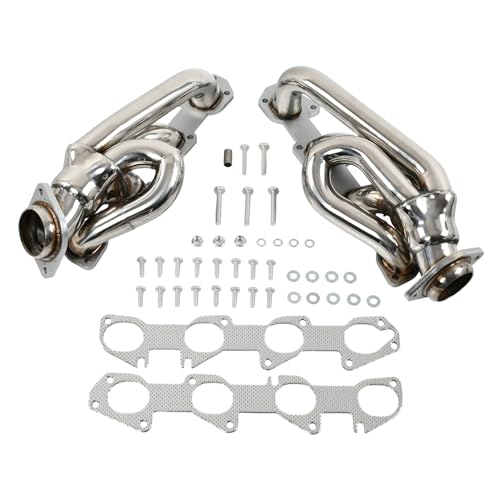
- Headers (Performance): Shorty headers (stainless steel) are a popular upgrade for Ram and Ford owners. They flow better and the thick steel flanges (3/8″ or 1/2″) are less prone to warping than cast iron. However, installation is tighter and hardware access is more difficult.
Warranty and Insurance Coverage
Powertrain Warranty
Manufacturer powertrain warranties (typically 5yr/60k or 5yr/100k miles) do cover exhaust manifolds, gaskets, and broken bolts. These are considered part of the engine assembly. If a bolt breaks inside the warranty period, the dealer must extract it and replace the manifold.
Federal Emissions Warranty (8/80)
There is a misconception that the “8 year / 80,000 mile” federal emissions warranty covers manifolds.
- Reality: The 8/80 warranty strictly lists the Catalytic Converter, ECU, and OBD device. Exhaust manifolds are generally excluded unless the vehicle is a PZEV (Partial Zero Emissions Vehicle) in a CARB state (California, NY, MA, etc.), where coverage may extend to 15 years/150k miles for all emissions parts.
Extended Warranties
Third-party Vehicle Service Contracts (VSC) usually cover manifolds under “Gold” or “Platinum” powertrain plans. However, owners must be wary of “corrosion exclusions.” If the adjuster claims the bolt broke due to rust (not a defect), they may deny the claim.
Repair Methodologies and Labor Time Guide
For the DIY mechanic or fleet manager estimating costs, understanding the labor breakdown is key.
Table 9.1: Estimated Labor Times (Mitchell/AllData Standard)
| Operation | Ford F-150 (5.4L) | Ram 1500 (5.7L) | Chevy Silverado (5.3L) |
| R&R Gasket (One Side) | 3.5 – 5.0 Hrs | 2.8 – 4.0 Hrs | 2.5 – 3.5 Hrs |
| R&R Gasket (Both Sides) | 7.0 – 9.0 Hrs | 5.0 – 7.0 Hrs | 4.5 – 6.0 Hrs |
| Broken Bolt Extraction (Per Bolt) | +0.5 – 1.0 Hr | +0.5 – 1.0 Hr | +0.5 – 1.0 Hr |
| Cab Removal (Extreme Cases) | N/A | N/A (Rare) | N/A |
| Turbo R&R Add-on | +2.0 – 4.0 Hrs (EcoBoost) | N/A | N/A |
Step-by-Step DIY Overview (Ram/Chevy/Ford V8)
- Preparation (Crucial): Soak all nuts in penetrating oil (PB Blaster/Kroil) for 24-48 hours. Remove the front wheels and the plastic inner fender liners. This provides direct access to the side of the engine.
- Removal: Remove the oil dipstick tube (often bolted to the manifold). Unbolt the exhaust flange. Remove manifold bolts.
- Extraction: Identify broken bolts. Use the weld-nut method if possible. If drilling is required, use a right-angle drill and a template.
- Cleaning: Scrape the aluminum head surface with a carbide scraper. Do not use steel wool (it leaves particles that can rust).
- Reassembly: Install the new MLS gasket dry (no RTV sealant). Install new bolts.
- Pro Tip: Use stainless steel bolts with nickel anti-seize to prevent future corrosion.
- Torque: Torque to spec (usually 18-25 ft-lbs) starting from the center bolts and spiraling outward to flatten the gasket.
Conclusion and Recommendations
The replacement of an exhaust manifold gasket is a deceptively simple part failure that masks a complex and expensive repair ecosystem. For truck owners, the data supports the following recommendations:
- Early Intervention: Addressing the “cold start tick” immediately can often save the manifold from permanent warping, potentially reducing the repair cost by $200-$400.
- Comprehensive Repair: When a leak is confirmed on a known problem platform (Ram Hemi, Ford Triton), assume the manifold is warped. Do not pay for labor to install a new gasket on an old manifold; replace the manifold assembly.
- Labor Budgeting: Always budget for broken bolts. If a shop quotes $600, have $1,000 ready. The probability of stud failure in trucks over 5 years old is extremely high.
- Safety First: If the repair must be delayed, install a battery-operated carbon monoxide detector in the cabin. The risk of CO poisoning is statistically significant and life-threatening.
![6.7 Cummins Exhaust Manifold Upgrade [2026]](https://truckguider.com/wp-content/uploads/2026/03/6-7-cummins-exhaust-manifold-upgrade-featured.webp)

![5.7 Hemi Exhaust Manifold Upgrade [2026]](https://truckguider.com/wp-content/uploads/2026/03/featured-5f91c218-768x768.webp)