Ford F150 Check Engine Light Reset 2026: 4 Proven Methods That Work

Yes, you can reset the check engine light on your Ford F-150 at home. The safest way is an OBD-II scanner, used after you find and fix the cause. Check the gas cap first, since it costs nothing.


This guide covers four reset methods, the causes behind the light, and the Ford drive cycle that restores your readiness monitors. It also covers when a reset is the wrong move.
What the Check Engine Light Means on Your F150


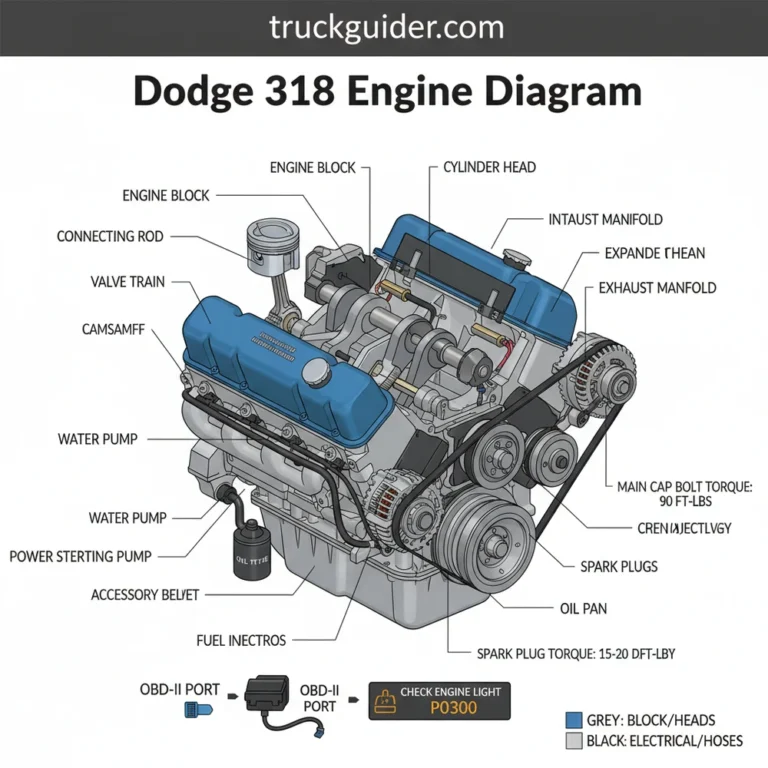
The check engine light is your F-150 malfunction indicator lamp. The powertrain control module (PCM) turns it on when a sensor reports a reading outside its normal range. Every F-150 built after 1996 uses OBD-II.
A steady light means the PCM found a fault that needs attention soon. The truck is usually safe to drive to a shop, but do not ignore it for weeks.
A flashing light means an active misfire is sending raw fuel into the exhaust, and that can overheat the catalytic converter in minutes. Ease off the throttle and get the truck checked right away.
7 Common Causes of a Ford F150 Check Engine Light
Most F-150 lights trace back to a short list of faults. The table pairs each cause with its typical code, symptom, and urgency.
| Cause | Typical Code | Symptom | Urgency |
|---|---|---|---|
| Loose or damaged gas cap | P0455, P0456 | Light only | Low |
| EVAP system leak | P0442, P0455, P0456 | Light only | Low to medium |
| Faulty oxygen sensor | P0135, P0420 | Worse fuel economy | Medium |
| Mass airflow sensor fault | P0101 | Poor acceleration | Medium |
| Worn spark plugs or coils | P0300 | Misfire, rough running | Medium to high |
| Catalytic converter failure | P0420, P0430 | Power loss | High |
| Thermostat fault | P0128 | Slow warm up | Medium |
A loose gas cap is the cheapest fix on this list. The fuel system is a sealed loop, and a broken seal lets vapor escape, which the EVAP system reads as a leak. A Ford service guide lists EVAP leaks, oxygen sensors, and ignition coil misfires among the common causes on 2015 to 2026 F-150 trucks.
Spark plugs and coils cause the misfires F-150 owners report most on high mileage trucks. On EcoBoost engines, a single cylinder misfire can also point to a weak coil, so a persistent P0300 deserves a real diagnosis. The same EVAP codes show up on other full-size trucks, and our guide to resetting a GMC Sierra check engine light follows the same order: read the code, fix the cause, then clear it.
4 Safe Ways to Reset Your F150 Check Engine Light
Fix the cause first, then reset the light. Clearing a code without a repair only buys a short quiet period before the light returns. A dedicated F-150 reset guide covers the same four methods and names the scanner as the most reliable option.
| Method | What It Clears | Settings Lost | Best For |
|---|---|---|---|
| OBD-II scanner | Stored codes only | None | Every reset |
| Gas cap fix | EVAP codes only | None | Loose cap codes |
| Battery disconnect | Codes, learned values | Radio, clock, learning | No scanner available |
| Drive cycle | Runs monitors only | None | Confirming a repair |
The scanner method is the same on other full-size trucks, and our guide to resetting a Ram 1500 check engine light follows the same steps.
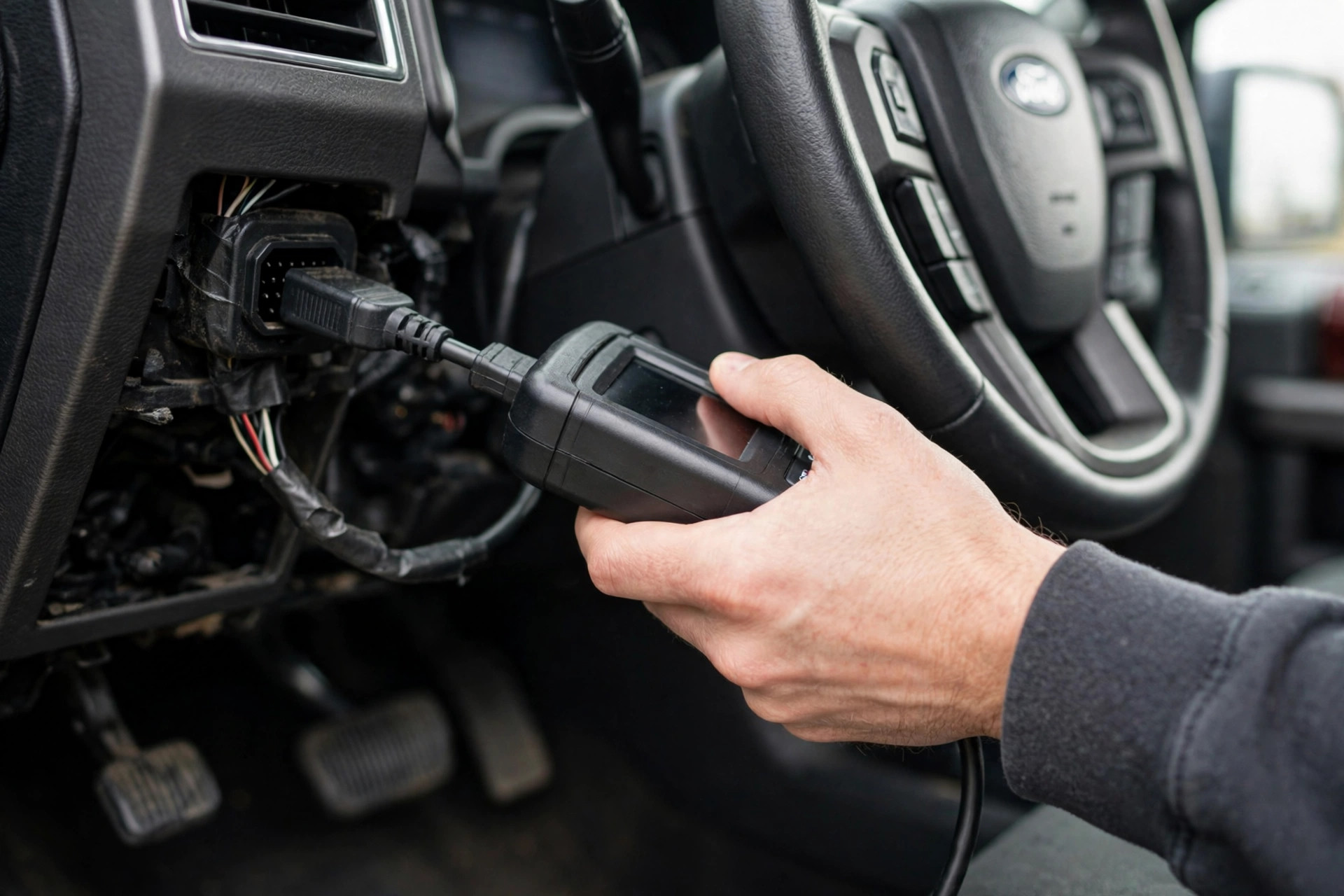
Scan and Clear With an OBD II Scanner
- Turn the engine off and find the 16-pin OBD-II port under the dash on the driver side, near the steering column.
- Plug in the scanner and turn the ignition to ON without starting the engine.
- Read the codes and write them down before you clear anything.
- Fix the fault the code points to, then choose Clear Codes or Erase DTCs on the scanner.
- Start the engine, idle for two to three minutes, then take a short drive.
This method is the only one that shows you the code before it clears it. Basic scanners start near $20, and many auto parts stores read codes for free. For the full sequence, see how to reset a Ford check engine light with a scanner.
Tighten or Check the Gas Cap


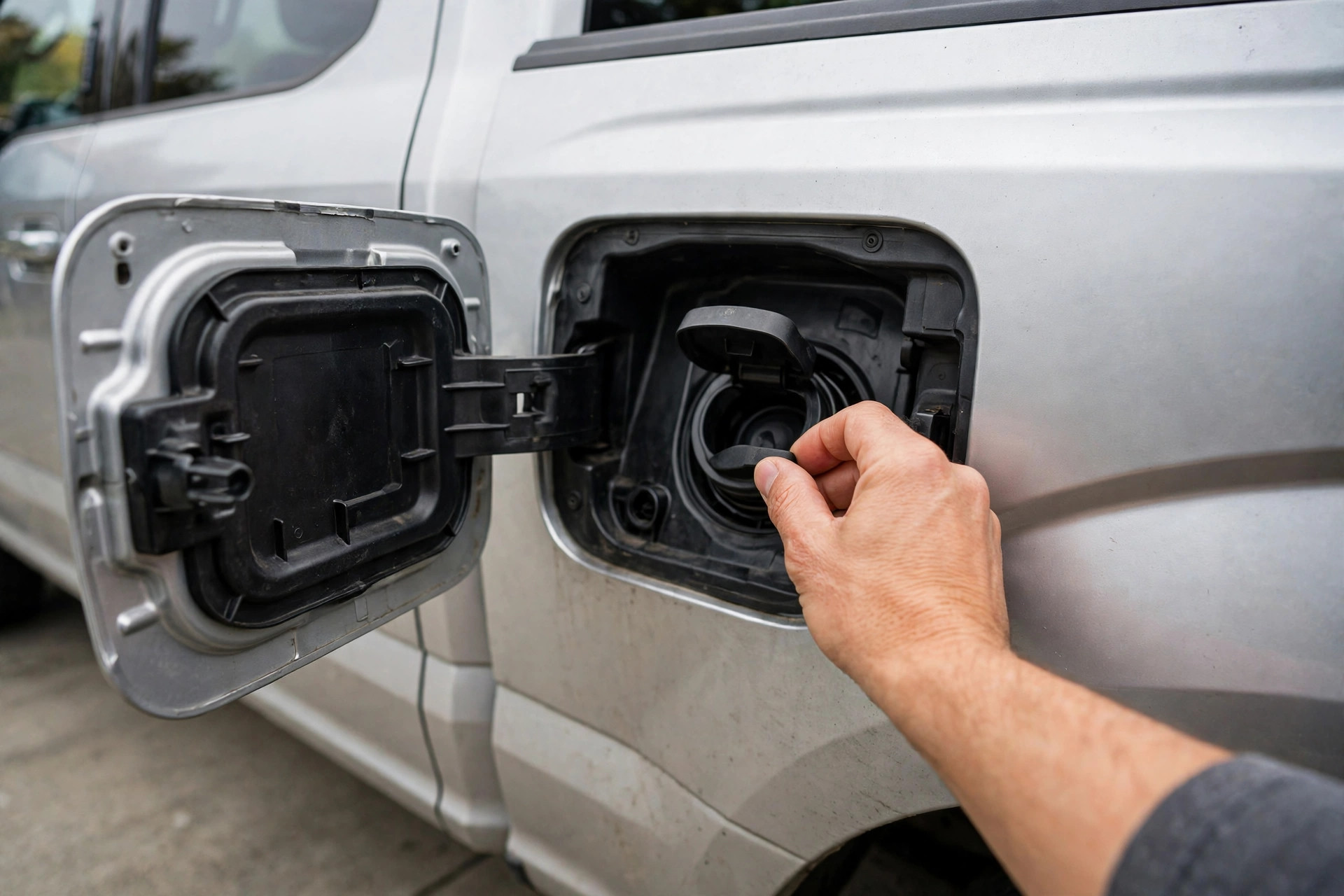
Open the fuel door and check the seal. On 2009 and newer F-150s, Ford uses a capless Easy Fuel filler, so inspect the spring loaded flap for grit or damage and clean the filler neck if dirt is present. On older trucks, check the rubber seal for cracks or wear, then screw the cap back on until it clicks.
A loose cap code does not clear at once. The PCM must run its EVAP test over several drive cycles, so the light may take a few days of normal driving to go out.
Disconnect the Battery as a Last Resort
Use this method only when you have no scanner. Turn the engine off, put on gloves and eye protection, and remove the negative (black) cable first with a 10 mm wrench. Leave it off for at least 15 minutes.
Reconnect the negative cable and tighten it firmly. Expect to lose radio presets and the clock, plus a rough idle or firm shifts for the first miles while the truck relearns.
On 2021 and newer F-150s, the extra electronics make this trade-off steeper. If the tire pressure light comes on after the reconnect, our Ford F150 TPMS reset guide covers the relearn steps.
Never bridge the battery terminals together or disconnect the battery with the engine running. Both moves can damage modules.
Complete a Drive Cycle After Reset
A reset clears codes, but it also clears the readiness monitors. Those monitors are self tests the PCM runs during driving, and an emissions test will fail while they read Not Ready.
Ford F150 Check Engine Light Reset at a Glance
Read the code. Plug an OBD-II scanner into the port under the driver side dash and note every stored code.
Fix the cause. Repair the fault the code points to before you clear anything.
Clear the code. Use Clear Codes after the repair, then idle the engine for two to three minutes.
Run the drive cycle. Drive the Ford cycle so the readiness monitors set again.
What the Ford Drive Cycle Does After a Reset
The Ford drive cycle is a set pattern of cold start, idle, acceleration, steady speed, and coasting. The Ford F150 drive cycle guide lists the same sequence with its fuel level and temperature preconditions.
- Cold soak the truck for at least eight hours, with fuel between 15 and 85 percent and outside air between 50 and 100 degrees.
- Start the engine and idle for four minutes.
- Idle in Drive for 40 seconds with your foot on the brake.
- Accelerate to 45 mph at one quarter to one half throttle, then hold 45 mph for 30 seconds.
- Stop and idle in Drive for 40 seconds.
- Drive at speeds between 25 and 45 mph for 15 minutes.
- Drive between 45 and 60 mph for eight minutes in high gear.
- Stop and idle for 40 seconds, then drive normally.
A few days of mixed city and highway driving usually sets the same monitors. The EVAP monitor is often the last to run, and it needs a cold soak of about eight hours first.
Do not book an emissions test until a scanner shows the monitors Ready. The New York DMV readiness guide explains that a vehicle fails inspection while its monitors read Not Ready, even when the light is off and nothing is broken.
How Reset Steps Change by F150 Generation
The reset methods work on every F-150, but the details shift by generation.
| Generation | Years | Key Engines |
|---|---|---|
| 10th Gen | 1997 to 2003 | 4.2L V6, 4.6L and 5.4L Triton V8 |
| 11th Gen | 2004 to 2008 | 4.2L V6, 4.6L and 5.4L Triton V8 |
| 12th Gen | 2009 to 2014 | 5.0L Coyote V8, 3.5L EcoBoost V6, 6.2L V8 |
| 13th Gen | 2015 to 2020 | 2.7L and 3.5L EcoBoost V6, 5.0L Coyote V8, 3.0L Power Stroke diesel |
| 14th Gen | 2021 to present | 2.7L and 3.5L EcoBoost V6, 5.0L Coyote V8, 3.5L PowerBoost hybrid |
Tenth and 11th generation trucks (1997 to 2008) tolerate a battery disconnect with few side effects. The main loss is radio presets and the clock.
Twelfth and 13th generation trucks (2009 to 2020) added EcoBoost engines and more modules, so a battery reset also wipes learned shift points and idle trim. Fourteenth generation trucks (2021 to present) carry the most electronics, so use a scanner and skip the battery method when you can.
When You Should Not Reset Your Check Engine Light
Do not clear codes before a diagnosis. The stored code is the best clue a mechanic has.
Do not reset the light to pass an emissions test. Clearing codes also clears the readiness monitors, and the station will fail the truck. Repair the fault and test only when the monitors read Ready.
Do not reset a flashing light and keep driving. A flashing light means an active misfire, and the fix is to stop and diagnose. The same rule applies to a light paired with overheating or low oil pressure.
5 Mistakes That Keep Your F150 Light Coming Back
- Clearing the code without fixing the cause. The fault is still there, so the PCM sets the code again.
- Replacing parts by guessing the code. A P0420 can mean a failing catalyst or a weak downstream sensor.
- Ignoring a cracked gas cap seal or a dirty capless flap. A worn seal keeps setting EVAP codes no matter how many times you clear them.
- Testing emissions right after a reset. The monitors read Not Ready, so the test fails even when the repair is sound.
- Using the battery method on a 2021 or newer truck first. It wipes settings across many modules, and a scanner avoids all of it.
Your F150 Check Engine Light Reset in 4 Steps
Read the code with a scanner, fix the fault it points to, clear the code, and run the drive cycle. That order works on every F-150 generation.
If the light returns with the same code after a proper repair, the fault needs a deeper diagnosis. A shop with a professional scan tool can run the monitor tests that a basic reader cannot.
Keep the scanner in the glove box after the repair. The next time the light comes on, you can read the code on the spot and know whether the fix is simple or needs a shop. That habit saves time and guesswork on every F-150 you own.
6 Questions About Resetting Your F150 Check Engine Light
Can I reset the check engine light without a scanner? Yes, by disconnecting the negative battery cable for at least 15 minutes. It wipes radio presets and learned shift points, while a scanner is safer and shows the code first.
Will the light turn off by itself after I fix the problem? Often yes. The PCM clears the light after several drive cycles with no fault detected, and a scanner clears it at once.
How long does the drive cycle take after a reset? The Ford cycle takes about 45 minutes of driving, but the EVAP monitor may need an eight-hour cold soak and a few days of normal driving.
Is it safe to drive with the check engine light on? A steady light with no symptoms is usually safe for a short drive to a shop. A flashing light means an active misfire, so stop driving.
Why did the light come back after I cleared it? The fault is still present, so the PCM sets the code again once its test runs. Read the code again and fix the cause.
Will disconnecting the battery erase my door code? No, the factory keyless entry code lives in the body control module and survives a battery disconnect. If you lost the code, our guide to resetting a Ford F150 door code without the factory code shows the recovery steps.