Ford F150 Serpentine Belt Diagram: All Engines and Years 1997-2026

Ford F150 serpentine belt routing depends on which of seven engine families sits under the hood, not just the model year. A 1997 4.2L V6 routes completely differently than a 2022 3.5L EcoBoost, and even trucks with the same engine split into different pulley counts depending on whether they have air conditioning.
Guessing wrong here does not just mean a squealing belt. It can mean a dead alternator, no power steering, or an overheated engine within minutes.

Prime for Young Adults — 6 Months Free
Students and 18–24s get six months of Prime free, then half price.
Start 6 Months FreeThis guide breaks down routing by engine family so you can go straight to the diagram that matches your truck, confirm your pulley count, and see the tensioner tool size before you start. We will also flag the one configuration almost every other guide misses: the dual belt setup on trucks equipped with Pro Power Onboard.
Ford F150 Serpentine Belt Guide By Engine
Belt count, pulley count, and tensioner tool size for every F150 engine family
4.2L V6
1997 to 2008
4.6L V8
1997 to 2010
5.4L V8
1997 to 2010

Audible — Listen Free for 30 Days
One free credit a month and thousands of titles included.
Listen Free for 30 Days5.0L Coyote V8
2011 to present
3.5L EcoBoost V6
2011 to present
2.7L EcoBoost V6
2015 to present
3.3L Ti VCT V6
2018 to present
Audible Premium Plus — Annual Membership
12 audiobook credits up front, plus the full Audible catalogue.
See Annual PlansPro Power Onboard
2.7L, 3.5L, 5.0L option
Pulley count varies with AC equipment. Confirm exact belt length and part number against your VIN before ordering.
Identify Your Ford F150 Engine Before Routing The Belt
Recommended Best Deal Products


Before touching a wrench, confirm exactly which engine is in your truck. The engine code is usually stamped on a sticker in the driver door jamb, and it also appears on the engine cover itself on most V8 and EcoBoost models.
Ford has used seven distinct engine families in the F150 since 1997:
- 4.2L Essex V6 (1997 to 2008)
- 4.6L Triton V8, 2 valve and 3 valve versions (1997 to 2010)
- 5.4L Triton V8, 2 valve and 3 valve versions (1997 to 2010)
- 5.0L Coyote V8 (2011 to present)
- 3.5L EcoBoost V6 (2011 to present, including PowerBoost hybrid)
- 2.7L EcoBoost V6 (2015 to present)
- 3.3L Ti VCT V6 (2018 to present)
Two trucks with the identical engine can still route differently if one has air conditioning and the other does not, since the AC compressor adds a pulley to the path. If you are cross shopping parts across years, our F150 parts interchangeability guide covers which components actually swap between generations.
Once you know your engine, jump to the matching section below.
42L V6 Serpentine Belt Diagram 1997 To 2008
The 4.2L V6 is the simplest routing on this list, with the belt driving the alternator, power steering pump, and water pump directly off the crankshaft pulley. Trucks with air conditioning add the AC compressor into the same single belt loop, which changes the pulley count from six or seven pulleys up to eight depending on model year.
To release tension, use a 15mm socket on a breaker bar and rotate the tensioner arm counterclockwise. Slide the belt off the alternator first, then work it free from the remaining pulleys before releasing the tensioner slowly.
A belt routing diagram sticker is usually present on the radiator support or the underside of the hood. If yours has worn off, photograph the old belt’s path before removing it so you have your own reference.
46L And 54L V8 Serpentine Belt Diagram 1997 To 2010
Recommended Best Deal Products


The 4.6L and 5.4L Triton V8 engines share the same basic belt architecture across both the 2 valve and 3 valve variants, running the belt around the crankshaft, alternator, power steering pump, water pump, and AC compressor when equipped.
These two engines cover the widest year span of any F150 engine family, powering trucks from the original 1997 redesign through the final year before the 2011 Coyote switch.
Release the main tensioner with a 15mm or 16mm socket, rotating counterclockwise, then walk the belt off the pulleys starting at the alternator. A-Premium and other OEM cross reference parts confirm that later 4.6L and 5.4L trucks (2002 to 2010) used a dedicated AC belt tensioner separate from the main accessory tensioner, so budget for two tensioner locations if your truck has AC.
If your belt has already snapped and you are also seeing timing related symptoms, confirm the two are not related before you start. Our F150 timing chain replacement cost breakdown explains what a timing chain failure actually looks like compared to a simple belt issue.
50L Coyote V8 Serpentine Belt Diagram 2011 To Present
The 5.0L Coyote is where routing gets more involved. Starting in 2011, Ford split the accessory drive into two separate belts on most trims: a main serpentine belt that drives the alternator, water pump, and idler pulleys, and a second independent AC belt that drives only the compressor. Both belts share the crankshaft pulley but ride on their own tensioners.
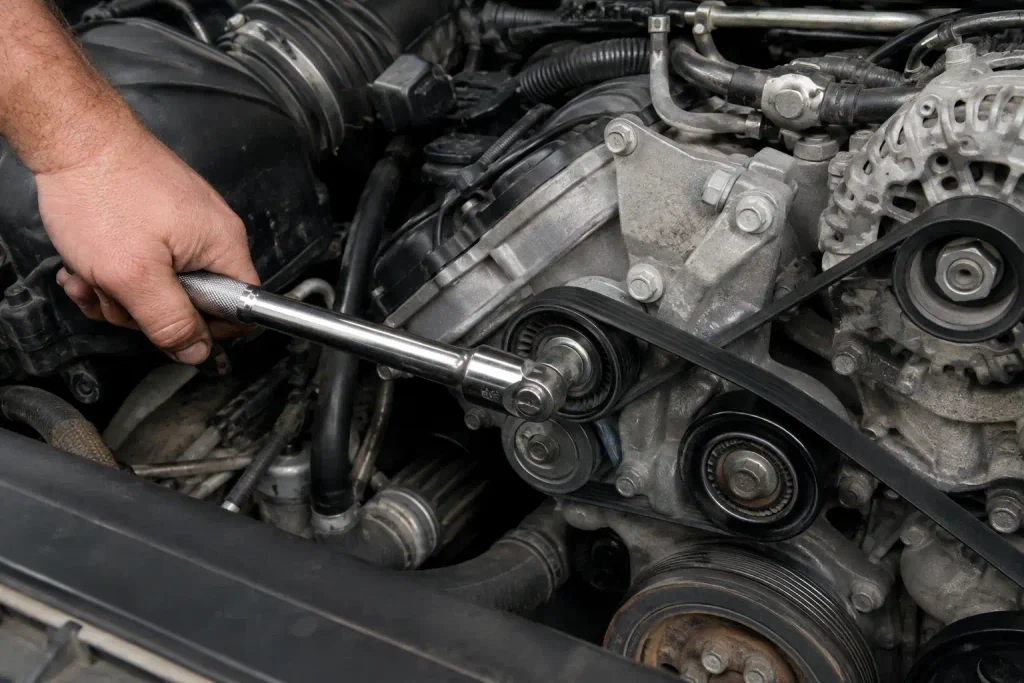
For the main belt, locate the tensioner at the bottom right of the engine and release it with a 15mm socket on a breaker bar, rotating counterclockwise. The AC belt tensioner sits at the upper left of the engine and is typically accessed with a 13mm or 15mm socket, though on many trucks you will need to remove the main belt and its tensioner first just to create clearance to reach the AC belt.
This two belt layout applies consistently to 2011 through 2016 trucks across trims including XL, STX, FX2, FX4, Lariat, King Ranch, and Platinum. A real world Motorcraft cross reference part, JK6-645, is documented as fitting the 2011 to 2014 5.0L main serpentine belt, which is useful if you want to confirm you are looking at the correct listing before buying.
27L And 35L EcoBoost Serpentine Belt Diagram 2011 To Present
Recommended Best Deal Products


Standard 2.7L and 3.5L EcoBoost trucks use a single serpentine belt driving the alternator, water pump, power steering, and AC compressor around the turbocharged V6 layout, similar in concept to the Coyote’s main belt.
Here is the configuration most competing guides miss entirely. Trucks equipped with the Pro Power Onboard generator option, specifically the 2.0 kW system available on gas powered 2.7L, 3.5L EcoBoost, and 5.0L trucks, use a genuinely different setup.
These trucks run a 24 volt electrical system built from two conventional 12 volt batteries wired in series, feeding a 2,000 watt pure sine wave inverter through a second alternator.
According to owners who have referenced the belt routing section of their Ford owner’s manual, this configuration is documented there as a dual serpentine belt and dual alternator layout, distinct from the standard single alternator setup on trucks without Pro Power Onboard.
If your truck has the Pro Power Onboard hard button on the dash or center display, or bed mounted 120 volt outlets rated at 2.0 kW or higher, check for a second belt and second alternator before you assume single belt routing applies.
Confirm your exact routing against the diagram sticker under your hood, since this is a case where guessing wrong leaves you short a belt mid job.
Trucks in this power range also intersect with a known reliability issue worth knowing about. Our EcoBoost timing chain recall coverage explains which EcoBoost model years were affected and how to check if your VIN is included.
33L V6 Serpentine Belt Diagram 2018 To Present
The 3.3L Ti VCT V6 is the simplest belt routing in the modern F150 lineup, running a single belt around the crankshaft, alternator, power steering pump, water pump, and AC compressor with no dual belt variant offered on this engine.
Release the tensioner with a 15mm socket, rotating counterclockwise, and slide the belt free starting at the alternator pulley. Because this is the base engine on new F150 trucks, expect fewer aftermarket accessory pulleys competing for space compared to the V8 and EcoBoost layouts.
Ford F150 Serpentine Belt Reference Chart By Engine
Use this chart to confirm your engine’s belt configuration at a glance before you start the job. Exact belt length and OEM part number vary by trim, model year, and AC equipment within each engine family, so match your belt to your VIN at a parts counter or measure your old belt directly rather than ordering from engine size alone.
| Engine | Years | Belt Count | Tensioner Tool |
|---|---|---|---|
| 4.2L V6 | 1997 to 2008 | Single belt, AC adds a pulley | 15mm socket |
| 4.6L V8 | 1997 to 2010 | Single belt, separate AC tensioner on AC trucks | 15mm to 16mm socket |
| 5.4L V8 | 1997 to 2010 | Single belt, separate AC tensioner on AC trucks | 15mm to 16mm socket |
| 5.0L Coyote V8 | 2011 to present | Two belts, main plus separate AC belt | 15mm main, 13mm to 15mm AC |
| 3.5L EcoBoost V6 | 2011 to present | Single belt standard, dual belt with Pro Power Onboard | 15mm socket |
| 2.7L EcoBoost V6 | 2015 to present | Single belt standard, dual belt with Pro Power Onboard | 15mm socket |
| 3.3L Ti VCT V6 | 2018 to present | Single belt, no dual variant | 15mm socket |
Common Ford F150 Serpentine Belt Mistakes
Mixing Up AC And Non AC Diagrams
The most common source of confusion in F150 belt forums is applying an AC routing diagram to a non-AC truck or vice versa, since the pulley count changes between the two even on the identical engine.
Always confirm whether your compressor pulley is actually connected to the belt path before assuming a diagram applies. If your AC system itself is acting up independent of the belt, our F150 air conditioning troubleshooting guide walks through diagnosing compressor and clutch issues separately from belt problems.
Installing The Belt Backward
A serpentine belt has a ribbed side that must sit in the grooved pulleys and a smooth back side that only contacts flat idler pulleys. Installing it backward causes immediate squealing and rapid wear, so double check the rib orientation against your reference photo before you release the tensioner fully.
Skipping The Tensioner Inspection
Replacing the belt without checking the tensioner spring and idler pulleys for play or noise is the fastest way to end up back under the hood within a few months. If the tensioner arm does not snap back firmly when released, replace it alongside the belt rather than reusing a worn unit.
Match The Diagram To Your Engine First
Getting F150 belt routing right starts with identifying your exact engine and AC configuration, not just your model year. The Coyote V8 and EcoBoost trucks equipped with Pro Power Onboard are the two configurations most likely to catch DIYers off guard with a second belt they were not expecting.
Keep the reference chart above open while you work, and confirm your specific belt length against your VIN or your old belt rather than guessing from engine size alone. A correctly routed belt should run quiet and smooth within the first few minutes of driving.
Frequently Asked Questions
How many pulleys does a Ford F150 serpentine belt have?
Pulley count ranges from six on the simplest non-AC 4.2L V6 setups up to eight or more on V8 and EcoBoost trucks with air conditioning and power steering both on the main belt. Trucks with a separate AC belt, like the 5.0L Coyote, split those pulleys across two belts instead of one.
Is the F150 serpentine belt routing different with air conditioning?
Yes, AC equipped trucks add the compressor pulley into the belt path, which changes both the pulley count and the physical routing compared to a non-AC truck with the same engine. Always confirm your AC equipment before following a diagram meant for the other configuration.
What tool do I need to release the F150 belt tensioner?
Most F150 tensioners release with a 15mm socket on a breaker bar rotated counterclockwise, though some 4.6L and 5.4L trucks use a 16mm socket and some 5.0L AC tensioners use 13mm. Check your specific engine section above before buying a single size.
Does the 27L EcoBoost F150 have two serpentine belts?
Only if it is equipped with the Pro Power Onboard 2.0 kW generator option, which adds a second alternator and second belt for the truck’s 24 volt inverter system. Standard 2.7L EcoBoost trucks without that option run a single belt.
How often should the F150 serpentine belt be replaced?
Most F150 belts last well past 60,000 miles when EPDM rubber construction is used, though the real signal is condition rather than a fixed mileage. Replace it at the first sign of visible cracking, glazing, or a chirping noise on cold starts, and inspect it during every oil change once the truck passes 60,000 miles.