P0087 Duramax: Code Causes Symptoms and Fix by Generation 2026

P0087 on a 6.6L Duramax Turbo Diesel means the ECM has detected fuel rail pressure that’s dropping below what it’s commanding, most often below roughly 3,263 PSI, and it usually shows up under acceleration, towing, or wide-open throttle when fuel demand spikes.
The code spans every generation of the 6.6L Duramax, from the 2001 LB7 through the current L5P, but the root cause is not the same truck to truck. Early CP3-pumped trucks fail differently than the CP4-equipped LML and L5P, and GM has documented technical bulletins for both patterns.

Prime for Young Adults — 6 Months Free
Students and 18–24s get six months of Prime free, then half price.
Start 6 Months FreeGuessing at parts before you know which generation you’re driving is how a $100 fuel line repair turns into a $2,500 pump swap you didn’t need. Which fix applies to you depends on which Duramax generation you’re driving, so start there.
P0087 Duramax: Diagnose By Generation
Low fuel rail pressure means something different on every 6.6L Duramax generation
LB7, LLY, LBZ
- Primary Cause
- Worn injectors leaking excess return, or a weakening CP3 pump
- Typical Fix
- Injector diagnosis, CP3 pump or injector set replacement
- Repair Cost
- $1,000-$5,000
- GM Bulletin
- PI0474
LMM
- Primary Cause
- Rubber fuel supply line kinking or collapsing under heat and load
- Typical Fix
- Rubber fuel line section replacement
- Repair Cost
- $100-$200
- GM Bulletin
- PIP4526
LML, L5P
- Primary Cause
- Bosch CP4 pump wear, prone to catastrophic failure
- Typical Fix
- CP4 to CP3 conversion, or full fuel system repair
- Repair Cost
- $1,800-$10,000+
- GM Bulletin
- PIP4949E
3-Step Diagnostic Checklist
- Replace the fuel filter if overdue, then test low-pressure vacuum under load (5-8 inHg is normal)
- Confirm your RPO code (VIN digit 8 or door jamb QR code) and match your generation above
- Scan-tool compare desired vs. actual rail pressure at wide-open throttle to confirm the cause
What Duramax Generation Determines Your P0087 Fix
Recommended Best Deal Products


Not every Duramax generation throws P0087 for the same reason, and identifying yours takes about two minutes. The fastest way is the 8th digit of your VIN: a “1” means LB7, a “2” means LLY, a “D” means LBZ, a “6” means LMM, an “8” means LML, and a “Y” means L5P. On 2018-and-newer trucks, GM moved this information to a QR code on the door jamb weight rating sticker.
LB7 LLY and LBZ 2001 to 2007
These are the CP3-pump, pre-DPF trucks. LB7 covers 2001 through early 2004, LLY covers 2004.5 through 2005 (and continued into 2006 with a recalibration), and LBZ covers 2006 through 2007. P0087 on these trucks typically comes down to worn injectors or a weakening CP3 pump.
LMM 2007.5 to 2010
LMM introduced the Diesel Particulate Filter and a new GMT900 body style, but it still runs a CP3 pump. On this generation, P0087 is most often mechanical rather than pump-related: a collapsing or kinked rubber fuel supply line.
LML and L5P 2011 to Present
LML (2011-2016) switched to a Bosch CP4 pump, a change GM carried into the L5P (2017-present). This is the generation most associated with catastrophic, expensive P0087 failures, and it’s the one GM has an active technical bulletin for.
Start with your generation below to get the right diagnosis.
P0087 Causes on LB7 LLY and LBZ Duramax Engines
If you’re driving a 2001-2007 LB7, LLY, or LBZ Duramax, P0087 usually points to excessive injector return flow overwhelming the CP3 pump’s ability to keep up, not a mechanical restriction.
According to a diesel repair shop’s technical writeup on the issue, injectors with worn internal clearances can leak fuel back to the return line at roughly double the factory-spec rate, and GM has documented this wear pattern under bulletin PI0474.

Audible — Listen Free for 30 Days
One free credit a month and thousands of titles included.
Listen Free for 30 DaysBalance rate tests at idle often come back normal even when the injectors are the problem, because the excessive return only shows up under load and higher fuel temperatures, so a clean balance rate test at idle does not rule injectors out.
If your fuel filter is fresh and the low-pressure side of the system checks out (5-8 inHg of vacuum under load is the commonly cited normal range), the next step is a CP3 pump or injector diagnosis rather than more filter changes.
A remanufactured CP3 pump for this generation runs roughly $650-$840 in parts alone, and shops report 6-18 hours of labor depending on the truck, which realistically puts a pump-only repair in the $1,000-$2,000 range before injectors are considered.
If injectors turn out to be the cause, expect that number to climb further. A remanufactured set of 8 stock-power injectors for LB7 through LBZ trucks typically runs $1,968-$2,750 in parts alone,
and owners doing the job themselves report total costs around $2,800 once lines and seals are included, while shop quotes for a full set with labor commonly land in the $3,000-$5,000-plus range.
If your truck is a 2007.5-2010 LMM, the cause is usually mechanical, not the pump.
P0087 Causes on 2007 to 2010 LMM Duramax Trucks
On the 2007.5-2010 LMM, P0087 is frequently a mechanical fuel line problem rather than a failing pump, and GM has a specific bulletin covering it. GM bulletin PIP4526 (“Diesel Engine Fuel Line Repairs,” issued November 2008) covers 2001-2007 Silverado/Sierra
Classic and 2007-2009 Silverado/Sierra trucks equipped with LB7, LBZ, LLY, or LMM engines, and it identifies the rubber section of the fuel supply (suction) line as prone to kinking or collapsing, which restricts fuel flow and sets P0087, P0093, or P1093.
Audible Premium Plus — Annual Membership
12 audiobook credits up front, plus the full Audible catalogue.
See Annual PlansThe symptom pattern is distinctive: the truck runs fine cold, then loses power or drops into limp mode after 30-90 minutes of driving, especially while towing or holding steady highway RPM under load, because the rubber line softens with heat before it collapses.
GM’s fix in the bulletin is to replace only the affected rubber section rather than the entire hard line assembly. Complete low-pressure fuel hose kits for LBZ/LMM trucks run roughly $100-$180 depending on the brand, well under what a pump replacement costs, which makes this one of the cheapest fixes covered in this article once you’ve confirmed it’s actually the cause.
Some owners pair this fix with a lift pump install to reduce strain on the CP3 going forward, though GM’s bulletin itself only calls for the line repair.
LML and L5P owners are dealing with a different and more expensive problem: CP4 pump wear.
P0087 Causes on LML and L5P Duramax Engines
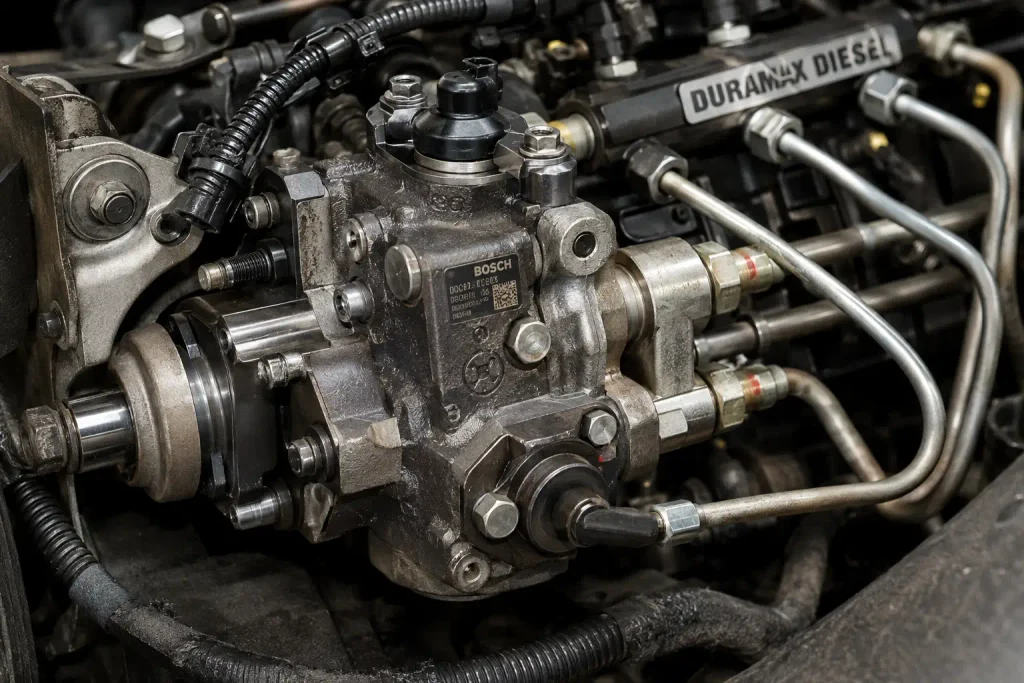
On LML and L5P Duramax trucks, P0087 is most often tied to CP4 pump wear, and GM has a documented technical bulletin covering the related hard-start pattern. GM bulletin PIP4949E (“Duramax Diesel Hard Start No Start P0087 P0088 P0191 P128E,” June 2015) covers 2010-2015 Silverado,
Sierra, Express, and Savana trucks with LGH and LML engines, and it instructs technicians to inspect Fuel Pressure Regulator 1 for magnetic metal debris before condemning the injection pump.
That debris warning matters because CP4 failures on this platform are frequently catastrophic rather than gradual. One documented case involved fuel pressure at wide-open throttle reading 18,000 PSI against a commanded 26,000 PSI before the pump failed outright.
When a CP4 comes apart internally, metal debris spreads through the injectors, rails, and lines, and a full fuel system replacement after a catastrophic CP4 failure commonly runs in excess of $10,000.
Because of that risk, a preventive CP4-to-CP3 conversion is a common route for LML and L5P owners who catch P0087 early rather than waiting for full failure.
Aftermarket CP3 conversion kits for the LML currently run roughly $1,780-$3,257 depending on the brand and whether the kit includes a new CP3 pump, and shop labor for the swap is commonly quoted around $500-$1,800 depending on region and whether tuning is required.
That’s a meaningful expense, but it’s a fraction of the cost of a metal-debris CP4 failure working through the entire fuel system.
Whichever generation you have, the same quick diagnostic steps confirm the cause before you spend money.
How To Diagnose P0087 In 3 Steps
Once you know your generation, confirming the cause of P0087 takes three checks before you order any parts.
| Step | What To Do | What It Tells You |
|---|---|---|
| 1. Check the supply side | Replace the fuel filter if overdue, then test low-pressure vacuum at the filter housing under load (5-8 inHg is the commonly cited normal range) | High vacuum points to a restriction such as a collapsed line or clogged filter |
| 2. Match your generation | Confirm your RPO code (LB7, LLY, LBZ, LMM, LML, or L5P) via VIN digit 8 or door jamb QR code | Routes you to the correct branch above: injector/pump wear, fuel line collapse, or CP4 wear |
| 3. Scan-tool confirm | Compare desired vs. actual rail pressure at wide-open throttle, or run the LBZ Enhanced Injector Return Flow Test if injectors are suspected | A large gap between desired and actual pressure under load confirms a supply or pump problem rather than a sensor fault |
A few symptom patterns show up across every generation and are worth knowing regardless of which Duramax you own.
Common Symptoms That Come With A P0087 Code
Regardless of generation, P0087 tends to arrive with a consistent set of warning signs:
- Reduced power or limp mode under acceleration, towing, or sustained highway load
- A “Change Fuel Filter” dash message, sometimes appearing within 500-2,000 miles of a fresh filter if rail pressure is already low, which can be a false alarm rather than an actual filter problem
- Surging or rough idle, more commonly reported on LMM and LML trucks
- Related codes appearing alongside P0087, most often P0088, P0093, P0191, P128E, and P1093, depending on generation
Ignoring these symptoms risks turning a low-cost fuel line or filter fix into a full fuel system failure, particularly on CP4-equipped LML and L5P trucks where the failure mode is abrupt rather than gradual.
If your fuel rail pressure sensor readings look erratic rather than consistently low under load, it’s also worth ruling out the sensor itself before replacing supply-side parts, since sensor symptoms and pump or line symptoms can overlap.
Fix P0087 Based On Your Duramax Generation Not Guesswork
P0087 on a 6.6L Duramax always means the same thing electronically (low fuel rail pressure) but almost never the same thing mechanically. LB7 through LBZ trucks usually point to worn injectors or a tired CP3 pump. LMM trucks are frequently a collapsed rubber fuel line covered under GM’s own bulletin.
LML and L5P trucks carry the highest financial risk, since CP4 wear can escalate into a full fuel system failure if it’s ignored. Confirm your generation, run the three diagnostic checks above, and test before you order parts. That sequence is what separates a $150 fuel line repair from a $10,000 fuel system replacement.
Duramax P0087 Frequently Asked Questions
What does P0087 mean on a Duramax?
P0087 means the engine control module has detected fuel rail pressure dropping below the commanded level, most often below roughly 3,263 PSI. It typically shows up under acceleration, towing, or wide-open throttle when fuel demand increases.
Can I drive with a P0087 code?
You can drive short distances, but the truck will likely enter limp mode under load, and continuing to drive with unresolved low rail pressure risks further damage to injectors or the pump. It’s best treated as a diagnose-soon rather than drive-normally code.
Is P0087 always the CP4 pump?
No. CP4 wear is the leading cause on 2011-and-newer LML and L5P trucks specifically, but on 2001-2010 CP3-equipped trucks (LB7 through LMM), the cause is more often a collapsed fuel line, a worn injector, or a restricted filter.
How much does it cost to fix P0087 on a Duramax?
Cost depends heavily on cause and generation. A fuel line repair on an LMM runs well under $200 in parts, a CP3 pump replacement typically lands in the $1,000-$2,000 range with labor, and a preventive CP4-to-CP3 conversion on an LML runs roughly $1,800-$3,500 installed, compared to $10,000-plus for a catastrophic CP4 failure repair.
Does a fuel filter change fix P0087?
Sometimes. A clogged or overdue filter is one of the most common causes of low rail pressure and is the first thing to rule out. If a fresh filter doesn’t resolve the code, the cause is likely further upstream, such as a fuel line restriction or pump wear, and confirming your engine’s cylinder and component layout can help when working through the rest of the diagnostic steps.