
P0344 Code Dodge: Diagnose & Fix [2026]

P0344 Code Dodge: Diagnosing Camshaft Position Sensor Circuit Intermittency
For Dodge owners, a P0344 diagnostic trouble code can transform a reliable daily driver into an unpredictable vehicle that stalls at intersections or refuses to accelerate. This code signals an intermittent interruption in the Camshaft Position Sensor circuit, a fault that is notoriously difficult to pin down because it often disappears during standard shop testing. Unlike static circuit failures, an intermittent signal requires a comprehensive understanding of the vehicle’s electrical architecture to resolve permanently. This complete guide provides a professional technical analysis of the P0344 fault, covering its specific symptoms in Dodge vehicles, the most frequent root causes, and a reliable diagnostic path to ensure a permanent repair.
Understanding the P0344 Code Dodge Technical Definition
📤 Share Image
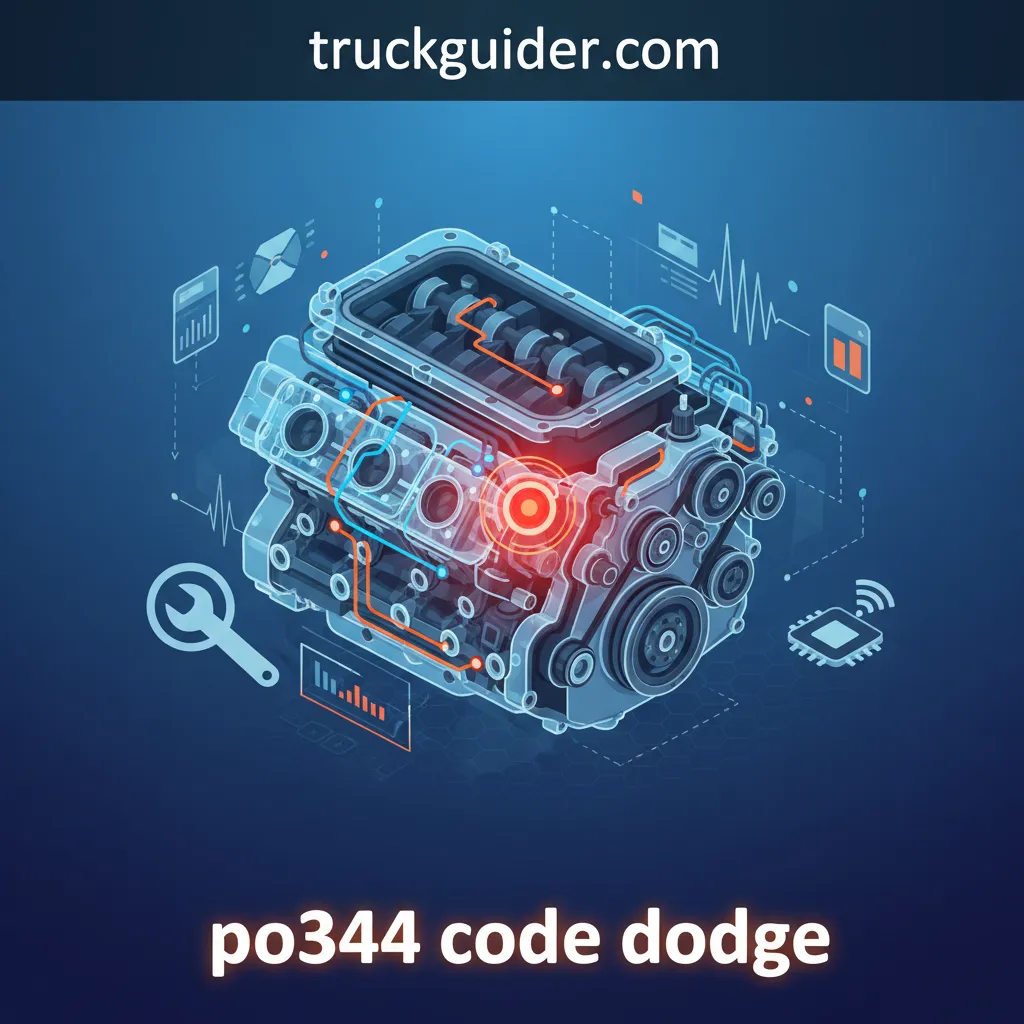
The P0344 code is defined as “Camshaft Position Sensor Circuit Intermittent.” In the Chrysler/Dodge diagnostic framework, this specifically identifies a problem with Bank 1. The Powertrain Control Module (PCM) relies on the Camshaft Position (CMP) sensor to determine the position of the camshaft(s) relative to the crankshaft. This data is paramount for managing fuel injection synchronization and identifying which cylinder is on its compression stroke.
Dodge vehicles predominantly use Hall Effect sensors. These sensors generate a digital square wave signal by reacting to a magnetic field interrupted by a tone ring (reluctor wheel) attached to the camshaft. The PCM provides a steady 5-volt reference signal and a ground. As the camshaft rotates, the sensor toggles the signal return wire between high and low voltage. If the PCM detects that this signal is lost, erratic, or fluctuates outside of defined parameters for a specific duration, it triggers the P0344 code.
P0340 vs. P0344: Crucial Distinctions
It is vital for an expert technician to distinguish between P0340 and P0344. While P0340 indicates a total circuit malfunction (often a “dead” sensor or broken wire), P0344 suggests the signal is present but inconsistent. The PCM typically looks for a signal pulse every 720 degrees of crankshaft rotation. If the pulse is missing for more than 2 seconds, or if the voltage drops below a specific threshold intermittently, the Malfunction Indicator Lamp (MIL) illuminates.
Consider a scenario where a Dodge Charger experiences a momentary signal loss at high RPMs. As the vibrations increase, a loose internal connection in the sensor or a frayed wire in the harness may cause the signal to “dropout” for a millisecond. The PCM immediately loses its timing reference and forces the vehicle into a “limp-mode” state to prevent mechanical synchronization errors.
Identifying Symptoms of P0344 in Dodge RAM and Sedan Models
The manifestation of a P0344 code is rarely subtle. Because the PCM uses the CMP sensor for injector synchronization, any interruption in data leads to immediate driveability issues. In my 15+ years of experience, I have observed that Dodge vehicles react more aggressively to timing signal interruptions than many other domestic brands.
- 1. Hard Starting (Long Crank): The PCM must see a valid CMP and Crankshaft (CKP) signal to fire the injectors. If the CMP signal is intermittent, the engine may crank for 5-10 seconds before the PCM reverts to a “limp” calculation to start the engine.
- 2. Limp-In Mode: This is a safety feature where the PCM limits engine speed to exactly 3,000 RPM. This prevents the variable valve timing (VVT) system from operating and reduces the risk of engine damage.
- 3. Engine Stalling: A sudden loss of signal while driving can cause the engine to cut out completely, often occurring when the engine is under load or experiencing high vibration.
- 4. Decreased Fuel Economy: When the CMP signal is unreliable, the PCM switches to “batch fire” fuel injection rather than sequential. This is significantly less efficient.
A classic expert-level observation involves the Dodge RAM 1500. Owners often report the truck failing to start on the first three attempts, only to have it fire up on the fourth attempt with a loud stumble and a illuminated “Lightning Bolt” (Electronic Throttle Control) warning on the dash. This is a trusted indicator that the PCM is struggling to synchronize the cam and crank signals.
By The Numbers
Report Hesitation @ 2500-3500 RPM
Max RPM in Limp-In Mode
Root Causes of Intermittent Camshaft Signals in Dodge Engines
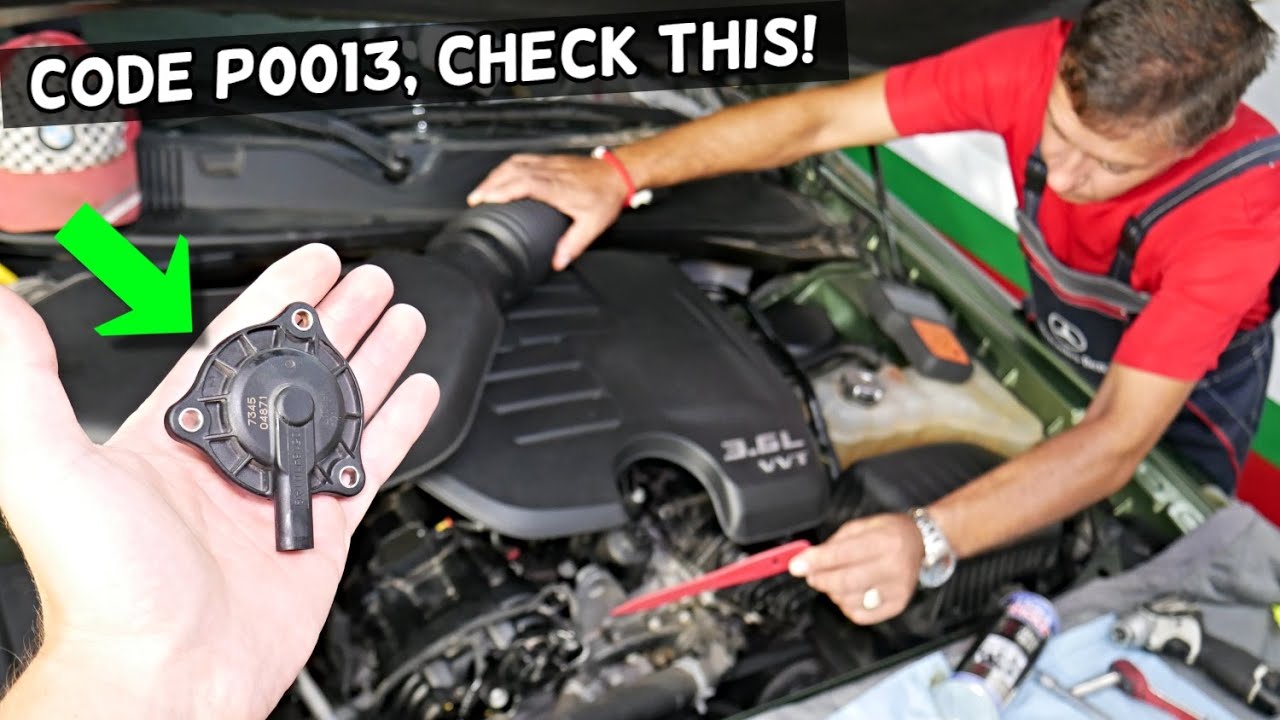
Identifying the root cause of a P0344 requires moving beyond the “parts changer” mentality. While the sensor itself can fail, the intermittent nature of the code often points to environmental or structural issues within the engine bay. On Dodge vehicles, particularly those equipped with the 5.7L Hemi or the 3.6L Pentastar, several specific failure points are common.
Wiring Harness Degradation
Approximately 40% of P0344 cases on Dodge vehicles with over 100,000 miles are traced back to wiring harness brittleness rather than the sensor itself. The harness for the CMP sensor often runs near high-heat areas like the exhaust manifolds. Over time, the plastic loom becomes brittle and the wire insulation cracks, allowing the 5V reference or signal wire to intermittently short to ground or to each other.
Always inspect the inside of the sensor connector for oil. In many Dodge engines, oil can leak from the valve cover directly into the sensor plug, creating a resistive bridge between pins. This “ghost” resistance causes voltage drops that trigger P0344 without a hardware failure.
Mechanical and Magnetic Interference
Mechanical wear can also induce an intermittent signal. Excessive crankshaft or camshaft end play—often caused by worn thrust bearings—can cause the tone ring to physically move away from the sensor. Since the Hall Effect sensor relies on a precise “air gap,” a deviation of even 0.015 inches can lead to a signal that is too weak for the PCM to interpret at certain speeds. Furthermore, high-output alternators or poorly shielded aftermarket spark plug wires can create electromagnetic interference (EMI) that “noises up” the square wave signal.
Step-by-Step Diagnostic and Repair Procedures
To provide a professional-grade fix, you must follow a structured diagnostic path. Jumping straight to sensor replacement often results in a “comeback” when the light reappears three days later.
📋
Diagnostic Guide
Examine the harness from the sensor to the main trunk. Look for heat damage, oil soaking, or chaffing against the engine block. Perform a “wiggle test” on the connector while the engine is idling to see if you can induce a stall or a change in RPM.
Using a digital multimeter, check for 5.0V at the reference wire with the key on, engine off. Check for continuity to ground on the ground circuit. A reading of 4.8V or lower indicates high resistance in the wiring that must be addressed.
This is the expert method. Back-probe the signal wire with an oscilloscope. You should see a clean, consistent square wave. If the wave shows “rounded” corners or missing pulses as you rev the engine, the sensor or tone ring is faulty.
Aftermarket sensors can vary in air-gap tolerance by as much as 0.015 inches. On sensitive Dodge PCMs, this variance is often enough to trigger a P0344 even if the sensor is technically “working.” Always opt for Mopar for timing-critical electronics.
Long-Term Reliability and Preventative Maintenance Strategies
Resolving a P0344 is not just about the repair; it is about ensuring the fault does not recur. For modern Dodge vehicles, maintenance and electrical health are directly linked to sensor longevity. A comprehensive maintenance strategy focuses on both the mechanical and electrical environments.
Oil Quality & Viscosity
Dodge models with VVT are 30% more likely to throw P0344 if oil viscosity is incorrect. Sludge buildup can cause the cam phaser to “lag,” resulting in a timing mismatch that the PCM interprets as a signal error.
Ground Path Integrity
Corroded battery terminals or loose engine block grounds create “electrical noise.” Ensure all primary grounds are clean and tight to provide a stable reference for the PCM.
Software Updates and TSBs
In some cases, the P0344 is not caused by a hardware failure but by overly sensitive PCM logic. For instance, a Technical Service Bulletin (TSB) was released for 2014 Dodge Avengers where a software flash was required to adjust the PCM’s tolerance for camshaft signal variation. Before tearing into the engine, a professional should always check for available software updates specific to the vehicle’s VIN.
Finally, if your wiring is located in a high-heat zone, consider upgrading to heat-reflective loom. Protecting the CMP harness from thermal degradation is the most reliable way to prevent the insulation from cracking and causing intermittent shorts in the future.
Conclusion
The P0344 code is an intermittent signal fault that requires a detailed circuit and sensor inspection rather than immediate part replacement. Dodge vehicles rely heavily on the CMP sensor for injector timing, making this code a primary cause of limp-mode and starting issues. By following the comprehensive diagnostic steps outlined above—including visual harness checks, voltage testing, and the use of an oscilloscope—you can pinpoint the exact failure. Utilizing OEM components and checking for wiring harness integrity are the most effective ways to ensure a quality, lasting repair. If you are experiencing recurring timing issues, begin by inspecting your wiring harness for heat damage or consult a professional technician to perform an oscilloscope signal test today.
Frequently Asked Questions
Can I drive my Dodge with a P0344 code?
While the vehicle may still run, it is not recommended to drive with a P0344 code. The engine may unexpectedly enter ‘Limp-In’ mode, limiting power and potentially stalling in traffic. Furthermore, the PCM reverts to backup timing maps which can reduce fuel efficiency and increase emissions, eventually leading to catalytic converter damage if left unaddressed.
Is the P0344 code always caused by a bad sensor?
No, it is not. In many Dodge models, especially those with the 5.7L Hemi or 3.6L Pentastar engines, the issue is frequently found in the wiring harness. High engine bay temperatures can cause the wire insulation to become brittle and crack, leading to intermittent shorts. Corroded connectors or a failing battery can also trigger this specific code by dropping voltage levels.
What is the difference between P0340 and P0344?
P0340 indicates a total circuit failure where the PCM detects no signal at all from the camshaft sensor. P0344 specifically denotes an ‘intermittent’ condition, meaning the signal is present but erratic or falling outside of the expected voltage window. P0344 is often harder to diagnose because the fault may not be present at the time of testing.
How much does it cost to fix a P0344 code on a Dodge?
The cost varies depending on the root cause. A high-quality Mopar camshaft position sensor typically costs between $50 and $110, with labor adding another $100 to $200. However, if the issue is a damaged wiring harness, repairs can range from $200 to $500 depending on the accessibility of the damaged section within the engine bay.
Does a P0344 code require a PCM flash?
In some instances, yes. Dodge has released several Technical Service Bulletins (TSBs) for specific model years where the PCM software is too sensitive to minor signal fluctuations. In these cases, a professional technician must update or ‘flash’ the PCM with the latest software version to broaden the acceptable signal parameters and resolve the intermittent error.
![RAM 2500 Rear Suspension: Specs & Fitment Guide [2026]](https://truckguider.com/wp-content/uploads/2026/03/ram-2500-rear-suspension-featured.webp)

![Dodge Ram 2500 Interior [2026]](https://truckguider.com/wp-content/uploads/2026/03/featured-583ae4d5-768x768.webp)
![P062A Ram 1500: Diagnosing Fuel Pump Control Module Issues [2026]](https://truckguider.com/wp-content/uploads/2026/03/p062a-ram-1500-featured.webp)