
Ram 1500 Crankshaft Position Sensor Location: Year and Engine 2026

The Ram 1500 crankshaft position sensor location depends on the engine. On most 4.7L V8 and 5.7L Hemi V8 trucks, the Crankshaft Position Sensor, or CKP sensor, sits at the passenger-side rear of the engine block near the transmission.
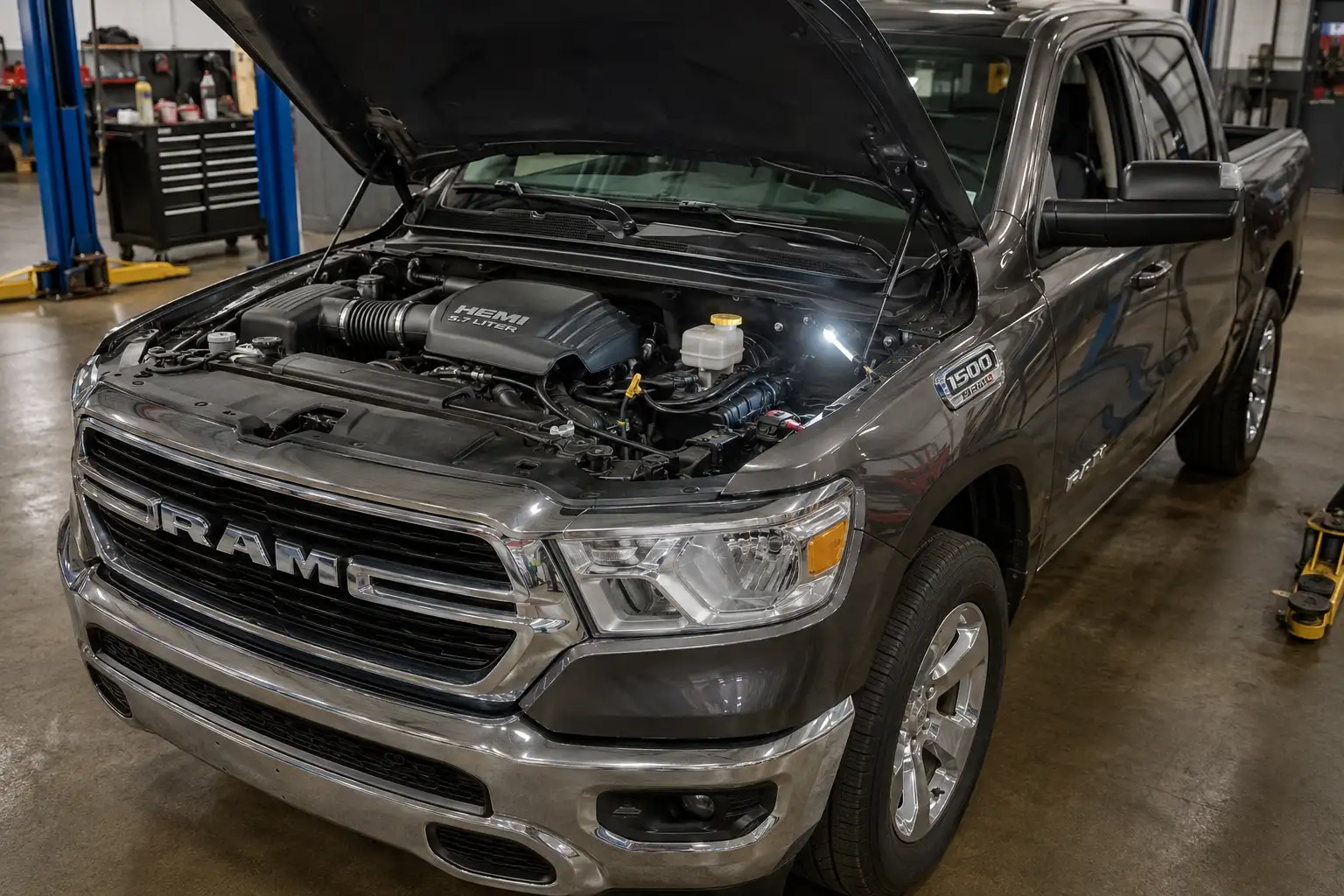
Older 3.9L, 5.2L, and 5.9L Magnum engines position the sensor around the rear of the engine and flywheel area. The 3.6L Pentastar V6 also places the sensor low near the engine-to-transmission area, while the 3.0L EcoDiesel V6 is considerably harder to access.

Prime for Young Adults — 6 Months Free
Students and 18–24s get six months of Prime free, then half price.
Start 6 Months FreeDo not buy or remove a sensor until you confirm your Ram 1500’s model year and engine.
Ram 1500 Crankshaft Position Sensor Location by Engine
Start with your engine, then use the rear of the engine and transmission as reference points. Exact access changes by model year.
3.9L Magnum V6
1994–2001CKP sensor is positioned at the rear of the engine near the flywheel or starter-ring-gear area.
5.2L and 5.9L Magnum V8
1994–2002Look around the rear-right side of the engine near the cylinder head, flywheel, or bellhousing depending on year.
4.7L V8
2002–2013Sensor mounts in a machined opening on the right-rear side of the engine cylinder block.
5.7L Hemi V8
2003–2024Start on the passenger side at the rear and lower portion of the engine block close to the transmission.
3.6L Pentastar V6
2013–CurrentLook low on the passenger side near the rear of the engine and transmission housing.
3.0L EcoDiesel V6
2014–2023CKP sensor is located at the rear of the engine in the flexplate area, with more difficult physical access.
3.0L Hurricane I6
2025–2026Mopar confirms a dedicated crankshaft position sensor, but public parts data does not provide a reliable service-level mounting coordinate.

Audible — Listen Free for 30 Days
One free credit a month and thousands of titles included.
Listen Free for 30 Days6-Step CKP Sensor Identification Process
Exact mounting position, surrounding components, and removal procedure can change by model year. Verify the procedure for your engine before removing the sensor.
Where Is the Ram 1500 Crankshaft Sensor Located
Recommended Best Deal Products


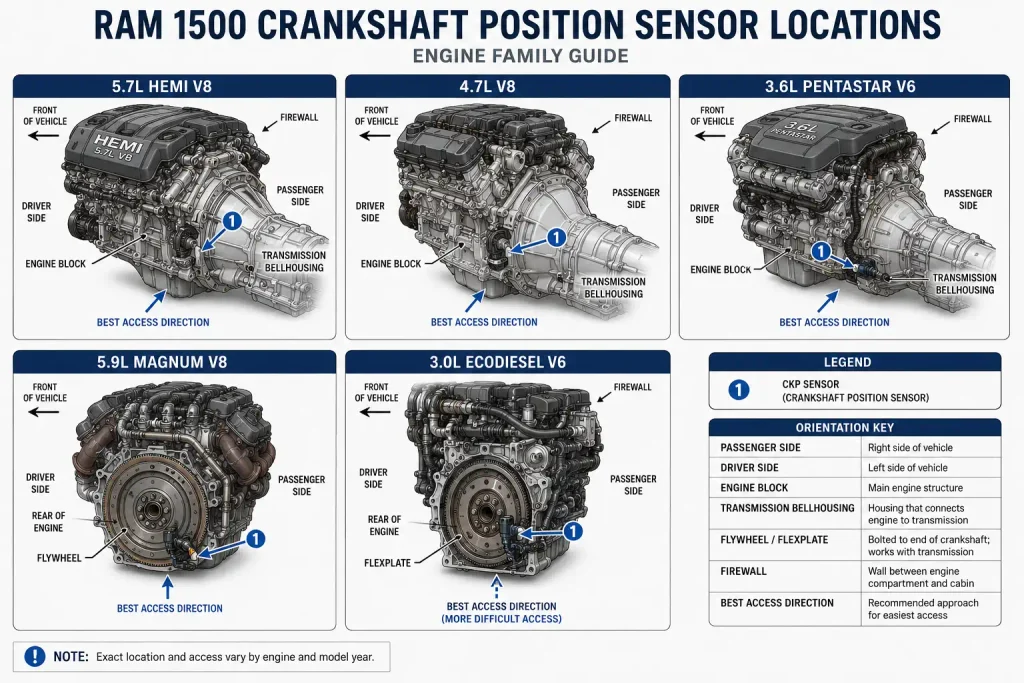
Your engine determines where you should start looking for the CKP sensor.
| Ram 1500 Engine | Typical Ram 1500 Years | Crankshaft Sensor Location | Best Access |
|---|---|---|---|
| 3.9L Magnum V6 | 1994-2001 | Rear of engine near flywheel and bellhousing | Rear of engine |
| 5.2L Magnum V8 | 1994-2001 | Top or rear-right cylinder block near flywheel | Above or rear |
| 5.9L Magnum V8 | 1994-2002 | Rear-right engine area near flywheel | Rear or underneath |
| 4.7L V8 | 2002-2013 | Right-rear side of engine cylinder block | Underneath |
| 5.7L Hemi V8 | 2003-2024 Ram applications | Passenger-side rear of engine block | Underneath |
| 3.6L Pentastar V6 | 2013-current applications | Passenger-side lower engine area near transmission | Underneath |
| 3.0L EcoDiesel V6 | 2014-2023 | Rear of engine near flexplate and transmission | Major disassembly may be required |
| 3.0L Hurricane I6 | 2025-2026 | Verify through VIN-specific service information | Engine-specific |
The table is a starting point, not permission to use another engine’s procedure. A 5.7L Hemi V8 diagram should not be used to locate the sensor on a 3.0L EcoDiesel or Hurricane I6.
Where Is the CKP Sensor on 1994 to 2002 Magnum Engines
Second-generation Dodge Ram trucks use several Magnum engines, and their CKP layouts are not identical across every production year.
3.9L Magnum V6 Location
Service information for the 3.9L Magnum V6 places the crankshaft position sensor near the outer edge of the flywheel or starter ring gear. The sensor reads slots in the flywheel as the crankshaft rotates.
On some service illustrations, the sensor is described at the rear of the right cylinder head or rear engine area. The important visual reference is the engine-to-transmission junction rather than the front accessory drive.
5.2L Magnum V8 Location
On a 1998 Ram 1500 5.2L Magnum V8, factory-style service information places the CKP sensor on top of the cylinder block near the rear of the right cylinder head. Removal starts by taking off the air-cleaner intake tube before disconnecting the sensor harness.
Earlier trucks can differ. For example, 1995 service information describes the 5.2L sensor as mounted to the transmission bellhousing.
Audible Premium Plus — Annual Membership
12 audiobook credits up front, plus the full Audible catalogue.
See Annual PlansThat year difference is why a generic “1994-2001 Dodge Ram crank sensor location” answer can send you to the wrong spot.
5.9L Magnum V8 Location
The 5.9L Magnum V8 follows the same basic rear-engine strategy. Service information for a 1996 truck places the CKP at the top of the cylinder block near the rear of the right cylinder head.
Later 2002 documentation describes the sensor near the outer edge of the flywheel and bolted to the rear of the engine.
If you are also identifying the cam sensor on an older Ram, our Dodge Ram 1500 camshaft position sensor location guide helps separate the two sensors.
Where Is the 4.7L Ram 1500 Crank Sensor
Recommended Best Deal Products


The 4.7L V8 has one of the clearest Ram CKP locations.
Factory service information for 2002, 2008, 2011, and 2012 applications consistently places the sensor in the right-rear side of the engine cylinder block. It installs into a machined hole in the block.
Best Landmark From Underneath
Raise and safely support the truck, then look toward the passenger-side rear of the engine where the block approaches the transmission.
The electrical connector plugs directly into the CKP sensor. One mounting bolt retains the sensor, and an O-ring seals it inside the block. Factory procedures remove it by disconnecting the connector, removing the bolt, then carefully twisting the sensor out.
For a 2006 4.7L application, service information specifies 28 N·m or 21 lb-ft for the CKP mounting bolt during installation. Do not automatically apply that torque specification to other Ram engines.
What Not to Mistake for CKP
Do not identify a sensor only by finding a three-wire connector.
The camshaft sensor, knock sensors, transmission connectors, and nearby harness plugs can look similar from underneath. Confirm that the component actually enters the rear of the engine block before removing it.
Where Is the 5.7L Hemi Crankshaft Position Sensor
On the 5.7L Hemi V8, start at the passenger-side rear of the engine.
Service information for a 2006 Ram 1500 places the CKP at the right-rear side of the engine cylinder block, installed into a machined opening. This matches later repair information that describes the sensor at the lower rear of the block near the transmission.
Passenger Side Reference Point
The sensor is easier to understand from underneath than from the top of the engine bay.
Move toward the passenger side and look upward at the rear portion of the block. You are looking for a small electrical sensor entering the block close to the transmission side of the engine.
Bellhousing Reference Point
Use the engine-to-transmission junction as your main landmark.
The CKP is not the sensor on the front timing cover. Service information for the 5.7L Hemi places the crank sensor at the rear of the block, while the camshaft position sensor occupies a different location.
Our Ram 1500 5.7 Hemi engine diagram is useful if you need to orient the engine before working around the rear of the block.
CKP Versus Camshaft Sensor
The CKP tells the Powertrain Control Module, or PCM, crankshaft speed and position. The camshaft position sensor provides cam timing information so the PCM can synchronize combustion events.
If you are unsure which component you found, compare it with our 5.7 Hemi camshaft position sensor location before unplugging anything.
Where Is the 3.6L Pentastar Crank Sensor
Recommended Best Deal Products


The 3.6L Pentastar V6 uses a different engine layout from the 5.7L Hemi V8.
Current Ram 1500 repair information places the CKP on the passenger-side lower portion of the engine near the transmission housing, with access normally made from underneath. A replacement procedure covering 2011-2018 Ram 1500 3.6L applications also identifies the sensor in this engine-to-transmission area.
Mopar parts data confirms that Ram continued using a dedicated 3.6L crankshaft sensor on later applications. For 2025, the genuine Mopar ignition-system catalog identifies crankshaft sensor 68079375AD for the 3.6L engine.
Do not use the 5.7L Hemi sensor position as an exact Pentastar installation reference. If you are diagnosing other common issues on this engine, the 3.6 Pentastar engine problems guide covers the broader engine platform.
Where Is the 3.0L EcoDiesel Crank Sensor
The 3.0L EcoDiesel V6 is the major exception in this guide because locating the CKP is easier than physically reaching it.
Service information cited for a 2014 Ram 1500 EcoDiesel places the crankshaft sensor behind the flexplate at the rear of the engine, below the crankshaft. That source describes transmission and flexplate removal as part of gaining direct access.
Diagnostic information for 2014-2018 EcoDiesel trucks also identifies the sensor connector near the rear driver’s side of the engine where the block meets the transmission bellhousing.
This engine also has a known crankshaft tone-wheel issue. NHTSA recall campaign 20V475000 covers certain 2014-2018 Ram 1500 trucks with the 3.0L diesel because crankshaft tone-wheel delamination can cause loss of crankshaft position information.
A CKP-related code on an EcoDiesel therefore does not automatically mean the sensor itself has failed.
What Is Known About the 2025 to 2026 Hurricane CKP Sensor
The 2025-2026 Ram 1500 uses the 3.0L Hurricane Standard Output I6 and 3.0L Hurricane High Output I6 in applicable trims.
Mopar’s official parts catalog confirms that both Hurricane SO and HO engines use crankshaft position sensor 68445913AB.
The public OEM catalog, however, does not provide enough service-level information to state a precise mounting point with confidence. It identifies the component in the sensor illustration but does not publish a reliable removal procedure or engine landmark.
For a 2025 or 2026 Hurricane truck, verify the CKP location through VIN-specific Mopar service information before disassembly. Do not assume it occupies the same rear-block position as the outgoing 5.7L Hemi V8.
How to Find the Ram 1500 CKP Sensor in 6 Steps
The exact access procedure changes by engine, but the identification process is straightforward.
- Confirm the model year and engine. Check the emissions label, VIN information, or build data before searching for the sensor.
- Park on level ground. Set the parking brake and allow hot exhaust components to cool before working underneath.
- Raise the truck when required. Use properly rated lifting equipment and support the truck at approved points.
- Find the engine-to-transmission junction. Most Ram 1500 CKP sensors covered here are located toward the rear of the engine rather than near the radiator.
- Trace the CKP electrical harness. Inspect the connector, locking tab, insulation, and nearby harness routing before removing the sensor.
- Confirm the component before loosening it. Compare the location against the procedure for your exact engine and year.
For the 4.7L V8, the factory-style procedure follows this same pattern by raising the truck, disconnecting the CKP connector, removing its retaining bolt, and twisting the sensor from the block.
Does P0335 or P0339 Mean the CKP Sensor Is Bad
No. P0335 or P0339 does not prove that the Ram 1500 crankshaft sensor itself has failed.
P0335 indicates a crankshaft position sensor circuit problem. P0339 refers to an intermittent crankshaft position sensor signal. Wiring faults, connector problems, tone-wheel damage, electrical interference, PCM calibration, or the sensor itself can produce CKP-related faults.
Check the Connector First
Inspect the sensor connector and wiring before ordering parts.
Look for damaged insulation, loose terminal tension, corrosion, oil contamination, heat damage, and harness sections rubbing against metal or exhaust components.
Check Engine RPM While Cranking
A capable scan tool can display engine RPM while the starter turns the engine.
A missing RPM signal can support further CKP circuit testing, but it should not be treated as proof that the sensor itself is defective. Check the wiring and mechanical trigger system as well.
Check Applicable PCM Updates
This matters particularly on certain 2019 Ram 1500 DT trucks.
FCA Technical Service Bulletin 18-074-20 REV. A, dated October 30, 2020, applies to certain 2019 DT Ram 1500 trucks with the 5.7L Hemi MDS VVT engine. The bulletin lists P0339 Crankshaft Position Sensor Intermittent and P0335 Crankshaft Position Sensor Circuit among conditions addressed by PCM reprogramming.
That bulletin is a strong reason not to replace a CKP sensor solely because one of those codes appears.
Which Ram 1500 CKP Location Applies to Your Truck
Use your engine as the deciding factor.
| If Your Ram 1500 Has | Start Looking Here |
|---|---|
| 3.9L Magnum V6 | Rear of engine near flywheel |
| 5.2L Magnum V8 | Rear-right cylinder block or bellhousing depending on year |
| 5.9L Magnum V8 | Rear-right engine area near flywheel |
| 4.7L V8 | Right-rear cylinder block |
| 5.7L Hemi V8 | Passenger-side rear of engine block |
| 3.6L Pentastar V6 | Passenger-side lower engine near transmission |
| 3.0L EcoDiesel V6 | Rear of engine behind flexplate |
| 3.0L Hurricane I6 | Verify VIN-specific Mopar service information |
The most common mistake is assuming every Ram 1500 places the crank sensor in the same location. Even within one generation, engine choice changes the answer.
5 Common Ram 1500 Crank Sensor Questions
Is the Ram 1500 Crankshaft Sensor on the Driver or Passenger Side?
Most 4.7L V8 and 5.7L Hemi V8 applications place the CKP toward the passenger or right-rear side of the engine block. EcoDiesel and other engines use different layouts, so verify the engine before using passenger-side location instructions.
Where Is the 5.7 Hemi Crankshaft Position Sensor?
The 5.7L Hemi V8 crankshaft position sensor is mounted toward the passenger-side rear of the engine block, near the transmission. It is generally easier to locate from underneath the truck than from above.
Can You Reach the Ram 1500 CKP Sensor From Above?
It depends on the engine. Older Magnum engines may allow some access from above, while 4.7L V8, 5.7L Hemi V8, and 3.6L Pentastar V6 procedures commonly favor access from underneath.
Can a Bad Ram Crank Sensor Cause a No Start?
Yes. The PCM depends on crankshaft position information to determine engine speed and crank position for ignition and fuel-control functions. A lost CKP signal can cause stalling or a crank-no-start condition, but wiring and tone-wheel faults can produce similar symptoms.
Does a Ram P0335 Code Mean I Need a New Sensor?
No. P0335 identifies a crankshaft position sensor circuit fault, not a confirmed failed sensor. Inspect the connector and wiring, check scan data, investigate applicable tone-wheel issues, and check relevant PCM software updates before replacing parts.
Find the Correct Ram 1500 Crank Sensor Before Removing It
The Ram 1500 crankshaft position sensor location is engine-specific. The 4.7L V8 and 5.7L Hemi V8 place it toward the right or passenger-side rear of the engine block, while Magnum, Pentastar, EcoDiesel, and Hurricane engines need their own location references.
Confirm the year and engine first, then use the transmission and rear-engine landmarks to identify the CKP. If you have P0335 or P0339, inspect the entire crankshaft-position circuit before assuming the sensor needs replacement.
![2021 Ram 1500 Battery Replacement: Specs & Expert Tips [2026]](https://truckguider.com/wp-content/uploads/2026/03/2021-ram-1500-battery-replacement-featured-768x403.webp)

![2018 Ram 1500 5.7 Oil Capacity [2026]](https://truckguider.com/wp-content/uploads/2026/03/featured-cc58a684.webp)