6.7 Cummins Oil Capacity by Year: 2007–2026 Chart & Oil Type

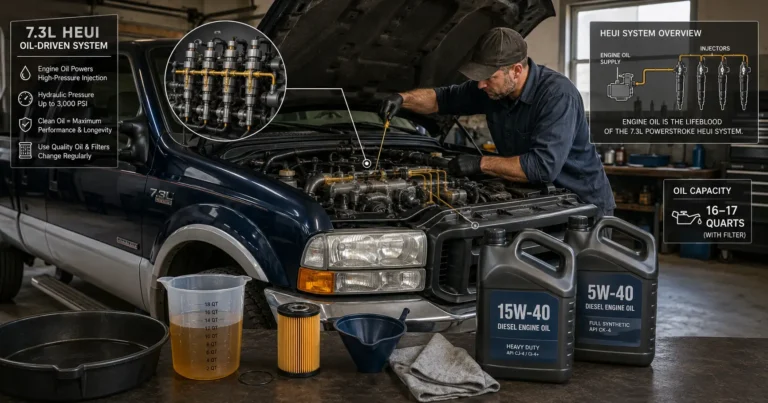
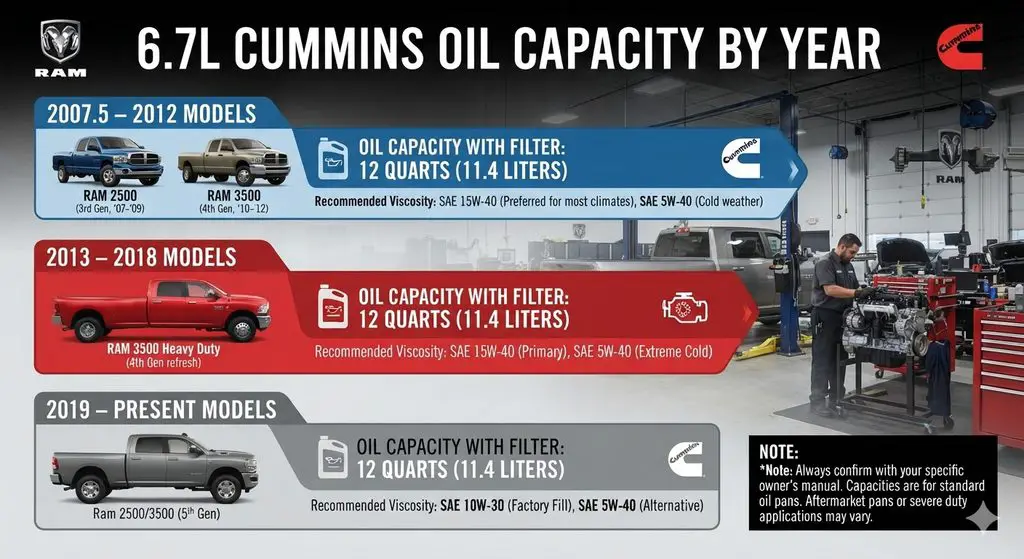
The engine oil capacity for a 6.7L Cummins Turbo Diesel engine remains highly consistent across model years. For standard Ram 2500 and 3500 pickup trucks, the factory specification is 12 quarts (11.4 liters) when replacing the oil filter.
Quick Answer: A stock 6.7 Cummins takes 12 quarts (11.4 liters) of engine oil with a new filter in Ram 2500/3500 applications. Oil viscosity guidance changed around the 2019 generation, so owners should verify the viscosity specified for their particular year and operating temperature.

Prime for Young Adults — 6 Months Free
Students and 18–24s get six months of Prime free, then half price.
Start 6 Months Free6.7 Cummins Oil Capacity by Year 2007–2026
Recommended Best Deal Products

| Model Year | Engine | Oil Capacity With Filter | Liters | Common Oil Viscosity |
|---|---|---|---|---|
| 2007.5 | 6.7L Cummins Turbo Diesel | 12 qt | 11.4 L | 15W-40 / 5W-40 |
| 2008 | 6.7L Cummins Turbo Diesel | 12 qt | 11.4 L | 15W-40 / 5W-40 |
| 2009 | 6.7L Cummins Turbo Diesel | 12 qt | 11.4 L | 15W-40 / 5W-40 |
| 2010 | 6.7L Cummins Turbo Diesel | 12 qt | 11.4 L | 15W-40 / 5W-40 |
| 2011 | 6.7L Cummins Turbo Diesel | 12 qt | 11.4 L | 15W-40 / 5W-40 |
| 2012 | 6.7L Cummins Turbo Diesel | 12 qt | 11.4 L | 15W-40 / 5W-40 |
| 2013 | 6.7L Cummins Turbo Diesel | 12 qt | 11.4 L | 15W-40 / 5W-40 |
| 2014 | 6.7L Cummins Turbo Diesel | 12 qt | 11.4 L | 15W-40 / 5W-40 |
| 2015 | 6.7L Cummins Turbo Diesel | 12 qt | 11.4 L | 15W-40 / 5W-40 |
| 2016 | 6.7L Cummins Turbo Diesel | 12 qt | 11.4 L | 15W-40 / 5W-40 |
| 2017 | 6.7L Cummins Turbo Diesel | 12 qt | 11.4 L | 15W-40 / 5W-40 |
| 2018 | 6.7L Cummins Turbo Diesel | 12 qt | 11.4 L | 15W-40 / 5W-40 |
| 2019 | 6.7L Cummins Turbo Diesel | 12 qt | 11.4 L | 10W-30 / 5W-40 |
| 2020 | 6.7L Cummins Turbo Diesel | 12 qt | 11.4 L | 10W-30 / 5W-40 |
| 2021 | 6.7L Cummins Turbo Diesel | 12 qt | 11.4 L | 10W-30 / 5W-40 |
| 2022 | 6.7L Cummins Turbo Diesel | 12 qt | 11.4 L | 10W-30 / 5W-40 |
| 2023 | 6.7L Cummins Turbo Diesel | 12 qt | 11.4 L | 10W-30 / 5W-40 |
| 2024 | 6.7L Cummins Turbo Diesel | 12 qt | 11.4 L | 10W-30 / 5W-40 |
| 2025 | 6.7L Cummins Turbo Diesel | 12 qt | 11.4 L | 10W-30 / 5W-40 |
| 2026 | 6.7L Cummins Turbo Diesel | 12 qt | 11.4 L | 10W-30 / 5W-40 |
The important takeaway is that the factory 6.7L Cummins in Ram 2500/3500 pickups has essentially maintained a 12-quart (11.4-liter) oil capacity with filter throughout its 2007.5–2026 production run. The 2008 owner’s manual, for example, explicitly lists 12 quarts / 11.4 liters with the filter. Manual Shelf More recent references likewise list 12 quarts for current Ram 2500/3500 applications. DieselTrucks.ca
Important: 2007 is a split year. The 6.7L Cummins appeared during the 2007 model year (“2007.5”), replacing the 5.9L Cummins, so an early-2007 truck may have the 5.9L instead.
Important Exceptions & Variations
- Commercial Applications: The Cummins B6.7 engine used in medium-duty box trucks, school buses, and specific chassis-cab applications utilizes a completely different, deeper oil pan. These versions typically hold 16 quarts (standard pan) or 19.5 quarts (high-capacity pan). [1, 2]
- Aftermarket Pans: If your truck is equipped with an aftermarket deep-sump oil pan (such as Mag-Hytec or AFE), the capacity increases by an additional 2 to 3 quarts, bringing total capacity closer to 14–15 quarts. [1]
- The “3-Gallon” Rule: Because 12 quarts equals exactly 3 gallons, most pickup owners simply buy three 1-gallon jugs of diesel-grade engine oil. It is highly recommended to fill 11 quarts first, cycle the engine briefly to fill the new oil filter, let it settle, and then use your dipstick to top off the remaining oil precisely to prevent overfilling. [1, 2]
Would you like information regarding the oil change mileage intervals or the specific API specification requirements for your exact model year?
Fluid Capacities and Viscosities
The Ram 2500 6.7 Cummins oil capacity is a specification that has caused genuine confusion among diesel owners for nearly two decades — yet the answer is consistent across all model years. The 6.7-liter Cummins Turbo Diesel inline-six engine was introduced halfway through the 2007 model year (universally known as “2007.5”) to replace the legendary 5.9-liter Cummins platform.
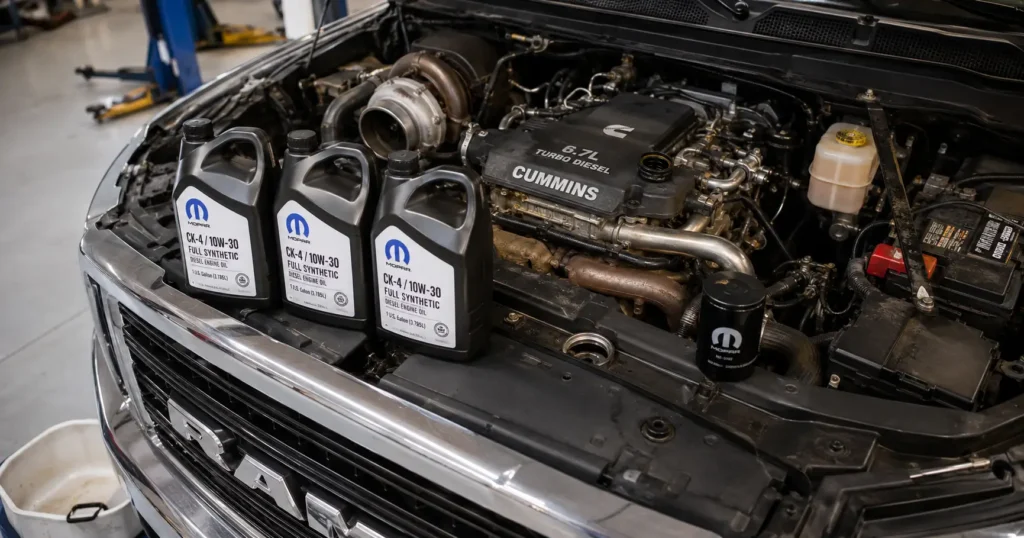
This transition was primarily mandated by federal emissions standards requiring a larger displacement to maintain power output while accommodating aggressive exhaust aftertreatment systems.
Despite multiple generational redesigns, shifts in fuel injection pressure parameters, sweeping internal valvetrain modifications, and even a complete filtration architecture change in 2025, the core oil capacity of the engine sump has remained remarkably stable across nearly two decades of production.
The absolute standard oil capacity for the Ram 2500 6.7L Cummins — across all Regular Cab, Crew Cab, and Mega Cab configurations — is precisely 12 US quarts (11.4 liters) when completing a standard comprehensive oil and filter change. For a model-specific oil type breakdown, also see our dedicated 2020 6.7 Cummins oil type guide and our 2020 Ram 2500 6.7 oil capacity deep-dive.
Ram 2500 6.7 Cummins oil specs: 12 quarts total capacity across all years 2007-2026, with viscosity and filter chart by generation.
Recommended Best Deal Products


Ram 2500 6.7L Cummins — oil specs at a glance
Total oil capacity

Audible — Listen Free for 30 Days
One free credit a month and thousands of titles included.
Listen Free for 30 Days12 qts
11.4 L — all years
Without filter swap
~11 qts
Source of “10 qt” myth
Drain plug torque
37 ft-lb
3/8″ sq drive
Audible Premium Plus — Annual Membership
12 audiobook credits up front, plus the full Audible catalogue.
See Annual PlansCertification
CK-4 + MS-10902
CES 20081 required
Three-generation viscosity & filter guide
Solid lifter era
15W-40 (>0°F) · 5W-40 (all temp)
Filter: Mopar 05083285AA
Spec: API CJ-4 / CK-4
10W-30 (>0°F) · 5W-40 (all temp)
Filter: Mopar 05083285AA
Spec: API CK-4 + MS-10902
10W-30 (>0°F) · 5W-40 (all temp)
Filter: Mopar 68677810AA
Cap: 28mm socket
12 qt vs. 10 qt — the definitive answer
With filter change
Full system capacity
Without filter change
Never skip filter swap
16.6% underfill risk
Filling only 10 qts with a new filter installed = chronic underfill. Leads to premature bearing wear, thermal breakdown, and turbo damage.
Maintenance interval guide
2007.5–2012 models
7,500 mi max
or 6 months
2013+ models (normal)
15,000 mi max
or 6 months / 500 hrs
All years (severe duty)
5–7,500 mi
towing · idling · off-road
Master Fluid Capacity and Viscosity Chart (2007.5–2026)
The following table provides the definitive, year-by-year parameters for lubrication management across all generations of the 6.7L Cummins platform. This matrix is designed for rapid diagnostic reference by both fleet managers and independent owner-operators.
| Model Year | Total Capacity (w/ Filter) | Partial Capacity (w/o Filter) | Preferred Viscosity (>0°F) | Preferred Viscosity (All Temps) | OEM Filter Part No. | Required Certification |
|---|---|---|---|---|---|---|
| 2007.5–2018 | 12 Quarts (11.4 L) | ~11 Quarts (10.4 L) | 15W-40 Synthetic Blend/Full | 5W-40 Full Synthetic | Mopar 05083285AA | API CJ-4 / CK-4, CES 20081 |
| 2019–2024 | 12 Quarts (11.4 L) | ~11 Quarts (10.4 L) | 10W-30 Full Synthetic | 5W-40 Full Synthetic | Mopar 05083285AA | API CK-4, MS-10902, CES 20081 |
| 2025–2026 | 12 Quarts (11.4 L) | ~11 Quarts (10.4 L) | 10W-30 Full Synthetic | 5W-40 Full Synthetic | Mopar 68677810AA (new cartridge) | API CK-4, MS-10902, CES 20081 |
Generational Engineering Analysis of the 6.7L Cummins Lubrication Architecture
Recommended Best Deal Products

To truly master the maintenance profile of the 6.7 Cummins, technicians and owners must understand exactly how the engine’s internal architecture dictates its specific lubrication requirements. The engine has undergone three highly distinct evolutionary phases regarding its oiling system and internal mechanical tolerances. For an overview of what years to be cautious with, see our 6.7 Cummins years to avoid guide.
Phase 1: The Foundation and Solid Lifter Era (2007.5–2018 Models)
When the 6.7L Cummins debuted, it introduced a substantially larger cylinder bore and longer piston stroke alongside a Variable Geometry Turbocharger (VGT) and a robust Exhaust Gas Recirculation (EGR) system.
The EGR system routes spent, inert exhaust gases back into the intake manifold to lower peak combustion temperatures and reduce NOx emissions. However, this recirculation process introduces massive amounts of abrasive carbon soot directly into the crankcase and engine oil.
For the entirety of the 2007.5 to 2018 production run, the engine utilized a traditional solid lifter valvetrain design. Cummins engineers specified a highly robust, thick 15W-40 viscosity oil for ambient temperatures above 0°F (-18°C).
This fluid provides an exceptionally thick hydrodynamic protective film that stubbornly resists mechanical shear under the massive torque loads generated by the inline-six layout (loads that scaled up to 900 lb-ft in later high-output iterations). For cold climates, a 5W-40 full synthetic was mandated to prevent cold-start starvation. Common mechanical issues specific to this generation are catalogued in our 2014 Ram 2500 diesel problems guide and our 2018 Ram 2500 diesel problems guide.
The total system capacity of 12 quarts was engineered specifically to ensure that the heavy volume of EGR-induced soot is adequately suspended in a large, circulating volume of dispersant-rich oil, preventing the agglomeration of carbon particles that could score engine main bearings or block critical oil galleys. The 6.7 Cummins CCV filter system works in concert with the oil to manage crankcase pressure from this soot loading — it must be serviced regularly to prevent oil contamination.
Phase 2: The Acoustic Refinement and Hydraulic Lifter Transition (2019–2024 Models)
The introduction of the 2019 model year marked a profound and permanent shift in the 6.7L Cummins internal mechanical operation. To reduce inherent diesel clatter, improve long-term durability, and eliminate the need for costly periodic manual valve lash adjustments (previously required at 150,000-mile intervals), Cummins engineers transitioned the entire engine architecture to hydraulic valve lifters.
Hydraulic lifters rely on highly precise oil pressure and rapid, unimpeded fluid flow to maintain exactly zero valve clearance. Consequently, the thick, viscous 15W-40 oil of previous generations proved entirely too thick for optimal hydraulic lifter pump-up during cold starts.
The manufacturer officially updated the viscosity specification to a much lighter 10W-30 weight for all ambient temperatures above 0°F. This physically thinner oil flows exponentially faster into the microscopic lifter oil galleries, ensuring immediate valve actuation and preventing destructive lifter tick, lobe galling, or complete lifter collapse during critical first seconds of engine operation.
Despite persistent rumors across the diesel community, the overall system fluid capacity remained locked at 12 quarts (11.4 liters) with a concurrent filter change. Common problems specific to this refined generation are covered in our 2022 Ram 2500 problems troubleshooting guide.
Phase 3: The Environmental Mandate and Eco-Cartridge Era (2025–2026 Models)
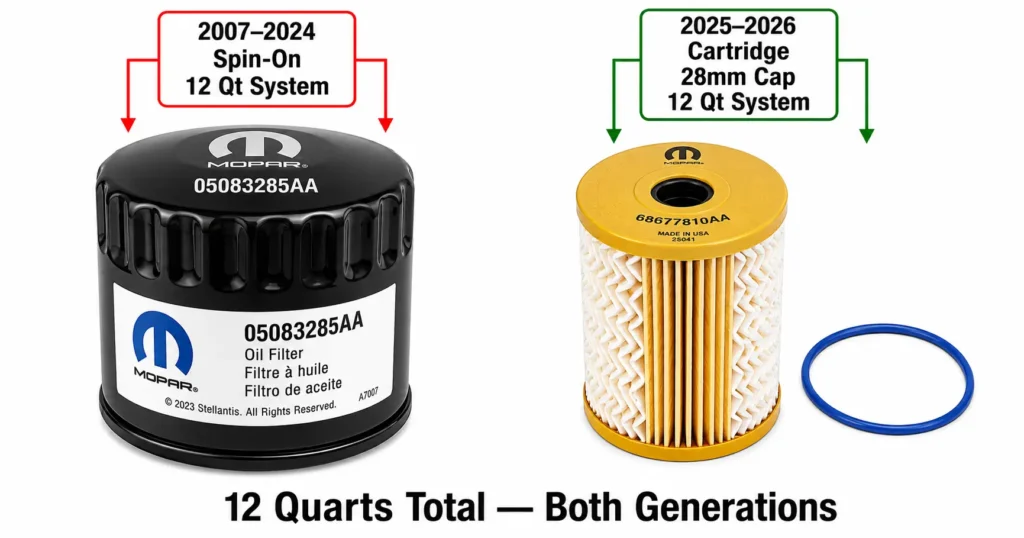
While internal mechanics, hydraulic lifter requirements, and viscosity specifications (10W-30 or 5W-40) remained identical to the 2019–2024 models, the 2025 and 2026 Ram 2500 Cummins introduced a radical, highly visible change to the oil filtration hardware. The traditional heavy steel spin-on filter was completely abandoned in favor of a top-loading, reusable housing cartridge-style filter system.
The permanent filter housing is now a fixed structural fixture located on the upper passenger side of the engine block assembly. Mechanics and owners simply unscrew a reinforced composite plastic cap (requiring a specialized 28mm socket) and extract the internal pleated cellulose media element.
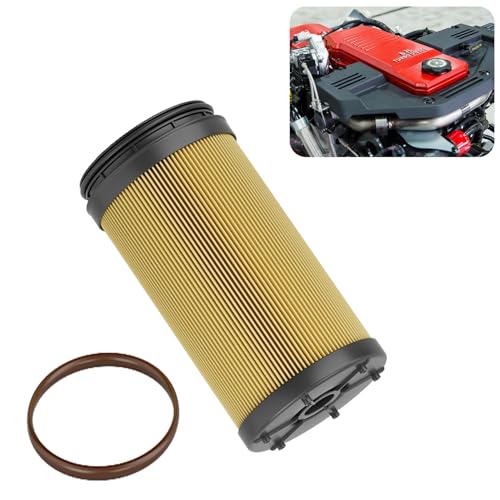
The new OEM replacement part number is Mopar 68677810AA (Fleetguard equivalent: LF16453). This transition elegantly eliminates the notorious, messy “oil bath” that mechanics previously endured when unscrewing the horizontally mounted spin-on filter. For a comprehensive look at 6.7 Cummins oil filter part numbers across all years, see our 6.7 Cummins oil filter part number guide.
Deconstructing the Persistent 10-Quart vs. 12-Quart Discrepancy
A highly persistent, heavily debated point of confusion among Ram 2500 owners, fleet managers, and independent mechanics is whether the 6.7L Cummins actually requires 10 or 12 quarts. This discrepancy demands definitive, scientifically backed resolution.
The confusion stems from three compounding data points. First, the massive oil filter on a 6.7L Cummins holds approximately 1 to 1.5 quarts of oil independently of the sump. If a technician drains the oil pan but fails to replace the oil filter, the engine will only accept roughly 10 to 10.5 quarts of new oil before registering full on the dipstick. Therefore, 10 quarts represents the “drain only” capacity, while 12 quarts represents the true “dry system” capacity inclusive of a fresh, empty filter.
Second, historical documentation errors plagued the platform. Certain early printings of Ram service manuals erroneously copied fluid capacity data from smaller displacement Cummins engines or entirely different stationary industrial Cummins generator applications. Third, the legacy of the 5.9L engine continues to influence modern mechanics — the direct predecessor often operated at slightly lower fluid capacities (10 to 11 quarts), leading veteran diesel mechanics to systematically underfill the newer, larger 6.7L engine out of decades-old habit.
The consequence: Operating a Ram 2500 6.7L Cummins on only 10 quarts while simultaneously replacing the filter constitutes a severe underfill condition. Reducing the total operating oil volume by 16.6% (the mathematical difference from 12 to 10 quarts) proportionally decreases the oil’s lifespan, compromises its chemical shear stability,
and exponentially accelerates thermal breakdown, leading to premature bearing wear. The 6.7 Cummins oil pressure sensor will eventually flag a fault if oil pressure drops from chronic underfill — address the root cause before replacing components.
The Destructive Physics of Overfilling a Heavy-Duty Diesel Engine
Overfilling the sump of a Ram 2500 Cummins by even a single quart can rapidly induce catastrophic mechanical failures. When the static fluid level rises too high in the oil pan sump, the massive rotating steel counterweights of the engine’s crankshaft physically strike the surface of the oil pool at thousands of revolutions per minute.
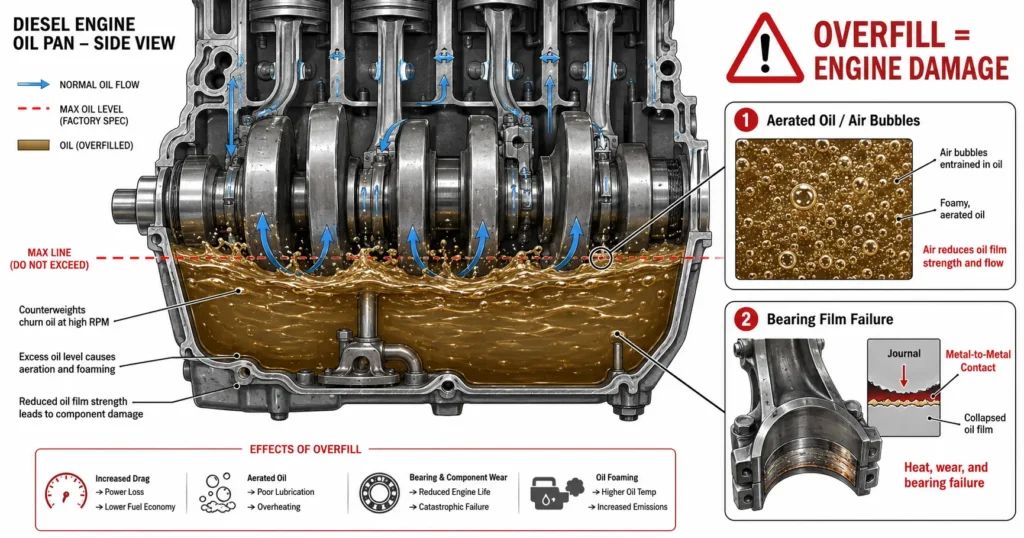
This violent, continuous mechanical agitation whips the liquid oil into a thick, oxygen-rich froth — a dangerous tribological condition technically known as oil aeration.
Aerated oil contains millions of microscopic atmospheric air bubbles. When the engine oil pump draws this froth from the pickup tube, the air bubbles compress under load. Because atmospheric air is highly compressible and liquid oil is theoretically incompressible, the microscopic hydrodynamic fluid wedge protecting the connecting rod bearings and main crankshaft bearings instantly collapses, causing metal-on-metal contact that can destroy a bottom-end in minutes under load.
Furthermore, aerated oil cannot effectively absorb or transfer thermal energy, leading to localized, destructive boiling within the turbocharger center cartridge. Overfilling also drastically increases internal crankcase pressure beyond the capacity of the Crankcase Ventilation (CCV) system.
For a comprehensive overview of the CCV system’s role in managing this pressure, see our best 6.7 Cummins CCV filter replacement guide and our 6.7 Cummins diesel CCV filter review. Excessive crankcase pressure can violently blow out front and rear main engine seals, or force liquid oil directly past the piston rings and into the combustion chamber, leading to uncontrolled engine runaway. See also our 6.7 Cummins crankcase pressure sensor location if the DIC is flagging a crankcase pressure fault.
Fluid Specifications: Deciphering Certifications, Chemistry, and Viscosities
Modern heavy-duty diesel engine oil is a highly engineered chemical matrix. Choosing the correct oil for a Ram 2500 6.7L Cummins extends far beyond simply picking a viscosity off the shelf; it requires strict adherence to both American Petroleum Institute (API) standards and proprietary manufacturer certifications.
The Chemical Evolution: API CJ-4 versus API CK-4
For over a decade, the API CJ-4 classification was the gold standard for heavy-duty diesel engine oils, specifically formulated with a low-ash content to prevent permanent clogging of sensitive Diesel Particulate Filters (DPFs).
The American Petroleum Institute then introduced the superior CK-4 standard, which represents a monumental leap in tribological chemistry: significantly enhanced shear stability, superior resistance to oxidative thickening, and vastly better aeration control.
For 2019 and newer models featuring hydraulic lifters, API CK-4 is an absolute, non-negotiable warranty requirement. CK-4 is entirely backward compatible with older CJ-4 engines, making it the universally superior choice for any 6.7L Cummins regardless of production year. Monitor DPF health status via the 6.7 Cummins DPF pressure sensor — premature ash clogging often traces back to incorrect oil chemistry.
Proprietary Manufacturer Standards: Cummins CES 20081 and FCA MS-10902
Beyond the broad API standards, both Cummins and Stellantis require approved oils to pass proprietary, highly rigorous testing parameters. The Cummins CES 20081 standard specifically ensures the lubricant can handle massive soot loading generated by the proprietary Cummins EGR system without thickening to the point of impeding flow through the filter media.
It also dictates strict limits on Sulfated Ash, Phosphorus, and Sulfur (SAPS) content. Using an oil with high ash content will rapidly and prematurely clog the expensive DPF, leading to constant fuel-wasting active regeneration cycles.
The MS-10902 specification is the FCA/Mopar internal material standard that validates chemical compatibility with the specific synthetic rubber seal materials, the delicate hydraulic lifters introduced in 2019, and the precise mechanical oil pump tolerances found specifically in the Ram 2500 chassis.
The rule is absolute: if an oil container does not explicitly list both the API CK-4 donut symbol and the MS-10902/CES 20081 approval codes on its rear label, it should never be poured into the sump of a 6.7L Cummins.
The Tribological Argument for Full Synthetic Lubricants
While high-quality conventional 15W-40 oils technically meet baseline warranty requirements for older, solid-lifter 6.7L models, the transition to a full synthetic oil (whether 5W-40 or 10W-30) is widely considered by diesel technicians to be the single most effective preventative maintenance action an owner can take.
Full synthetic oils possess a perfectly uniform molecular structure that aggressively resists thermal breakdown under the extreme heat generated by the VGT turbocharger. Conventional oils contain lighter, naturally occurring volatile compounds that rapidly evaporate at high temperatures, leaving behind heavy, destructive carbon sludge.
Synthetic base stocks inherently resist this volatilization, ensuring the oil remains fluid and protective even when the turbocharger housing is glowing red under maximum heavy towing loads. For reference on the towing loads that define severe thermal duty on the Ram 2500, see our Ram 2500 towing capacity chart.
Filtration Science: The Evolution from Spin-On to Cartridge
2007.5–2024: The Golden Era of Spin-On Filtration
For 17 consecutive years, the 6.7L Cummins utilized a heavy-duty metal spin-on filter. The undisputed OEM standard for this application is the Mopar 05083285AA (also known as the MO-285), which is actually manufactured by Fleetguard — Cummins’ wholly-owned internal filtration engineering division — under the commercial part number LF16035.
These filters utilize a proprietary synthetic “Stratapore” media that traps particulates down to 30 microns with a 99.8% absolute efficiency rating, while maintaining the exceptional fluid flow rates required by the massive Cummins oil pump.
The fluted metal exterior canister requires a standard heavy-duty flute filter wrench for proper removal, as the gasket often swells and tightly grips the engine block over a 15,000-mile interval.
This is also the section where double-gasketing risk is highest — always visually inspect the engine block’s machined mating surface to guarantee the old rubber gasket did not stick to bare metal. Double-gasketing is the leading cause of immediate post-service oil blowouts. If you notice an oil cooler efficiency decline alongside filter changes, review our 6.7 Cummins oil cooler review and the 6.7 Cummins oil cooler location guide.
2025–2026: The Cartridge Revolution and Top-Load Mechanics
The 2025 and 2026 Ram 2500 models completely transitioned to a top-load cartridge system. The required OEM replacement part is Mopar 68677810AA (Fleetguard equivalent: LF16453). This filter element is composed of a highly engineered, rigid cellulose and synthetic blended media.
Crucially, every single replacement Mopar cartridge box includes a fresh synthetic rubber O-ring intended for the reusable composite housing cap. Failing to replace this O-ring, or accidentally double-gasketing the housing by leaving the old O-ring in place, will result in an immediate, catastrophic, high-pressure loss of engine oil across the engine bay.
The cap requires a precise 28mm socket for safe removal — using adjustable pliers or the wrong size socket will instantly round off the soft composite plastic. After installing the new O-ring (lubricated with fresh oil), the cap must be hand-tightened until O-ring contact is made, then an additional ¾ to 1 full turn with a wrench — do not use a torque wrench, as over-torquing can crack the composite housing.
The Masterclass Step-by-Step Maintenance Protocol
Performing an oil service on a Ram 2500 6.7L Cummins requires significantly more physical preparation and tooling awareness than a standard passenger vehicle, primarily due to the massive fluid volume and heavy-duty nature of the chassis components.
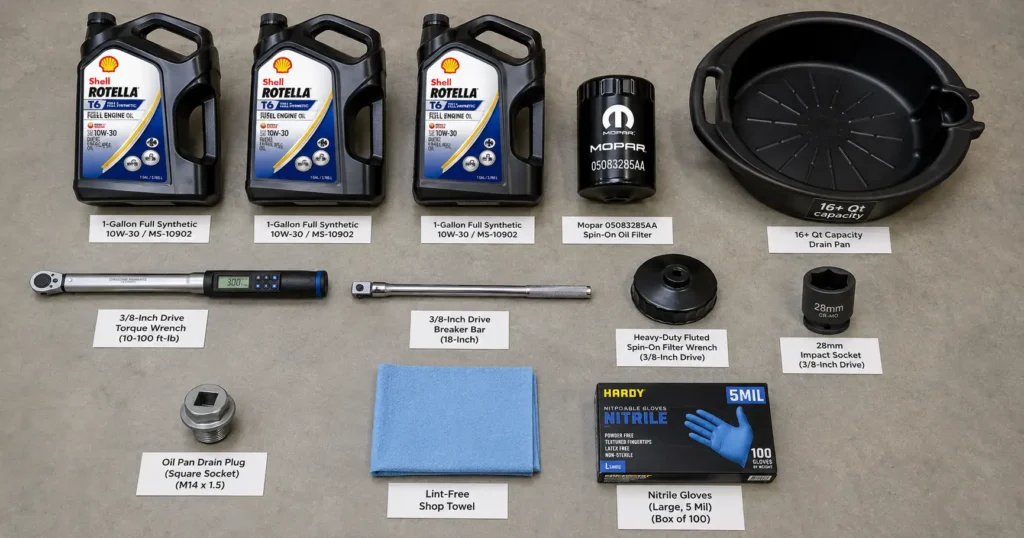
Required Heavy-Duty Tooling and Supply Matrix
| Tool / Supply | Specification | Purpose |
|---|---|---|
| Diesel Engine Oil | 3 Gallons (12 US Quarts) — CK-4, MS-10902 rated | System lubrication |
| Oil Filter Element | Year dependent (see Master Chart above) | Critical particulate filtration and soot capture |
| High-Volume Drain Pan | Minimum 16+ Quart Capacity | Must accommodate the sudden 12-quart rush of fluid without overflowing |
| Drain Plug Socket Tool | Typically 3/8″ square drive | Directly interfaces into the recessed square of the oil pan drain plug |
| Filter Wrench/Socket | Fluted wrench (2007–2024) or 28mm Socket (2025–2026) | Extracting the oil filter assembly without damaging surrounding components |
| Precision Torque Wrench | Calibrated to at least 50 ft-lbs | Securing the pan drain plug to exactly 37 ft-lbs |
Advanced Procedural Execution
- Step 1 — Thermal Fluid Preparation: Engine oil within a diesel should never be drained completely cold. Drive the truck under moderate load until the coolant reaches standard operating temperature (approximately 190°F to 200°F). Warm diesel oil flows exponentially faster, physically carrying suspended soot particles out of the drain hole rather than leaving them clinging to the internal walls of the oil pan.
- Step 2 — Vehicle Positioning and Safety: Park the Ram 2500 on perfectly level, solid ground and engage the parking brake. Due to the exceptionally high factory ground clearance of the Ram Heavy Duty 2500 chassis, hydraulic floor jacks or ramps are rarely required for an oil service.
- Step 3 — Primary Sump Evacuation: Position the high-capacity (16+ quart) drain pan directly beneath the oil pan drain port. Using a 3/8″ square drive breaker bar, slowly crack the drain plug loose. The 12 quarts of hot oil will exit with significant velocity; adjust the drain pan backward slightly to correctly catch the outward arc of the fluid stream. Allow a strict minimum of 15 to 20 minutes for the thick oil to drain fully from the upper cylinder heads, valvetrain galleries, and turbocharger cooling lines.
- Step 4 — Spin-On Filter Extraction (2007.5–2024 Models Only): Relocate the drain pan beneath the side-mounted filter area. Using a specialized fluted filter wrench, break the spin-on filter loose. Lower it carefully — it contains well over a full quart of hot oil. Critically, inspect the engine block’s machined mating surface to guarantee the old black rubber gasket did not stick to the bare metal. Double-gasketing here is the leading global cause of immediate post-service oil blowouts and engine seizures.
- Step 5 — Top-Load Cartridge Extraction (2025–2026 Models Only): Apply a 6-point 28mm socket to unscrew the composite plastic filter cap from the upper passenger side of the engine bay. Lift and extract the spent cartridge. Remove the old O-ring using a non-marring brass or plastic pick to avoid scratching the sealing surface. Install and lubricate the new O-ring generously with fresh oil. Snap the new Mopar 68677810AA cartridge into the housing cap.
- Step 6 — Filter Priming and Installation (Spin-on Models Only): Pre-fill the new filter with fresh engine oil before threading it onto the block. This crucial step prevents a “dry-start” where bearings are starved while the pump tries to fill the massive empty filter void. Lubricate the new rubber gasket with clean oil. Spin the filter onto the threaded stud until initial rubber contact, then tighten an additional 3/4 of a turn by hand. Never use a wrench to tighten a spin-on filter.
- Step 7 — Drain Plug Inspection and Installation: Wipe the heavy steel drain plug clean, specifically inspecting the magnetic tip for large metallic shavings that would indicate severe internal bearing failure. Thread the plug back in completely by hand to prevent catastrophic cross-threading. Using a calibrated torque wrench, secure the plug to exactly 37 ft-lbs of torque. For complete oil pan drain plug gasket and pan service information, see our 6.7 Cummins oil pan gasket replacement guide.
- Step 8 — Initial Fluid Replenishment: Using a clean, wide-mouth funnel, introduce approximately 11 quarts of fresh, certified engine oil through the valve cover fill port.
- Step 9 — System Pressurization and Circulation: Start the engine and monitor the dashboard closely. The oil pressure gauge should register standard pressure within 3 to 5 seconds. Allow the truck to idle for approximately 2 to 3 minutes to fully fill the new filter housing, charge the hydraulic lifters (on 2019+ models), and circulate fresh fluid through the VGT turbocharger lines. If the check engine light appears after service, consult our 6.7 Cummins check engine light reset guide.
- Step 10 — Final Volumetric Verification: Shut off the engine and allow the truck to rest undisturbed for a strict minimum of 15 minutes — thick diesel oil takes significant time to drain from the expansive upper valvetrain back down into the main sump. Withdraw the long dipstick, wipe clean, reinsert fully, withdraw, and add final fractions of the 12th quart in small, measured increments until the fluid level rests exactly in the middle of the “MIN” and “MAX” crosshatched zone.
Maintenance Intervals: Defining Normal vs. Severe Duty Operations
Cummins engineered the 6.7L platform to sustain incredible, industry-leading mileage intervals between fluid services, provided the correct chemically certified fluids are utilized. For early iteration models (2007.5–2012), the factory recommended maximum interval was firmly capped at 7,500 miles or 6 months. The older, less refined emission systems generated significantly more internal soot, which rapidly depleted the base oil’s dispersant additive package.
For 2013 and newer models, massive advancements in internal combustion efficiency and synthetic oil chemistry allowed Cummins engineers to officially extend the standard normal operating interval to a maximum of 15,000 miles, 6 months, or 500 total engine operating hours — whichever metric occurs first. For a comprehensive scheduled maintenance overview for the modern platform, see our 2022 Ram 2500 maintenance schedule.
Severe Duty Operations — When to Cut the Interval
The vast majority of Ram 2500 trucks on the road today actually operate under what the manufacturer strictly defines as Severe Duty conditions, which include any of the following:
- Frequent, sustained towing of heavy loads (5th-wheel RVs, gooseneck horse trailers, heavy construction equipment)
- Extended, prolonged periods of engine idling (extreme cold climates, construction job sites, PTO systems) — see our Cummins high idle guide for idle management strategies
- Consistent driving in dusty, highly abrasive off-road, mining, or agricultural environments
- Frequent short trips under 10 miles where the engine never reaches full sustained operating temperature, leading to destructive moisture and condensation accumulation in the crankcase
Under Severe Duty conditions, the oil change interval must be aggressively reduced to every 5,000 to 7,500 miles. This drastically shortened interval is the only guaranteed way to prevent microscopic abrasive soot wear on the ultra-sensitive turbocharger journal bearings and the high-pressure camshaft lobes.
The Algorithmic Oil Life Monitor System (OLMS)
The modern Ram 2500 dashboard is equipped with a sophisticated Oil Life Monitor System (OLMS). It does not physically sample the oil for actual fluid degradation — instead, it utilizes a proprietary mathematical algorithm based on duty cycle data (real-time engine coolant temperatures,
RPM variances, specific load factors, fuel consumed, and exact idle times) to calculate the theoretical remaining lifespan of the fluid additive package. When the instrument cluster illuminates “Oil Change Due,” the service must be performed promptly to maintain warranty compliance.
How to reset the OLMS post-service: Cycle the push-button ignition to the “ON/RUN” position without depressing the brake pedal (do not start the engine). Navigate the instrument cluster menu using the directional steering wheel controls to the “Vehicle Info” section. Select “Oil Life” and firmly hold the “OK” button until the digital gauge resets completely to 100%.
Frequently Asked Questions: 6.7 Cummins Oil Capacity
What physically happens if I overfill my 6.7 Cummins by one quart?
Overfilling by a single quart is unlikely to cause catastrophic connecting rod failure immediately, but it drastically increases the risk of severe oil aeration at highway speeds. The spinning crankshaft counterweights can whip the excess oil into a thick, airy foam.
Because the engine oil pump cannot properly pressurize aerated oil (air compresses, liquid does not), the critical hydrodynamic film protecting main bearings weakens substantially. Furthermore, it massively increases internal crankcase pressure, which can push liquid oil directly past the PCV breather system and into the turbocharger intake tract, causing excessive tailpipe smoke and accelerating the permanent clogging of the DPF.
Why did Ram switch to 10W-30 for the 6.7 Cummins in 2019?
The transition from thick 15W-40 to thinner 10W-30 was driven entirely by the implementation of hydraulic valve lifters for the 2019 model year. Hydraulic lifters absolutely require oil that flows exceptionally rapidly at low ambient temperatures to pump up internally and maintain zero mechanical valve clearance.
The physically thinner 10W-30 provides immediate, unimpeded flow during freezing cold starts, completely preventing destructive valvetrain wear, while advanced synthetic base stocks still offer robust thermal protection at peak operating temperatures. This is explained in detail in our 2020 6.7 Cummins oil type guide.
Can I still safely use 15W-40 in my 2024 Ram 2500 Cummins?
No. Using a heavy 15W-40 viscosity oil in a 2019 or newer 6.7L Cummins directly violates the manufacturer’s MS-10902 chemical specification. The heavier, thicker viscosity physically restricts proper fluid flow to the microscopic ports of the hydraulic lifters during cold engine starts, potentially causing immediate lifter collapse, excessive audible valvetrain clatter, and premature, irreversible camshaft lobe wear. Owners must always use the factory-specified 10W-30 or 5W-40 synthetics.
What is the exact torque specification for the 6.7 Cummins oil drain plug?
The absolute factory torque specification for the square-drive oil pan drain plug on a 6.7L Cummins is precisely 37 ft-lbs. Exceeding this specification by overtightening can permanently strip the threads in the steel oil pan, requiring a highly costly pan replacement, while under-torquing risks a catastrophic, total loss of engine oil on the highway due to diesel engine vibration backing the plug out. Always use a calibrated torque wrench.
Does the stated 12-quart capacity include the oil filter volume?
Yes. The widely cited 12-quart (11.4 liters) specification represents the total, maximum system capacity, explicitly including both filling the main engine block sump and the volume required to completely saturate a fresh, empty oil filter. If a technician drains the pan but reuses the old, saturated filter, the engine will only physically take approximately 10.5 to 11 quarts to reach the maximum full mark on the dipstick.
What is the actual chemical difference between API CJ-4 and CK-4 oil?
API CK-4 is the modern, highly upgraded chemical formulation of the older CJ-4 standard. CK-4 oils were engineered to handle much higher sustained operating temperatures, provide vastly greater mechanical shear stability within turbocharger bearings, and offer superior long-term resistance to oxidative thickening.
Because it is a more robust standard, CK-4 is entirely backward compatible with all older engines that originally required CJ-4, making it the unilaterally superior choice for any 6.7L Cummins regardless of production year.
Why does my dipstick reading constantly change on my 6.7 Cummins?
The 6.7L Cummins contains a massive volume of oil (3 gallons) that naturally expands significantly when thermally heated. Checking oil when the engine is cold will yield a drastically different reading than checking it immediately after towing.
thick diesel engine oil takes upwards of 15 to 30 minutes to drain fully from the expansive upper valvetrain and cylinder head back down into the main sump after the engine is shut off. For perfectly consistent, accurate readings, always check the oil on perfectly level ground, exactly 15 minutes after shutting down a fully warmed-up engine.
How do I know if my 6.7 Cummins oil is diluted with diesel fuel?
Fuel dilution is a highly common, well-documented issue in all modern emissions-equipped diesels due to the active regeneration cycle of the DPF, which intentionally injects raw diesel fuel into the cylinder during the exhaust stroke. If the oil level on the metal dipstick begins to “rise” over time without adding fluid, or if the oil smells heavily of raw diesel fuel rather than exhaust soot, severe dilution has occurred. Severe fuel dilution chemically breaks down the oil’s viscosity, utterly destroying its ability to maintain a hydrodynamic wedge. If the oil level rises above the factory MAX mark, the oil must be changed immediately, regardless of the current mileage on the fluid. Monitor your Ram 2500’s fuel economy as an indirect indicator — see our Ram 2500 6.7 Cummins MPG guide for baseline consumption figures. Also review our best Ram 2500 6.7 fuel filter guide — a deteriorating fuel filter can accelerate the DPF regeneration cycles that cause diesel fuel dilution.