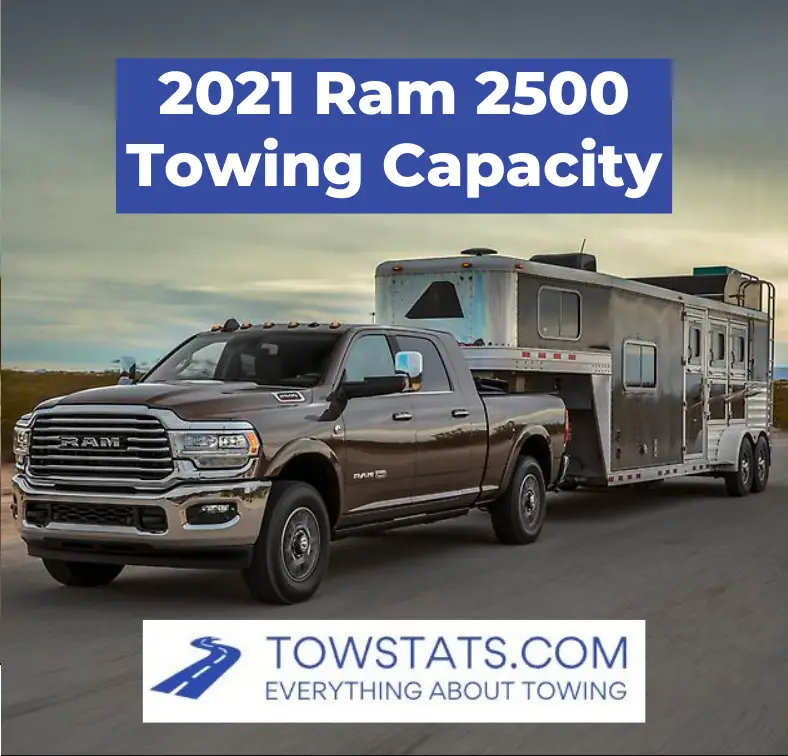
2021 Ram 2500 Towing Capacity Chart: Engine And Configuration Specifications

For the professional hauler or recreational adventurer, the 2021 Ram 2500 represents a pinnacle of heavy-duty capability, bridging the gap between daily drivability and industrial-strength performance. However, with two distinct engines, three cab styles, and multiple axle ratios, identifying the exact towing capacity for a specific configuration can be a complex challenge for prospective owners. Navigating these specifications requires more than just looking at a brochure; it requires an expert understanding of how mechanical components interact under load. In this comprehensive guide, we provide a trusted, data-driven 2021 Ram 2500 towing capacity chart alongside professional analysis of how configuration choices affect your truck’s ultimate limits.


Decoding the 2021 Ram 2500 Towing Terminology and Powertrain Options
Before diving into the numbers, it is essential to understand the physics of heavy-duty trailering. As a professional with years of experience in the field, I often see owners confuse Gross Vehicle Weight Rating (GVWR) with Gross Combined Weight Rating (GCWR). The GCWR is the maximum permissible weight of the entire “rig”—the truck, the trailer, all passengers, fuel, and cargo. If your truck has a GCWR of 28,000 lbs and the truck itself weighs 8,000 lbs, your actual towing capacity is limited by that remaining 20,000 lbs. Conversely, GVWR limits the weight of the truck alone, which is critical when calculating tongue weight or fifth-wheel pin weight.
The Gas vs. Diesel Performance Divide
The 2021 Ram 2500 offers two legendary powerplants, each suited for different quality performance profiles. The standard 6.4L HEMI V8 gasoline engine produces 410 horsepower and 429 lb-ft of torque. It is paired with the 8HP75 8-speed automatic transmission, which features on-the-fly shift mapping to optimize gear changes during steep climbs. This setup is ideal for those hauling 5,000-lb utility trailers or moderate campers where payload is a higher priority than raw pulling power.
For those tackling the heaviest loads, the 6.7L Cummins Turbo Diesel is the expert choice. Delivering 370 horsepower and a massive 850 lb-ft of torque, this engine utilizes the 68RFE 6-speed automatic transmission. The Cummins’ torque curve is the key: it provides maximum pulling force at much lower RPMs than the HEMI, allowing for smoother starts and more controlled descents. Research indicates that the diesel’s integrated exhaust brake is a game-changer for safety when navigating mountain passes with a 15,000-lb fifth-wheel trailer.
When reviewing Ram specs, pay close attention to the axle ratio. A 4.10 axle ratio provides better mechanical advantage for getting heavy loads moving but will result in higher engine RPMs at highway speeds compared to the 3.73 ratio.
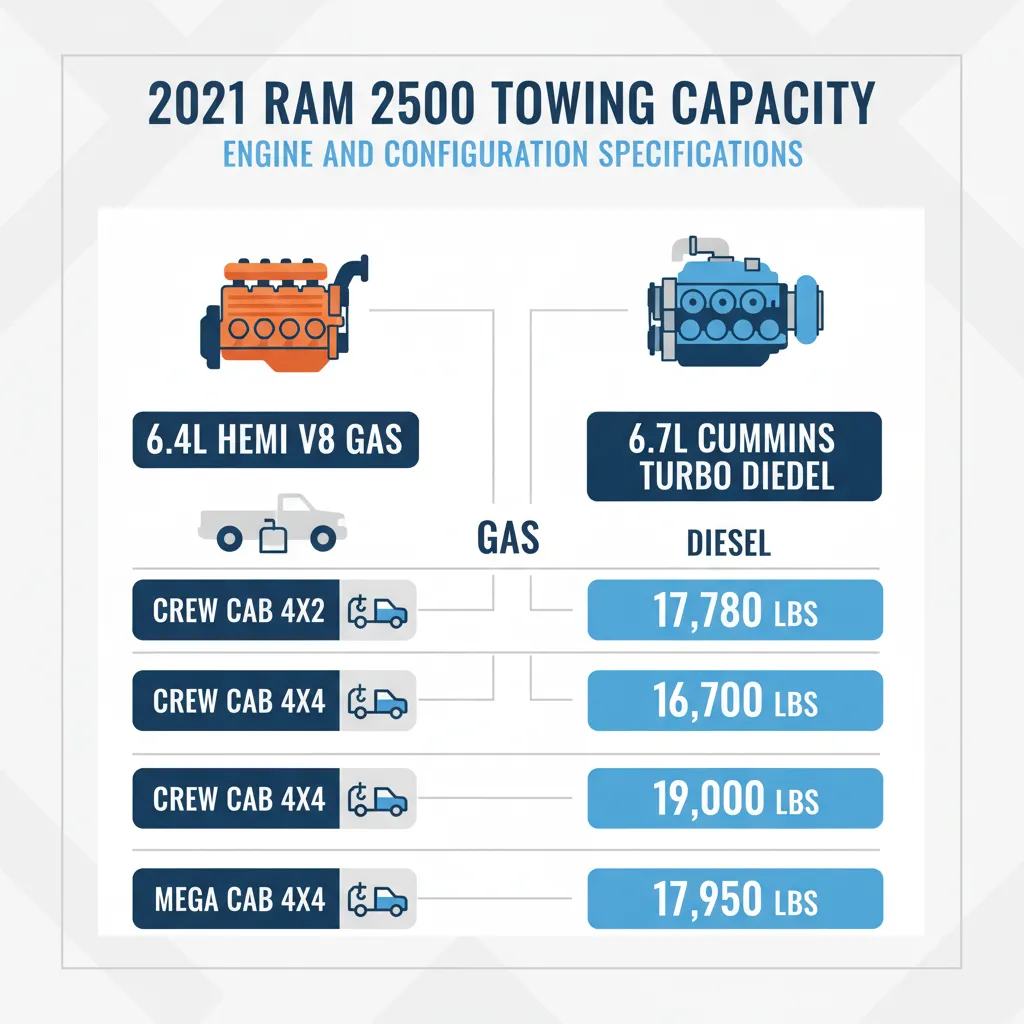
2021 Ram 2500 Towing Capacity Chart by Engine and Drive Type
To provide a complete picture of capability, we must look at how the drive system impacts the net numbers. A 4×4 system adds significant weight to the front of the truck due to the transfer case, front drive shaft, and differential. This additional “curb weight” directly subtracts from the maximum towing capacity. In most configurations, a 4×4 model will have approximately 300-500 lbs less towing capacity than its 4×2 counterpart.
As shown in the data, the maximum towing capacity for the 2021 Ram 2500 with the 6.7L Cummins Turbo Diesel engine is up to 20,000 lbs. This configuration is typically found in the Tradesman Regular Cab 4×2 model. For those who prefer gasoline, the 6.4L HEMI V8 engine is no slouch, maxing out at 17,540 lbs when paired with the optional 4.10 rear axle ratio. It is vital to consult the official guide for your specific VIN, as luxury options like leather seating and sunroofs in the Limited trim can reduce these figures by several hundred pounds.
By The Numbers
Max Diesel Towing (lbs)
Max HEMI Towing (lbs)
Max Payload (lbs)

How Cab Configurations and Bed Lengths Influence Towing and Payload
When choosing a truck, there is a fundamental rule in the professional hauling industry: “The lighter the truck, the higher the towing.” This is because every pound of luxury material, extra seating, or extended sheet metal uses up the Gross Combined Weight Rating. This is why a Regular Cab Tradesman will consistently out-tow a Mega Cab Limited.



The Cab Style Spectrum
- Regular Cab (8′ Bed): The towing champion. With a smaller cabin and lighter chassis, more of the GCWR is allocated to the trailer.
- Crew Cab (6’4″ or 8′ Bed): The most popular choice, offering a balance of passenger space and capability. Choosing the 8-foot bed adds wheelbase stability for long trailers but slightly reduces payload due to the heavier frame.
- Mega Cab (6’4″ Bed only): The ultimate in passenger comfort. However, the sheer weight of the extended cabin means this model typically has the lowest payload and towing capacity in the 2500 lineup.
Payload is another critical factor. The 2021 Ram 2500 has a maximum payload capacity of up to 4,010 lbs. This is especially important for gooseneck and fifth-wheel towing, where 15-25% of the trailer’s weight sits directly over the rear axle. If you are pulling a heavy fifth-wheel, you might exceed your payload capacity long before you hit your maximum towing capacity. Always check the “Tire and Loading Information” sticker on your specific truck’s door jamb for the most reliable data.
✅ Pros of Diesel
- Superior low-end torque for heavy starts
- Integrated exhaust braking for safety
- Higher overall towing limit (20,000 lbs)
- Better resale value in heavy-duty markets
❌ Cons of Diesel
- Significantly lower payload capacity
- Higher upfront purchase cost
- Increased maintenance expenses
- Heavier front-end weight
Optimizing Your 2021 Ram 2500 for Heavy-Duty Performance
To truly maximize your towing experience, you must look beyond the engine. Ram offers several factory-engineered solutions that enhance both safety and ease of use. As an expert, I highly recommend the Rear Auto-Level Air Suspension system. Unlike traditional leaf springs, this system uses air bladders to maintain a level ride height regardless of tongue weight. This ensures that your headlights remain aimed correctly and that your steering geometry isn’t compromised by a “squatting” rear end.
Advanced Towing Technologies
5th-Wheel Prep Group
Includes a factory-installed rear structural crossmember and integrated mounting holes for hitch pucks, ensuring a trusted connection to the frame.
Reverse Steering Control
A knob-based system that allows the driver to control the trailer’s direction while backing up, simplifying a complex task for even novice haulers.
Furthermore, the integrated trailer brake controller and ‘Tow/Haul’ mode are essential for quality operation. The ‘Tow/Haul’ mode adjusts the transmission shift points to keep the engine in its power band longer and provides aggressive downshifting to assist in deceleration. This is particularly effective on the Cummins diesel, where it engages the variable-geometry turbocharger to create backpressure, acting as a powerful engine brake.
Professional Safety Tips and Pre-Towing Checklist
Towing at or near the 20,000-lb limit is a serious undertaking that requires meticulous preparation. Safety is not just about having a powerful truck; it is about ensuring every component of the system is working in harmony. For conventional towing, industry standards recommend that 10-15% of the trailer’s weight should be on the tongue to prevent trailer sway. If your tongue weight exceeds 500 lbs, a weight-distribution hitch is essential to return weight to the front wheels and maintain steering control.


📋
Step-by-Step Pre-Tow Inspection
Check tire pressure on both the Ram 2500 and the trailer. Ensure the load range (e.g., Load Range E) is sufficient for the weights you are carrying.
Visit a CAT scale to find your actual steer axle, drive axle, and trailer axle weights. Compare these against the Gross Axle Weight Rating (GAWR) on your B-pillar sticker.
Adjust the gain on your integrated brake controller while driving at low speeds. The trailer should slow the truck without locking its wheels.
Exceeding the GCWR or GAWR can lead to catastrophic component failure, including blown tires, overheated transmissions, or brake fade. Always operate within the expert tips provided by seasoned haulers and the manufacturer.
In summary, the 2021 Ram 2500 offers a broad range of towing capabilities, maxing out at 20,000 lbs with the Cummins diesel and 17,540 lbs with the HEMI V8. Configuration matters: choosing the right cab, bed length, and axle ratio is critical to achieving peak payload and towing performance. Safety and equipment, such as air suspension and proper hitching, are as vital as raw numbers for a reliable towing experience. Before hitching your trailer, always verify your specific VIN’s ratings on the door-jamb sticker to ensure you are operating within professional safety standards.
Frequently Asked Questions
What is the towing capacity of a 2021 Ram 2500 with the Cummins diesel?
When properly equipped, the 2021 Ram 2500 with the 6.7L Cummins Turbo Diesel engine offers a maximum towing capacity of up to 20,000 lbs. This peak figure is typically achieved with the Regular Cab 4×2 configuration. Higher trim levels and 4×4 systems will slightly decrease this maximum due to the increased curb weight of the truck itself.
How does cab configuration affect towing capacity?
Cab configuration significantly impacts towing capacity because it changes the vehicle’s base weight. A Regular Cab is the lightest option, allowing more of the Gross Combined Weight Rating (GCWR) to be allocated to the trailer. In contrast, the Mega Cab is the heaviest, which provides more interior room but reduces the total amount of weight you can safely tow and haul.


What is the difference between towing capacity and payload capacity?
Towing capacity refers to the maximum weight the truck can pull behind it, while payload capacity refers to the weight that can be carried in the truck bed and cabin. This includes passengers, cargo, and the tongue weight or pin weight of your trailer. For the 2021 Ram 2500, payload peaks at 4,010 lbs, which is a critical figure for gooseneck and fifth-wheel setups.
What is the GCWR of a 2021 Ram 2500?
The Gross Combined Weight Rating (GCWR) for the 2021 Ram 2500 varies by engine. For models equipped with the 6.4L HEMI V8, the GCWR typically ranges up to 24,000 lbs. For models equipped with the 6.7L Cummins Turbo Diesel, the GCWR can reach up to 27,400 lbs. This figure represents the maximum allowable weight of the truck, trailer, cargo, and passengers combined.
What kind of hitch do I need for my 2021 Ram 2500?
The hitch required depends on the weight and type of your trailer. For loads under 5,000 lbs, a standard Class IV receiver is sufficient. For heavier conventional trailers, a weight-distribution hitch is professionally recommended to maintain steering control. If you are approaching the 20,000-lb limit, you must use a fifth-wheel or gooseneck hitch installed in the truck bed, ideally utilizing the factory-installed prep group.
![2022 RAM 2500 Fender Flares: Top Styles & Fitment Guide [2026]](https://truckguider.com/wp-content/uploads/2026/03/2022-ram-2500-fender-flares-featured.webp)